
The translation of technical documents is a highly specialized field. It's the process of converting complex, industry-specific content—think user manuals, patents, or engineering schematics—from one language to another. But this isn't just about swapping words. It's about meticulously preserving the precise meaning, technical accuracy, and overall integrity of the original text.
In this discipline, a single mistake can have serious consequences, from equipment failure and safety hazards to failing a regulatory audit. You're not just translating language; you're translating precision.
Understanding The Scope of Technical Translation
Think of it like this: translating a novel allows for some creative interpretation to capture the author's tone. Translating an architect's blueprint for a skyscraper, however, demands absolute fidelity. Every measurement, material specification, and structural note must mean the exact same thing in every language. Any deviation, no matter how small, could compromise the entire project.
This is the high-stakes environment where technical translation operates. It’s a very different animal from other types of language services, and it's helpful to start by understanding the distinction between transcription and translation to get your bearings. Technical translation is a demanding subset of the latter, requiring a unique skill set.
What Kinds of Documents Are Considered Technical?
The range of documents that need this level of expert handling is huge, touching nearly every major industry. Knowing which of your own documents fit this description is the first step. We're not talking about marketing copy or general business emails; we're talking about content that instructs, defines, or regulates.
To give you a clearer picture, I've put together a table breaking down some common examples and what the real priority is for each one.
Common Technical Documents and Their Translation Priorities
This breakdown clarifies the primary translation goal for common technical document types, helping ensure the intended purpose is met with precision.
| Document Type | Primary Purpose | Key Translation Priority |
|---|---|---|
| User Manuals & Installation Guides | To instruct end-users on safe and effective product operation. | Clarity and Usability: Instructions must be unambiguous and easy to follow. |
| Engineering Specifications & Datasheets | To define precise technical parameters for design and manufacturing. | Absolute Accuracy: Numbers, units, and tolerances must be flawlessly converted. |
| Patents & Legal Contracts | To protect intellectual property and define legal obligations. | Legal & Technical Precision: Terminology must be legally binding and technically sound. |
| Medical & Pharmaceutical Reports | To document clinical trials, procedures, and drug information. | Regulatory Compliance & Safety: Content must meet strict health authority standards. |
| Software Strings & API Documentation | To enable developers and users to interact with software correctly. | Functional Context: Terminology must align with the user interface and code. |
As you can see, the "why" behind the translation dictates the entire approach. It’s not a one-size-fits-all process.
The Core Purpose: Functional Equivalence
At the end of the day, the goal is to achieve functional equivalence. This means the translated document must do the exact same job as the original.
Whether it’s guiding a surgeon through a delicate procedure, instructing a field engineer on vital maintenance, or detailing a chemical formula for a lab technician, the outcome must be identical, no matter what language the document is in.
The core principle is this: A user reading the translated document should be able to perform a task with the same level of safety, efficiency, and accuracy as a user reading the source document. Any ambiguity or error represents a failure in the translation process.
The High-Stakes World of Technical Translation: Core Challenges
Translating technical documents isn't just about swapping words from one language to another. It's a high-stakes discipline where a tiny mistake can have huge consequences. We’re talking about a field where precision is everything, and the challenges go way beyond vocabulary.
This isn't a small niche, either. Technical document translation makes up a massive 35% of the entire translation services market. That figure alone shows how vital it is for global industries to get this right. It's no surprise that Europe, a hub for manufacturing and regulation, held the largest market share for translation management systems at 31.0%. This points to a deep-seated need for structured, top-quality translation workflows. You can dive deeper into the market dynamics on Grand View Research to see the full picture.
So, what makes it so tough? Let’s break down the main hurdles.
The Tyranny of Terminology
Imagine you're putting together a complex piece of machinery. In chapter one, the manual calls a part the "primary control valve." In chapter three, it's the "main fluid regulator," and by the appendix, it's the "central flow switch." You'd be confused, frustrated, and probably worried about safety. This is the exact problem that inconsistent terminology creates, and it's the number one challenge in technical translation.
When consistency breaks down, things go wrong fast:
- It Confuses Users: People can’t follow instructions, leading to them using a product incorrectly or failing to assemble it.
- It Creates Safety Risks: In a medical or industrial setting, a vague term can cause a serious accident. One wrong word on a prescription drug label could have devastating health impacts.
- It Damages Your Brand: Sloppy documentation makes a company look unprofessional. It erodes trust and makes customers question the quality of your products.
The goal is to create a single, undeniable source of truth for your terminology. Every critical term—a component, a process, a safety warning—must be translated identically every time it appears, no matter where.
Navigating the Maze of Regulatory Standards
Technical documents rarely exist in a vacuum. They’re tied to a web of strict legal and regulatory standards that change from one country to the next. A product that sails through compliance checks in the United States could be dead on arrival in the European Union if its documentation isn't perfectly localized.
These aren't just friendly guidelines; they're hard and fast rules.
- ISO Standards: Industries worldwide rely on standards from the International Organization for Standardization (ISO) to ensure quality and safety. Your translated documents have to reflect these to the letter.
- Medical Regulations: Agencies like the U.S. Food and Drug Administration (FDA) and the European Medicines Agency (EMA) have incredibly detailed rules for everything from packaging labels to patient information leaflets.
- Legal Documents: Patents, contracts, and other legal paperwork must be translated with a deep understanding of the local legal system to hold up in court.
Getting this wrong can lead to hefty fines, forced product recalls, or being blocked from a market entirely.
Keeping Complex Formatting Intact
Let's be honest, technical documents are rarely just walls of text. They’re intricate layouts filled with diagrams, charts, tables, and schematics. The formatting isn’t just for looks—it’s a crucial part of the information.
Think about a wiring diagram where the translated labels are slightly out of place, or a data table where the columns get mixed up. The document immediately becomes confusing, useless, and potentially dangerous. The real challenge is making sure the new text fits perfectly back into the original design without breaking the layout or compromising the clarity. This takes more than just language skills; it requires technical savvy and the right tools.
3. Building a Modern Technical Translation Workflow
If you're still managing technical translations with a tangled web of emails and spreadsheets, it's time for an upgrade. A modern workflow isn't just about tidying up; it's a strategic system built for accuracy, consistency, and speed.
Think of it like a finely tuned assembly line. Each stage has a specific job, from prepping the files to the final quality inspection. This structure turns a chaotic, unpredictable process into a smooth, manageable operation that catches costly errors before they happen.
Phase 1: Pre-Translation and Preparation
The success of a translation project is often sealed before a single word gets translated. This first phase is all about laying a solid foundation by getting your assets in order and setting the ground rules. A little bit of prep work here saves a ton of headaches later.
First up is creating a termbase, which is basically a project-specific dictionary or glossary. This becomes the single source of truth for all your key terms. It ensures that a phrase like "actuator assembly" is translated the same way every single time, whether it's in a user manual or a service bulletin. This consistency is critical for user understanding and safety.
Next, you'll need a Translation Memory (TM). Picture a smart database that saves every sentence pair (source and translated) you've ever approved. The TM then automatically suggests these saved translations for new projects. This delivers two massive wins:
- Consistency: The TM guarantees that identical phrases, like safety warnings or standard instructions, are always translated the same way.
- Efficiency: Translators don't have to waste time re-translating content you've already paid for, which dramatically speeds up the entire process.
Getting these linguistic assets in place is the first real step toward a high-quality outcome.
Phase 2: The Translation and Editing Cycle
With the prep work done, the real translation begins. These days, it's rarely a 100% manual job. The industry has largely shifted to a hybrid model called Machine Translation Post-Editing (MTPE), which gives you the best of both worlds: the speed of a machine and the precision of a human expert.
Here’s the breakdown of how it works:
- Initial Machine Translation: A powerful AI engine, often trained on data from your specific industry, produces the first draft of the translation. This is worlds away from the free tools you find online.
- Human Post-Editing: A professional linguist who is also a subject-matter expert steps in. They meticulously review the AI's output, correcting subtle errors in nuance, fixing contextual mistakes, and ensuring the tone is exactly right for the intended audience.
This one-two punch combines the raw power of AI with the irreplaceable critical thinking of a human. The machine does the heavy lifting, and the human expert provides the final polish and guarantees the accuracy that technical content absolutely demands.
Phase 3: Quality Assurance and Finalization
The final step is a rigorous quality assurance (QA) process that goes way beyond a simple spell-check. The QA team is there to catch anything that might have slipped through.
They'll verify that the translation sticks to the glossary, double-check all numbers and units for accuracy, and make sure the formatting of the final document perfectly mirrors the original.
The flowchart below shows the three main hurdles that a solid workflow is designed to clear.
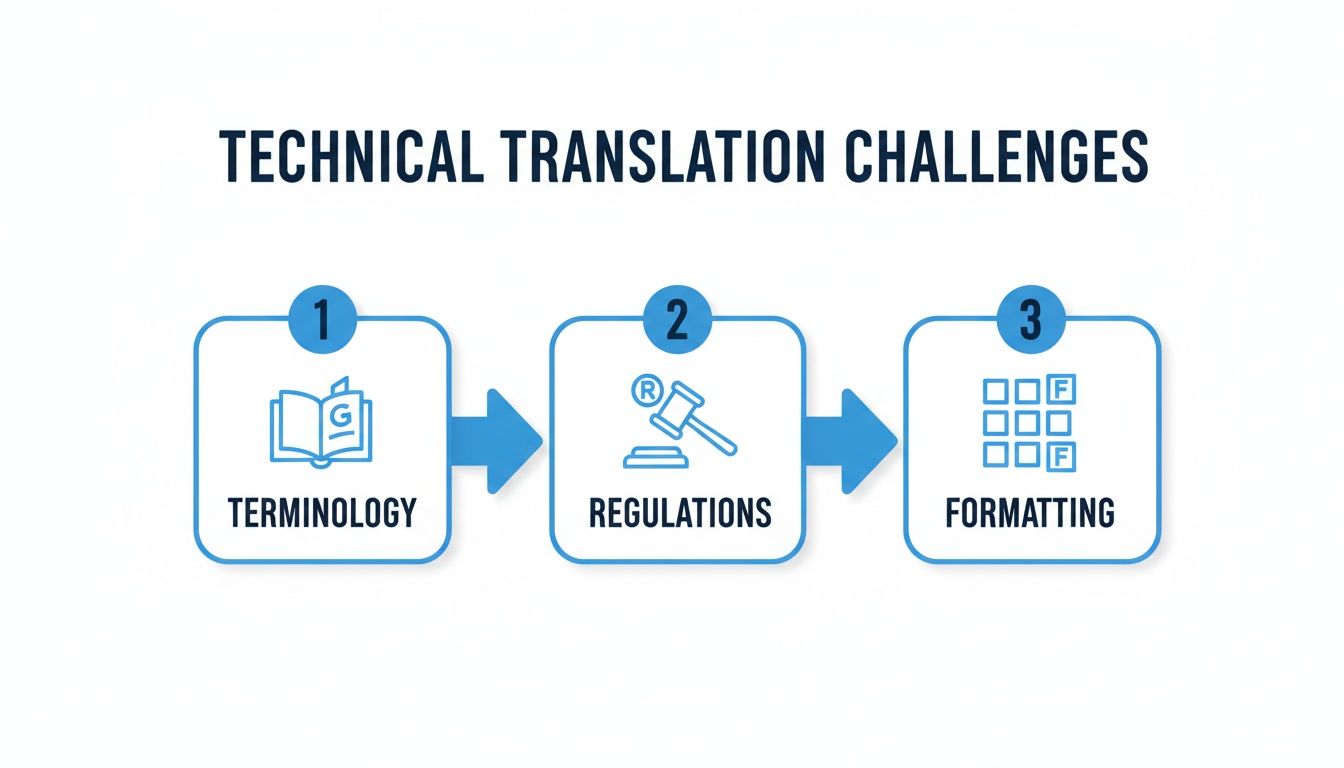
This process systematically tackles the challenges of terminology, regulations, and formatting to produce a flawless final product. Once the document passes QA, the approved translations are fed back into the Translation Memory, making it an even more valuable asset for your next project. This creates a cycle of continuous improvement—the true sign of an effective, modern workflow.
How AI Is Changing the Game for Technical Translations
AI in translation isn’t some far-off concept anymore; it's a practical tool that’s actively fixing some of the biggest headaches in translating technical documents. We’ve all seen the clunky, literal machine translations from years ago. Thankfully, those days are quickly becoming a memory.
Think about the nightmare of translating a detailed engineering handbook saved as an EPUB file. In the past, running it through a machine translator would obliterate the formatting. You’d be left with a wall of text, and someone would have to spend days manually putting back all the headings, charts, and chapter breaks. It was a massive bottleneck that made quick turnarounds for big projects a pipe dream.
More Than Just Swapping Words
Today's AI models are built on a completely different foundation. They don't just see a string of words; they understand the document's structure, context, and even its intent. This is thanks to sophisticated neural networks that can analyze a file's layout and styling, ensuring the translated version looks just like the original. For anyone working with complex file formats, this is a massive leap forward.
This is especially true for independent authors trying to take their technical guides global or for researchers who need to digest foreign-language papers without second-guessing the output. Getting a translated file back that is immediately usable—with its layout perfectly preserved—is a huge time and money saver.
For instance, this screenshot from a modern AI translation service shows just how simple the workflow has become. You’re no longer wrestling with text; you’re working with the entire file.
The process is refreshingly straightforward: upload your EPUB, pick a language, and the system gets to work, creating a high-quality translation that keeps the original structure intact.
The Impact on Quality and Cost
This shift isn't just about making life easier; it's having a major economic impact. The machine translation market as a whole has already hit USD 9 billion and is on track to reach a staggering USD 23.53 billion by 2032. Technical documentation is riding that wave, with specialized AI tools now hitting up to 90% accuracy in certain fields. Projects that once took weeks can now be turned around in a matter of hours. For more on this, check out these automated translation accuracy statistics.
It's a big deal when you consider that written translation services make up 70% of the global market, valued at USD 29.6 billion. But AI isn't about replacing human experts. It’s about giving them superpowers.
The real breakthrough with modern AI is its ability to handle both language and structure at the same time. It delivers a first draft that's not just linguistically solid but also perfectly formatted, freeing up human professionals to focus on the high-level work of nuance and quality control.
Getting the Nuance and Jargon Right
One of the most impressive developments is how AI now handles technical nuance. Old-school machine translation would constantly trip over industry jargon, giving you literal translations that made no sense. Today’s systems are far more intelligent.
- Contextual Understanding: Advanced models don't just translate word-for-word. They analyze whole paragraphs to grasp the context, ensuring they pick the right translation for a specific term.
- Domain-Specific Training: Many AI platforms are trained on massive datasets from specific industries like engineering, medicine, or law. This makes them fluent in the unique language of that field.
- Rock-Solid Consistency: An AI will never forget a term. If it translates "non-volatile memory" one way on page 1, you can be sure it will be translated the exact same way on page 100.
This level of sophistication is powered by technologies like neural machine translation, which is designed to mimic the human brain’s ability to recognize patterns. We dive much deeper into this in our article explaining what neural machine translation is and how it works. It's this technology that allows an AI to produce translations that feel natural and are technically spot-on, making global communication easier and more accessible than ever before.
Essential Tools and Best Practices for High-Quality Results
Getting consistent, high-quality results when you translate technical documents isn't about luck. It's about having the right tools and a disciplined process in place. Moving from theory to practice means adopting specific habits and technologies that stamp out ambiguity and guarantee precision every step of the way. A solid workflow is your best defense against the costly errors that crop up from inconsistent or unclear documentation.
This structured approach is more critical than ever. As businesses go global, the translation services market has ballooned to USD 41.78 billion, and it's expected to hit USD 50.02 billion by 2033. Technical manuals and specifications make up a huge chunk of that market, showing just how vital this work is to global trade. The foundation for great translations starts with great content management best practices.
Build Your Terminology Foundation
If there's one tool that can make or break consistency, it's the termbase (often called a glossary). Think of it as a custom dictionary for your project, defining exactly how key terms—from product components to software commands—should be translated every single time.
A well-maintained termbase is what prevents a "control panel" in chapter one from becoming a "dashboard interface" in chapter five. It enforces a unified language across all your documents, which is absolutely essential for user comprehension and safety. For any organization serious about technical translation, this isn't optional; it's foundational.
A termbase acts as the single source of truth for your project's language. By pre-defining critical terms, you eliminate guesswork for translators and ensure that every component, process, and warning is communicated with unwavering consistency.
Prepare Your Source Documents for Success
Here's a simple truth: the quality of the final translation is directly tied to the quality of the original document. A confusing source file will almost certainly produce a confusing translation. Cleaning up your text before it ever gets to a translator is a proactive step that pays off big time.
Before sending a document out for translation, run it through this simple prep-checklist:
- Write with Clarity and Simplicity: Stick to short, direct sentences. Avoid convoluted phrasing and use simpler terms where possible without losing meaning.
- Eliminate Cultural Idioms: Phrases like "hit a home run" or "bite the bullet" rarely translate well and can cause major confusion. Keep your language literal and universal.
- Ensure Factual Accuracy: Meticulously double-check all numbers, units of measurement, and technical specs. A tiny error in the original will be faithfully reproduced in every language.
By tidying up your source text, you make the translator's job far easier and dramatically increase the odds of a flawless result. To see how technology can streamline this, explore our guide on different kinds of document translation software.
Below is a quick comparison to help you understand which translation method might be the best fit for your specific needs, weighing speed, cost, and the level of quality required.
Comparing Approaches to Technical Document Translation
A practical comparison of different translation methods, helping you choose the right approach based on your project's specific needs for speed, cost, and quality.
| Approach | Best For | Pros | Cons |
|---|---|---|---|
| Raw Machine Translation (MT) | Internal-only documents, gisting, non-critical content where speed is the top priority. | - Extremely fast and low-cost. - Handles huge volumes of text instantly. |
- Prone to errors in terminology and nuance. - Lacks contextual understanding; unsuitable for user-facing content. |
| MT + Post-Editing (MTPE) | User manuals, knowledge bases, and semi-critical documents where budget and speed are key. | - Balances speed and cost with human oversight. - More accurate than raw MT. - Faster turnaround than full human translation. |
- Quality can vary depending on the post-editor's skill. - May not capture the full stylistic tone of the original. |
| Human Translation (HT) | High-stakes documents: medical device instructions, legal contracts, complex engineering specs. | - Highest level of accuracy, nuance, and contextual awareness. - Ideal for creative and brand-sensitive content. |
- Slower and more expensive. - Consistency can be a challenge across large teams without strong tools. |
| HT with CAT Tools & TM | The industry standard for professional, scalable translation of technical documents. | - Enforces consistency with Translation Memory (TM) and termbases. - Reduces costs over time by reusing previous translations. - Improves speed and quality simultaneously. |
- Requires an initial investment in software and setup. - The process needs to be managed properly to see benefits. |
Each approach has its place. The key is to match the method to the document's purpose and audience, ensuring you don't overspend on internal drafts or cut corners on safety-critical instructions.
Implement a Final Quality Checklist
Once the translation is back, how can you be sure it’s ready for the world? A final review guided by a structured checklist gives you confidence that the project meets the highest standards. This isn't just a quick spell-check; it's a comprehensive audit.
Your final quality assurance (QA) checklist should cover these essential points:
- Terminological Consistency: Does the translation strictly follow the approved termbase? Are key terms used the same way every time?
- Numerical and Factual Accuracy: Have all numbers, dates, and units of measurement been correctly converted and localized for the target region?
- Formatting and Layout: Does the translated document's layout perfectly mirror the original? Are all tables, charts, and images in the right place with correct labels?
- Contextual Appropriateness: Does the translation make sense in its technical context? Is the tone right for the audience (e.g., a field engineer vs. a consumer)?
- Completeness: Is anything missing? Check that every bit of the source document has been translated, including headers, footers, and text embedded in images.
Using a systematic checklist turns quality control from a subjective opinion into an objective, repeatable process. It’s how you guarantee every document you publish meets your organization's highest standards.
How to Choose the Right Technical Translation Service
Picking a partner for your technical document translation is a make-or-break decision. It directly impacts your project's timeline, budget, and overall success. Whether you’re looking at a full-service agency, a specialized freelancer, or a powerful AI tool, your evaluation process needs to be as meticulous as the documents themselves.
Think of it like hiring a specialist contractor to work on your home’s electrical system. You wouldn’t just go with the cheapest quote. You'd demand proven expertise, check their tools, and verify they follow safety codes. The same logic applies here. The right choice means accuracy and reliability; the wrong one leads to expensive mistakes and frustrating delays.
Key Questions to Ask Potential Providers
Before you sign on the dotted line, you need to look past the marketing language. Your goal is to get a real feel for their process and confirm they can handle the unique demands of your content.
Here are the essential questions you should be asking:
- Subject-Matter Expertise: Can they prove they've worked in your specific field before? Don't just take their word for it. Ask for concrete examples or case studies from similar engineering, medical, or software projects.
- Technology and Tools: What’s in their toolkit? A modern workflow should absolutely include Translation Memory (TM) and termbases to maintain consistency. If they use AI, find out which models they rely on and how they handle complex technical jargon without losing context.
- Quality Assurance Process: How do they catch mistakes? A solid QA process isn't just a spell-check. It should involve a review by a second linguist, automated checks for consistency, and a final pass to ensure all formatting and numbers are perfect.
Understanding Different Pricing Models
The cost of technical translation is all over the map, and the way a service structures its pricing says a lot about its approach. To manage your budget effectively, you need to understand what you're paying for. You can get a better sense of the landscape by exploring various online document translation services.
The best services offer transparent, predictable pricing. Steer clear of hidden fees or complicated subscription models that lock you in. You want to see clear value for every dollar you spend.
Here are the three most common models you'll run into:
- Per-Word Rates: This is the classic model. It's straightforward but can get pricey for large projects, and it often doesn't give you credit for repeated phrases that a Translation Memory would handle instantly.
- Per-Project Fees: A flat fee is great for budgeting, as you know the total cost upfront. The downside is that it can be rigid if the project's scope unexpectedly changes.
- Usage-Based Pricing: This is the modern way, especially for AI-driven platforms. You only pay for what you actually use, often calculated by the word or token. This model is incredibly flexible, working just as well for a single document as it does for ongoing localization needs. A service like BookTranslator.ai, for example, offers simple pay-per-book plans. This gives creators a clear, upfront cost with no long-term commitment, making it a perfect fit for everyone from indie authors to major publishing houses.
Frequently Asked Questions
Got questions about translating technical documents? You're not alone. Let's tackle some of the most common ones that come up, so you can move forward with confidence.
What's the Real Difference Between Technical and General Translation?
Think of it this way: general translation is about capturing the spirit of a message, like translating a novel or a marketing slogan. There's room for a bit of creative flair.
Technical translation is a whole different ballgame. It's about absolute, unwavering precision. We're talking about things like engineering specs, safety manuals, or pharmaceutical data sheets. Here, a single misplaced decimal or a slightly off-key term isn't just a minor mistake—it could cause equipment to fail, create serious safety hazards, or get you in hot water with regulators. It’s all about clear, functional, and unambiguous communication.
What Exactly Is a Translation Memory (TM)?
A Translation Memory, or TM, is essentially a smart database. It saves every sentence, phrase, and paragraph that you've ever had translated and approved. The next time you submit a new document, the TM scans it for matches. If it finds an identical or similar sentence, it instantly suggests the approved translation.
A TM is like your project’s institutional knowledge. It's what keeps your terminology consistent from one user manual to the next, and it saves a ton of time and money by making sure you never pay to translate the same sentence twice.
Honestly, working without a TM in technical translation is like trying to build a house without a blueprint. It's a fundamental part of a professional workflow.
Can't I Just Run My Manual Through a Free Online Translator?
For a quick, rough idea of what a foreign email says? Sure. For an official technical document? Absolutely not.
Free online tools are getting better, but they still struggle with the highly specific jargon and context that define technical content. They simply can't guarantee the level of accuracy needed for critical instructions, safety warnings, or regulatory compliance. Using one for an official manual is a huge gamble that could lead to serious liability issues down the road. It's just not worth the risk.
So, What's the Price Tag on Technical Document Translation?
That's a bit like asking "how much does a car cost?" It really depends on what you need. The final price is shaped by a few key factors:
- Language Pair: Translating between common languages like English and Spanish is usually more affordable than, say, English to Icelandic.
- Content Complexity: A standard IT guide will cost less than a complex patent for a new biochemical process that requires a translator with a Ph.D. in the field.
- File Format: A simple Word document is straightforward. A complex InDesign or CAD file that needs a lot of desktop publishing (DTP) work to recreate the original layout will add to the cost.
- Turnaround Time: Need it yesterday? Rush projects naturally cost more than those with a standard timeline.
Your best bet is to always ask for a detailed quote that breaks down exactly what you're paying for.
Ready to get your technical guides, research papers, or manuals translated with the precision they deserve? BookTranslator.ai uses specialized AI to deliver accurate translations in over 50 languages, all while keeping your original layout and formatting perfectly intact. Check out our simple, pay-as-you-go plans to get started.