
So, what exactly is document translation software? At its core, it's a specialized tool that uses artificial intelligence to convert text from one language to another, all while keeping the original file—be it a book, a report, or a manual—intact. This is a huge step beyond just swapping words; the real magic is in its ability to preserve the document's original structure, layout, and formatting.
From Simple Words to Entire Worlds
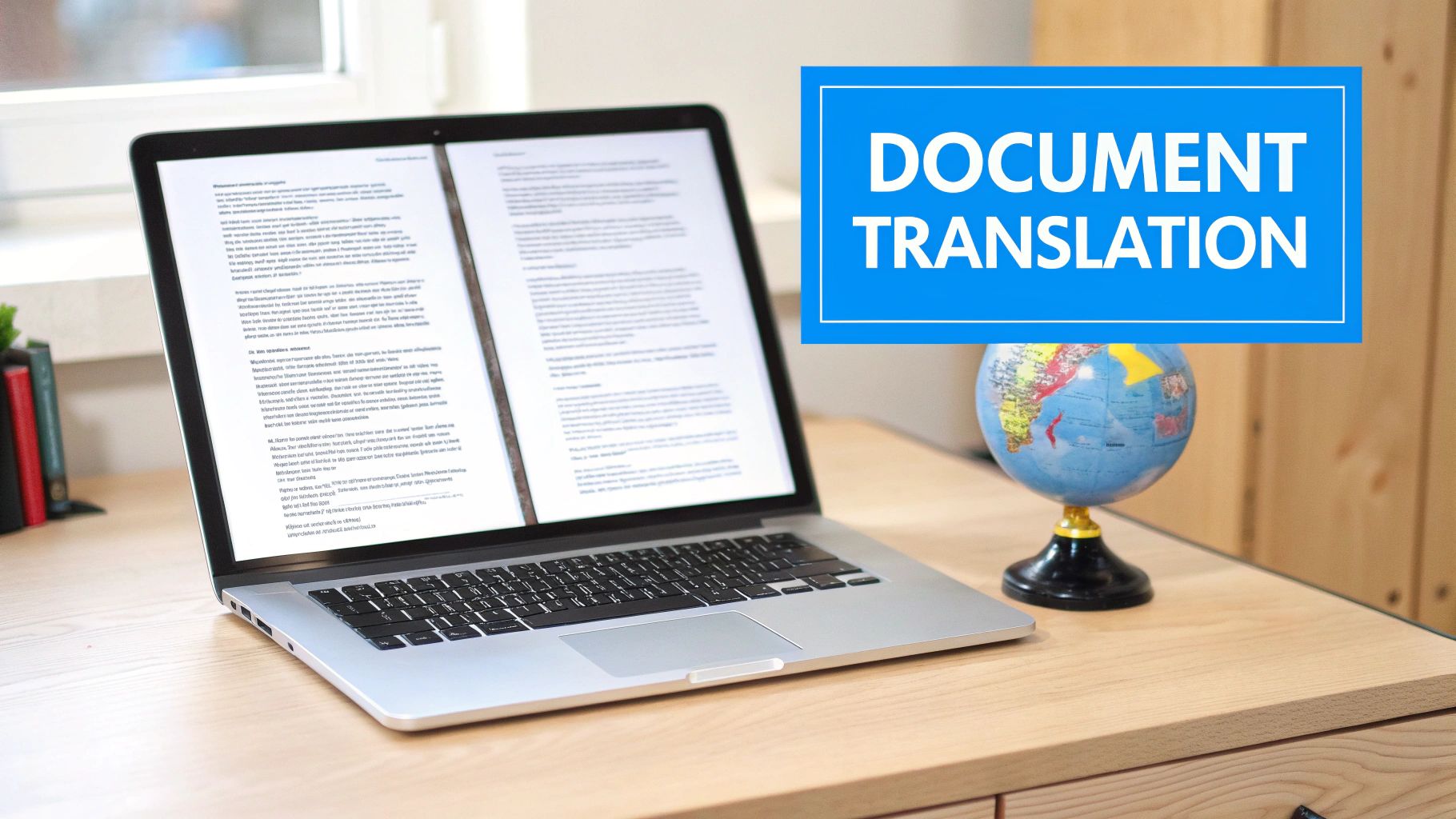
Think of it less like a dictionary and more like a brilliant multilingual assistant. Its job isn't just to translate words, but to grasp the context, maintain the visual flow, and do it all at an incredible speed. This kind of technology has become an absolute game-changer for anyone dealing with long-form content, from indie authors and academic researchers to global publishing houses.
At its heart, this software is about bridging communication gaps on a massive scale. Gone are the days of manually copying and pasting text into a generic online translator, only to spend hours painstakingly fixing the mangled formatting. Now, you can upload an entire file and get back a fully formatted, translated version in minutes.
The Core Technology Driving Modern Translation
The engine running under the hood of today's best tools is Neural Machine Translation (NMT). This isn't your old, clunky translation tech. NMT is a sophisticated form of AI that analyzes entire sentences and paragraphs to understand the underlying meaning, context, and subtle grammatical nuances.
NMT models are built to mimic the human brain's neural networks. This allows them to learn language patterns and produce translations that feel remarkably fluid and natural, not just technically accurate.
This is a massive leap forward. The market data tells the same story. The global Document Translation Services market, which is now heavily driven by these software solutions, was valued at $34,496.3 million in 2021 and is on track to hit $44,562 million by 2025. This explosive growth shows just how much automation is overtaking traditional, manual services because of its sheer efficiency.
Why Is Format Preservation Such a Big Deal?
For authors, publishers, and even readers, the layout of a document isn't just window dressing—it's part of the experience. A novel is more than a wall of text; it's a journey guided by chapters, headings, italicized thoughts, and deliberate paragraph breaks. The best software ensures these critical elements don't get lost in translation.
Here’s why it matters so much:
- It Maintains Structural Integrity: Chapter titles, section breaks, and headings all stay where they belong, so the document is still easy to navigate and read.
- It Preserves Text Styling: All those important nuances—bolded text, italics, and underlines—are carried over, keeping the author's original emphasis intact.
- It Handles Complex Files: The software is specifically designed to work with formats like EPUB, DOCX, and PDF, which are notorious for falling apart when you try to translate them manually.
Ultimately, the goal is to break down language barriers without sacrificing the professional quality and readability of the original work. By automating the tedious, technical side of things, the right software for translating documents empowers authors to connect with global audiences and allows readers to explore a world of literature that was once out of reach.
From Clunky Tools to AI Platforms: The Story of Translation Tech
The journey to today’s fluid, context-aware document translation software wasn't a short one. The earliest tools were more like clumsy digital dictionaries than intelligent assistants.
This first wave was called Rule-Based Machine Translation (RBMT). It was built on a massive, rigid foundation of grammatical rules and linguistic maps. Think of it like trying to assemble a complex engine using only the instruction manual, without ever having seen one run. The system would painstakingly apply pre-programmed rules, resulting in translations that were often literal, grammatically clunky, and completely devoid of the author's original tone.
The First Big Leap: Learning from Data
Things started getting interesting with the arrival of Statistical Machine Translation (SMT). Instead of being spoon-fed linguistic rules, SMT systems learned by crunching huge amounts of existing human translations. By analyzing these bilingual texts, they could identify statistical patterns and make much better predictions about which word or phrase was the most probable choice.
This was a major improvement. SMT produced far more natural-sounding translations because it learned from how real people actually write and speak. The downside? It still had a hard time with context. It often translated sentence by sentence, or even in smaller chunks, missing the bigger picture and the subtle connections within a paragraph.
The Real Breakthrough: Neural Machine Translation
The genuine game-changer, and the engine behind modern document translation software, is Neural Machine Translation (NMT). This is where AI truly comes into play. NMT models don't just look at isolated words or phrases; they analyze entire sentences and paragraphs at once to understand deep contextual relationships, syntax, and even stylistic nuances.
NMT works a bit like the human brain, using a sophisticated neural network to connect ideas. This is what allows it to finally grasp idioms, preserve an author's unique voice, and produce translations that feel human, not robotic.
This technological jump is precisely why today’s software can handle complex, high-stakes content like novels, legal documents, and technical manuals with impressive accuracy. We're seeing this advanced technology pop up everywhere, with AI-powered solutions like supportgpt showing just how far these advanced language models have come.
This explosion in capability has lit a fire under the market. The AI language translation market, for example, jumped from $1.88 billion in 2023 to $2.34 billion in 2024—a massive 24.9% growth spurt in just one year. Looking at the bigger picture, the entire machine translation industry is expected to grow from USD 9 billion in 2024 to USD 23.53 billion by 2032, fueled by the global demand for these smart, AI-driven tools. You can dive deeper into this trend and read the full research about AI translation market trends.
At the end of the day, this journey from rigid, rule-based systems to intelligent AI platforms has completely redefined what's possible. Modern document translation software now gives creators and readers a genuine way to connect across language barriers, preserving not just the words but the soul of the original work.
What to Look for in Good Document Translation Software
Choosing the right document translation software can feel like a maze, but a handful of key features really separate the great tools from the merely average ones. Getting this right from the start means you'll get professional, polished results instead of a messy document that creates more work for you. After all, translation isn't just about swapping out words; it's about keeping the soul of your original document intact.
Core Features of Modern Document Translation Software
To make sense of it all, here's a quick rundown of the must-have features. Think of this as your checklist for finding a tool that truly works for you.
| Feature | What It Means | Why It Matters for Authors & Readers |
|---|---|---|
| Translation Accuracy | The software uses advanced AI, like Neural Machine Translation (NMT), to understand context, idioms, and nuance—not just literal words. | This ensures the author's voice and intended meaning are carried over, making the translated text feel natural and authentic, not robotic. |
| Format Preservation | Your original layout—headings, chapters, bold/italic text, and paragraph breaks—is perfectly maintained in the translated file. | This is a game-changer. It means a beautifully designed book or paper stays that way, providing a seamless reading experience without any manual reformatting. |
| Broad Language Support | The tool can translate to and from a wide variety of languages, not just the most common ones. | It opens the door to global audiences. An author can reach new markets in Japan, Brazil, or Germany just as easily as in Spain. |
| Robust Security | Your files are protected with strong encryption, and the service has a clear privacy policy that respects your intellectual property. | Essential for unpublished manuscripts or sensitive data. It gives you peace of mind that your work won't be compromised or used without permission. |
Each of these features plays a crucial role in delivering a final product that honors the original work while making it accessible to a whole new audience.
Translation Accuracy: Beyond Word-for-Word
The most important feature, without a doubt, is translation accuracy. This is where modern AI truly shines. We've moved far beyond the clunky, literal translations of the past. Today's best tools rely on Neural Machine Translation (NMT), a sophisticated technology that analyzes entire sentences to grasp context, cultural idioms, and subtle nuances.
This is what allows a translated novel to retain its original tone and a technical manual to remain clear and precise.
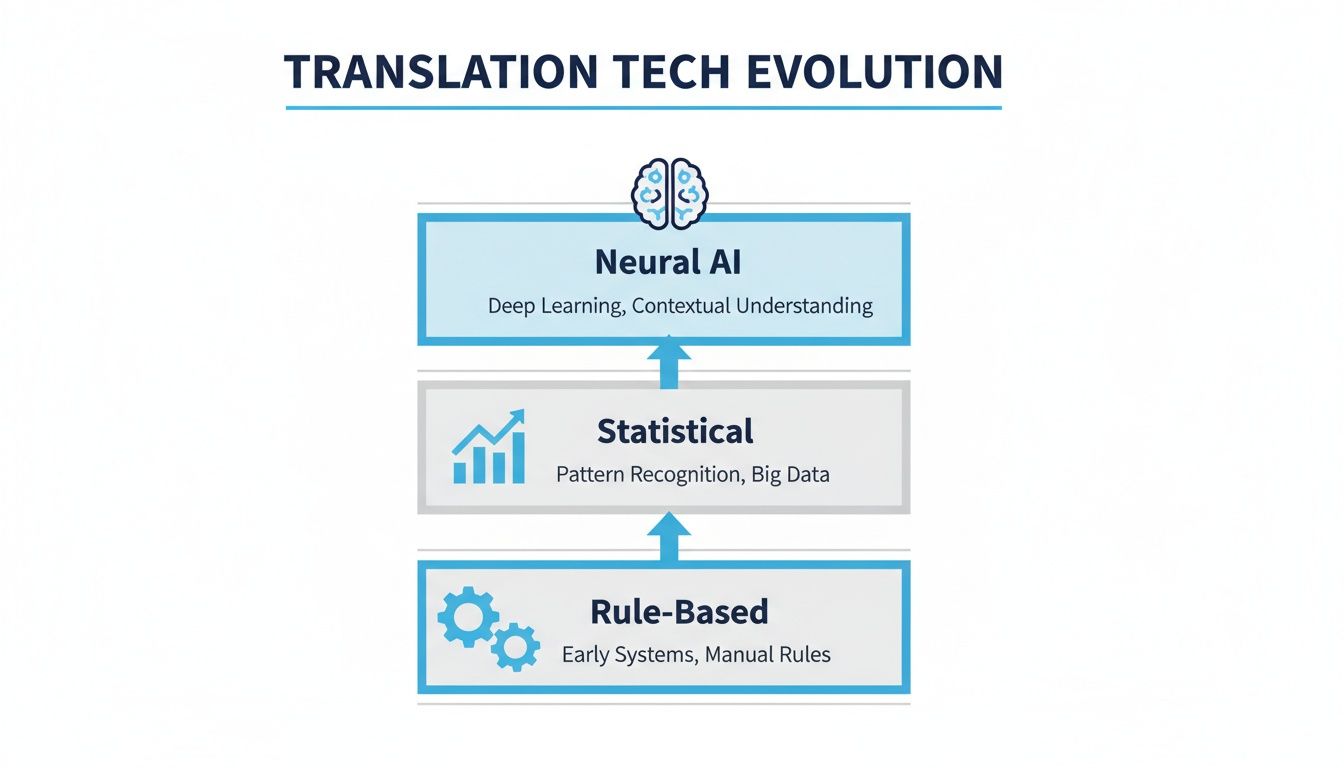
This evolution from rigid, rule-based systems to today's more intuitive Neural AI is precisely why we can now achieve such high-quality, natural-sounding translations.
Format and Layout Preservation: No More Rework
Just as critical is format preservation. What good is an accurate translation if it's delivered as a giant, unformatted wall of text? Imagine translating a meticulously designed EPUB, only to lose all your chapter breaks, headings, and italicized emphasis. It would be a nightmare to fix.
Top-tier software is built to avoid this mess entirely by meticulously preserving the original structure. That means:
- Headings and Chapters: All your structural elements stay perfectly in place.
- Text Styling: Bold, italics, and other formatting choices are kept just as you intended.
- Paragraph Integrity: The original flow and spacing of your writing remain untouched.
Preserving formatting isn't a "nice-to-have" feature; it's absolutely fundamental. It ensures the translated document looks and feels just as professional as the original.
This becomes even more important when dealing with scanned documents or PDFs. For these, strong OCR capabilities are a must, as they allow the software to "read" the text from an image and process it correctly. You can learn more about how to preserve formatting while translating globally in our other guide.
Language Support and Security: Your Global Reach and Peace of Mind
The breadth of a tool's language support determines its real-world value. A great platform should offer a wide range of languages, empowering you to connect with readers and colleagues around the world. Look for software that goes beyond the usual suspects to give you the flexibility to enter new and unexpected markets.
For instance, a platform like BookTranslator.ai supports over 50 languages, making it possible for an author to translate their book from English into Japanese, German, and Portuguese all at once.
Finally, let's talk about security. This is non-negotiable, especially if you're handling unpublished manuscripts, sensitive research, or confidential business files. You have to be confident your work is safe.
Always choose a service with a crystal-clear privacy policy that guarantees your data isn't being stored or used to train other AI models without your explicit consent. Strong encryption and secure file handling aren't just buzzwords—they are essential safeguards for your intellectual property.
Real-World Uses for Translation Software
The true value of any technology isn't in its features, but in how it solves real problems for real people. Document translation software is no different. It’s not just about swapping words from one language to another; it's about building bridges—connecting creators with new fans, researchers with critical information, and readers with a universe of stories they couldn't access before.
Let's look at a few practical scenarios where this technology is making a huge difference.

Unlocking Global Markets for Independent Authors
Picture this: you're an indie author, and your first novel is finally out. It's getting great reviews locally, but you know there are readers in Germany, Japan, and Brazil who would love it. Not long ago, reaching them meant navigating a maze of literary agents and foreign rights deals, hoping a publisher would invest thousands of dollars in a human translator. That whole process could take years—if it ever happened at all.
This is where modern document translation software completely rewrites the story.
An author can now take their finished EPUB file, upload it to a service like BookTranslator.ai, and get back high-quality translations for multiple languages in a matter of minutes. The best part? The software is smart enough to keep all the original formatting—chapter breaks, dialogue styles, and paragraph structure—perfectly intact.
This simple workflow unlocks some serious advantages:
- Cost-Effectiveness: We're talking a tiny fraction of the thousands you'd pay a traditional translator for each language. Suddenly, global distribution is actually affordable.
- Speed to Market: You can launch international editions in days, not years. This lets you ride the wave of your initial launch buzz and connect with new fans while your book is hot.
- Creative Control: You're in the driver's seat. You get to oversee the final product and ensure the translated version stays true to your original vision.
What was once a massive, impenetrable barrier has crumbled. An author from a small town can now genuinely compete on a global stage and share their work with the world.
Accelerating Discovery for Students and Researchers
In the academic world, progress often hinges on understanding research from around the globe. A breakthrough climate science paper might be published in a German journal, or a pivotal historical text might only exist in its original French. Waiting around for official translations can bring research to a screeching halt.
Document translation software acts as a powerful research accelerator, allowing scholars to instantly access and comprehend foreign-language source materials. This speed is crucial when building upon the latest global discoveries.
Think about a PhD student studying ancient civilizations. Instead of painstakingly translating sources one by one or spending their limited grant money on a specialist, they can now translate dozens of scanned academic papers in an afternoon. By converting these files, they can rapidly sift through the material, identify the most relevant sources, and get back to the actual work of analysis. It saves them hundreds of hours.
This kind of immediate access fosters a far more connected and efficient global academic community. Researchers can build on a much wider foundation of knowledge, which leads to faster discoveries and more complete, well-rounded studies.
Expanding Horizons for Avid Readers
Finally, let's consider the passionate book lover. You’ve heard incredible things about a bestselling thriller from South Korea or an award-winning novel from Italy. For decades, your only hope of reading it was that a major publisher would deem it commercially viable enough to translate. So many amazing books simply never made that leap.
Today, translation software puts the power right back into the reader's hands.
If you can get a digital copy of a book in its original language, you can now translate it for your own personal enjoyment. A simple file upload can open up a world of literature that was completely locked away. A reader in the United States can dive into a niche Japanese sci-fi series, while someone in Spain can explore the latest literary fiction from Poland.
It changes reading from a passive experience—where you're limited to what's been chosen for you—into an active journey of cultural exploration. This technology is finally starting to deliver on the dream of a truly global library, accessible to anyone, anywhere.
How to Choose the Right Translation Solution
Picking the right document translation software can feel like a huge decision, but it doesn’t have to be. With a bit of a roadmap, you can zero in on a tool that fits what you’re trying to do, whether that’s translating a single novel you’ve poured your heart into or managing a steady stream of academic papers. Get this choice right, and you'll save yourself a ton of time, money, and headaches.
The first step is always to get crystal clear on your goal. Are you an author trying to crack new international markets? A student who needs to make sense of foreign research? Or maybe just a curious reader eager to explore global literature? What you want to accomplish will steer every other decision.
After all, a one-off project, like translating a single book, has completely different needs than an ongoing workflow. Nailing this down from the start keeps you from overpaying for features you’ll never touch or, worse, picking a tool that can’t grow with you.
Evaluate the Pricing Models
Once you know what you need, the next big question is cost. The world of document translation software has a few different pricing models, and getting your head around them is key to not overspending. Don't just glance at the price tag; think about what you’re actually getting for your money.
- Pay-Per-Use or Pay-Per-Book: This is perfect for one-and-done projects. You only pay for what you need, exactly when you need it. For an author with one book or a student with a thesis, this is usually the most direct and budget-friendly path.
- Subscription Plans: If you know you'll have a constant flow of documents to translate, a monthly or yearly subscription can make more sense. These plans often bundle in extra features and support, but they're total overkill for a single project.
- Tiered Plans: Many services give you options, like a basic and a pro version. For example, BookTranslator.ai offers a "Basic" plan for rock-solid standard translations and a "Pro" plan that taps into more advanced AI for really capturing nuance and accuracy. This lets you match the tool’s power to how important your project is.
Your best bet is to look for a service with a transparent pricing structure—no hidden fees, no tricky long-term commitments. A pay-per-book model gives you total flexibility and guarantees you're never paying for software that's just sitting there.
If you want to dig even deeper, you might find our complete guide on how to choose translation software for documents helpful.
Take It for a Test Drive
You wouldn’t buy a car without driving it first, right? The same logic applies here. The absolute best way to know if a translation service is any good is to actually use it. Look for a free trial, a demo, or a money-back guarantee that lets you test the software with your own files, no strings attached.
This is where the rubber meets the road. It’s your chance to move past the slick marketing and see how the tool performs in the real world. A good test run will give you clear, undeniable answers to your most pressing questions.
When you're trying it out, really focus on these three things:
- Assess the Translation Quality: Translate a sample chapter or a few pages of your real document. Does the output sound natural? Does it actually capture the tone and feeling of the original text? This is the ultimate test of the AI engine.
- Check Format Preservation: Upload a file that has some tricky formatting—headings, italics, bold text, weird paragraph breaks. Does the translated version look exactly like the original? This tells you how much cleanup work you’ll have to do later (hopefully none).
- Evaluate the User Experience: How easy is it to actually use the thing? Is the whole process, from upload to download, straightforward? A clunky interface can turn a simple job into a massive pain.
This hands-on evaluation is the final, most crucial step. It takes the guesswork out of the equation and helps you make a confident decision. By defining your goals, comparing the costs, and testing the results, you can find a piece of document translation software that doesn't just look good on a feature list but is genuinely the right partner for your work.
Common Mistakes to Avoid When Translating Documents
Getting your hands on powerful document translation software can feel like unlocking a superpower. Suddenly, global audiences are within reach. But getting professional results isn't as simple as hitting "translate." To really make these tools work for you, it helps to know where the common traps are—the little mistakes that can sink your project or create a mountain of extra work.
One of the biggest misconceptions is thinking of the software as a magic wand. People often upload a complex document, like a creative novel or a dense legal contract, and expect a flawless, ready-to-publish version to pop out the other side. As smart as modern AI is, it's not a replacement for a human expert when the stakes are high and nuance is everything.
That brings us to the first, and most critical, mistake.
Relying Solely on Raw AI Output
Look, AI translation has gotten ridiculously good for general text, but it still stumbles over the subtle stuff. It can miss cultural inside jokes, misinterpret niche industry jargon, or completely flatten the tone of creative writing. Trusting a raw, unedited machine translation for an important document is a gamble. The AI might give you a translation that's technically correct but feels sterile, awkward, or just plain wrong to a native speaker.
Think of the AI-generated text as an excellent first draft—maybe even a 95% complete one. But for something as important as a book or a legal agreement, that last 5% is where the magic happens. A quick pass by a native speaker is the secret to catching those subtle errors and making sure the content truly connects with your audience.
This hybrid workflow—AI speed plus human polish—is the new gold standard.
Disregarding a Tool's Formatting Capabilities
It's so easy to get fixated on just the words. But what happens when your perfectly translated text comes back as a jumbled mess? If your beautifully designed report or EPUB file turns into a chaotic wall of text, you've just signed yourself up for hours of painful cleanup.
Imagine this: you translate a 300-page book, and when you open the file, all the chapter headings are gone, the paragraphs are merged, and every bit of italics has vanished. This completely defeats the purpose of using dedicated document translation software, which is built specifically to avoid this nightmare.
Before you commit to any tool, run a test with your exact file type. A platform like BookTranslator.ai is engineered to meticulously preserve the structure of complex files, so the document you get back looks just like the one you uploaded.
Failing to Understand AI Model Differences
A lot of people think "AI translation" is a single thing, but that's not the case. The underlying AI model makes a huge difference, and assuming they're all the same can lead to some seriously underwhelming results. Using a basic, general-purpose engine for a project that needs a delicate touch is like using a sledgehammer for a keyhole.
Here's a simple way to think about it:
- Standard Models: These are the workhorses. They’re fantastic for most day-to-day documents and provide solid, reliable translations.
- Advanced Models: These are the newer, more sophisticated engines. They’ve been trained on massive, diverse datasets, giving them a much better grasp of context, style, and complex sentence structures.
The key is to match the tool to the task. If you're translating your life's work or a critical business proposal, choosing a service that gives you access to the latest and greatest AI models isn't a cost—it's an investment in quality.
Frequently Asked Questions
Jumping into the world of document translation software can feel a bit overwhelming, and it's natural to have questions. Let's tackle some of the most common ones to help you get started with confidence.
How Accurate Is AI Document Translation?
Honestly, it’s remarkably good these days. Modern AI, especially systems built on Neural Machine Translation (NMT), can hit over 95% accuracy for most documents. These tools have gotten incredibly skilled at understanding context and nuance, a huge leap from the clunky translations of the past.
That said, for a creatively rich novel or a critical legal contract, it's always a smart move to have a native speaker give it a final polish. They can catch those subtle cultural shades of meaning that make a good translation truly great.
What File Types Can Be Translated?
The best tools are designed specifically for the file types that writers, academics, and business pros rely on. You're not just translating a block of text; you're translating a whole, structured document.
Look for support for formats like:
- EPUB: The gold standard for e-books, preserving all your chapters and styling.
- DOCX: Perfect for manuscripts, reports, and any standard document from Word.
- PDF: Yes, even scanned documents. Good software uses OCR (Optical Character Recognition) to read the text from an image before translating it.
The real magic here isn't just swapping words from one language to another. It's about preserving the entire layout and structure, so you don’t spend hours putting your document back together again.
It's a common mistake to think all translation tools are built equal. A generic text translator is great for a quick sentence, but a dedicated document translator is engineered to respect the integrity of your file, a feature the simple tools just don't have.
Is My Document Secure When I Upload It?
This is a huge—and completely valid—concern. You're often dealing with unpublished work or sensitive data. Reputable services take this seriously and use strong encryption to protect your files from the moment you upload them to the moment you download the translation.
Before you commit, always check for a clear privacy policy. Make sure the provider explicitly states they won't store your data long-term or use your content to train their AI models without your permission. Your intellectual property is yours, and it needs to stay that way.
Ready to see your book reach a global audience with its formatting perfectly intact? Give BookTranslator.ai a try and see how easy it can be. Get started at https://booktranslator.ai.