
Online document translation services aren't just about swapping words from one language to another. They're a powerful blend of sophisticated AI and human expertise, designed to take complex files like EPUBs, PDFs, and Word documents and accurately convert them for a new audience.
For authors, publishers, or students, this means you can finally reach global audiences or access international materials without the headache of losing your original formatting and layout.
Why Online Document Translation Is a Game-Changer
In a world this connected, talking across languages is essential, not just a "nice-to-have." Online translation has evolved light-years beyond the clunky, word-for-word tools of the past. Modern platforms are smart enough to handle massive, complex files, grasp stylistic nuances, and produce professional results—all for a fraction of what traditional translation used to cost.
At the heart of this shift is powerful AI that doesn’t just translate words; it understands context, tone, and even industry-specific terminology.
The demand for these services is skyrocketing. The global translation industry is valued at roughly USD 71.7 billion, with online and cloud-based platforms driving most of that growth. This isn't surprising when you consider that global e-commerce is booming, and businesses need to connect with key markets to tap into as much as 50% of worldwide sales potential.
The New Era of Accessibility
What really makes today's services different is how accessible and specialized they've become. An author can now get their entire novel translated into Spanish or Japanese in a matter of minutes, and every single chapter heading and paragraph break stays exactly where it should be. At the same time, tools like the auto translate device are changing our expectations for breaking down language barriers on the fly.
This evolution brings some massive advantages to the table:
- Speed and Efficiency: A project that used to take weeks of back-and-forth can now be turned around in a few hours. You can read more about this in our article on how AI speeds up translation timelines.
- Cost-Effectiveness: With automated workflows and flexible pricing, professional-grade translation is no longer out of reach for independent creators or small businesses.
- Preservation of Quality: The AI is smart enough to make sure the final document keeps its original voice, layout, and professional feel.
Today’s online translation platforms are more than just tools; they are gateways to global markets. They empower creators and researchers to break down language barriers and share their work with the world on their own terms.
How To Choose The Right Translation Service
With so many online document translation services out there, it’s easy to feel a bit lost. The goal isn't just to find a "good" service, but the right one for your specific needs—whether you're translating a novel, a technical manual, or an academic paper. Your decision will really come down to a few key things: the languages you need, the file types you work with, and the quality of the AI doing the heavy lifting.
First things first, take a hard look at your document's complexity. A simple, straightforward text file? A free, automated tool might get the job done just fine. But if you're dealing with a book filled with nuanced dialogue or a manual packed with industry jargon, you'll need something more powerful.
This decision tree gives you a good visual map for figuring out whether a pure AI approach is enough or if your project needs a human in the loop.
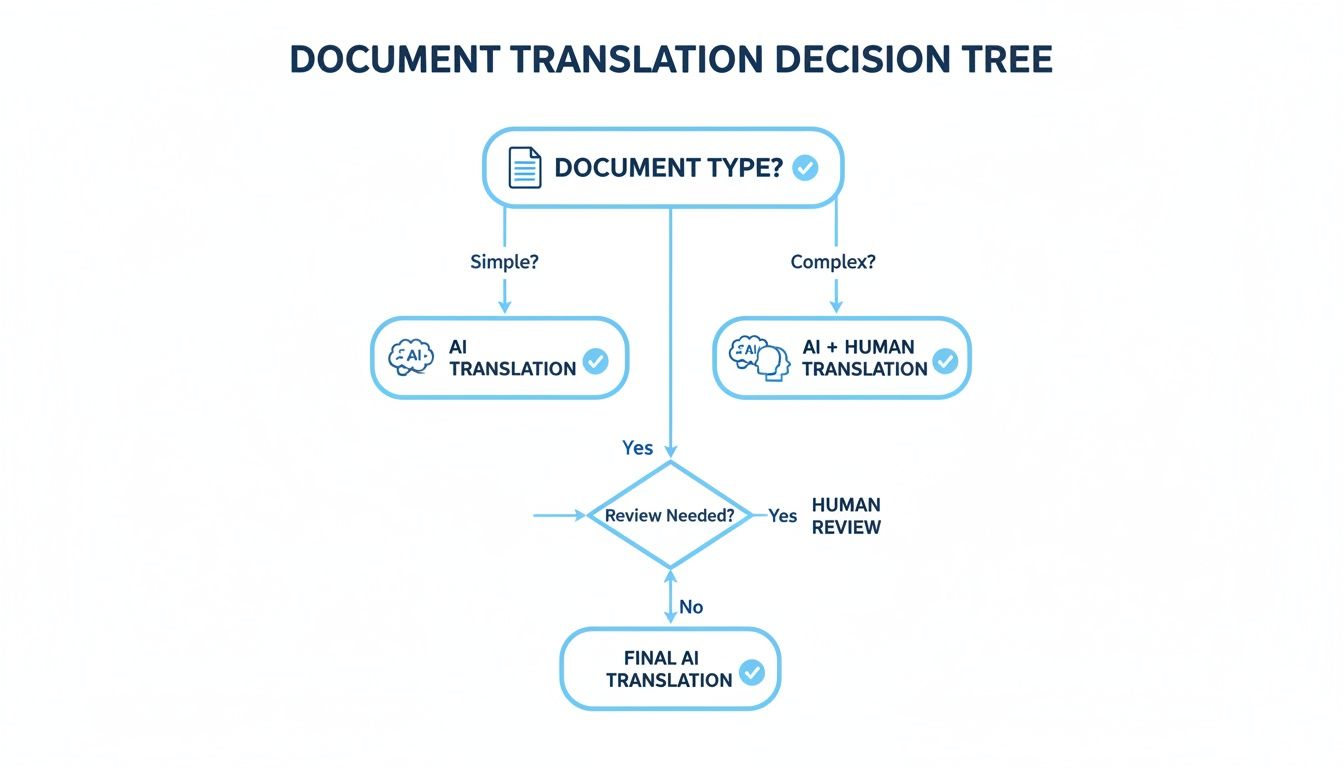
As you can see, the content itself is your biggest guide. For simple, low-risk documents, a quick AI translation is often sufficient. But for more complex, sensitive, or high-value material, building in a human review step is always a smart move.
Evaluating Key Service Features
Once you have a general idea of what you need, it's time to get into the nitty-gritty of what different services offer. This is where you can really separate the good from the great, especially when you have specific requirements for file formats or data privacy.
Think of it like creating a checklist. Here are the must-haves I always look for:
- File Format Compatibility: This is a big one. Does the service actually support your file type? For authors, EPUB and DOCX compatibility is an absolute must. Also, keep an eye out for file size limits—some platforms just can't handle a full-length manuscript.
- Language Support: Don't just be impressed by a long list of languages. The real question is how good the translation is for your specific language pair. A service might be fantastic for English-to-Spanish but produce clunky results for Japanese-to-German. Look for reviews or samples if you can.
- AI Technology: It’s worth asking what’s under the hood. For instance, services like BookTranslator.ai build their plans around the latest, most advanced AI models. These are much better at understanding tone, context, and complex sentences, which is essential for any kind of creative or literary work.
A quick comparison of different service models to help you choose the best fit for your project, budget, and quality requirements.
| Feature | Free Tools (e.g., Google Translate) | Subscription Services | Pay-Per-Book (e.g., BookTranslator.ai) |
|---|---|---|---|
| Best For | Quick, informal translations; getting the gist of a text. | Ongoing, high-volume needs; corporate or academic use. | Authors & publishers; one-off large projects like manuscripts. |
| Cost Structure | Free. | Monthly/annual fee; often tiered by usage limits. | One-time payment based on word count. |
| Quality | Varies widely; often struggles with nuance and context. | Generally good to high, depending on the underlying AI. | Optimized for literary content; uses advanced AI for tone and style. |
| File Format Support | Limited; usually plain text or basic document types. | Broader support, but may have limitations on specific formats. | Specialized for EPUB and DOCX; preserves layout and formatting. |
| Data Privacy | Often uses your data to train its models; not ideal for sensitive content. | Better; policies are usually clearer, but you need to check. | Strong privacy focus; documents are not used for training. |
| Specialized Features | Basic translation only. | Collaboration tools, glossaries, API access. | Layout preservation, glossaries for character names, batch processing. |
This table isn't about finding a single "best" option, but about matching the tool to the task. For a quick email, a free tool is fine. For a book you've poured your heart into, a specialized service is a much safer bet.
Don't Forget Security and Support
This last point is crucial: don't overlook security and customer support. You're uploading your intellectual property, sometimes before it's even published. You have to be able to trust the platform.
Always look for a crystal-clear data privacy policy. You want to know exactly how your files are handled and, most importantly, confirm they aren't being used to train AI models. A trustworthy service will be upfront about its security protocols.
Finally, think of good customer support as your safety net. Knowing you can reach a real person if something goes wrong is incredibly reassuring. A service that offers a money-back guarantee is also a great sign—it shows they stand behind their product and care about keeping their users happy.
Prepping Your Files for a Flawless Translation
You can't expect a great translation from a messy starting point. The single biggest factor for a high-quality result from any online document translation service isn't the AI itself, but how well you prepare your original document. Think of it like cooking: the best chef can't make a masterpiece with subpar ingredients.
This prep work goes way beyond a quick spell-check. It’s about giving the translation engine a clean, logical, and unambiguous file to work from. A little cleanup now prevents a whole host of headaches later.
For starters, go through your DOCX file and resolve all tracked changes and comments. If you leave them in, you're asking for trouble. The AI can get confused, sometimes translating the comments themselves or ignoring critical edits you thought were final. Also, standardize your formatting. Using five different font sizes for the same heading level is a surefire way to wreck your layout during translation.
Build a Solid Structure for Accuracy
If you're an author working with EPUB files, your book's structure is paramount. The AI relies on a clean, consistent hierarchy to figure out how the translated version should look. If your chapter titles aren't properly tagged as H1s and your subheadings as H2s and H3s, the AI might just see them as plain old paragraphs. Suddenly, your book's flow is completely broken.
The language you use matters just as much as the formatting. While modern AI is pretty smart, it's not a mind reader. Clear, direct language will always give you a better translation.
- Ditch the Idioms: Phrases like "bite the bullet" or "it's a piece of cake" will almost certainly be translated literally, leaving your new audience completely baffled. Stick to direct language.
- Chop Up Long Sentences: If you have sentences that ramble on for half a paragraph, break them up. Shorter, punchier sentences reduce the odds of the AI making grammatical mistakes or losing the original meaning.
- Define Your Acronyms: The first time an acronym appears, spell it out completely. This gives the AI crucial context it needs to get things right.
A well-prepared document is like a clear blueprint for the translation AI. When you get rid of ambiguity and weird formatting in the original file, you skyrocket the chances of getting a translation that's not just accurate, but also looks just as professional as your original.
Dealing With Tricky Layouts and Elements
So, what do you do about the stuff that isn't just text? Things like images with words in them, complicated tables, and footnotes all need a bit of special attention.
If you have text baked into your images, the best approach is to pull that text out, get it translated on its own, and then create a new graphic for the target language. Most automated tools can't "read" text inside a JPEG or PNG file. And if you're starting with a scanned document, you'll need to run it through Optical Character Recognition (OCR) software first to make the text editable. We have a whole guide on how to translate a scanned PDF that walks you through it.
Tables and footnotes can also throw a wrench in the works. Keep your tables simple—avoid merged cells and other complex formatting. For footnotes, just double-check that they are formatted correctly in your word processor. This ensures the translation service can spot them, translate them, and keep the little reference numbers linked up properly. Taking care of these details upfront is the key to a smooth, headache-free translation.
The Power Of Cloud-Based Translation Platforms
The old way of translating documents using desktop software is quickly becoming a relic. Today, the real action is happening on powerful, flexible cloud platforms. This isn't just about convenience; it’s a total game-changer for anyone tackling large translation projects, whether it's a dense academic paper or a full-length novel.
The cloud is what makes translating massive volumes of text in near real-time a reality.
Just picture trying to translate a 50MB EPUB file on your own computer. The processing power needed would grind your machine to a halt. Cloud-based services handle all that heavy lifting on their powerful remote servers, so you can process huge files in a snap without ever maxing out your CPU. For an author, this means getting a localized book to market that much faster.
Always-On Access to the Best AI
One of the biggest perks of going cloud-based is that you’re always using the latest and greatest AI models. You never have to think about downloading updates or wonder if your software is obsolete. The platform manages all the improvements behind the scenes, giving you constant access to top-tier translation quality with zero effort.
This continuous improvement is fueling incredible growth. Cloud platforms are on track to capture a massive 71.9% market share by 2035 as more people demand solutions that can scale with their needs. The machine translation market, which is the heart of these services, ballooned from USD 650 million in 2020 to over USD 1.1 billion in 2022 and is projected to hit USD 3 billion by 2027.
Centralized Security and Collaboration
Security is another area where cloud platforms truly shine. Instead of emailing sensitive documents back and forth—a major security risk—everything stays within a single, secure environment. This is a huge deal for publishers handling manuscripts before they're published or researchers working with confidential data.
This centralized setup also makes teamwork a breeze. Multiple people can access project files, review translations, and manage the entire workflow from anywhere on the globe. It's a lifesaver for publishing teams or academic groups spread across different time zones.
By leaning on the cloud, online document translation services offer more than just words on a page. They deliver a scalable, secure, and constantly evolving infrastructure that supports the entire localization process, from the first upload to the final sign-off. You can learn more about this in our guide on how AI simplifies translation workflows.
The reach of cloud translation is also expanding beyond just text. We're now seeing similar principles applied to new areas, with incredible results. For instance, the same cloud-powered technology is at the heart of modern AI video translation tools, showing just how versatile this approach has become.
Mastering Post-Translation Editing and Review
Let's be clear: even the most sophisticated AI from top-tier online document translation services gives you a solid first draft, not a finished masterpiece. The final, critical step is post-translation editing and review. This is where you elevate a good translation to a great one. For any document that truly matters—be it your next novel, a business agreement, or your academic thesis—this quality assurance (QA) phase is absolutely essential.
Think of the raw AI translation as a perfectly carved block of marble. It has the right shape, but it's your job to do the fine sanding and polishing. You need to smooth the rough edges, refine the subtle details, and make sure the final piece connects with its intended audience. Skipping this step is a huge gamble, risking awkward phrasing, cultural blunders, or tiny errors that can seriously damage your credibility.
A Practical Review Checklist
A structured review process helps you catch the little things that AI often overlooks. Don't just give it a quick scan for typos. You need to dig deeper to find the nuances that separate a document that feels translated from one that feels truly native.
Here’s a checklist I use to guide my own reviews:
- Grammatical Accuracy: Move past a simple spell-check. Are the verb tenses right? Do the sentence structures feel natural in the new language? Is the punctuation correct according to local conventions?
- Contextual Nuance: This is a big one. Does a translated joke land, or does it fall flat? For authors, this means checking if a character's sarcastic tone is preserved or if an emotional scene still carries the same weight.
- Cultural Appropriateness: Hunt for any idioms, pop culture references, or examples that just won't make sense to a different audience. What's a common saying in English might be confusing or even offensive in another culture.
- Consistency: Make sure key terms, character names, or technical jargon are translated identically every single time they appear. Inconsistent terminology is a fast track to confusing your reader.
Here's my rule of thumb: read the document as if it were originally written in the target language. If any part feels clumsy, unnatural, or just a little bit "off," it needs more work.
Smart Proofreading Strategies
When you’ve stared at the same text for hours, your brain starts to fill in the blanks and skip over mistakes. The trick is to force yourself to see the words in a new way.
One of the most powerful techniques is simply reading passages out loud. Your ears are fantastic at catching clunky phrasing and awkward rhythms that your eyes will skim right over. If it sounds weird when you say it, it's going to read weird, too.
Another great hack is to use a text-to-speech tool. Listening to a synthetic voice read your translated text makes you slow down and process each word individually. It’s a surprisingly effective way to pinpoint grammatical errors and stilted sentences.
Finally, for your most important projects, nothing beats a "human-in-the-loop" workflow. This just means hiring a native speaker to review the entire document or at least the most critical sections. Their intuitive grasp of the language and culture provides a layer of quality control that no machine can match. They ensure your message isn't just translated, but truly localized.
Handling Specialized Document Translation
Let's be honest, not all documents are created equal. You wouldn't use the same tool to translate a casual email and a complex legal contract, would you? When you're dealing with specialized content—think legal briefs, medical research, or technical manuals—a generic, one-size-fits-all translation tool just won’t cut it.
The real challenge is the jargon. Every field has its own language, and accuracy isn't just about swapping words. It’s about preserving the precise, often subtle, meaning behind them. A legal term like "indemnification" carries a specific weight that a standard AI can easily miss. The same goes for scientific concepts in an academic paper; if the terminology is even slightly off, the entire paper's credibility can crumble. This is where specialized online document translation services really prove their worth.
Why Context Is Everything
Imagine a law firm submitting evidence for a major court case. If a key witness statement is translated incorrectly, it could throw the entire proceeding into chaos. Or picture a medical researcher publishing their clinical trial results. A single mistranslated metric could completely invalidate years of work. These aren't just hypotheticals; they highlight the incredibly high stakes involved.
The demand for this kind of specialized work is booming. The judicial translation niche alone is expected to grab over 25.5% of the market share by 2035. This is part of a much bigger picture: the online translation market is set to grow from USD 27.78 billion in 2025 to USD 28.86 billion in 2026 as our world becomes more connected. For a closer look, you can dig into these translation service market trends.
Finding the Right Service for Complex Documents
When you absolutely cannot afford a mistake, you need to be picky. Look for platforms that are built to handle complexity. Here’s what I’d look for:
- Industry-Specific AI Models: Don't be afraid to ask the provider if their AI has been trained on legal, medical, or technical glossaries. This is a game-changer for handling niche terminology correctly.
- Glossary Support: This feature is a lifesaver. It lets you upload your own list of terms to ensure consistency. Think of character names in a novel you're translating or recurring technical phrases in a user guide.
- Human Review Options: For your most critical documents, nothing beats a final check by a human expert. A service offering a "human-in-the-loop" review provides that essential layer of quality assurance and peace of mind.
Putting a little extra effort into finding a specialized service ensures the crucial details in your document aren’t lost in translation.
Got Questions About Online Document Translation? You're Not Alone.
It's completely normal to have a few questions when you're looking at online document translation services. The technology is moving at a breakneck pace, and figuring out the nuts and bolts will help you pick the right tool for the job, avoiding any nasty surprises down the road.
I talk to authors and publishers all the time, and a common worry is whether an automated service can really keep the professional look and feel of their original document. It's a fair point—a sloppy, poorly formatted file reflects badly on you and your work.
Another frequent sticking point is the pricing. The difference between a "Basic" and a "Pro" plan isn't always obvious, and you want to know what you're actually paying for.
Let's clear up some of that confusion.
Will AI Actually Keep My Original Formatting Intact?
Yes, the good ones will. Modern AI services are built with what I call "smart formatting" technology. Before it even starts translating, the AI scans your entire file—be it an EPUB or a DOCX—and maps out the structure. It identifies every heading, paragraph break, bulleted list, italicized word, you name it.
As it translates the text, it reapplies that same structure to the new language. The end result is a translated document that mirrors the original layout, often perfectly. This is an absolute game-changer for long-form content like books or technical manuals where a professional presentation is non-negotiable.
What's the Real Difference Between a Basic and Pro AI Plan?
The main distinction boils down to the engine under the hood—the AI model doing the actual translating.
A "Basic" plan typically uses a solid, standard AI model. It's great for general-purpose translation and more than capable of handling straightforward content accurately. Think business reports, articles, or internal documents.
A "Pro" plan gives you access to the latest and greatest language models. These are the heavy hitters, significantly better at picking up on subtle nuances, decoding complex sentences, and maintaining a consistent voice.
This makes "Pro" the clear choice for projects where style and precision are paramount, like literary fiction, academic papers, or specialized technical guides.
My rule of thumb is this: if your content has a distinct authorial voice or complex subject matter, go Pro. For a standard internal memo, Basic will get the job done just fine.
How Does Pay-Per-Use Pricing Actually Work?
Pay-per-use is a beautifully simple model that ditches monthly subscriptions. It’s all about transparency and paying only for what you need. These platforms typically charge based on the amount of text you translate, often using a word or token count.
Here’s a real-world scenario: you upload your manuscript, the service analyzes it and counts, say, 80,000 words. It then calculates the cost based on a set rate, like a specific price per 100,000 words. You see the total cost upfront, no hidden fees.
This approach is perfect for people with project-based needs. An author translating a single novel or a student translating one research paper doesn't need a recurring subscription. You just pay for the one-off job. Simple as that.
Ready to translate your book with confidence? At BookTranslator.ai, we offer professional-grade AI translation that preserves your formatting and voice. Try our pay-per-book service today and bring your story to a global audience!