
Figuring out the best translation software really boils down to what you're trying to accomplish. For a quick email or a simple paragraph, a general tool like DeepL is fast and effective. But when you're talking about translating an entire book, you need something far more specialized—a platform like BookTranslator.ai that understands the importance of preserving formatting and capturing nuance.
The trick is to match the software’s core strengths, whether that's raw accuracy, file handling, or workflow features, to the specific needs of your project.
Finding the Right Translation Software for Your Book
Picking the right translation tool for long-form content—a novel, a research paper, a textbook—can feel like a huge task. For authors and publishers, the stakes couldn’t be higher. You're not just swapping out words; you're trying to protect the original meaning, tone, and overall reading experience. A generic tool might translate a sentence just fine, but an entire manuscript is a completely different beast.
The market is flooded with options, which makes having a clear set of evaluation criteria so important. The AI translation software market is booming, jumping from USD 1.88 billion in 2023 to USD 2.34 billion in 2024, according to Research Nester. This explosive growth is mostly driven by Neural Machine Translation (NMT), which now commands a 48.67% market share because it translates whole sentences at a time, creating a much more natural flow than clunky, word-for-word methods.
Navigating Your Software Options
When you’re translating a book, your needs are worlds apart from someone just translating a business email. The real difference-makers are the specialized features that most general-purpose tools simply don't offer.
So, what should you be looking for?
- Format Preservation: Can the software handle complex files like EPUBs without scrambling your layout, chapter breaks, and custom styling? This is non-negotiable for authors.
- Contextual Accuracy: Does the AI grasp literary devices, idioms, and the author's unique voice consistently over hundreds of pages?
- Workflow Simplicity: Is the process painless? Can you go from uploading your manuscript to receiving a ready-to-publish file without a dozen manual steps?
The best translation software for a book author is almost never a free, web-based tool. Specialized platforms are built from the ground up to solve one core problem: maintaining the integrity and structure of a long, complex document from start to finish.
Comparing General vs. Specialized Tools
To make the right call, it helps to see a direct comparison between the different types of software out there. The table below breaks down the trade-offs between everyday translators and platforms built specifically for long-form content. For a deeper dive, you can explore our guide on online document translation services.
| Feature | General-Purpose Tools (e.g., Google Translate) | Specialized Platforms (e.g., BookTranslator.ai) |
|---|---|---|
| Primary Use Case | Quick translations of short text snippets or simple documents. | Translating entire books, research papers, and technical manuals. |
| File Support | Limited to basic text, DOCX, or PDF with potential formatting loss. | Optimized for complex formats like EPUB, preserving layout and structure. |
| Accuracy | Good for literal meaning but often misses nuance and context. | High contextual accuracy, trained on long-form content for better flow. |
| Workflow | Manual copy-pasting or basic file uploads. | A simple, integrated process designed for large projects. |
What to Look for in Translation Software
Not all translation tools are built the same, especially when you're dealing with something as intricate as a book or a detailed academic paper. To find the right software for a project that really matters, you have to look past the marketing hype and focus on the features that actually deliver. A quick feature checklist won't tell you if a tool can keep the soul of your work intact.
This means we need to get serious about quality, functionality, and security. For authors, publishers, and academics, these aren't just nice-to-haves; they're essential for protecting the integrity of a manuscript while opening it up to the world.
Translation Accuracy and Nuance
Let's start with the big one: translation accuracy. We've come a long way from the clunky, word-for-word translations of the past, thanks to Neural Machine Translation (NMT). Modern NMT models don't just look at individual words; they analyze entire sentences to grasp the context, which is absolutely critical for preserving the nuance, tone, and unique voice of an author.
Think about it. Translating a user manual is one thing, but translating a work of fiction is another beast entirely. A novel is filled with idioms, metaphors, and cultural references that require an AI to think, not just process. The best software uses sophisticated NMT to make sure the translated text reads naturally and carries the same emotional weight as the original. If you want to dive deeper, we have a guide that explains how translation accuracy metrics work.
Language Support and Global Reach
Your dream of reaching readers worldwide hinges on the software's language support. A tool with only a handful of popular languages immediately puts a ceiling on your market. The platforms worth your time offer dozens of language pairs, covering not just the usual suspects like Spanish and French but also less common languages that can open up new, untapped markets.
When you're comparing options, ask these questions:
- Does it cover my target markets? Check for the specific languages your potential readers speak.
- Can it handle dialects? Is there a difference between its European and Brazilian Portuguese, or its Castilian and Latin American Spanish? Precision matters.
- Is the quality consistent? Some tools are great with a few language pairs but fall flat on others. Look for consistent quality across the board.
This is what empowers an author in Tokyo to have their story read and loved by people in Berlin and São Paulo.
For authors, the goal isn't just translation; it's localization. The best software provides the linguistic tools necessary to make a story feel native to any reader, anywhere in the world.
Document Format Preservation
For anyone who has ever formatted a book, format preservation is non-negotiable. You’ve already poured hours into getting the layout just right—the chapter breaks, the headings, the italicized thoughts, maybe even a custom font. The last thing you need is a translated file that looks like a plain text document, with all your hard work erased.
This is where most generic, free online translators completely fall apart. They're notorious for stripping out all formatting, leaving you with a mountain of tedious rework.
Software designed specifically for books, however, is built to handle complex files like EPUBs. It intelligently reads the structure of your original file and carefully reapplies every single element to the new version. The result? A translated book that is a perfect mirror of the original, ready to go.
Pricing and Data Privacy
Finally, we have to talk about the practical side of things: pricing models and data privacy. Many services push a subscription model, which can get costly if you only translate a book or two a year. A pay-per-book or pay-per-word structure often makes more sense, giving you the flexibility to pay only for what you actually use.
Just as important is what a company does with your manuscript. This is your intellectual property, after all. A trustworthy platform will have a crystal-clear privacy policy that guarantees your content won't be used to train their AI models or be sold to third parties. Before you upload a single page, always read the fine print on their data security.
Comparing Different Types of Translation Tools
The market for translation software isn't one-size-fits-all. It’s a crowded space with tools built for completely different jobs, and picking the wrong one can seriously compromise your book's integrity. The choice between a free web tool and a dedicated platform could be the difference between a smooth global launch and a complete formatting disaster.
Let's break down the three main categories you'll encounter: free web translators, professional Computer-Assisted Translation (CAT) tools, and specialized AI platforms designed specifically for long-form content. Each has its place, but knowing the trade-offs is crucial for any author.
Free Web Translators Like Google Translate
Everyone has used a free online translator. They're incredibly handy for quick, simple tasks—like figuring out the gist of an email in another language or translating a short social media comment. Tools like Google Translate or Bing Microsoft Translator give you instant results in dozens of languages, and you can't beat the price.
But their limits become painfully obvious when you try to use them for anything complex. For an author, the biggest dealbreaker is their total inability to preserve formatting. If you upload a perfectly structured EPUB file, you'll almost certainly get back a giant, unreadable wall of text. All your chapter breaks, headings, and styling will be gone.
These free tools are built for short, low-stakes text. They are fundamentally the wrong tool for translating an entire book where structure and nuance are everything. Plus, their data privacy policies can be a real concern if you're dealing with an unpublished manuscript.
Professional CAT Tools Such as Trados or Phrase
On the other end of the spectrum are professional CAT tools. These are the industry standard for human translators, with platforms like Trados, MemoQ, or Phrase leading the pack. Think of them less as automated translators and more as a sophisticated workbench that helps a linguist work faster and more consistently.
A human translator works through your book sentence by sentence, and the software offers suggestions from "translation memories" (TMs), glossaries, and integrated machine translation. The translator then edits and approves each segment. This process ensures incredible accuracy and consistency, especially for technical or repetitive content.
The catch? CAT tools have a seriously steep learning curve and a hefty price tag, often running into thousands of dollars for the software and necessary training. They are built for the complex workflows of professional linguists, not for a self-publishing author who just needs to translate a finished EPUB file. For most authors, it's total overkill.
This infographic breaks down the core criteria to keep in mind when comparing these distinct software types.
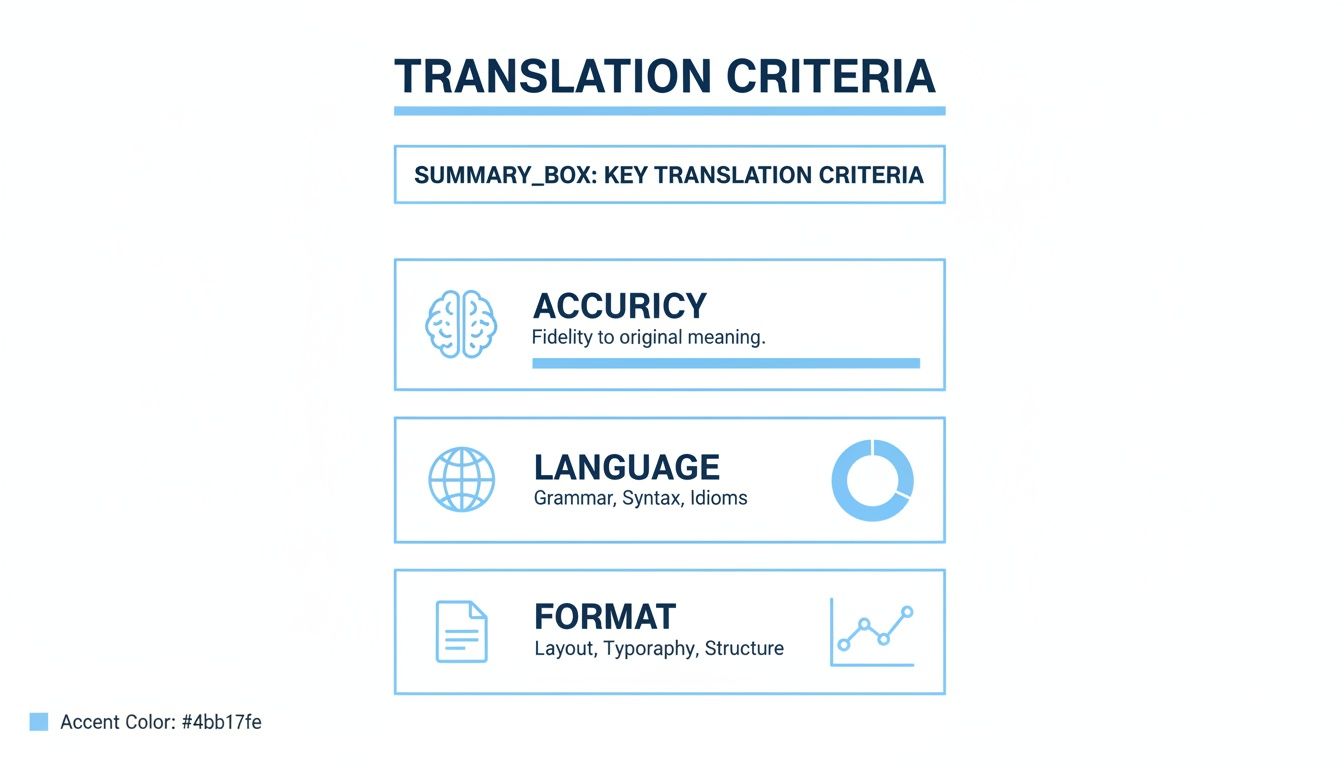
As you can see, for any author, preserving the book's format is just as important as the raw accuracy of the words themselves.
Specialized AI Platforms for Books and Documents
A third category has emerged to fill the huge gap between basic free tools and complex professional software: specialized AI platforms. Services like BookTranslator.ai are built from the ground up to handle long-form documents like books, research papers, and technical manuals.
Their key advantage is that they blend the speed of AI with an intelligent understanding of document structure.
- Format Preservation: They are designed to parse complex files like EPUBs, identify all the structural elements (chapters, headings, italics, etc.), and perfectly reapply them to the translated version.
- Optimized AI Models: The AI engines are often trained on massive libraries of literary and academic works, which helps them better capture nuance and an author's unique voice over a long narrative.
- Simple Workflow: The whole experience is designed for content creators, not professional linguists. It’s usually a simple upload-translate-download process that doesn’t require any technical background.
The industry data backs this up. Software platforms are dominating the market, pulling in a massive 72.88% of market revenue and growing at a 10.34% CAGR. Neural machine translation alone was responsible for 61.25% of that revenue by providing high-quality output at a fraction of the cost and time—a huge win for publishers working with e-books. You can dig into more data on the translation services market at Mordor Intelligence.
For an indie author who wants to translate their novel into Spanish, a specialized platform hits the sweet spot. It avoids the formatting mess of free tools and the overwhelming complexity and cost of professional CAT software, delivering a market-ready file you can actually use. To see how this works in practice, check out our guide on how AI simplifies translation workflows.
Comparing Translation Tool Categories for Authors
To make the decision clearer, here’s a direct comparison of how these three categories stack up on the criteria that matter most to authors.
| Feature | Free Web Translators (e.g., Google Translate) | Professional CAT Tools (e.g., Trados) | Specialized AI Platforms (e.g., BookTranslator.ai) |
|---|---|---|---|
| Best For | Quick, low-stakes translation of short text snippets (e.g., an email or sentence). | Professional linguists and large agencies managing complex, high-volume, and repetitive translation projects. | Independent authors, publishers, and academics needing to translate entire books or documents affordably. |
| Format Preservation | None. Strips all formatting, leaving a plain wall of text. | Excellent, but manual. Requires a professional to correctly configure and manage file structure. | Excellent and automatic. Designed to recognize and replicate chapter breaks, headings, and styling. |
| Cost | Free. | High. Thousands of dollars for software licenses, plus the cost of hiring a trained translator. | Affordable. Typically a low per-word rate or subscription model, with no upfront software costs. |
| Workflow | Simple copy-paste. Not designed for file uploads. | Very Complex. Requires significant training and technical expertise in translation project management. | Simple. A straightforward upload-translate-download process designed for non-technical users. |
| Privacy | Questionable. User data is often used to train models; not ideal for unpublished work. | High. Typically offers robust, on-premise, or private cloud solutions for secure handling of sensitive IP. | High. Reputable platforms have clear privacy policies and secure servers to protect intellectual property. |
Ultimately, while free tools and CAT software have their specific uses, specialized AI platforms are the only category built to solve the unique challenges that authors and publishers face when taking their work global.
A Deep Dive Into Leading Translation Platforms
Okay, let's move past the general categories and get our hands dirty with the actual platforms you'll encounter. While the big-name tools are great for many things, translating a full manuscript brings a unique set of challenges. My focus here is on how these platforms actually perform when you hand them a book, not just a paragraph.
We’ll put industry heavyweights like DeepL and Amazon Translate under the microscope and see how they stack up against a purpose-built tool like BookTranslator.ai. The real test isn't just word-for-word accuracy; it's about whether your book comes out the other side with its formatting—and your sanity—intact.
DeepL: The Nuance Specialist
DeepL has built a fantastic reputation since its launch in 2017, and for good reason. It’s known for delivering translations that just feel more natural, capturing context and idioms in a way that often outshines its rivals. If you need the best translation software for a quick email or a chapter summary, DeepL is a phenomenal choice.
Its neural networks are particularly skilled with European languages, which is a huge plus for authors who need to preserve a story's tone and voice. You're less likely to get those awkward, literal translations of complex sentences that scream "machine-translated."
But here’s the catch for authors: the standard DeepL interface simply isn't built for books. Sure, you can upload a DOCX or PDF file, but it chokes on the intricate structure of an EPUB. You’ll lose chapter breaks, headings, and all your careful styling, forcing you into a tedious, manual clean-up job.
Amazon Translate: The Enterprise Powerhouse
On the other end of the spectrum is Amazon Translate, a beast of a service from Amazon Web Services (AWS) designed for raw power and scale. This is an API-first tool, meaning it’s made for developers to plug into their own applications. It's less of a ready-to-use product and more of a powerful engine.
For a tech-savvy user, it offers some seriously advanced features. With Active Custom Translation, you can train the model on your own bilingual documents to get highly consistent terminology, which is invaluable for technical or academic works.
"The challenge with API-driven tools like Amazon Translate isn't quality—it's accessibility. For the average author or researcher, navigating AWS, managing API keys, and building a workflow to handle EPUB files is a steep technical mountain to climb."
This platform is absolutely not an "upload-and-go" solution. To make it work for book translation, you'd need to build a custom application around it. For most authors and researchers, that’s just not a realistic option.
Comparing Key Platforms for Book Translation
To put it all in perspective, let's lay out a direct comparison based on what truly matters when you're translating a book.
| Feature | DeepL (Web/Pro) | Amazon Translate (API) | BookTranslator.ai |
|---|---|---|---|
| Primary Strength | High-quality, nuanced translations for general text. | Scalable, customizable translations for enterprise applications. | Specialized EPUB translation with perfect format preservation. |
| EPUB Handling | Poor. Does not natively support EPUB structure. | Requires custom coding. No built-in support for EPUB files. | Excellent. Designed specifically to parse and replicate EPUB formats. |
| Workflow Simplicity | High. Simple drag-and-drop for basic document types. | Very Low. Requires development skills to use the API. | Very High. A simple 3-step upload, translate, and download process. |
| Ideal User | Individuals needing accurate translations of short texts. | Developers and large companies with technical resources. | Authors, publishers, and researchers who are not technical experts. |
| Pricing Model | Subscription-based for advanced features and higher volume. | Pay-per-character via an AWS account. | Simple, transparent pay-per-book pricing. |
This table really highlights the fundamental gap in the market. Big players like Google Translate, DeepL, and Amazon Translate dominate a highly concentrated AI translation software market, with North America and Europe accounting for over a 50% combined share. But their focus is on corporate needs, not creative ones. Neural Machine Translation holds a 48.67% market share, showing that AI excels at speed and cost-efficiency for general tasks, but it often misses the specific features required for high-value content like books. You can find more details in this AI translation market report from DataInsightsMarket.com.
The incredible leap in translation quality is largely thanks to technologies like Large Language Models (LLMs). Understanding how these models work reveals why they can grasp context so effectively, making today's tools so powerful.
In the end, it really comes down to specialization. DeepL and Amazon Translate are impressive, versatile platforms. They just weren't designed to solve the very specific problem of preserving a book's structure and formatting during translation. For an author, that's everything.
Why BookTranslator.ai Is the Clear Choice for Authors and Publishers

After looking at what's out there, a clear pattern emerges. General-purpose tools are fine for a quick email or a simple document, but they just can't handle high-stakes projects. For an author, academic, or publisher, translating a book isn't about changing words from one language to another; it's about keeping the reader's experience intact. This is exactly where BookTranslator.ai shines, proving itself as the best translation software for anyone serious about long-form content.
Unlike platforms designed for software developers or big corporations, BookTranslator.ai was built from the ground up with a single person in mind: the writer. It zeroes in on the biggest headaches authors run into, transforming a messy technical problem into a smooth, reliable process. That sharp focus is what really makes it stand out.
Solving the Formatting Nightmare
Ask any author who has tried to use a generic translation tool, and they'll tell you about the formatting nightmare. You can pour weeks into getting your EPUB manuscript just right—perfect chapter breaks, elegant styling, carefully placed images—only to have a standard translator spit back a wall of plain, jumbled text.
BookTranslator.ai was engineered to stop this from happening. It’s smart enough to understand the underlying structure of an EPUB file, not just the words.
- Chapter Breaks and Headings: It maintains the entire hierarchy of your book, so the translated version has the same easy-to-navigate structure as the original.
- Styling and Emphasis: All your carefully chosen formatting—italicized thoughts, bolded terms, and other nuances—are meticulously carried over to the new language.
- Images and Captions: Your visuals and their descriptions stay exactly where you put them, preserving the book's intended layout.
This means the translated EPUB you get back is a perfect reflection of your original file. It’s a market-ready book you can start selling immediately, saving you countless hours of frustrating rework.
A Pricing Model That Makes Sense for Authors
Let’s be honest, subscription fatigue is a real problem. For independent creators with sporadic project schedules, getting locked into a monthly fee just doesn't work. Most professional translation platforms force you into these recurring plans, which is a costly and inefficient way to operate if you only translate a few books a year.
BookTranslator.ai takes a different, much more sensible approach.
With a simple pay-per-book pricing structure, you only pay for what you use, when you use it. There are no hidden fees, monthly commitments, or confusing credit systems. It’s just a straightforward, cost-effective choice for both a single book project and a full publishing calendar.
This model is a perfect fit for the financial realities of self-publishing and academic work. It gives you access to top-tier technology without the enterprise-level price tag, making global publishing accessible to everyone.
An Effortless Three-Step Workflow
While powerful tools like Amazon Translate offer incredible capabilities, they demand technical know-how and often require complex API integrations. BookTranslator.ai, on the other hand, is all about simplicity. The entire process is boiled down to three quick steps, making it easy for anyone to use.
- Upload Your EPUB: Just drag and drop your manuscript file.
- Select Your Language: Pick from over 50 supported languages to find your target readers.
- Download the Translated Book: In minutes, you’ll have a perfectly formatted, ready-to-publish EPUB.
This dead-simple workflow removes the technical roadblocks that keep so many authors from reaching a global audience. It puts advanced AI translation right into your hands, no developer needed. The focus stays where it should be: on your story, not on learning a new piece of software.
For authors, publishers, and even dedicated readers wanting to translate a book, BookTranslator.ai is the purpose-built solution that gets it right where others fail. By mastering format preservation, offering fair pricing, and keeping the process simple, it’s the best partner for sharing stories and knowledge with the world.
How to Choose the Right Translation Software for You
There's no single "best" translation tool. The right choice for a self-publishing author tackling their first novel is worlds apart from what an academic institution needs to localize a library of research papers. Instead of a one-size-fits-all answer, let's walk through a few practical questions to pinpoint the perfect fit for your project.
This isn't about getting lost in feature lists. It's about mapping your specific needs to the types of software out there. By answering these questions honestly, you can pick a tool that feels like it was made for you and avoid paying for bells and whistles you'll never touch.
What Are You Translating?
First things first, what kind of content are we talking about? The answer will instantly narrow down your choices.
- Creative Works (Novels, Memoirs): If you're translating a novel, the author's voice, tone, and literary nuance are everything. You absolutely need a tool that can preserve that spark while also keeping your original EPUB formatting perfectly intact.
- Academic and Technical Docs (Research Papers, Manuals): For this kind of material, precision is the name of the game. The software has to nail specialized terminology consistently. Just as important is preserving the layout—tables, figures, and citations must survive the translation process untouched.
- Quick, Simple Text (Emails, Social Media): For casual, low-stakes communication, a free web translator is usually all you need. The goal is a quick gist, not perfect prose or formatting.
Knowing your content type is the first filter to find a tool that will treat it with the right kind of care.
How Tech-Savvy Are You?
Let’s be real about your comfort level with technology. This is a huge factor.
Are you an author who just wants something that works, no fuss? Then you're looking for a simple upload-translate-download workflow. Trying to wrestle with a complex, API-driven service like Amazon Translate without a technical background is a recipe for a headache and a steep learning curve.
On the other hand, a large publishing house with a dedicated dev team might jump at the chance to use a powerful and customizable API. They have the people and skills to build a translation workflow that fits their exact process.
The goal is to spend your time writing and publishing, not troubleshooting a complex system. Choosing software that matches your skill set is non-negotiable.
What's Your Budget and How Do You Want to Pay?
Money is always part of the equation, but it's not just about the sticker price. The way you pay can make a huge difference to your bottom line.
Think about how often you'll be translating:
- A One-Off Project: If you're just translating one book or a handful of documents, a pay-per-project model is your best bet. You pay for exactly what you need, no strings attached.
- Ongoing Needs: For publishers who release several titles a month, a subscription might offer more predictable costs and better overall value.
And don't fall into the "free is always better" trap. A free tool that butchers your EPUB's formatting can end up costing you dozens of hours in manual fixes. Suddenly, that "free" option becomes incredibly expensive. Look for a tool with a transparent pricing structure that makes sense for your project's scope.
A Practical Guide to Making Your Choice
Okay, with those questions answered, you can now make a confident decision. Here’s a quick guide mapping common scenarios to the right type of tool.
| Your Situation | Recommended Software | Why It's the Right Fit |
|---|---|---|
| Independent Author Translating an EPUB Novel | Specialized AI Platform (like BookTranslator.ai) | It's built to preserve EPUB formatting flawlessly, offers a simple workflow for non-techies, and has an affordable pay-per-book model. |
| Academic Researcher Translating a PDF Paper | Specialized AI Platform or a Pro-Level Tool | A specialized platform is great for PDFs. A tool like DeepL Pro can also work well if you have a DOCX file with simpler formatting. |
| Large Publisher with In-House Developers | API-First Service (like Amazon Translate) | This gives you the raw power, scale, and customization needed for a high-volume workflow managed by a technical team. |
| Quickly Checking an Email in Another Language | Free Web Translator (like Google Translate) | It’s fast, free, and perfect for getting the general meaning of short, informal text where formatting is a non-issue. |
By thinking through these scenarios, you can cut through the noise and find the tool that’s truly built for the job you need to do.
Ready to translate your book without the formatting nightmares? BookTranslator.ai was designed from the ground up for authors and researchers. See what a difference a specialized platform makes with our simple, pay-per-book service today at https://booktranslator.ai.