
Imagine you have a document—maybe a detailed PDF, an intricate Word file, or even a full-length eBook in EPUB format. Now, imagine needing to convert it into another language, not just the words, but everything: the layout, the formatting, the tables, and the chapter breaks. That's precisely what an online document translation service does. It's a digital platform built to handle the heavy lifting of converting entire files from one language to another while keeping the original structure perfectly intact.
What Exactly Is an Online Document Translation Service?
Think of an online document translation service as your digital multilingual expert. Unlike basic translation apps that just swap words, these sophisticated platforms use advanced AI to grasp the context, tone, and subtle cultural nuances of your text. The goal is to produce a translation that feels natural and fluent to a native speaker, avoiding the robotic and often nonsensical output of older tools.
These services exist to close language gaps quickly and affordably. Whether you're an author dreaming of a global readership, a researcher deciphering a foreign academic paper, or a business localizing its manuals, these platforms open up a world of possibilities without the steep costs and long waits associated with traditional translation agencies.
More Than Just Words On A Page
To really get what these services do, it helps to understand the difference between transcription and translation. Transcription is about converting spoken words into written text. Translation, on the other hand, is the art of converting written text from a source language to a target language, all while preserving the original meaning and intent.
As the world has become more connected, the demand for high-quality translation has exploded. The global translation industry, which is powered by these online platforms, swelled to nearly $27 billion back in 2021, with Europe and North America leading the charge. This isn't surprising when you consider the sheer volume of content—from legal contracts to entire novels—that needs to be translated quickly and accurately.
The best services don't just translate; they recreate. They meticulously preserve the structure of your document—from chapter headings and paragraphs in an EPUB to tables and images in a PDF—ensuring the final product is a perfect mirror of the original, just in a new language.
Who Benefits from Online Document Translation
So, who are the primary users of these platforms? The audience is surprisingly diverse, ranging from independent authors to large corporations. Here’s a quick look at who benefits the most and why.
| User Group | Primary Benefit | Example Use Case |
|---|---|---|
| Authors & Publishers | Global Market Access | Translating an eBook or manuscript to sell on international platforms. |
| Academics & Students | Research Accessibility | Translating foreign research papers or academic articles for study. |
| Businesses | International Expansion | Localizing user manuals, marketing materials, or internal documents. |
| Legal Professionals | Document Review | Quickly translating contracts or legal documents for initial analysis. |
This table just scratches the surface, but it highlights how these tools empower different professionals to overcome language barriers and achieve their specific goals. In short, anyone dealing with multilingual documents can find immense value here.
A Look Inside A Modern Translation Platform
Modern platforms are designed for simplicity. The process is usually as straightforward as dragging and dropping your file, choosing your languages, and clicking a button. The complex AI works its magic in the background.
This user-friendly approach makes powerful technology accessible to everyone, not just tech experts. The core advantages really boil down to a few key points:
- Accessibility: They open up a world of content for authors, students, and readers everywhere.
- Speed: An AI can translate a full-length book in a matter of minutes, a task that would take a human translator months.
- Fidelity: Advanced systems are now incredibly good at maintaining the author's original voice, style, and formatting.
- Affordability: For large projects, they offer a much more budget-friendly option compared to hiring a team of human translators.
Real-World Examples: How People Use Online Document Translation
It's one thing to talk about technology in the abstract, but the real magic happens when you see how it solves actual problems. An online document translation service isn't just a piece of software; it's a bridge connecting people, ideas, and stories across language divides.
Let’s step into the shoes of three different people—an author, a scientist, and a reader—to see how these tools work in the real world. Each story shows just how versatile modern translation can be.
The Independent Author Reaching New Markets
Meet Sofia, an indie author whose debut sci-fi novel is getting great reviews. It's a hit with English-speaking readers, but she knows there are huge fanbases for her genre in Spain and Japan. In the past, this meant a huge hurdle: finding, hiring, and managing two separate literary translators. That’s a process that could easily eat up a year and cost thousands of dollars she doesn't have.
Instead, Sofia turns to a service built for authors, like BookTranslator.ai. She simply uploads her finished EPUB file and selects Spanish and Japanese.
- The Challenge: Sofia’s story is filled with a unique authorial voice, from quirky character dialogue to invented sci-fi jargon. A generic, word-for-word translation would make her world-building fall flat and kill the narrative drive.
- The Solution: The platform’s AI, trained on millions of books, gets the difference between literal text and literary style. It translates the novel while protecting the original's creative spark and, just as importantly, its formatting. Chapter breaks, italics, everything stays in place. Sofia now has two professionally translated books ready for new markets, unlocking revenue streams that were once out of reach.
This is a perfect example of how an online document translation service levels the playing field, giving individual creators the kind of global reach that used to belong only to massive publishing houses.
The Academic Accelerating Groundbreaking Research
Now, let's picture Dr. Chen, a researcher working on a cure for a rare disease. He finds a critical research paper from China that could be his next big breakthrough. The catch? It's a dense, 150-page PDF packed with complex medical terms, charts, and data tables. Going through the university's translation department would mean a delay of several months, and he can't afford to wait.
Dr. Chen needs that information, and he needs it now. So, he uses a secure online platform designed for technical documents.
In fields like medicine, law, and engineering, speed and precision aren't just nice-to-haves—they're essential. The ability to translate dense, technical material quickly and accurately gives professionals a massive edge, driving faster innovation and smarter decisions.
He uploads the PDF, and the service takes over.
- The Challenge: The translation must be perfect. A single mistake in medical terminology could lead to a misinterpreted data point and send his research down a dead end. Plus, the layout—all those tables and figures—has to be preserved exactly, or the document will be impossible to understand.
- The Solution: The platform uses a specialized AI model that has been trained on scientific and medical language. It recognizes the jargon and translates it correctly. At the same time, its layout preservation technology creates a translated PDF that’s a perfect mirror of the original. All the charts and tables are right where they should be, just in English. Dr. Chen is reviewing the findings that afternoon, not months later.
The Avid Reader Accessing a Story Instantly
Finally, think of Marco, a huge fan of a British mystery series living in Brazil. The newest book is out in English, but the official Portuguese translation is at least six months away. He's dying to read it and wants to join the online fan discussions without seeing any spoilers.
He buys the English EPUB and uses a personal tool like BookTranslator.ai to create his own copy in Portuguese.
- The Challenge: Marco doesn't just want the words translated; he wants the story. He needs a translation that captures the author's dry wit and suspenseful tone. A clunky, literal translation would completely ruin the reading experience.
- The Solution: A high-quality AI translation gives him an immediate, readable version that flows naturally. The book feels engaging and alive in his native language, letting him dive into the plot twists right away. Thanks to accessible technology, he’s part of the global conversation without the frustrating wait.
The Core Features of a High-Quality Translation Service
Picking an online document translation service can feel a lot like choosing a car for a big road trip. Sure, a basic model might get you from point A to point B, but the right one makes the journey smooth, safe, and surprisingly efficient. The best services in this space are built on four key pillars that really separate the exceptional tools from the merely functional ones.
When you know what to look for, you can see past the simple promise of word-for-word translation. It helps you figure out if a platform can genuinely handle the nuances of your document, whether it’s a complex academic paper, an unpublished manuscript, or a meticulously designed eBook.
Translation Accuracy and Nuance
Let's start with the obvious: accuracy. But in today's world, great translation is about so much more than just getting the words right. The real magic is in capturing nuance—the subtle meanings, the author's specific tone, and the cultural context that brings a piece of writing to life.
Think about translating an English idiom like "it's raining cats and dogs." A literal, word-for-word translation would just be confusing. A sophisticated AI, however, has been trained on mountains of literature and conversational text. It understands the idea behind the phrase and finds its cultural equivalent, like "il pleut des cordes" (it's raining ropes) in French. This is where modern neural networks really prove their worth, by keeping the style and feel of the original text intact.
Quality translation is about recreating an experience, not just converting words. An effective service acts as a cultural interpreter, ensuring that jokes land, technical terms are precise, and the author's unique voice is never lost in translation.
Extensive Language Support
A wide selection of language pairs is another deal-breaker. While you can find English-to-Spanish translators almost anywhere, a top-tier service offers a deep catalog of languages. This includes languages with fewer native speakers or those with more complex grammar, which is a huge advantage for anyone trying to reach a truly global audience.
An author, for instance, might discover a massive fanbase for their fantasy novel in Poland, or a business writer could find their guide becomes a bestseller in South Korea. Having access to a diverse set of languages lets you connect with niche markets you might have otherwise missed. When you're comparing services, don't just think about the languages you need now—think about where your audience might grow tomorrow. For a deeper dive into the software side of this, our guide on the best document translation software offers some great perspectives.
Flawless Layout Preservation
What good is a perfectly translated eBook if the formatting is a complete mess? For documents like EPUBs, PDFs, and even DOCX files, keeping the original layout isn't just a nice-to-have; it's essential. This is probably one of the biggest things that separates a simple text translator from a professional document translation service.
The best platforms use advanced technology that actually analyzes your file's structure—things like chapter breaks, headings, italics, images, and tables—and carefully reapplies it to the translated version.
This screenshot from BookTranslator.ai shows just how simple the upload process can be, highlighting the platform’s focus on user experience. The goal is to give you a translated document that looks like a perfect mirror of the original, ready to go without you having to spend hours fixing the formatting by hand.
Robust Security and Confidentiality
Finally, let's talk about security. This is incredibly important, especially if you're working with unpublished manuscripts, confidential research, or sensitive business files. A service you can trust has to treat your intellectual property with the highest level of care, and that goes way beyond a simple privacy policy. It demands real, concrete security measures.
A truly high-quality online document translation service prioritizes security, implementing robust identity verification processes and end-to-end encryption. This protects your files from any unauthorized access, from the second you upload them to the moment you download the final version.
Here are a few must-have security features to look for:
- End-to-End Encryption: This scrambles your data, making it unreadable to anyone without the key, both when it's being sent and while it's stored.
- Secure Data Handling: Look for clear policies stating your documents won't be sold, shared, or used for anything other than your translation.
- Automatic Deletion: The best services will automatically and permanently delete your files from their servers after a certain amount of time, limiting any risk.
Choosing a service with solid security protocols gives you the peace of mind to translate your most valuable work without worry.
From Upload to Final Document: A Step-by-Step Guide
Jumping into new technology can feel a little daunting, but the best online document translation services are built to be incredibly straightforward. The whole process, from the file on your desktop to a fully translated version, is usually much simpler than people imagine.
Let's walk through the typical journey your document takes. We'll use a platform like BookTranslator.ai as a real-world example to pull back the curtain on AI translation, making it a concrete, easy-to-grasp concept. This guide will show you how a few clicks can convert your document into another language while keeping its professional look and feel completely intact.
Creating Your Account and Getting Started
First things first, you'll almost always need to create an account. This is usually a quick sign-up with just an email and password. For anyone handling sensitive manuscripts or unpublished work, this step is non-negotiable for security. It creates a private, secure dashboard where you can manage your files, see project progress, and grab your finished translations without worrying about prying eyes.
Once you’re in, you’ll find that quality platforms get straight to the point. The interface is typically clean and intuitive, guiding you right to the main event: uploading your document. This isn't an accident—the design is meant to cut through the clutter and technical jargon, making it a smooth ride for everyone.
The Three Core Steps: Upload, Translate, Download
At its heart, the entire translation workflow boils down to just three simple actions. You give the system your file, tell it what to do, and it hands you back the finished product.
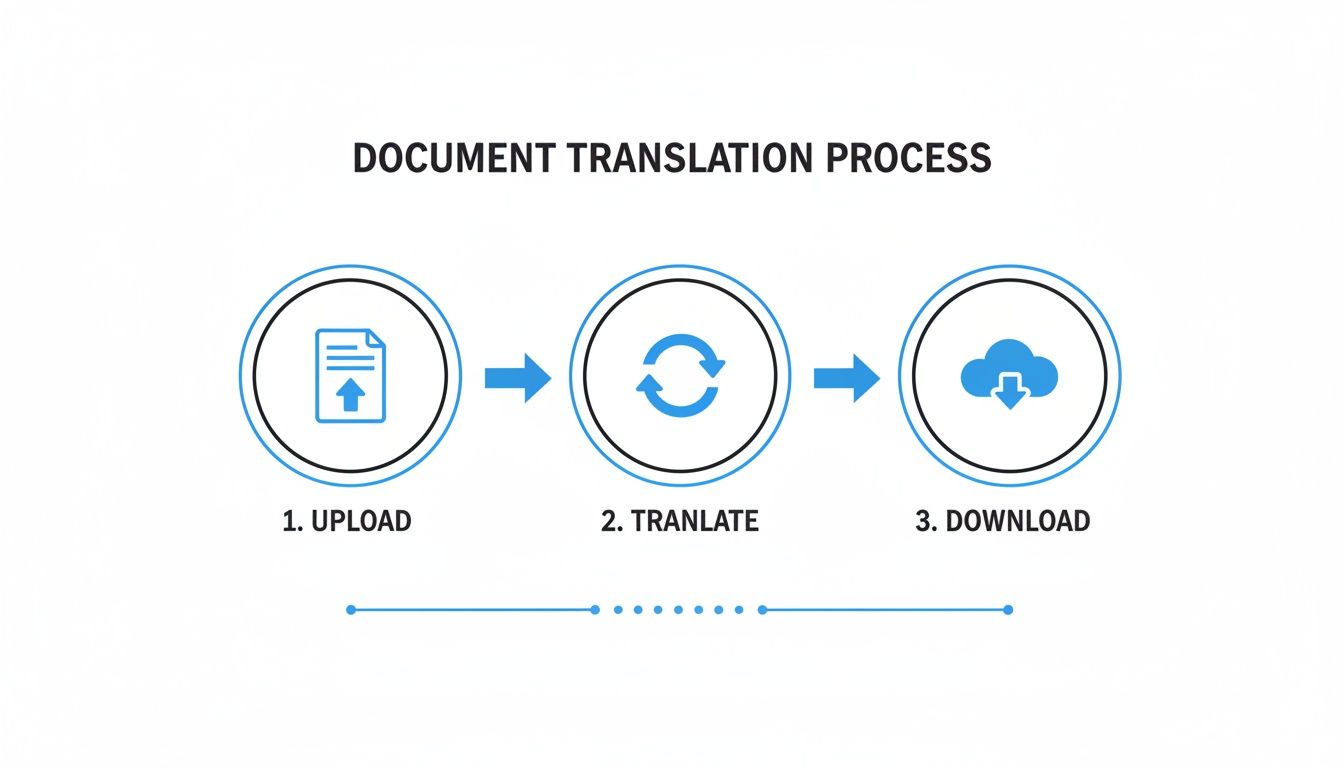
The user experience is designed for pure efficiency. Here’s a closer look at what’s happening behind the scenes at each stage:
Securely Upload Your Document: This is where you hand your file over to the system. You can usually just drag and drop it or browse your computer to select the file. Good services handle all the common formats you’d expect, like EPUB, PDF, and DOCX. For trickier files, like a scanned image-based PDF, some advanced platforms have you covered. If that’s what you’re working with, you can learn more about how to translate a scanned PDF with the right tools.
Select Languages and Initiate Translation: After your file is uploaded, you just need to tell the system your source and target languages. For example, you might select "English" as the source and "German" as the target. On platforms like BookTranslator.ai, this is also where you’d choose the quality level that matches your needs and budget. With your settings locked in, you hit the "Translate" button.
This is where the magic happens. The AI gets to work, but it's not just doing a simple word-for-word swap. It analyzes sentence structures, understands context, and preserves every bit of your document's formatting to create a translation that reads naturally and looks identical to the original.
Reviewing and Downloading Your File
The speed of AI translation is genuinely impressive. A full-length book that might take a human translator months of hard work can often be processed in a matter of minutes. As soon as the job is done, you'll get a notification that your newly translated document is ready.
You can then download the file in its original format. If you uploaded an EPUB, you get a perfectly formatted EPUB back in the new language. The best services make sure everything—from chapter headings and paragraph breaks to italicized words and images—stays exactly where it's supposed to be. What you get is a professional, ready-to-use document, no assembly required.
How to Choose the Right Document Translation Service
Now that you have a feel for how these platforms work, you're in a great position to make a smart choice. Picking the right online document translation service isn't about finding one tool that does everything; it’s about finding the one that gets your specific project right, whether that's a novel, a research paper, or a critical business document.
The trick is to step back from the marketing hype and ask a few pointed questions. This will help you find a service that actually delivers the accuracy, security, and quality you need.
Your Essential Decision-Making Checklist
To find your perfect match, run any potential service through this checklist. It's a straightforward way to see if you're looking at a generic tool or a platform truly built for what you do.
- File Format Compatibility: Does the service handle your exact file type? For authors and publishers, this is huge. You need to look for native support for EPUB and PDF, not just a tool that can process a simple Word doc.
- Layout and Formatting Preservation: Will your document come out looking the same, just in a different language? This is a deal-breaker for long-form content. You need a guarantee that chapter breaks, headings, italics, and image placements will all stay put.
- Pricing Model Transparency: Is it obvious how much you're going to pay? Look for clear, pay-as-you-go options, like per-word or per-document pricing. These are usually much more budget-friendly for one-off projects than getting locked into a subscription.
- Security and Confidentiality Protocols: How, exactly, will they protect your intellectual property? I'd look for services that mention end-to-end encryption and have a clear policy on automatically deleting your files after the translation is done.
Going through these points helps you build a solid picture of what you need, which makes comparing your options so much easier. If you want to dive deeper into how this works behind the scenes, our guide on how AI simplifies translation workflows has some great insights.
Evaluating Your Specific Use Case
Let's be honest: the right tool for a quick, informal translation is completely different from the one you'd trust with your unpublished manuscript. Your specific context is everything.
The market for these services is blowing up, especially in certain parts of the world. In North America, for example, the document translation market accounts for over 40% of global revenue and is expected to keep growing through 2033. This region is a hotbed for adopting advanced online solutions, which is great news for anyone needing specialized tools. You can read more about this market growth and its drivers.
Choosing a translation service is like hiring a specialist. You wouldn't ask a general practitioner to perform heart surgery. Similarly, for high-stakes documents like books or legal papers, you need a service with proven expertise in that specific domain.
This means you have to look past the generic sales pitch and figure out if the platform was genuinely built for your kind of content.
Generic Translators vs Specialized Services
One of the biggest questions you'll face is whether to use a general-purpose document translator or a specialized service like BookTranslator.ai. While both can translate basic text, the wheels start to come off for generic tools when you throw complex, long-form content at them.
So, when does it make sense to go with one over the other? This table breaks down the key differences to help you decide.
Service Comparison: Generic vs. Specialized Translators
| Feature | Generic Document Translator | Specialized Book Translator (e.g., BookTranslator.ai) |
|---|---|---|
| Primary Focus | Translating simple text in common file formats like DOCX and TXT. | Translating complex, long-form content like eBooks and academic papers. |
| Layout Preservation | Basic formatting is often lost or distorted, requiring manual correction. | Advanced technology preserves the original layout, including chapters, headings, and styling. |
| File Format Support | Limited to standard office documents. EPUB support is rare or unreliable. | Optimized for EPUB and complex PDFs, ensuring full compatibility. |
| AI Training Data | Trained on general web text, which may lack literary or technical nuance. | Trained on a vast library of books and academic texts for superior contextual accuracy. |
| Pricing Structure | Often subscription-based, which can be costly for single projects. | Typically offers pay-per-book or per-word models that are more affordable for authors. |
Ultimately, your choice boils down to your priorities. If you just need to translate a quick memo, a generic tool is probably fine. But for a document where formatting, nuance, and accuracy are everything, a specialized online document translation service is really the only way to go.
Frequently Asked Questions
Diving into AI translation for the first time can feel like a big step, especially when it’s your own creative work or a sensitive document on the line. It's only natural to have a few questions. Let's tackle some of the most common ones that come up.
How Accurate Is AI Translation for Creative Works?
This is the big one, isn't it? We've all seen clunky, literal translations that completely miss the point. The good news is that modern AI, particularly the neural machine translation (NMT) models used today, is a world away from that. These systems have been trained on massive libraries of literature, helping them learn the subtleties of context, tone, and style.
So, what does this actually mean for your book? It means the AI can often grasp idioms, hold onto your unique authorial voice, and even find culturally appropriate ways to handle figurative language. Of course, for a final, polished publication, having a human give it a final read-through is always a good idea. But the initial AI draft you get back is often so fluent and accurate that it gives you a fantastic head start.
A great AI translator doesn't just swap words. It aims to recreate the reading experience, making sure the translated story flows and hits all the same emotional notes as the original. For any author, that's what truly matters.
Will My Translated Document Keep Its Original Formatting?
Yes—as long as you pick the right service. This is a huge differentiator between a dedicated document translator and a simple copy-paste tool. The best platforms are built with layout preservation technology that intelligently scans your original file, whether it's an EPUB, PDF, or DOCX.
This tech essentially creates a map of your document's entire structure. It identifies things like:
- Chapter breaks and all your headings
- Paragraph styles and indents
- Any text you've put in italics or bold
- Where you've placed images and their captions
After the text is translated, the service rebuilds the document using that map, giving you a file that's a perfect mirror of the original. This feature alone can save you dozens, if not hundreds, of hours of painstaking manual reformatting.
Is It Safe to Upload My Unpublished Manuscript?
Your intellectual property is everything, and any reputable service will treat it that way. Security isn't just an afterthought; it's a core feature. A trustworthy online document translation service should offer several layers of protection.
First off, look for end-to-end encryption. This scrambles your file from the moment you upload it to the moment you download the translated version, making it unreadable to anyone else. Beyond that, solid platforms have iron-clad privacy policies, stating clearly that your work will never be shared, sold, or used to train their AI models. Many top services also permanently delete your files from their servers after a short window, which minimizes risk and gives you total peace of mind.
How Much Does It Cost to Translate an Entire Book?
This is where AI has really changed the game. Traditional translation agencies often charge steep per-word or hourly rates that can make translating a full book feel out of reach. Online AI services, on the other hand, typically use much more transparent and affordable pricing.
You'll often find they charge based on word count, sometimes bundled into large chunks. For instance, a service might have a plan that costs just $5.99 or $9.99 per 100,000 words. This pay-as-you-go model means you're not locked into a costly subscription, and you can get your entire manuscript translated without any surprise fees.
Ready to share your story with the world? With BookTranslator.ai, you can translate your EPUBs into over 50 languages while keeping the original layout and feel perfectly intact. Try it today and see how easy it is to reach readers worldwide!