
How AI Simplifies Translation Workflows
AI has completely changed how translation workflows operate, making them faster, more efficient, and less expensive. Here's what you need to know:
- Speed: AI reduces translation times by up to 80%.
- Cost Savings: Companies report 30-50% lower costs compared to older methods.
- Adoption: 70% of global translations now involve machine-assisted processes.
- Accuracy: AI tools like Human Adaptive Feedback (HAF) improve consistency by learning from edits in real time.
- Efficiency: Tasks like creating drafts, applying glossaries, and quality checks are automated, freeing up human translators for more complex work.
- Real Results: Companies like Polhus and Ajax Systems have saved millions while increasing productivity.
AI handles repetitive tasks and drafts, while human translators refine tone and context for high-quality results. This balance ensures faster, cost-effective translations tailored to business needs.
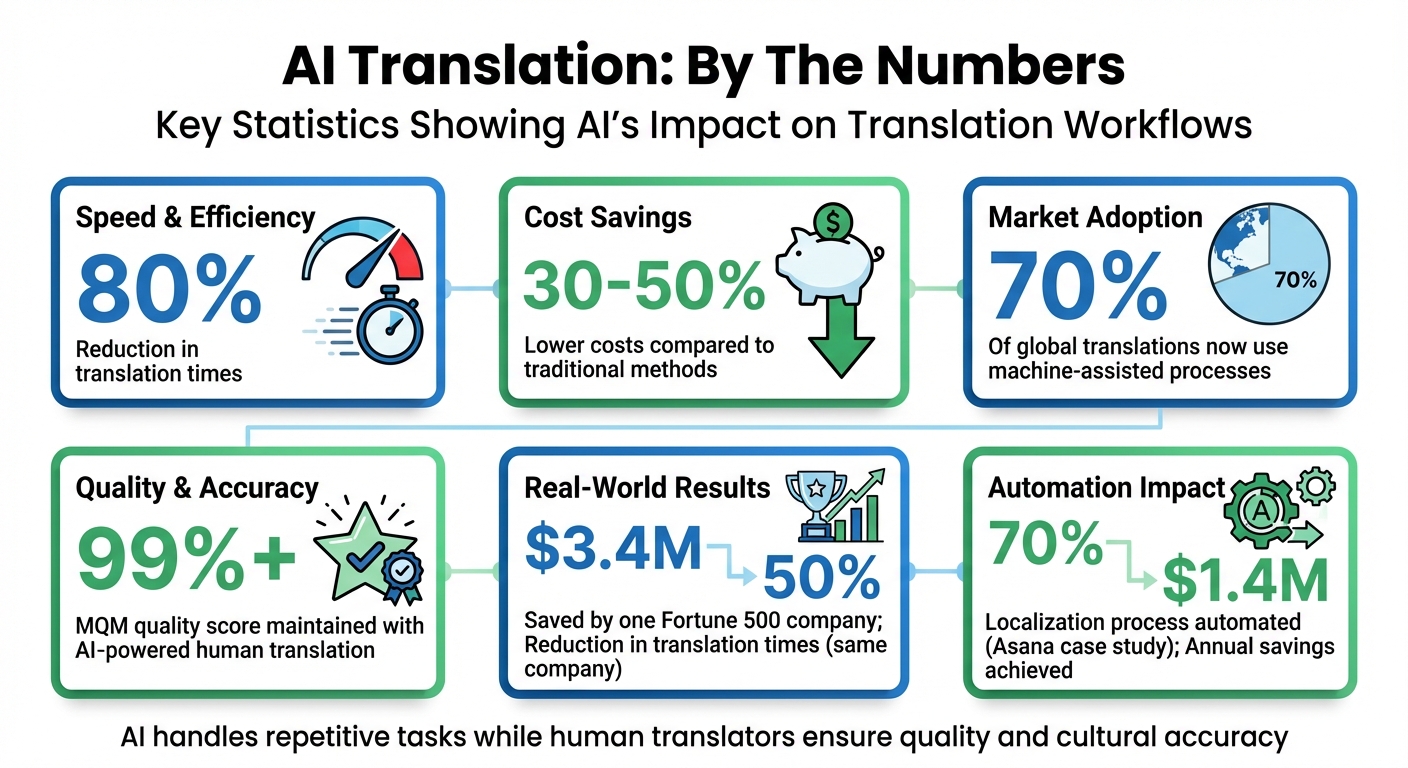
AI Translation Workflow Benefits: Speed, Cost Savings, and Adoption Statistics
This AI translation workflow replaced $300k in translation fees
How AI Improves Translation Workflows
AI has reshaped translation workflows by taking over time-consuming manual tasks, enabling teams to work faster and more effectively. Instead of starting from a blank slate, translators now benefit from instant drafts, automated quality checks, and consistent use of terminology.
Creating Initial Translation Drafts
Today’s AI tools can instantly generate full translation drafts, giving translators a head start to focus on refining tone, local nuances, and stylistic details.
In July 2025, Secret Escapes adopted AI tools to handle routine translation tasks by training models in their brand voice. This shift allowed their in-house linguists to support 20% more campaigns without increasing freelance expenses. Similarly, Therabody used AI-powered workflows for technical content like user manuals, cutting translation costs by 60% while achieving a 99.7% on-time delivery rate [6].
AI systems also incorporate Human Adaptive Feedback (HAF), meaning they learn from every edit a translator makes. For instance, if a linguist corrects a term or phrase, the system applies that change project-wide, eliminating repetitive fixes [5]. This real-time learning loop not only saves time but also ensures greater consistency throughout the work.
By building on these advancements, AI takes the lead in simplifying repetitive tasks within translation processes.
Automating Repetitive Tasks
AI’s ability to handle repetitive tasks is where it truly shines. Tasks like extracting text from PDFs or other non-editable files, segmenting content, and routing documents to the right translator based on complexity are now automated, freeing up valuable time for teams.
Translation Memory (TM) systems store previously translated phrases for future use. When similar or identical sentences appear, AI automatically fills them in, ensuring consistency and sparing translators from redundant work [1][7]. AI also enforces glossaries, applying approved translations for technical or industry-specific terms, reducing the need for manual corrections.
On top of that, AI-powered quality assurance tools scan translations for issues like inconsistent capitalization, punctuation errors, or grammar mistakes - catching these before human review even begins [1]. Batch processing further speeds things up, allowing teams to upload multiple files at once and apply changes across all of them in seconds [7].
While automation enhances efficiency, finding the right balance between speed and quality is essential.
Balancing Speed and Quality
AI doesn’t just speed things up - it also ensures quality remains intact. The key is using the right AI approach for each type of content. For example, internal FAQs or support tickets can be translated using raw AI for maximum speed and cost savings. In contrast, marketing materials or in-app content benefit from AI-Powered Human Translation (AIHT), where AI drafts are refined by humans for tone and fluency [6].
One Fortune 500 company transitioned from fully human workflows to AIHT, saving $3.4 million and cutting translation times by 50%, all while maintaining a Multidimensional Quality Metrics (MQM) score above 99 - nearly matching human-level quality [6]. AI platforms now even assign quality scores to drafts, helping teams decide which translations are ready for publication and which need further refinement [1]. This targeted approach allows translators to focus on high-value edits.
"AI provides the same, very solid foundation for linguists not just to work faster, but actually to use more of their pure linguistic expertise."
– Andreas Laursen, Director of Program Management, Lilt [5]
Using AI in Team Translation Platforms
AI is reshaping how translation teams work together, simplifying communication and workflow management. With AI-driven platforms, translators, editors, project managers, and clients can collaborate in one shared space, eliminating the hassle of juggling emails, spreadsheets, and scattered files.
Real-Time Collaboration Features
Modern AI tools let team members work on translations simultaneously, using a bilingual view that displays the source and target texts side by side [1]. This segment-focused editing approach allows editors to refine specific sentences without affecting the rest of the document.
Features like Visual Context give translators a clear picture of how their work will appear in the final design. Instead of guessing whether the translated text will fit within a user interface, they can see layout adjustments in real time [8]. Additionally, Human Adaptive Feedback (HAF) ensures that when a linguist updates a term or phrase, the AI applies those corrections across the entire project instantly [5].
These real-time editing tools, combined with centralized communication, make workflows smoother and more efficient.
Centralized Communication Systems
AI platforms simplify team communication by consolidating all project-related discussions in one place. Integration with tools like Slack allows teams to discuss specific strings or terms without leaving the platform. In-editor commenting enables clients to provide feedback directly on individual sentences, with notes automatically linked to the relevant sections.
Real-time dashboards offer a clear view of project progress, helping managers spot issues like delays or terminology inconsistencies early on [10][9]. AI also flags tasks that may be falling behind schedule, ensuring that potential bottlenecks are addressed promptly. Centralized repositories for linguistic assets - such as Translation Memories, glossaries, and style guides - ensure consistent terminology and brand language throughout the project.
Take Asana, for example: by implementing a dedicated translation management system, they centralized their workflow and automated 70% of their localization process. This shift reduced manual effort by 30% and saved about $1.4 million annually in time, licensing, and operational costs [9].
sbb-itb-0c0385d
Combining AI with Human Expertise
AI can speed up translation workflows, but it’s human translators who ensure the final product truly resonates with readers. While AI efficiently handles initial drafts, human expertise refines these translations by addressing nuances like cultural context, emotional tone, and subtle meanings that machines often miss. Together, this collaboration delivers translations that are both fast and accurate. Even as team platforms streamline workflows, it’s the human touch that guarantees translations meet cultural and contextual expectations.
How Human Reviewers Improve AI Translations
Human reviewers play a key role in polishing AI-generated translations, especially when it comes to idioms, humor, slogans, and cultural subtleties. For example, a survey revealed that 82% of respondents found standard machine translation failed to accurately handle industry-specific jargon[3]. Imagine AI translating the phrase "bite the bullet" literally - it misses the intended meaning entirely. Human linguists step in to fix these issues, ensuring the message connects with the target audience as intended.
Human Adaptive Feedback (HAF) takes this a step further by allowing translators to retrain AI models in real time. When a linguist corrects a term or tweaks phrasing, the system learns from those adjustments and applies them across the entire project instantly[5].
"AI provides the same, very solid foundation for linguists not just to work faster, but actually to use more of their pure linguistic expertise." - Andreas Laursen, Director of Program Management, Lilt[5]
Managing Complex Content
When it comes to specialized materials like legal contracts, medical documents, or creative marketing campaigns, human oversight becomes essential. AI often struggles with strict terminology control or understanding the persuasive, offensive, or culturally sensitive nature of specific phrases[11]. For these high-stakes projects, human experts take the lead, using AI as a supporting tool for tasks like consistency checks and terminology management.
Take Gemini, a cryptocurrency exchange, as an example. They combined AI with expert human review to tackle crypto-specific terminology, cutting turnaround times in half while maintaining the precision required for financial content[6].
The most effective approach is to segment content by its risk level. High-volume, low-risk materials, such as FAQs, are well-suited for AI with light human editing. On the other hand, customer-facing marketing campaigns and regulated materials demand full human oversight to ensure they align with the intended brand voice, emotional tone, and compliance standards[11][12].
Tracking AI Performance in Translation Workflows
Once AI becomes part of your translation process, keeping tabs on its performance is crucial. To truly understand its impact, focus on measurable metrics that reflect practical outcomes. One standout metric is Time to Edit (TTE), which tracks how long a linguist spends refining AI-generated translations. This metric directly ties to ROI by highlighting reductions in turnaround times and costs [14][15].
Other key metrics include Words Per Hour (WPH), which measures productivity, and On-Time Delivery (OTD), ensuring deadlines are consistently met [13]. Financial reporting tools also play a role, helping you quantify cost savings and make better localization budget decisions. For example, the LILT Platform has shown a 20% boost in linguist efficiency, and advanced analytics have achieved connector reliability rates of up to 99.99% [13]. Together, these metrics paint a clear picture of how AI enhances translation workflows.
| Metric Category | Key Measurement | Purpose |
|---|---|---|
| Quality | Time to Edit (TTE) | Tracks the effort needed to perfect AI output |
| Efficiency | Words Per Hour (WPH) | Measures productivity with AI support |
| Reliability | On-Time Delivery (OTD) | Ensures deadlines are consistently met |
| Financial | ROI / Localization Spend | Assesses the cost-effectiveness of AI |
Key Metrics for Translation Teams
Beyond basic efficiencies, detailed metrics help validate AI's role in improving workflows. For instance, tracking specific error types in AI drafts can highlight recurring issues and guide quality assurance improvements [13]. Another valuable metric is the Human Adaptive Feedback loop, which shows how the AI evolves by learning from linguist corrections in real time [5]. Instead of treating quality assurance as a final step, integrate automated checks for terminology and style guide compliance throughout the entire workflow.
"TTE is a direct, empirical measure of the friction between the AI's output and human standards of excellence." - Translated [14]
Examples of AI Impact on Translation Projects
Real-world examples highlight the tangible benefits of AI in translation. For instance, Asana teamed up with Translated to implement an AI-first workflow using TranslationOS. This approach automated 70% of their localization process, slashed manual effort by 30%, and saved $1.4 million annually in operational and licensing costs [9]. Similarly, game developer Vizor used machine translation post-editing across nine languages. By conducting quarterly retests, they found that the latest version of their Gemini model outperformed earlier versions across all language pairs, enabling continuous quality improvements [17]. In another case, a translation team focused on improving Turkish language accuracy. Through consistent monitoring and targeted actions, they raised accuracy from 47% to 68% over four months [16].
Conclusion
AI has transformed the way translation teams operate, offering efficiency gains that were once out of reach. Some organizations report up to 80% faster turnaround times and 30-50% cost savings compared to traditional methods [1][4]. But the true game-changer isn’t about replacing human translators - it’s about reshaping their role. AI steps in to handle tasks like drafting, maintaining terminology consistency, and automating repetitive processes, while human experts focus on the finer details, such as cultural nuances, brand tone, and strategic adjustments.
This combination of speed and human insight creates a balanced workflow. The most effective teams strategically pair AI with human expertise: machine translation for straightforward content like support tickets, AI-assisted human translation for marketing materials, and fully human translation for high-stakes campaigns [6]. This "translation mix" ensures the right balance of speed, cost, and quality tailored to different content needs. It’s this synergy between technology and human skill that is shaping the future of translation workflows.
Looking ahead, success lies in adopting systems that learn from human corrections in real time and tracking performance metrics to fine-tune strategies. Organizations seeing 345% ROI over three years aren’t cutting corners - they’re building smarter workflows that amplify human abilities rather than replace them [2].
At BookTranslator.ai, we embrace these advancements to optimize translation workflows. Our approach empowers teams to deliver fast, accurate translations while preserving the creative and cultural subtleties that only human expertise can achieve.
FAQs
How does AI make translations more accurate?
AI has taken translation to the next level by using machine learning algorithms to process vast amounts of linguistic data. This allows it to grasp context, interpret idiomatic expressions, and even account for subtle cultural nuances, producing translations that sound smooth and natural.
What’s more, these systems are designed to learn and improve over time. By integrating feedback, AI fine-tunes its abilities, ensuring translations remain consistent and accurate. By automating intricate language tasks, it not only cuts down on errors but also speeds up the process, making it a game-changer for creating multilingual content efficiently.
What are the benefits of combining AI with human translators?
Combining AI with human translators offers a powerful boost to translation workflows. AI brings speed and efficiency to the table, making it possible to tackle large-scale translations much faster - an essential advantage in today’s world of ever-increasing global content demands. By automating repetitive tasks, AI lightens the load for human translators, allowing them to focus on more complex aspects of the job while ensuring production stays on track without sacrificing quality.
On the flip side, human translators contribute something AI simply can’t replicate: an understanding of nuance, context, and cultural sensitivity. They ensure the translated text captures the original meaning and tone while adapting it to feel natural and appropriate for the target audience. Together, AI and human expertise create a balanced partnership - AI delivers speed and scalability, while humans provide the precision and cultural insight needed for authentic translations.
How does AI improve collaboration for translation teams?
AI-powered platforms are reshaping the way translation teams work together by taking over repetitive tasks like drafting, managing terminology, and performing quality checks. This frees up team members to concentrate on the more creative and strategic parts of their projects, boosting both productivity and the overall quality of their work.
These platforms also streamline project management by centralizing communication and file sharing. Teams can review translations, give feedback, and monitor progress in real time, all within a single platform. This eliminates delays caused by miscommunication. For instance, tools like BookTranslator.ai support over 99 languages while preserving the original tone, style, and formatting. This consistency ensures that translations meet high standards across the board, even in complex, multi-language projects.
By automating routine tasks and creating a more collaborative environment, AI enables translation teams to save time, enhance accuracy, and deliver polished results more efficiently.