
Kicking off an Arabic document translation to English project can feel a bit overwhelming. It’s not just a simple word-for-word swap. You have to wrestle with right-to-left formatting, navigate deep cultural nuances, and maintain technical precision to get a final document that’s both accurate and actually readable.
Getting Started with Your Arabic Document Translation Project
Translating from Arabic to English throws a few unique curveballs that you don't see with many other language pairs. The most obvious one is the script direction. Arabic flows from right-to-left (RTL), while English is left-to-right (LTR). This isn't just a minor detail; it affects the entire document's layout, from how tables and images are positioned to basic paragraph alignment.
If you don't have the right tools for the job, your translated document can quickly turn into a formatting mess. Imagine text flowing backward and layouts falling apart. This is a huge problem for complex files like e-books or technical manuals, where the visual structure is just as critical as the text itself.
Understanding the Core Challenges
Beyond the formatting headaches, the linguistic and cultural divides are pretty significant. Arabic is an incredibly rich language filled with regional dialects and expressions that just don't have a clean, one-to-one match in English. A literal, machine-gun translation often comes out sounding stiff, awkward, or, even worse, completely misses the point.
This is where you hit a fork in the road: do you go with traditional human translators or rely on modern AI tools?
Here are some common hurdles you'll likely encounter:
- Wrestling with Scanned PDFs: A lot of older documents are just image-based scans. Before you can even think about translation, you need solid Optical Character Recognition (OCR) to turn those images into editable text.
- Nailing Technical Accuracy: For legal contracts, medical reports, or academic papers, precision is non-negotiable. One small mistake can have serious real-world consequences.
- Keeping the Cultural Vibe: Idioms, humor, and cultural references don't translate directly. They need to be carefully adapted to make sense and connect with an English-speaking audience.
Think of this guide as your roadmap. We'll walk through a modern workflow that tackles these very challenges, weighing old-school methods against today’s advanced AI-powered tools.
A Modern Workflow for a Smooth Process
The end goal is simple: to get from your original Arabic file to a perfectly formatted, culturally sensitive English document without pulling your hair out.
For big projects, like translating a whole e-book, using an app that translates documents can be a game-changer. But for smaller, highly sensitive legal or personal documents, you might be better off looking into dedicated translation services that provide specialized human expertise.
This guide will zero in on how platforms like BookTranslator.ai are making this once-daunting process much more manageable. We'll show you how to prep your files, pick the right translation approach, and polish the final output until it’s ready for publication, giving authors and researchers the power to bridge the language gap with confidence.
Choosing Between Human and AI Translation
When you've got an Arabic document that needs to be in English, the first fork in the road is deciding who—or what—will do the translating. Do you go with a professional human translator or a powerful AI service? Honestly, there’s no single right answer. The best choice really boils down to your specific project: what you're translating, why you're translating it, and what your budget looks like.
For something like a legal contract, a marriage certificate for an immigration filing, or marketing copy that’s packed with cultural nuance, a human translator is almost always the way to go. They bring an irreplaceable understanding of context, subtle idioms, and legal jargon that machines still struggle with. They're not just translating words; they're translating meaning.
On the other hand, if you're dealing with a huge volume of text—think entire books, lengthy academic papers, or dense technical manuals—AI translation has completely changed the game. The sheer speed and cost-effectiveness are hard to beat. AI can churn through millions of words in the time it takes to drink a coffee, all while keeping key terms consistent, which is a massive win for technical content.
Scenarios for Each Approach
This isn't just a theoretical debate; it's a practical decision businesses and individuals make every day. The global language services market hit around $75 billion in 2025, and a big chunk of that growth is fueled by demand for languages like Arabic and the rise of machine translation. These tools are making large-scale projects possible for people who couldn't have afforded them a decade ago.
So, how do you decide? Here are a few real-world scenarios to guide you:
- Go with a Human Translator for: High-stakes legal documents, official certificates for government agencies like USCIS, literary fiction where the author's voice is everything, or ad campaigns that won't work without a deep understanding of local culture.
- Go with an AI Translator for: Academic research papers where consistent terminology is critical, translating entire e-books (especially non-fiction), internal company documents, or simply converting large text archives for informational purposes.
As a side note, when using AI, the final polish is key. It's smart to bypass AI detection ethically by refining the text to ensure it reads with a natural, human quality. This last step can make all the difference.
Key Takeaway: Stop thinking about which method is "better" and start asking which is better for your project. AI is an incredible tool for speed and scale, while human experts provide the nuance and precision needed for high-impact, sensitive documents.
Human vs AI Translation: A Practical Comparison
To help you visualize the trade-offs, here’s a quick breakdown of how human and AI translation services stack up against each other for a typical Arabic-to-English project.
| Factor | Human Translation | AI Translation (e.g., BookTranslator.ai) |
|---|---|---|
| Speed | Slow; can take days or weeks for long documents. | Extremely fast; translates a full book in minutes. |
| Cost | High; typically charged per word ($0.10-$0.25). | Low; a fraction of the cost of human services. |
| Nuance & Context | Excellent; understands idioms, culture, and tone. | Improving, but can miss subtleties and artistic intent. |
| Consistency | Can vary between translators or over long projects. | Perfectly consistent with terminology throughout. |
| Confidentiality | Depends on the agency/freelancer's security protocols. | Generally secure, especially with dedicated platforms. |
| Formatting | Layouts must be manually recreated, adding time and cost. | Preserves original formatting (chapters, images) automatically. |
| Best For | Legal contracts, marketing, literary fiction, official certificates. | E-books, academic papers, technical manuals, internal docs. |
Ultimately, this table shows that the two are less competitors and more like different tools for different jobs.
What About Complex Formatting?
This is where modern AI tools really shine, especially for authors and publishers. Preserving the original layout of an EPUB file—with all its chapters, headings, footnotes, and images perfectly intact—is a huge deal.
A human translator would have to rebuild that entire structure by hand after translating the text. That's a slow, painstaking process that drives up the final bill. In contrast, platforms designed for this, like BookTranslator.ai, handle it automatically. The AI translates the text within the existing structure, giving you a ready-to-publish file in a fraction of the time and for a fraction of the cost.
Getting Your Arabic Documents Ready for a Flawless Translation
A great translation from Arabic to English doesn’t just happen when you hit the “translate” button. The real magic, and the secret to avoiding frustrating errors, starts with preparing your files properly. Think of it like a chef prepping ingredients—getting your source document in order is the first step toward a perfect result. This pre-flight check is your best defense against garbled text and formatting nightmares down the line.
One of the most common hurdles I see, especially with older academic papers or official records, is the scanned PDF. These files are really just pictures of text, and translation tools can't read them directly. This is where Optical Character Recognition (OCR) comes in. OCR technology scans the image, identifies the Arabic characters, and converts them into editable text that software can actually understand.
Giving an AI a scanned PDF without OCR is like asking someone to read a book with the cover glued shut. OCR is the key that unlocks the content inside, allowing the translation engine to process every single word.
Dealing with Scanned Arabic PDFs
When you're working with scanned documents, the quality of your translation is directly tied to the quality of your OCR conversion. A rushed or low-quality OCR job can misread Arabic characters—which can have very subtle differences—and those mistakes will get baked right into your English translation.
Here’s how to get the best results from your OCR process:
- Start with a clean scan. Your source document needs to be clear, well-lit, and free from any shadows or smudges. Aim for a resolution of at least 300 DPI (dots per inch), as this is the industry standard for reliable character recognition.
- Use a tool built for the job. While some basic PDF readers have a simple OCR feature, specialized software or a dedicated online service will almost always give you more accurate results, especially with the nuances of Arabic script.
- Quickly proofread the output. Before you even think about translation, spend a few minutes scanning the new editable text. Correcting any obvious character mistakes at this stage will save you a ton of editing time later.
If you find yourself handling these types of files often, it's worth taking a deeper dive into the best ways to translate a scanned PDF. It’s a core skill for many translation projects.
Why You Should Fix Formatting Before Translating
Once you have clean, editable text, there's one more step: tidying up the formatting. Things like inconsistent fonts, strange line breaks in the middle of a sentence, or jumbled paragraphs in the original Arabic file can easily trip up translation software. This is particularly true for complex layouts, like those found in EPUB e-books.
A tool like BookTranslator.ai, for example, is built to replicate the original document’s structure—every chapter, heading, and table. But if the source file’s structure is a mess, the translated version will be too. Spending a little time fixing these issues upfront ensures the AI can correctly understand the layout and preserve it perfectly in the final English document. It’s a small time investment that pays off big in the end.
From Upload to Final Polish: Making Your Translation Shine
Once your Arabic documents are properly prepped, you're ready for the main event. Kicking off the translation with a tool like BookTranslator.ai is refreshingly simple. You just upload your cleaned-up EPUB file, and the AI takes over. But what it does next is far more than a basic word-for-word swap.
The system is smart enough to understand the document's entire structure. It doesn't just see a wall of text; it recognizes the right-to-left (RTL) formatting inherent to Arabic and completely reassembles it for English's left-to-right (LTR) standard. It also identifies chapters, headings, footnotes, and even where images are supposed to go. This means the final English document will mirror the original layout, which is a massive time-saver compared to fixing it all by hand.
The flowchart below gives you a clear picture of how crucial that initial prep work is. Getting it right from the start makes everything that follows go smoothly.
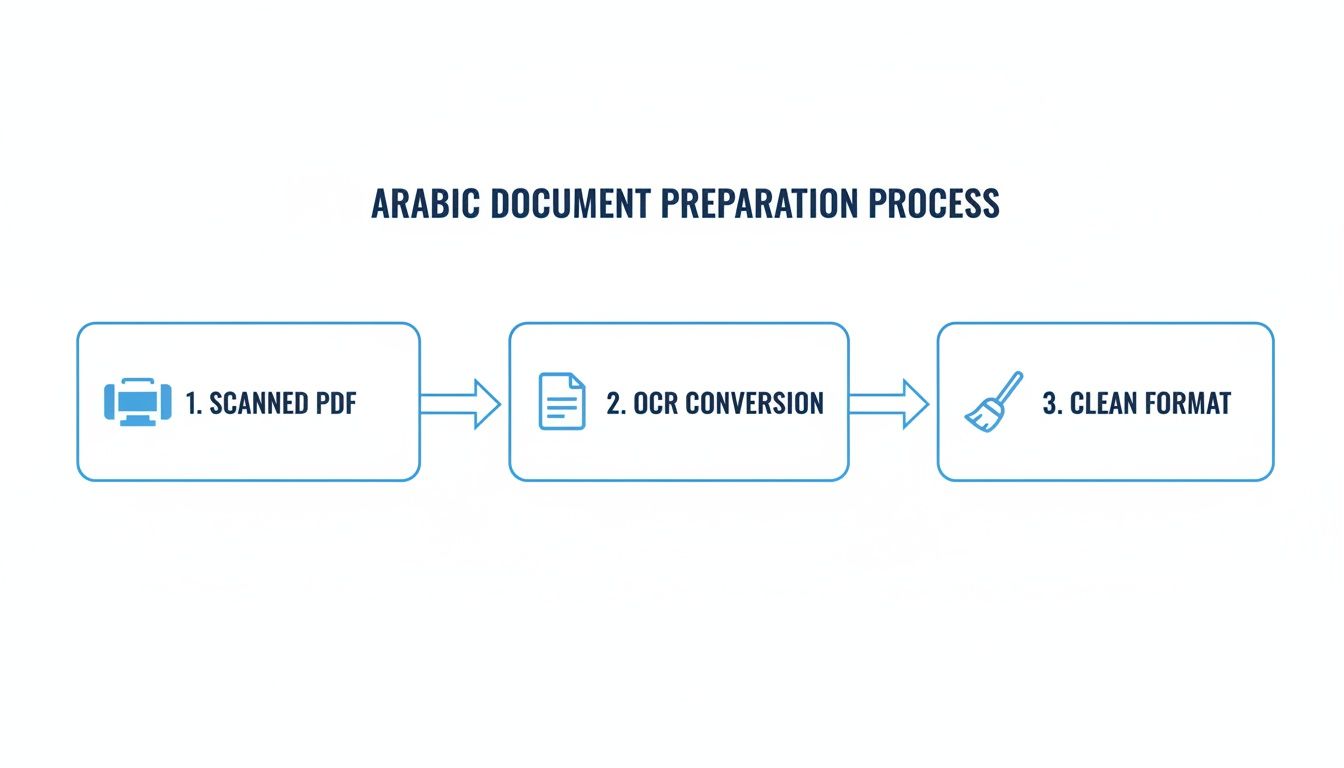
As you can see, a successful AI translation really starts before you even hit "upload." That OCR conversion and format cleanup aren't just suggestions; they're essential first steps.
The Critical Role of Human Post-Editing
Even with the best AI in the world, the work isn't done when the machine finishes. The final—and I'd argue most important—part of the process is the quality check, which absolutely requires a human eye. A machine can't fully grasp every subtle nuance of an author's voice or the deep cultural context embedded in the language. Post-editing is where you take the AI's solid draft and polish it into something truly ready for publication.
The demand for high-quality Arabic document translation to English is booming, and for good reason. Arabic is consistently one of the highest-paying languages for translators, which speaks to its significance in a global market that hit $62.6 billion back in 2021. At the same time, the machine translation industry is on track to reach $4 billion by 2030. This growth is exactly what fuels tools like BookTranslator.ai, allowing them to offer sophisticated features like smart formatting. You can read more about these translation industry trends to see how the market is evolving.
A great AI translation gets you a 95% perfect draft in a matter of minutes. A great human review is what closes that last 5% gap, turning a good translation into one that feels authentic, accurate, and completely natural to an English reader.
A Practical Approach to Proofreading
Your quality assurance process doesn't need to be overwhelming. The goal here is to refine and verify, not to start over from scratch.
Here are a few things I always focus on during my own reviews:
- Sense-Check for Context: Read through key sections and ask yourself, "Does this actually make sense in English?" AI can sometimes pick a word that's technically correct but completely misses the intended meaning. For instance, it might use a formal term in a casual conversation, making the dialogue feel stilted and unnatural.
- Listen for the Author's Voice: Does the translation sound like the original? If the Arabic text was sharp and witty, the English version shouldn't read like a dry academic paper. Tweak the phrasing until it captures the original's personality.
- Confirm Key Terminology: This is non-negotiable for technical, legal, or academic work. Go through and verify that all specialized terms are translated correctly and, just as importantly, consistently. If you're dealing with a lot of jargon, it's worth creating a simple glossary to keep everything straight.
This final human touch is what elevates a raw translation into a genuinely effective piece of communication.
Handling Specialized Content: Legal, Technical, and Literary
Translating a dense legal contract from Arabic is a world away from translating a work of fiction. The nuances are completely different, and your entire approach to an Arabic document translation to English has to change based on what you're working with. Getting this right from the start is often what separates a successful project from a costly mistake.
For anything legal or technical, precision is the only thing that matters. One wrong word in a legal agreement, a medical report, or an engineering manual can lead to serious financial or even safety consequences. There’s simply no room for error.
It's telling that skilled Arabic translators command some of the highest rates in the world, right up there with German and Mandarin. This isn't just about language proficiency; it's about deep, specialized expertise where a mistake isn't just an option—it's a liability.
For Legal and Technical Precision
When you're dealing with legal or highly technical material, using AI for the first pass is a smart move. It can power through the bulk of the text, giving you a solid, consistent draft to work with. But that’s where the AI's job ends.
A final, meticulous review by a human expert is absolutely essential. And I don't just mean a translator—I mean a lawyer, an engineer, or a doctor who is also fluent in both languages. Their role is to ensure the translation isn't just grammatically correct, but that it's functionally accurate within its specific professional context. For a deeper dive, you can learn more about translating technical documents and see why this hybrid model works so well.
For Capturing Literary Artistry
Literary translation, on the other hand, is all about art. The goal isn't just about transferring meaning; it's about preserving the author's voice, the unique tone, the cultural subtext, and all the creative flourishes. This is where more sophisticated AI, like the kind that powers BookTranslator.ai, really shines.
These models have been trained on massive literary collections, so they can do more than just swap words. They understand narrative flow, stylistic choices, and creative language. They can capture the rhythm of dialogue in a way that your standard translation app just can't touch.
The English-to-Arabic language pair is actually the 9th most translated globally, making up 2.64% of all translation work. This just goes to show how vital it is for connecting cultures through books, media, and art.
Ultimately, whether your document is destined for a courtroom, a factory floor, or a bookshelf, your strategy has to match the content. That’s the secret to producing a final translation that truly hits the mark.
Common Questions About Arabic Document Translation
If you're getting ready to translate a document from Arabic to English, you probably have a few questions. It’s completely normal. From wondering about the cost and how long it’ll take, to dealing with the finer points of the language, getting good answers upfront makes the whole process smoother.
Let’s walk through some of the most common things people ask.
How Much Is This Going to Cost?
This is usually the first question on everyone's mind, and the answer really depends on the path you take: human or machine.
If you go with a professional human translator, you can expect to pay around $0.12 per word for standard documents. For official paperwork that needs to be certified for bodies like USCIS, the pricing structure often changes. You’re more likely to see a per-page rate, typically around $39.00 per page (for up to 250 words).
On the other hand, AI-powered services have completely changed the pricing game. A tool like BookTranslator.ai can translate an entire e-book for just a few dollars. This makes it an incredibly practical choice for authors, researchers, or anyone with a large volume of text and a close eye on the budget.
What’s a Realistic Turnaround Time?
Time is almost always a factor. Just like with cost, the answer hinges on whether a human or an AI is doing the work.
A human translator can only move so fast, and good work takes concentration. A short document, maybe 1-3 pages, will likely take a couple of business days. Got something longer, like a 20-page report? You could easily be looking at a week or more.
AI translation operates on a totally different clock. A platform built for handling large files can process an entire novel in a matter of minutes. For anyone on a tight deadline, that kind of speed is a massive advantage.
A quick tip from experience: When working with a human translator, always confirm the final delivery date. Their timeline usually doesn't include weekends or holidays, and asking for a rush job will almost certainly cost you extra.
Remember, the initial translation is just step one. You still need to budget time for a final quality check and any necessary edits—and that’s true no matter which method you choose.
What About Dialects and Transliteration?
This is where things can get a bit tricky. Arabic isn't a single, uniform language; it's a collection of regional dialects. For most books, business documents, and professional writing, Modern Standard Arabic (MSA) is the go-to. But if your content is aimed at a specific audience in, say, Egypt or the Gulf, using the right local dialect can make all the difference in how your message is received.
You'll also hear the term "transliteration" thrown around. It’s crucial to know how it differs from translation.
- Translation focuses on meaning. The Arabic word "سلام" translates into the English word "peace."
- Transliteration focuses on sound. It converts the Arabic characters into the Latin alphabet so a non-speaker can pronounce them. The same word, "سلام," transliterates as "salaam."
Transliteration is handy for names and places, but it's not a replacement for a proper translation of your document's content.
Do I Really Need a Certified Translation?
Whether you need a "certified translation" comes down to one simple question: Who are you giving this document to?
If it's for an official government body like United States Citizenship and Immigration Services (USCIS), then yes, you almost certainly need one. This applies to things like birth certificates, academic transcripts, or marriage licenses. A certified translation comes with a signed statement from the translator vouching for its accuracy and completeness.
For most other purposes—like internal business documents, website content, or just a book you want to read—a standard, high-quality translation is all you need. The key is to always check the requirements of the institution you're submitting to. It can save you a world of headaches later.
Ready to get your e-book translated with impressive speed and accuracy? With BookTranslator.ai, you can translate entire EPUB files from Arabic to English in minutes, all while keeping your original formatting intact. It's a professional-grade solution at a fraction of the traditional cost. Start your translation today at https://booktranslator.ai.