
A Cacique (or Cacica for a female leader) is a title that comes straight from the Taíno language of the Caribbean. The original word, kasikɛ, was what the Taíno people called their tribal chiefs long before Columbus arrived in the Bahamas, the Greater Antilles, and the northern Lesser Antilles.
When the Spanish began colonizing the Americas, they took this local term and started applying it broadly. It became their go-to word for the leaders of just about any indigenous group they encountered across the Western Hemisphere.
In their own communities, Caciques were the center of power. They weren't just political leaders; they organized the village's resources, acted as its main spokesperson, and represented their people to outsiders. Think of them as the mayor, diplomat, and general all rolled into one. When Columbus first explored the islands, he had to get a Cacique's permission to move through their lands.
During times of war, the Cacique was expected to be a lead warrior, guiding their people in conflict.
The relationship between a Cacique and their people was built on mutual trust. In exchange for loyalty, the community expected their leader to provide protection and ensure their well-being. While a Cacique wasn't obligated to feed and provide for everyone, their reputation often depended on it. This was especially true in warfare—Taino warriors followed their leader into battle expecting to get a share of any spoils, with the Cacique always receiving the largest portion.
Early Spanish accounts suggest that Caciques practiced polygyny, though this might have been a misunderstanding of the Taino's matrilineal inheritance system, which was unfamiliar to the Europeans. The Spanish also reported that women could hold the title of Cacique, a fact that has been debated but seems to be supported by the way Taino society was structured.
Power wasn't always passed from father to son. The role of Cacique could be inherited through the mother's line. For example, if a Cacique died without a son, the title could go to his sister's son. One account even notes, "if a cacique died without sons, the title passed to his sister if she had children." A woman who inherited the role of Cacica was treated with the same respect and held the same authority as any male chief.
What Are Document Translation Apps?
So, what exactly is a document translation app? Think of it as a specialized tool that takes a full document—like a PDF, a Word file, or even an entire eBook in EPUB format—and translates all the text inside from one language to another.
Unlike simple text translators where you copy and paste snippets of text, these apps are built to handle the entire file. They're designed to understand not just the words, but also the structure and layout of your document.
How Does This Actually Work?
At its core, the process is pretty straightforward, but the technology behind it is incredibly complex. When you upload a document, the app gets to work by first pulling out all the text. It then sends this text, piece by piece, to a powerful AI translation engine.
This engine, often based on sophisticated neural networks, analyzes the source text and generates a translation in your chosen target language. The final, and arguably most crucial, step is reassembling the document. The app carefully puts the newly translated text back into the original layout, trying its best to preserve all the formatting—from headings and paragraphs to images and tables.
Here’s a quick visual of that workflow:
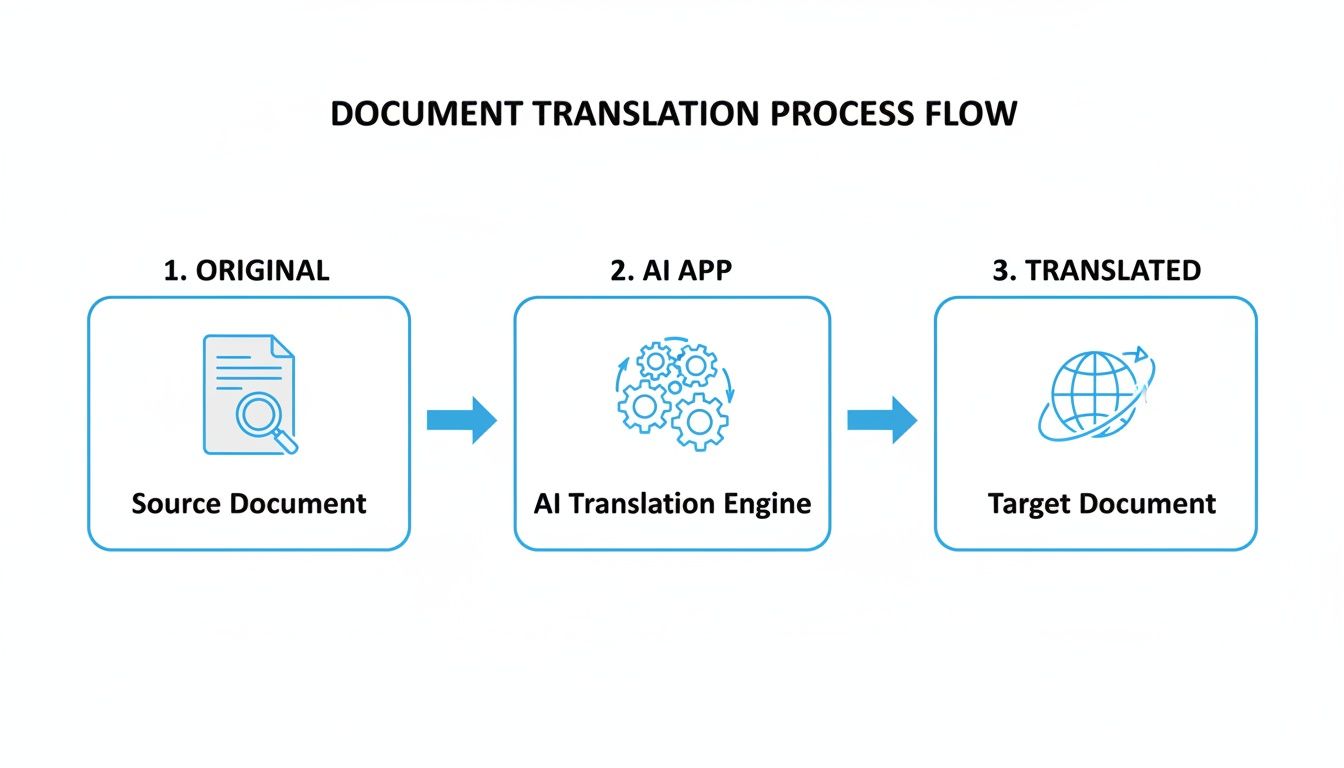
This whole process can take anywhere from a few seconds for a simple one-page document to several minutes for a dense, 300-page book.
Key Features to Look For
Not all document translators are created equal. When you're trying to find the right tool for the job, especially for important or complex documents, there are a few key things you absolutely need to check.
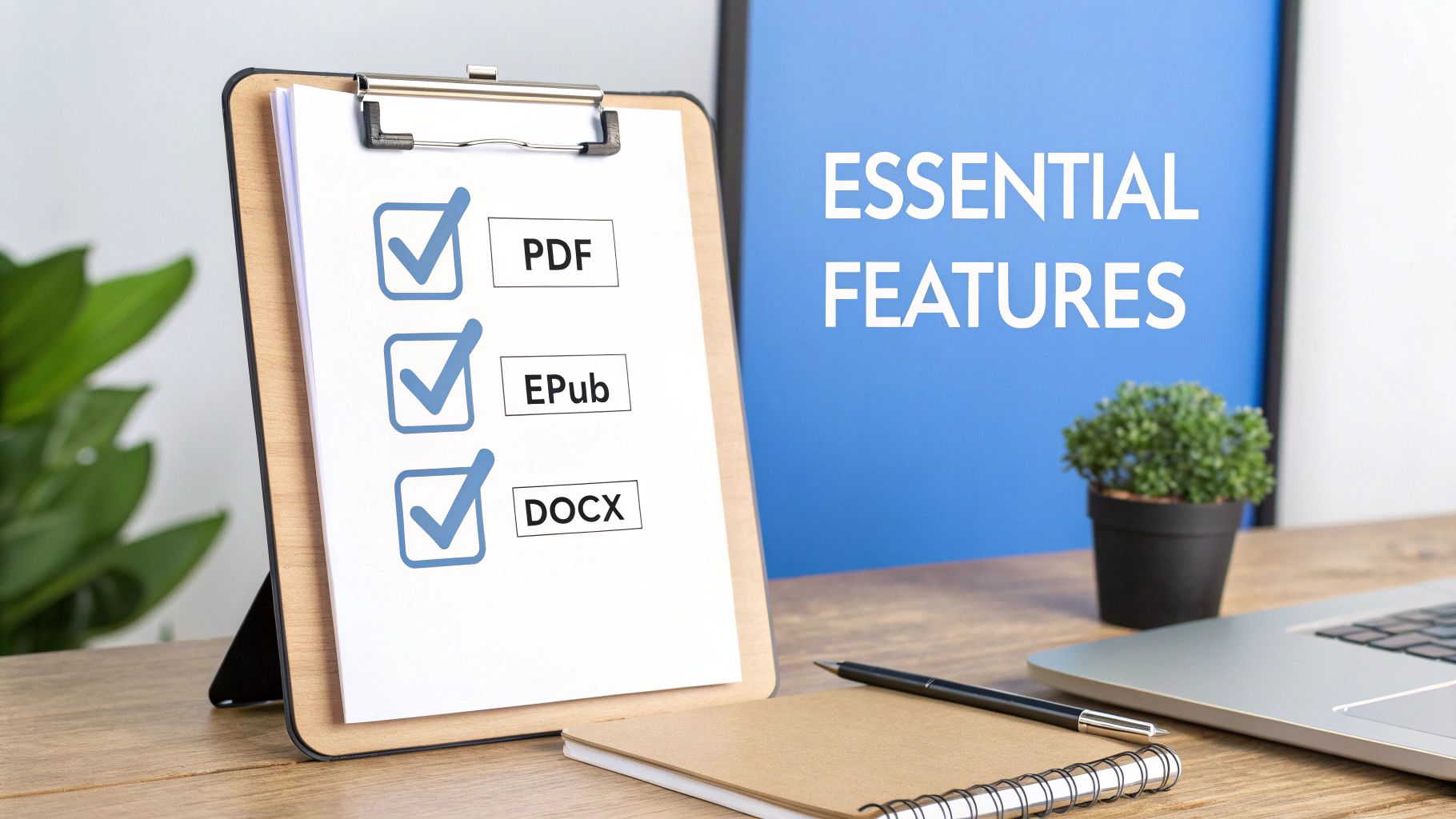
1. Supported File Types What kinds of files can you actually upload? Most tools handle the basics like DOCX and PDF, but support can vary wildly. If you work with different formats, look for an app that can also manage PPTX (PowerPoint), XLSX (Excel), or even more specialized formats like EPUB for eBooks or SRT for video subtitles. Some advanced AI PDF reader tools offer translation as a core feature, which is perfect if you mainly work with PDFs.
2. Formatting Preservation This is a huge one. A perfect translation is useless if the final document is a jumbled mess. A good app will keep your original formatting intact—things like:
- Bold and italic text
- Headings and subheadings
- Paragraph breaks and line spacing
- Images and their captions
- Lists and tables
The ability to preserve the look and feel of the original file is often what separates a decent tool from a great one.
3. Translation Accuracy Accuracy is the name of the game. Modern AI translation has gotten incredibly good, often producing text that feels natural and context-aware. However, quality can still differ between engines (like those from Google, DeepL, or Microsoft) and across different language pairs. Always look for a tool that uses a top-tier translation engine known for high-quality output.
4. Number of Supported Languages Does the app cover the languages you need? While most support major global languages like English, Spanish, French, and Chinese, you might need something more specific. Some platforms offer translation for over 100 languages, giving you the flexibility to reach a truly global audience.
5. Pricing and Plans How you pay can make a big difference. Many apps use a subscription model, offering different tiers based on how many pages or words you can translate per month. Others might use a pay-as-you-go system with credits. Be sure to find a pricing structure that matches your expected usage so you're not overpaying for features you don't need.
6. Security and Privacy When you're uploading a document, you're handing over your data. It's critical to understand how the service handles it. Look for a clear privacy policy that explains whether your documents are stored, for how long, and if they're used for training the AI models. For sensitive or confidential material, you'll want a provider that guarantees your data is deleted immediately after the translation is complete.
6 Essential Features Every Great Translation App Needs
When you start looking for a tool to translate your documents, the options can be overwhelming. Plenty of apps promise the world, but from my experience, only a handful deliver on what truly matters. The difference between a clunky text converter and a professional-grade translation app comes down to a few critical features.
Getting these right means your translated document isn't just a jumble of foreign words, but a faithful, readable, and professional recreation of your original work.
1. Robust File Format Support
First things first: can the app even open your file? A great application won’t box you into simple .txt files. It needs to handle the real-world formats you actually use, especially for long and complex documents like books or official reports.
Look for tools that can confidently manage:
- EPUB: The gold standard for ebooks. A good app has to understand its structure to keep chapter breaks, tables of contents, and embedded images intact.
- PDF: Notoriously tricky to work with, but absolutely essential for business reports, scanned contracts, and academic papers.
- DOCX & DOC: The bread and butter of the professional world. Solid support here is a must-have.
2. Meticulous Formatting Preservation
This is the big one, and where many apps fall flat. What good is a translation if it completely destroys your document’s layout? All your careful formatting—bold text, italics, headings, blockquotes, and paragraph breaks—can vanish in an instant.
The goal isn't just to translate words; it's to replicate the original reading experience. A powerful app understands that formatting is part of the content’s meaning and intent.
The best tools don't just paste text back in; they intelligently reconstruct the document after translation. Chapter titles stay as titles, bullet points remain lists, and that crucial italicized phrase isn't lost. For an author or publisher, this is non-negotiable. It's one of those core principles that make a good app popular—it just works the way you expect it to.
3. High-Quality, Context-Aware AI
The engine under the hood is what drives everything. The quality of the Neural Machine Translation (NMT) model is what determines whether your output sounds fluent and natural or stiff and robotic. Top-tier apps often give you a choice between different AI models.
For instance, you might use a standard model for a quick internal memo, but a "Pro" model for a novel that requires a deep understanding of nuance, tone, and context. The sophistication of the AI also affects how quickly the job gets done, a topic we dive into deeper in our guide on how AI speeds up translation timelines.
4. Broad Language Support
This might seem obvious, but it's important to check the specifics. Does the app support the languages you need? Go beyond the common European languages and see if it handles a wide range, including those with different character sets and grammatical structures.
An app with 100+ languages gives you the flexibility to reach global audiences without having to hunt for a new tool for every region.
5. Clear and Fair Pricing
Nobody likes confusing subscription tiers or hidden fees. Avoid services that lock you into expensive monthly plans just to translate a single document.
A transparent, pay-per-use model is often the most honest and cost-effective approach. With a tool like BookTranslator.ai, you only pay for the words you actually translate. This makes it affordable for a one-off project but scalable for frequent users.
6. Ironclad Data Security and Privacy
Your documents contain your hard work, proprietary information, and creative ideas. The last thing you want is for that data to be stored indefinitely or used to train an AI model without your permission.
A trustworthy service will have a crystal-clear privacy policy that guarantees your files are deleted after translation and your data remains your own. Always check the privacy policy before uploading anything sensitive.
To help you prioritize, here's a quick breakdown of what features are truly essential versus those that are simply nice to have.
Essential Features of a Modern Document Translation App
| Feature | Why It's Essential | Ideal for |
|---|---|---|
| Formatting Preservation | Maintains the original layout, saving hours of manual rework. | Authors, publishers, legal professionals, and business users. |
| High-Accuracy AI | Ensures the translation is fluent, context-aware, and professional. | Anyone publishing or sharing the final document. |
| Broad File Support | Lets you work with the files you already have (EPUB, PDF, DOCX). | All users, especially those with diverse document types. |
| Data Privacy | Protects your intellectual property and sensitive information. | Everyone. This is non-negotiable. |
| Multiple Language Options | Allows you to reach different global markets with a single tool. | Businesses, authors, and international organizations. |
| Glossary/Terminology Control | (Nice-to-have) Guarantees consistency for brand names or technical terms. | Technical writers, legal teams, and branded content creators. |
| Team Collaboration | (Nice-to-have) Allows multiple users to work on and review translation projects. | Translation agencies and large corporate teams. |
Ultimately, choosing the right app comes down to matching its capabilities with your specific needs. By focusing on these core features, you can be confident you're selecting a powerful tool that respects your work and delivers professional results.
4. Who Is Using Document Translation Apps and Why?
The idea of a "document translator" can feel a bit abstract until you see who's actually using these tools and what they're accomplishing. This isn't just niche tech for big corporations. A solid app that translates documents has become a secret weapon for a surprisingly wide range of people, from creatives to academics.
Let's dive into a few real-world examples to see how this technology is making a tangible difference.
Independent Authors and Publishers
Picture an indie author who has poured their heart into a new sci-fi novel. It's doing well in English, but they dream of reaching readers in Germany or Brazil. The cost of hiring a professional translator for each language is just too steep for their budget.
This is where a tool like BookTranslator.ai changes the game. They can take their English EPUB file, translate it into Spanish, German, and French, and have new versions ready for different markets in a matter of minutes. It's a low-risk way to test the waters globally and build an international following. For small publishers, this means they can finally translate their back-catalog without breaking the bank.
Academic Researchers and Students
Now, think about a history grad student researching 19th-century French philosophy. The most important primary sources are, naturally, in French. Trying to translate dense, academic texts on your own is a slow, painstaking process that can stall research for weeks.
An app that translates documents lets that student convert PDFs of scholarly articles or digitized books almost instantly. This completely transforms their workflow, allowing them to get through source material ten times faster.
This technology empowers researchers to access a worldwide library of knowledge without language barriers, fostering greater cross-cultural academic collaboration and discovery.
It's the same for students everywhere. A literature major can analyze a Russian classic in its original context, or an engineering student can finally make sense of a technical manual that was only published in German. The focus shifts from wrestling with the language to actually learning the material.
Enthusiastic Readers and Hobbyists
The benefits aren't just for professional or academic work. Consider a huge fan of a niche manga or light novel series from Japan. The official English translation is always months, if not years, behind the original release. The online fan community is buzzing with spoilers, and they're stuck waiting.
Using a specialized EPUB translator, that fan can read a new volume the day it comes out in Japan. For them, an app that translates documents is a key to a world of entertainment that used to be locked away. It’s about being part of a global conversation and enjoying the stories you love without the frustrating delays.
Your Step-by-Step Guide to Translating an EPUB
Getting your book translated might sound like a huge technical challenge, but with the right app that translates documents, it’s surprisingly straightforward. Let's walk through the exact process using BookTranslator.ai as our example, so you can see how to get a translated EPUB without losing your mind over formatting glitches.
I'll show you every click and setting, so your layout stays just the way you want it. For a deeper dive, check out our full guide on how to translate EPUB books.
Step 1: Prepare Your EPUB File
Before you even think about uploading, a little prep work goes a long way. Make sure your EPUB file is clean and ready for the machine. A few minutes here can save you from a lot of frustration later.
First, check that your file is under the 50MB limit. It also needs to be DRM-free—that’s the copy protection that can block translation tools from accessing the text. Finally, make sure the text inside is selectable, not just a bunch of images.
- Check the file: Confirm it has the
.epubextension and isn't corrupted. - Remove DRM: Use a tool like Calibre to remove any digital rights management restrictions.
- Clean up headings: Make sure your chapters are clearly marked for the best results.
Step 2: Upload Your Book
Now for the easy part. Head over to BookTranslator.ai and you’ll see a big drag-and-drop box. Just drop your prepared EPUB file right onto it.
You can also click the box to open your file browser and find the book on your computer. You'll see a progress bar fill up as the file uploads. If you run into any trouble, a quick browser cache clear usually does the trick.
Step 3: Select Your Language and Plan
With your book uploaded, it's time to tell the AI what you need. First, choose the language you want to translate your book into.
Next, you'll pick a translation plan. BookTranslator.ai has two main options: Basic and Pro. Think of Basic as a fast, functional draft—great for getting the gist of a text or for a first pass. The Pro option, on the other hand, is where the magic happens. It delivers a much more nuanced, near-human level of fluency that’s ready for readers.
"Basic is perfect for quick drafts, while Pro shines with nuanced, near-human fluency."
Choosing the right model is all about balancing your need for speed against your desire for quality.
Step 4: Start the Translation
Ready? Just hit the Start Translation button. That single click kicks the whole process into gear.
The AI gets to work, carefully parsing your EPUB’s structure, translating the text line by line, and then meticulously rebuilding the file with the new language while keeping your original formatting. Even for a full-length novel, this usually only takes a few minutes. You can watch its progress in real-time.
Step 5: Download Your Translated EPUB
Once the process is complete, you'll get a notification. Simply click the download button, and your newly translated EPUB is ready to go.
Open it in any e-reader, and you should see all your chapter breaks, images, and paragraph styles perfectly preserved. It’s now ready to be shared with your new global audience.
The demand for this kind of technology is exploding. The global market for document translation was valued at $34,496.3 million in 2021 and is on track to hit $44,562 million by 2025. That growth is a clear signal that readers and authors everywhere are embracing tools that break down language barriers.
If you've spent any time around Natural Language Processing (NLP), you've probably heard the term word embeddings. They've become a foundational tool in the field over the last several years, and for good reason. At their core, they are simply a way to represent words as numbers—but in a very clever way that captures their meaning and relationships to other words.
This is a big leap from older methods. Think about traditional approaches like one-hot encoding, where each word is just a long list of zeros with a single '1' to mark its spot in a vocabulary. That tells you what the word is, but nothing about what it means.
Word embeddings, on the other hand, manage to grasp the semantic and syntactic nuances between words. This means that words with similar meanings, like "king" and "queen," will have numerical representations (or vectors) that are close together. Conversely, words with very different meanings, like "king" and "bicycle," will have vectors that are far apart.
One of the most well-known techniques for creating these embeddings is an algorithm called Word2Vec. It works by training a neural network on a massive amount of text. The network learns a word's meaning by looking at the company it keeps—the words that frequently appear around it.
The final output is a set of high-dimensional vectors, one for each word. These aren't just abstract numbers; they're the raw material for a huge range of NLP tasks, from text classification and machine translation to sophisticated question-answering systems.
6 Essential Features Every Great Translation App Needs
When you start looking for a tool to translate your documents, the options can feel overwhelming. Plenty of apps promise the world, but from my experience, only a handful deliver on what truly matters. The difference between a clunky text converter and a professional-grade translation app comes down to a few critical features.
Getting these right means your translated document isn't just a jumble of foreign words, but a faithful, readable, and professional recreation of your original work.
1. Robust File Format Support
First things first: can the app even open your file? A great application won’t box you into simple .txt files. It needs to handle the real-world formats you actually use, especially for long and complex documents like books or official reports.
Look for tools that can confidently manage:
- EPUB: The gold standard for ebooks. A good app has to understand its structure to keep chapter breaks, tables of contents, and embedded images intact.
- PDF: Notoriously tricky to work with, but absolutely essential for business reports, scanned contracts, and academic papers.
- DOCX & DOC: The bread and butter of the professional world. Solid support here is a must-have.
2. Meticulous Formatting Preservation
This is the big one, and where many apps fall flat. What good is a translation if it completely destroys your document’s layout? All your careful formatting—bold text, italics, headings, blockquotes, and paragraph breaks—can vanish in an instant.
The goal isn't just to translate words; it's to replicate the original reading experience. A powerful app understands that formatting is part of the content’s meaning and intent.
The best tools don't just paste text back in; they intelligently reconstruct the document after translation. Chapter titles stay as titles, bullet points remain lists, and that crucial italicized phrase isn't lost. For an author or publisher, this is non-negotiable. It's one of those core principles that make a good app popular—it just works the way you expect it to.
3. High-Quality, Context-Aware AI
The engine under the hood is what drives everything. The quality of the Neural Machine Translation (NMT) model is what determines whether your output sounds fluent and natural or stiff and robotic. Top-tier apps often give you a choice between different AI models.
For instance, you might use a standard model for a quick internal memo, but a "Pro" model for a novel that requires a deep understanding of nuance, tone, and context. The sophistication of the AI also affects how quickly the job gets done, a topic we dive into deeper in our guide on how AI speeds up translation timelines.
4. Broad Language Support
This might seem obvious, but it's important to check the specifics. Does the app support the languages you need? Go beyond the common European languages and see if it handles a wide range, including those with different character sets and grammatical structures.
An app with 100+ languages gives you the flexibility to reach global audiences without having to hunt for a new tool for every region.
5. Clear and Fair Pricing
Nobody likes confusing subscription tiers or hidden fees. Avoid services that lock you into expensive monthly plans just to translate a single document.
A transparent, pay-per-use model is often the most honest and cost-effective approach. With a tool like BookTranslator.ai, you only pay for the words you actually translate. This makes it affordable for a one-off project but scalable for frequent users.
6. Ironclad Data Security and Privacy
Your documents contain your hard work, proprietary information, and creative ideas. The last thing you want is for that data to be stored indefinitely or used to train an AI model without your permission.
A trustworthy service will have a crystal-clear privacy policy that guarantees your files are deleted after translation and your data remains your own. Always check the privacy policy before uploading anything sensitive.
To help you prioritize, here's a quick breakdown of what features are truly essential versus those that are simply nice to have.
Essential Features of a Modern Document Translation App
| Feature | Why It's Essential | Ideal for |
|---|---|---|
| Formatting Preservation | Maintains the original layout, saving hours of manual rework. | Authors, publishers, legal professionals, and business users. |
| High-Accuracy AI | Ensures the translation is fluent, context-aware, and professional. | Anyone publishing or sharing the final document. |
| Broad File Support | Lets you work with the files you already have (EPUB, PDF, DOCX). | All users, especially those with diverse document types. |
| Data Privacy | Protects your intellectual property and sensitive information. | Everyone. This is non-negotiable. |
| Multiple Language Options | Allows you to reach different global markets with a single tool. | Businesses, authors, and international organizations. |
| Glossary/Terminology Control | (Nice-to-have) Guarantees consistency for brand names or technical terms. | Technical writers, legal teams, and branded content creators. |
| Team Collaboration | (Nice-to-have) Allows multiple users to work on and review translation projects. | Translation agencies and large corporate teams. |
Ultimately, choosing the right app comes down to matching its capabilities with your specific needs. By focusing on these core features, you can be confident you're selecting a powerful tool that respects your work and delivers professional results.