
Choosing the right program to translate a document can mean the difference between a clear, professional result and a jumbled, inaccurate mess. The options out there are vast, running the gamut from instant AI engines like Google Translate to highly specialized platforms like BookTranslator.ai, which are built to handle complex formats.
So, how do you choose? It really boils down to what you're trying to accomplish. A student translating a research paper has very different needs than an author preparing a novel for a global launch.
Why Finding the Right Translation Program Matters
If you've ever used an old translation tool, you probably remember the clunky, word-for-word output that made no sense. Thankfully, those days are mostly behind us. Modern tools, powered by sophisticated artificial intelligence, can grasp nuance, maintain the original tone, and even preserve tricky formatting with impressive skill. This leap forward has opened up a world of possibilities for businesses, writers, and academics to communicate across linguistic divides.
The demand for this technology is exploding. The global market for language translation software is expected to skyrocket from USD 68.04 billion in 2025 to a staggering USD 116.55 billion by 2035. This boom isn't just about translating websites; it's driven by a critical need for seamless document handling—everything from legal contracts and user manuals to marketing brochures and entire books. You can dig into the numbers and see what's driving this growth on Precedence Research.
Understanding the Translation Tool Landscape
To find your way, you first need a map of the territory. The programs available today generally fall into a few key categories, and each one is designed for a specific job. Think of it like choosing a vehicle: you wouldn't take a sports car on a rugged mountain trail. Similarly, you wouldn't use a basic text translator for a professionally formatted e-book.
This guide is here to help you make sense of it all. We'll look at everything from quick-and-dirty machine translation engines to dedicated services built for unique formats like EPUB files. Checking out curated lists of the best translation programs can also give you a good overview of what's currently leading the pack.
Here's a simple way to think about it:
- Quick, informal needs? An instant machine translator will probably do the trick.
- Professional publications? You'll want a specialized service that keeps your formatting intact.
- Technical documents? Look for tools that let you manage specific terminology for precision.
Getting these distinctions right from the start helps you sidestep common frustrations like mangled layouts or translations that completely miss the mark. If you want to go a bit deeper, we have a whole article breaking down the different kinds of software for translating documents. Having this foundation will make it much easier to evaluate the specific features we'll cover next.
Comparing the Three Core Types of Translation Software
When you start looking for a program to translate a document, you'll quickly realize it's a crowded space. The options can seem overwhelming, but they generally fall into three main categories. Getting a handle on these three types is the key to picking the right tool and avoiding a lot of headaches down the road.
Think of it like choosing a vehicle. You wouldn't take a sports car off-roading, and you wouldn't use a bulldozer for a quick trip to the store. Each translation tool is built for a specific job, and matching the tool to the task is what matters most.
This mind map breaks down the three main paths you can take, showing how they differ and who they're for.
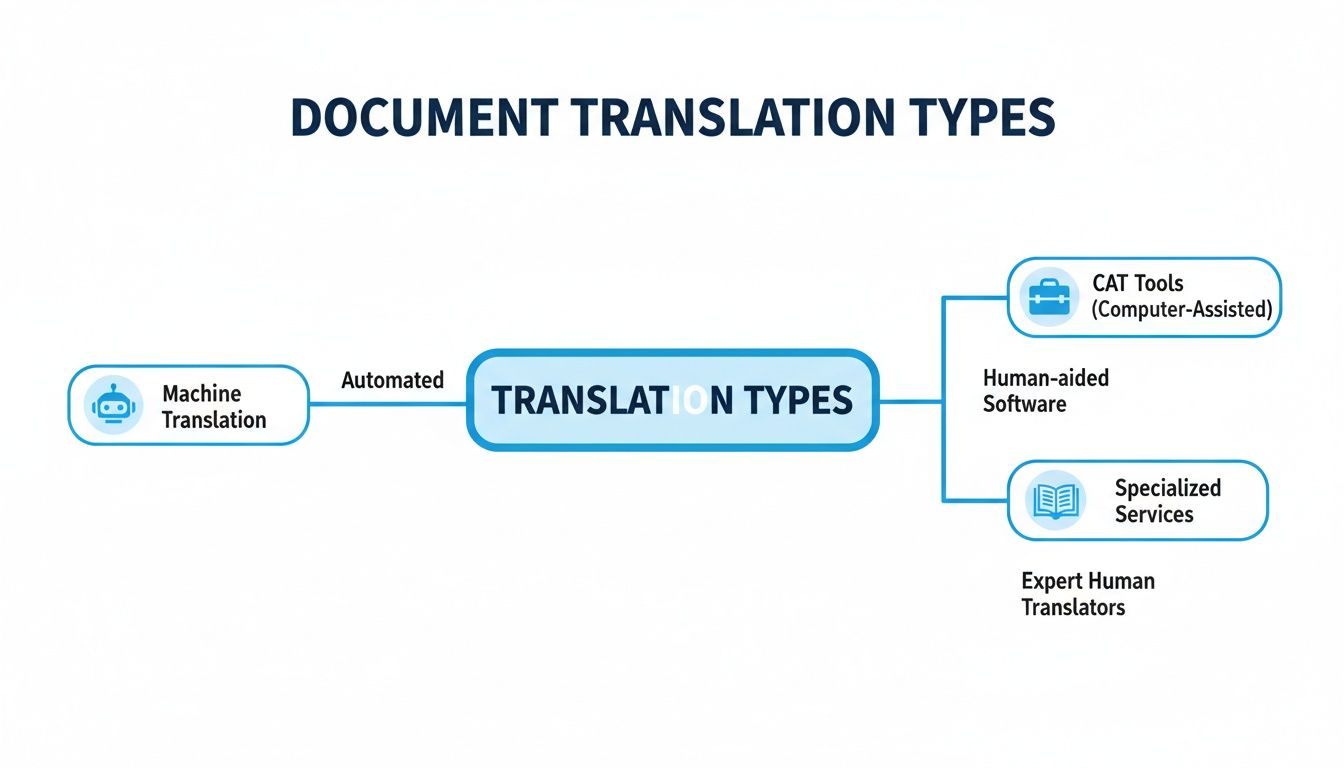
As you can see, the options range from raw, automated power to specialized, human-assisted platforms. Let's dig into what each one actually does.
Machine Translation Engines
First, we have Machine Translation (MT) Engines. These are the household names everyone knows, like Google Translate or DeepL. Think of them as super-fast, multilingual dictionaries that can process entire paragraphs at once. They're fantastic for getting the basic meaning of a block of text, figuring out a menu in another language, or translating a quick email.
Their biggest selling point is sheer speed. MT engines can tear through millions of words in the blink of an eye. The trade-off? They often miss the mark on cultural nuance, idiomatic expressions, and complex sentence structures. They're also notorious for messing up the formatting in polished documents. They are the quick-and-dirty solution—great for informal tasks but not built for projects where quality and presentation are critical.
Computer-Assisted Translation Tools
Next up are Computer-Assisted Translation (CAT) Tools, and this is where a lot of confusion comes in. Don't let the name fool you; these tools don't do the translating themselves. Instead, they are powerful, sophisticated workbenches designed for professional human translators. A CAT tool is to a translator what a professional editing suite is to a filmmaker.
These platforms are all about helping a human expert work more efficiently and consistently. They're packed with features that make a professional's life easier:
- Translation Memory (TM): This is a database that saves every sentence a translator has ever approved. If the same or a similar sentence pops up again, the tool automatically suggests the previous translation, saving tons of time.
- Terminology Databases: These are basically project-specific glossaries. They ensure that key terms—like a product name or a piece of technical jargon—are translated the exact same way every single time they appear.
- Quality Assurance Checks: Built-in checkers automatically scan for common errors like inconsistent translations, number mismatches, or formatting mistakes.
A CAT tool doesn't replace the human translator; it supercharges them. It's all about combining human expertise with smart software to achieve precision and consistency, especially on large, professional projects.
End-to-End Specialized Services
Finally, we have End-to-End Specialized Services. These aren't just tools; they're complete solutions built to solve one specific, often complex, problem from start to finish. Instead of being a jack-of-all-trades, they are masters of one.
A perfect example is a platform like BookTranslator.ai, which is designed for one job and one job only: translating books. It bundles powerful AI translation with features tailor-made for authors and publishers. For instance, it knows how to handle the complex structure of an EPUB file, preserving everything from chapter breaks and headings to italicized text and paragraph spacing.
This kind of specialization means the final product isn't just a wall of translated text. It's a properly formatted, ready-to-publish book that looks just as good as the original.
Essential Features of Top Document Translation Programs
Picking the right program to translate your documents goes way beyond just checking which languages it supports. The best tools are a complete package, offering features that work in concert to give you a result that's not just accurate, but professional and polished. Getting this wrong can lead to some classic translation headaches, like scrambled layouts and translations that just don't make sense.
Think of it like buying a car. The engine—the translation AI—is obviously the heart of it all. But you also need good brakes, a solid frame, and a comfortable ride to actually get where you're going. A great translation program is the same; it balances raw translation power with features that make it usable, reliable, and professional.

Accuracy and Contextual Nuance
Let's start with the absolute deal-breaker: translation accuracy. Modern neural machine translation (NMT) has made incredible leaps, moving far beyond the clunky, word-for-word translations of the past. Today's top-tier programs are masters of context. They can pick up on idioms, match the author's tone, and deliver a translation that feels natural.
This is especially critical for long-form content like books or in-depth reports. One poorly translated phrase can throw off the meaning of an entire chapter. The AI needs to understand the story, not just the sentences.
Robust File Format Support
Your documents aren't always simple text files, are they? A program's ability to handle different file formats without breaking a sweat is what separates the good from the great. Sure, most tools can manage a basic DOCX file, but the real test comes with more specialized formats.
You'll want a tool that can confidently handle:
- PDFs: These are notoriously tricky, especially when filled with complex layouts, images, and text that you can't easily select.
- EPUBs: This is the gold standard for e-books. EPUBs have a specific internal structure—chapters, headings, metadata—that generic tools often corrupt.
- DOCX, PPTX, XLSX: Translating Office documents means getting the text right inside tables, charts, and slides while keeping the original structure intact.
The ability to seamlessly process a complex file like an EPUB is a hallmark of a specialized, high-quality translation service. It shows the program was designed not just to translate words, but to handle the entire document as a cohesive whole.
Layout and Formatting Preservation
What's the point of a perfect translation if the document is a visual mess? Layout preservation is the magic that ensures your translated document looks exactly like the original. All your headings, paragraphs, bullet points, tables, and even font styles like italics and bolding should stay right where they belong.
For an author translating an e-book or a business localizing a marketing brochure, this is a non-negotiable feature. No one wants to spend hours rebuilding a document's formatting from scratch. The best programs to translate documents make this problem disappear.
Security and Pricing Transparency
Finally, let's talk about the practical stuff. If your documents contain sensitive or confidential information, you need a program with a rock-solid security policy. Be wary of free, browser-based tools that might store your data and create a risk. Look for services that offer data encryption and are upfront about how they handle your files.
Pricing should be just as clear. Steer clear of services with confusing subscription models or hidden costs. A straightforward, pay-per-use model, often based on a word or character count, lets you know exactly what you'll spend. This is crucial for budgeting, especially on larger projects.
The translation service market is booming and projected to hit USD 1.18 trillion by 2035, with document translation becoming a huge part of that. This growth is pushing the demand for reliable software, particularly in Europe, which is expected to hold 45.2% of the market share. You can read more about this expansion on Research Nester.
A Step-By-Step Workflow for Document Translation
It's one thing to know about the different programs to translate documents, but seeing how they work in the real world makes everything click. So, let's walk through a typical workflow from start to finish. We'll use a specialized service like BookTranslator.ai as our guide to see how a process built for a specific job—like translating an e-book—can deliver professional results without the usual headaches.
The whole point of a good workflow is to make a complicated task feel simple. It all starts with getting your original file ready to go.
Step 1: Prepare and Upload Your Document
The first step is easily the most important: make sure your document is finalized. Whether you're working with an EPUB, DOCX, or another format, any changes you make after the translation begins will mean starting all over again.
Once your file is truly ready, you just upload it, often with a simple drag-and-drop. For instance, an author who wants to translate their novel into Spanish needs to be certain their English EPUB file is the final, proofread version. They then upload that one file, and the platform takes it from there.
Step 2: Configure Your Translation Project
With your document uploaded, it's time to tell the program what you want it to do. This is where you set the ground rules for the translation.
Typically, you'll need to configure a few key things:
- Select the Source Language: This is the original language of your file (e.g., English).
- Choose the Target Language: This is the language you want to translate into (e.g., Spanish).
- Pick a Service Level: Many services offer different AI models. A standard model might work fine for everyday documents, but a "Pro" option often uses a more powerful engine that can capture nuance and complex phrasing, which is perfect for literary works.
Getting this stage right is critical. Your choices here directly impact how well the AI performs, ensuring the engine is primed for your specific content.
The core of a successful translation isn't just the final output; it's the seamless journey from the original file to the polished result. A well-designed workflow removes technical barriers, letting you focus on the content itself.
Step 3: Initiate Translation and Review
Once your settings are locked in, you kick off the translation. The AI gets to work, processing the entire document while carefully preserving its layout and formatting. But the job isn't done when the progress bar hits 100%. Now comes the part where the human touch makes all the difference: post-editing.
Post-Editing Machine Translation (PEMT) is simply the process of a human reviewing and refining the AI's output. Modern AI is stunningly accurate, but it can still miss a subtle turn of phrase or a specific cultural reference. This review stage is your chance to polish the text and ensure it perfectly captures the author's original voice. To see how this has changed the game, you can learn more about how AI simplifies translation workflows in our detailed guide.
This final check is what elevates a very good translation into a great one, giving you a professional-quality document that's ready for your readers.
Why Specialized Services Beat General-Purpose Tools
Think about it this way: a Swiss Army knife is handy to have around, but you'd never want a surgeon using one in an operating room. The same logic holds true when you're looking for programs to translate documents.
While tools like Google Translate are fantastic for a quick lookup or translating an email, they just aren't built for the heavy lifting required for a book or a critical business document.

The Specialist's Advantage
So, where do specialized services pull ahead? They're built from the ground up to solve one problem exceptionally well. They really shine in three key areas where the generalist tools just can't keep up.
Format Mastery: A service like BookTranslator.ai is designed to handle the complex structure of an EPUB file. It knows how to keep chapters, headings, and formatting perfectly intact, which is something a generic tool almost always messes up.
Contextual Intelligence: The AI in a specialized tool is often trained on vast amounts of long-form content. This means it understands how to maintain a consistent voice and narrative flow throughout an entire book, avoiding that weird, disjointed feeling you get from generic translators.
Workflow Simplicity: The whole process is designed with one goal in mind: getting you a polished, ready-to-publish document. It's not just about swapping words; it's about delivering a complete, professional product without the headache.
A general tool sees words. A specialized service sees a document. This fundamental difference is why a generic translation can butcher a book's formatting or kill its unique voice, while a dedicated service delivers a clean, professional result every time.
While many impressive AI content creation tools are popping up, it's vital to recognize the difference when your goal is clear, multilingual communication for a specific document type.
Ultimately, choosing a specialized platform is an investment in a tool built for your exact job. If you're an author or publisher, taking the time to explore the different online document translation services is the first step toward a successful global launch.
Common Questions About Translation Programs
Even after you've explored the options, a few questions tend to pop up when you're about to translate a major document. Let's clear up some of the most common ones so you can move forward with confidence.
What Program Gives the Most Accurate Translation?
Accuracy really depends on what you're translating. If you just need the gist of a short email or a paragraph, a general-purpose AI engine like Google Translate or DeepL does a fantastic job. They're quick, accessible, and surprisingly precise for everyday text.
But when you're talking about a book or a complex document, "accuracy" means more than just word-for-word correctness. It means capturing nuance, tone, and context over thousands of words. For that kind of specialized work, a dedicated platform like BookTranslator.ai usually comes out ahead. Its AI is specifically trained on long-form content, giving it a much better feel for an author's voice and the flow of a story, all while keeping your formatting intact.
Can AI Really Replicate an Author's Unique Style?
This is a big one, and the answer is a resounding yes—with a small caveat. Modern AI has gotten incredibly good at picking up on an author's tone and maintaining it consistently from chapter to chapter. It can learn the rhythm of your prose and carry that voice into a new language.
Of course, it's not a direct replacement for a human literary translator who brings their own creative artistry to the table. For a truly polished, market-ready book, the best approach is to use AI for the heavy lifting and then have a native speaker review the output. This final step, known as post-editing, adds that essential human touch.
Think of it this way: A CAT tool is like a professional carpenter's workshop, filled with specialized tools for a human expert. An AI translator, on the other hand, is like a high-end 3D printer that creates a finished product automatically—perfect for authors, students, or businesses who need a complete translation ready to go.
Ready to see how well your book can be translated while preserving its professional formatting? BookTranslator.ai offers a simple, pay-per-book service built specifically for authors and publishers. Translate your EPUB file today.