
Getting a high-quality Pashto translation into English is the critical step that connects stories, research, and big ideas with millions of new readers across the globe. For an author, it unlocks entirely new markets. For an academic, it means sharing vital knowledge that can transcend cultural divides. This guide will show you how to get a flawless translation for your books.
Why a Top-Notch Pashto to English Translation is Non-Negotiable
There has never been a better time to connect your work with both the global Pashtun diaspora and the wider English-speaking world. There are over 43 million native Pashto speakers, and the demand for accessible, well-translated literature is only growing. This isn't just a community in Afghanistan and Pakistan; it's a vast and engaged readership spread across the US, UK, and Canada.
But for a long time, bridging this language gap was a real headache. Authors and publishers were stuck choosing between sky-high costs, painfully long timelines, or inconsistent quality from manual translation services.
The Old Way is Broken
Let's be honest, traditional translation methods can be incredibly expensive. Professional translators often charge by the word, which quickly adds up to a massive investment when you're talking about an entire book. Beyond the cost, the process itself can drag on for months. This delay can kill the momentum of a new release or hold back the spread of important academic findings.
Worse yet is the risk of a flat, lifeless translation. A translator might get the literal meaning right but completely miss the author's unique voice, the story's tone, or the subtle cultural nuances that make it resonate. These problems have kept too much incredible Pashto literature from reaching the global audience it deserves.
A great translation isn’t just about swapping words. It's about recreating the original experience for a new audience, making sure every bit of the author's intent and artistic flair comes through.
A Modern Path Forward for Authors
Thankfully, we now have better tools for the job. AI-driven platforms like BookTranslator.ai were built specifically to solve these old problems, offering a smooth, accurate, and affordable way to handle your Pashto to English book translation. Instead of waiting for months, you can translate an entire EPUB in minutes, all while keeping the original layout, chapters, and formatting perfectly intact.
This technology gives authors and researchers the power to share their work without having to compromise. Getting Pashto included in major digital tools was a huge leap forward—a move that linguistic experts rightly called "long overdue," as you can read on aa.com.tr. Now, specialized tools are taking that progress even further for long-form content.
Understanding this new workflow is the key to confidently sharing your stories and knowledge across linguistic divides. For a closer look, explore our complete guide on Pashto translation to English.
Getting Your Pashto EPUB Ready for a Flawless Translation
Before diving into the actual Pashto translation into English, spending a little time prepping your source EPUB file is one of the smartest things you can do. Think of it as laying a solid foundation. A clean, well-structured file is your secret weapon for a smooth process, helping you sidestep technical glitches and ensuring the final English version is a perfect mirror of your original layout.
This upfront check helps automated tools read and process your book's content without a hitch. It’s what separates a seamless translation from a project bogged down by tedious manual fixes later. Trust me, small issues in the source file can snowball into much bigger headaches down the road.
Make Sure All Text is Actually Text
Here’s the most critical check: confirm that the words in your Pashto EPUB are selectable text, not just part of an image. This might sound basic, but it’s a surprisingly common pitfall, especially with older or hastily formatted ebooks. If the text is just a picture of words, a translation tool simply can’t "read" it.
The test is easy. Open your EPUB and try to highlight a sentence with your cursor. Can you select individual words? Great, you're good to go. If you can only select the entire page like a big image, that’s a red flag. It means the text is "flattened" and you'll need to run it through Optical Character Recognition (OCR) software first.
Tidy Up Formatting Glitches
AI translation engines are incredibly powerful, but they thrive on clean, consistent source material. Messy formatting can trip up the software, leading to small but annoying errors in the final output. A quick scan of your document now will save you a ton of time later.
Keep an eye out for these common culprits:
- Mixed-Up Fonts and Sizes: Make sure your body text, headings, and blockquotes all use a consistent style throughout the book.
- Weird Line Breaks: Get rid of any extra spaces or manual line breaks dropped into the middle of paragraphs. These can fracture a sentence for the AI.
- Sloppy Chapter Breaks: Check that each new chapter starts with a proper page break and a correctly tagged heading (like an H1 or H2).
A clean EPUB file is like sending a clear signal. The fewer formatting hiccups you have, the more accurately a translation tool can interpret and reconstruct your book's structure in English.
By standardizing these little things, you’re giving the translation software a perfect roadmap to follow. For a deeper dive into the technical side, our guide on cloud-based EPUB translation has some great additional tips.
Create a Quick Glossary for Key Terms
Even the best AI can use a little human guidance. If your book is full of specialized jargon, unique character names, or specific place names, putting together a simple glossary is a fantastic idea. It doesn’t need to be fancy—a basic list in a separate document works perfectly.
For instance, if your Pashto novel has a fictional city named "Da Marghzar Kili," you’ll want to decide if it should be translated or transliterated, and then ensure it appears that exact same way every single time.
This glossary becomes your cheat sheet during the post-editing stage. You can run a quick search-and-replace to fix any slip-ups, which is key to a professional, polished final manuscript. This step is absolutely essential for academic works or a fiction series where consistency is everything. It keeps the reader immersed and protects the integrity of the world you’ve worked so hard to build.
Getting Pashto Dialects and Cultural Nuances Right With AI
Translating Pashto isn't just about swapping words. It's about capturing a culture's soul. The language is incredibly diverse, and that richness is exactly what trips up a standard Pashto translation into English. A simple, word-for-word translation often ends up feeling flat, completely missing the heart and intent of the original author.
You see, Pashto is anything but monolithic. It’s a tapestry of different dialects, with the two main branches being Northern (or Eastern) and Southern (or Western). They share about 80% of their vocabulary, but the differences that remain are big enough to completely alter the tone and meaning of a sentence. We're not just talking about accents; we're talking about unique words and grammar.
The Dialectical Divide
Picture this: a character from Jalalabad says "Paxto," while another from Kandahar says "Pashto." They mean the same language, but that subtle difference speaks volumes about where they're from. A generic translation tool will likely steamroll right over that detail, erasing a crucial piece of characterization.
Here’s a quick look at how the dialects can differ:
- Northern (Eastern) Pashto: Common in places like Peshawar and Jalalabad, where you'd hear "kor" for "house."
- Southern (Western) Pashto: Spoken more in Kandahar and Quetta, where the word for "house" is typically "kalah."
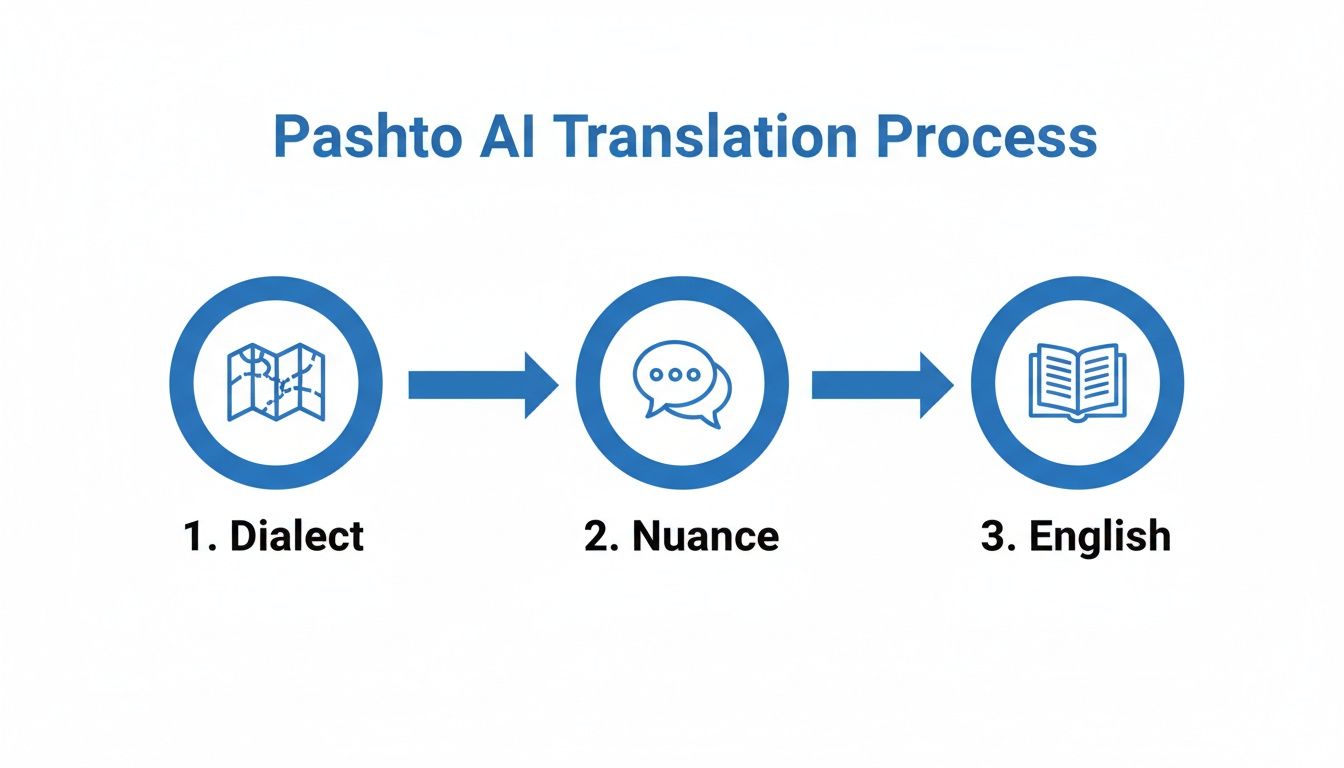
An AI model not trained on these regional variations might mistranslate or just standardize everything, stripping the text of its authentic flavor. This is where more advanced AI tools shine. They've been trained on huge amounts of literature from all over the Pashtun regions, so they can actually identify the specific dialect and keep its unique voice intact in the English version.
Capturing Culture Beyond the Words
Even trickier than dialects are the cultural subtleties baked into the Pashto language. These are the little things that give the language its depth and respectfulness, but they're often the first things lost in a sloppy translation.
Take honorifics, for example. Showing respect to elders and authority figures is a cornerstone of Pashtun culture, and it's built right into the grammar. The English word "you" is a blunt instrument compared to Pashto's "taso" ( تاسو), used for an elder, and the informal "ta" ( ته), used with a friend. A smarter AI translator can read the context and find the right English phrasing to convey that same level of formality, maybe by using "sir" or adopting a more respectful tone.
A truly great translation captures what is meant, not just what is said. It preserves the unspoken cultural context, ensuring the English version evokes the same feelings and respect as the original Pashto.
Idioms are another minefield. A phrase like "zma zra varta khogegi" (زما زړه ورته خوږیږي) literally translates to "my heart hurts for him/her." A basic tool will give you that clunky, literal version. But the real meaning is closer to "I feel deep sympathy or pity for him/her." An AI designed for literary work understands that sentiment and finds a natural English equivalent that just works.
This is where you can really see the difference between a simple, free tool and a more sophisticated platform.
Handling Common Pashto Translation Challenges
| Challenge | Generic Free Tools | Advanced AI (BookTranslator.ai) |
|---|---|---|
| Dialect Variation | Often standardizes to one dialect, erasing regional voice. | Recognizes and preserves Northern/Southern dialect distinctions. |
| Honorifics (e.g., taso vs. ta) | Translates both as "you," losing all social context. | Interprets context to convey formality (e.g., using "sir" or respectful tone). |
| Idiomatic Expressions | Provides a clunky, literal translation that makes no sense. | Finds a natural English equivalent that captures the original sentiment. |
| Cultural Proverbs | Fails to translate the underlying wisdom or moral of the proverb. | Can explain the proverb's meaning or find a comparable English saying. |
Ultimately, a tool that can't handle these challenges will produce a translation that feels hollow and disconnected from the original's rich cultural fabric.
How Specialized AI Makes the Difference
Modern AI platforms are being built specifically to handle these kinds of linguistic hurdles. With 40-60 million Pashto speakers worldwide, creating accurate digital bridges to English is more important than ever for global communication. While professional human translation can be expensive, advanced AI offers a practical middle ground for authors and researchers. In fact, localization experts often point out that bad translations fail to connect with audiences—a problem that sophisticated AI helps solve. You can learn more about why high-quality Pashto translations matter on csoftintl.com.
As we use AI to navigate complex languages like Pashto, it’s also important to think about the ethics of writing with AI and what it means for authorship. The goal isn't to replace human creativity but to enhance it. By choosing a service that respects linguistic diversity, you're making sure your work is introduced to the English-speaking world with all the cultural integrity it deserves. The result is a final product that feels both authentic and deeply resonant.
A Walkthrough of the BookTranslator.ai Workflow
So, you've got your Pashto EPUB prepped and ready to go. Now for the exciting part: turning it into a polished English book. I'm going to walk you through exactly how that happens on a platform like BookTranslator.ai. The whole system is designed to be incredibly straightforward, so you can forget about wrestling with complicated software. This is all about getting a high-quality Pashto translation into English with just a few clicks.
Let's dive into the practical steps, from getting your file into the system to choosing the right options for your specific book.
Getting Started on the Platform
First things first, you'll need to create an account on BookTranslator.ai. It’s a quick process that gets you into your personal dashboard, which is essentially your command center for all your translation projects. The dashboard is clean and simple, letting you easily keep track of your books—what you've uploaded, what's in progress, and what's finished.
Once you’re logged in, the next move is to upload the Pashto EPUB file you've already prepared. Since you've already done the hard work of cleaning up the formatting and ensuring the text is selectable, the platform will be able to process your file without a hitch. This is the secret to preserving your book's original layout, from chapter breaks to paragraph structure.
Choosing Your Translation Plan
After your book is uploaded, you’ll be asked to choose between two translation plans: Basic and Pro. This isn't about one being "good" and the other "better"; it's about matching the right AI model to your book's specific needs.
Here’s a simple way to think about it:
Basic Plan ($5.99 per 100,000 words): This is a fantastic, cost-effective choice for most books. The AI model is highly accurate and delivers a fluent, reliable translation that's perfect for most fiction, non-fiction, and general literature.
Pro Plan ($9.99 per 100,000 words): The Pro plan uses the absolute latest and most advanced AI models out there. This is the way to go for academic papers, technical manuals, or literary fiction where capturing every single layer of nuance and tone is mission-critical.
Honestly, for most authors doing a Pashto to English translation, the Basic plan hits that sweet spot of quality and value. But if your work is packed with specialized language or you want the highest possible level of linguistic subtlety, the Pro plan is a worthwhile investment.
One of the best parts is the transparent pricing. You pay per book—no subscriptions, no hidden fees. This gives you total control over your budget, whether you’re translating one novel or an entire series.
The One-Click Translation Magic
With your plan selected, the actual translation is almost laughably simple. You just confirm your choice, and the AI takes over. There are no complex settings to tweak or technical parameters to worry about.
Behind the scenes, the AI is doing some serious work. It’s not just swapping words; it’s reading your Pashto text, analyzing the sentence structure, and translating it into English while simultaneously mapping everything back to your original formatting. It knows where chapters start and end, how headings are styled, and where your paragraphs are supposed to be.
This intelligent formatting is what really separates a professional book translation tool from a simple text translator. It ensures the EPUB you get back isn't just a wall of English text but a fully structured book that looks and feels just like the original.
The whole thing is also incredibly fast. A full-length novel can often be translated in just a few minutes, not the months it would take with a traditional process. As soon as it's done, you’ll get an email letting you know your translated English EPUB is ready to download from your dashboard. That efficiency means you can move straight into the final review and polishing stage without any frustrating delays.
Reviewing and Polishing Your Translated Book
The AI has done its part, delivering a fully structured English EPUB in just a few minutes. Now, the real artistry begins. This is where your human insight takes a good translation and makes it exceptional. This review isn't about starting over; it's about polishing, refining, and making sure the author's original voice sings in every sentence.
This final check is what makes your Pashto translation into English feel completely authentic to a native speaker. It’s the step that smooths over subtle awkwardness and elevates the entire reading experience.
Create a Focused Review Checklist
It's easy to get lost in the text if you just start reading from page one. A much better approach is to go in with a clear, systematic plan. A simple checklist keeps you focused and ensures you cover all the bases for a professional-quality book.
Here are the key things I always look for:
- Character and Place Name Consistency: Are all the names spelled identically throughout the book? A character named "Ahmad" in chapter one can't magically become "Ahmed" in chapter ten.
- Dialogue Naturalness: Read the conversations. Do they sound like things real people would actually say in English? This is where you need to be ruthless about slang, idioms, and conversational rhythm.
- Tone and Voice Preservation: Did the English version keep the original Pashto's personality? If the source text was witty and sarcastic, the translation had better be, too.
- Formatting and Layout Integrity: Do all chapter breaks, headings, and paragraphs look right? A quick visual scan can catch glaring formatting hiccups before they become a problem.
This isn't about second-guessing the AI. Think of it as a collaboration—you're working with the technology to produce the best possible version of the book for a brand-new audience.
The Power of Reading Aloud
One of the most effective, low-tech tricks in the book is to simply read sections aloud. Your ears will catch clunky phrasing and awkward sentences that your eyes might just glide over.
If you find yourself stumbling over a sentence, that’s a dead giveaway. It needs to be tweaked for better rhythm and flow. This technique is especially brilliant for checking dialogue. Conversations should feel alive and dynamic, not like a stilted, word-for-word transcript.
The real goal of this final polish is to make the translation invisible. When someone opens your book, it should feel like it was originally written in English, carrying all the nuance and artistry of the Pashto original.
Checking for Cultural Contextualization
Beyond grammar and flow, a truly great review ensures cultural references land properly. Sometimes, a direct translation of a Pashto cultural concept just won't make sense to an English-speaking reader without a bit of help.
For instance, a specific Pashtun proverb might need a subtle explanation, or perhaps it’s better to use a comparable English idiom that carries the same weight. It's a delicate balancing act. You aren't changing the author's meaning; you're building a bridge for the reader. This is where a human editor’s touch adds incredible value. You can dive deeper into how this partnership works in our article on the synergy between AI and human editors in book translation.
This last, careful review ensures your book communicates not just words, but meaning, culture, and emotion. It’s the final, essential step in creating a truly impactful Pashto translation into English.
Finalizing and Formatting Your English EPUB
You’ve made it through the translation and editing trenches. The heavy lifting is done, and the journey from a Pashto manuscript to a polished English book is nearly complete. Now, it's time for the final, crucial step: making sure the finished EPUB looks professional and is ready for its new audience.
This is where smart formatting technology really shines. One of the biggest reliefs when using a tool like BookTranslator.ai is how it handles the original layout. It doesn’t just spit out a wall of text; it carries over your chapters, headings, and paragraph breaks into the English version. This is a massive head start, saving you from what could be hours of painstaking manual work.
Performing the Final Visual Check
Before you hit publish, you need to see your book exactly as a reader will. Don't just skim the file on your computer. Open it in proper e-reader software to get the full experience and catch any small visual glitches that might have slipped through.
I always recommend using one of these tools for a final inspection:
- Calibre: This is the Swiss Army knife of e-book management. It’s free, powerful, and lets you view EPUBs on your desktop, giving you a great idea of how they'll look on different devices.
- Apple Books: If you're in the Apple ecosystem, this is a no-brainer. It’s the native reader and gives you a perfect preview of the final product.
- Thorium Reader: Another fantastic, free desktop app that offers a clean, accessible reading experience for your final check.
At this stage, you’re not proofreading for typos anymore. You’re looking at the big picture. Are chapter titles styled correctly? Do images show up where they're supposed to? Does the text flow naturally without awkward page breaks? This quick visual QA is the difference between an amateur file and a professional book.
Updating Your Book's Metadata
With the content and layout locked in, the last piece of the puzzle is the metadata. This is the information embedded in the EPUB file that tells e-readers and online stores all about your book.
Think of metadata as your book's digital business card. Getting it right ensures your book is discoverable, categorized correctly, and properly attributed to you.
You'll need to switch a few key fields from Pashto to English. A tool like Calibre makes this easy.
- Title: Update the book's title to its new English version.
- Author: Make sure your name is spelled correctly in the Latin alphabet.
- Language: This is a big one. Change the language code from Pashto ("ps") to English ("en").
This small tweak is more important than it seems. It tells a reader's device that the book is in English, which allows it to use the right dictionary for lookups and the correct voice for text-to-speech. After this final touch, your professionally translated and perfectly formatted book is truly ready to meet the world.
Got Questions About Pashto Book Translation? We've Got Answers.
When you're ready to translate a full-length Pashto book into English, a few questions are bound to pop up. It's completely normal. You're thinking about accuracy, security, and the technical side of things, and getting those answers is key to feeling confident about the process. Let's walk through some of the most common queries we see.
A big one is always about the quality of AI translation. Can a machine really capture the soul of a story? Modern AI has come a long way; it doesn't just swap words. It analyzes context, tone, and sentence structure to produce English text that flows remarkably well. That said, I always tell authors to think of it as a powerful first draft—a final human review is what adds that last layer of polish and nuance.
Is My Manuscript Safe?
Understandably, authors are protective of their work. Your manuscript's security is paramount. When you upload your EPUB to a professional platform, look for assurances of strong encryption. This should cover the file during the upload and while it's stored on their servers.
Reputable services operate under strict privacy policies, meaning your intellectual property is never shared or used for anything else. Your book is your own, and the translated version should be delivered securely back to you, and only you.
The bottom line is that professional translation platforms are built on trust. Your creative work deserves the same confidentiality and respect you'd expect from a traditional publisher, keeping your data safe from start to finish.
Another practical question we often hear is about file size. What happens if your book is a massive epic?
- For Most Books: A file size limit of 50MB is pretty standard, and services like BookTranslator.ai handle this easily. This is more than enough space for the vast majority of books, even long novels with illustrations.
- For Extra-Large Files: If your EPUB is bigger than that, the culprit is usually large, uncompressed images. The fix is pretty simple: optimize the images in your file before uploading. This almost always gets the file size down without sacrificing visual quality.
Knowing these details helps ensure the whole experience is smooth, secure, and gets you the results you're looking for.
Ready to share your Pashto story with the world? At BookTranslator.ai, we've designed our process to be simple, secure, and affordable. Upload your EPUB and see your book come to life in English in just a few minutes. Start your translation today at BookTranslator.ai.