
Translating Pashto into English is far more than a simple word-for-word swap. It’s a deep dive into linguistic and cultural nuances that can easily trip up even the most advanced software. To get a translation that feels authentic and natural, you have to get a handle on Pashto’s unique script, its diverse dialects, and its treasure trove of idiomatic expressions.
Understanding Pashto's Unique Translation Challenges
Before you even think about starting a translation, it's critical to understand the specific hurdles Pashto throws your way. These aren't just minor quirks; they're fundamental aspects of the language that can make or break the quality of your final English text. If you ignore them, you're likely to end up with awkward phrasing, mangled formatting, and a final product that completely misses the author's original intent.
The most immediate challenge is the script itself. Pashto is written in a Perso-Arabic script, which reads from right-to-left (RTL). When you convert this to a left-to-right (LTR) language like English, especially in digital formats like EPUBs, chaos can ensue. Without careful handling, you’ll see punctuation in all the wrong places, broken tables, and jumbled sentences that completely derail the reading experience.
To give you a clearer picture, here’s a breakdown of the main obstacles you'll face.
Key Challenges in Pashto to English Translation
This table summarizes the primary linguistic and technical hurdles to anticipate before starting a translation project.
| Challenge Area | Specific Issue | Impact on Translation |
|---|---|---|
| Script and Formatting | Right-to-Left (RTL) vs. Left-to-Right (LTR) | Can cause major layout issues in digital formats, breaking sentence flow and visual elements. |
| Dialectal Variation | Southern (Kandahari) vs. Northern (Peshawari) | Different vocabulary and grammar can lead to inconsistent or inaccurate word choices if not identified. |
| Idiomatic Expressions | Proverbs and cultural phrases | Literal translation often results in nonsensical or misleading English, losing the original emotional weight. |
| Cultural Context | Social norms, history, and religious references | Concepts may not have a direct equivalent in English, requiring careful adaptation to be understood. |
Each of these areas requires a thoughtful approach to ensure the final translation is not just accurate, but also readable and faithful to the source.
Dialects and Vocabulary Differences
Pashto isn't one single, uniform language. It’s a collection of dialects, with the southern (Kandahari) and northern (Peshawari) variants being the most prominent. The differences aren't just in pronunciation; they often use completely different words for the same thing.
For example, the word for "we" is mūng (مونږ) in the north, but it becomes mūzh (موږ) in the south. A machine translation engine might miss this subtle shift, leading to a translation that feels off or inconsistent. This is where a human expert really shines—they can identify the source dialect and choose English terms that best fit the context.
The Problem with Literal Translation
Perhaps the trickiest part of the job is navigating Pashto's rich landscape of cultural idioms and proverbs. These expressions are woven into the fabric of the language and almost never have a direct English counterpart. A literal, word-for-word translation is usually a recipe for confusion.
Take the Pashto idiom pə zṛə bāndī dāğ (په زړه باندې داغ). If you translate it literally, you get "a stain on the heart," which sounds odd in English. But a skilled translator understands the feeling behind it—a deep, lasting sorrow—and will find an English equivalent like "a heavy heart" or "a scar on the soul" to convey that emotional weight.
The goal is never a word-for-word conversion. True Pashto to English translation is about transferring meaning, tone, and cultural context so that the English reader experiences the text as the author intended.
This need for cultural fluency is why relying solely on automated tools is so risky for literature, legal documents, or any text where nuance matters. And the demand for high-quality translation is only growing. With an estimated 40–60 million Pashto speakers worldwide and large communities in the Gulf, Europe, and North America, the need for accurate translation is more pressing than ever.
For those curious about the technology behind this, it’s worth looking into various open-source tools for rare language translation that can sometimes provide better support for managing these complex language pairs.
Preparing Your Digital Files for a Smooth Translation
Any good translation from Pashto to English starts long before the first word gets converted. Honestly, the prep work you put into your digital files is probably the most important thing you can do to avoid headaches later. Skipping this step is how you end up with costly errors, mangled formatting, and frustrating delays. Think of it as laying a solid foundation before you build the house.
This is especially true for ebooks. If you're curious about the nitty-gritty of why one file type works better than another, our guide on EPUB vs PDF for AI translation is worth a read. Trust me, rushing the prep stage just means you'll spend double the time fixing things during the final review.
Clean and Standardize Your Source Text
Machine translation tools are powerful, but they're not smart enough to navigate messy formatting. Your first job is to simplify your Pashto document. Strip out any fussy styling that could trip up the translation engine and prevent it from understanding the text correctly.
The goal is a clean, consistent source file. Here’s what I always recommend:
- Stick to standard fonts. Pick one or two simple, common fonts and use them everywhere. Custom or unusual fonts often cause rendering problems or just get misinterpreted by the software.
- Simplify the layout. Get rid of complex text boxes, multi-column layouts, and fancy tables if you can. A simple, top-to-bottom text flow is always your best bet.
- Hunt down hidden characters. Most word processors have a "show non-printing characters" option. Use it to find and delete extra spaces, unnecessary line breaks, or random tabs that can break sentence structures.
By cleaning things up, you ensure the translation tool can focus on the words, not on trying to figure out your design choices.
Handle Images with Embedded Pashto Text
Images with text baked into them are a classic translation roadblock. An automated tool can't read the Pashto words inside a JPEG or PNG file. That means you’ll end up with untranslated graphics scattered throughout your English ebook.
You've got a couple of ways to deal with this. The high-quality route is to manually extract the text from every image, get it translated, and then have a designer recreate the graphic with the new English text. It looks great, but it’s a lot of work.
Your other option is to create a simple list: one column with the original Pashto text from the images, and a second column with the English translation. You can then hand this off to your post-editor or designer to update the images later.
Pro Tip: If you're working with scanned documents or image-based PDFs, you'll need to convert PDFs to searchable OCR text first. This tech is a lifesaver—it turns flat images of text into actual characters that a translation tool can read and process.
Prioritize UTF-8 Character Encoding
Okay, this is the most important technical step, so pay close attention. Character encoding tells a computer how to display text. If your Pashto file is using the wrong encoding, you'll see that dreaded "garbled text"—characters showing up as random symbols (like "بنيادي").
For any language that doesn't use the Latin alphabet, UTF-8 is the absolute, non-negotiable standard. It’s a universal encoding that covers virtually every character in every language, including the entire Pashto script.
Before you do anything else, you must check your file's encoding. It’s simple:
- Open your file in a good text editor, like Notepad++ for Windows or BBEdit for Mac.
- Find the encoding setting, which is usually in the "File" menu or at the bottom of the editor window.
- Make sure it says "UTF-8." If it doesn’t, switch it to UTF-8 and save a fresh copy of the file.
These prep steps might feel a bit tedious, but they establish the technical groundwork for everything that follows. A clean source text, a clear plan for images, and correct UTF-8 encoding will dramatically reduce the chances of a technical meltdown and set you up for a much smoother translation.
Choosing the Right Translation Technology and Workflow
Picking the right technology isn't just a technical detail; it's the decision that will steer your entire translation project. When you're working with a language pair as nuanced as Pashto to English, the tools and workflow you choose will make or break the final quality, budget, and timeline. Let's be clear: just dumping your Pashto text into a free online translator won't work for any serious project.
What you need is a smarter approach—one that blends the raw speed of machine translation with the irreplaceable expertise of a human linguist. This hybrid model is really the only way to get a high-quality Pashto to English translation without spending a fortune.
Before any translation even begins, the real work starts with getting your files in order. This first technical stage is absolutely critical for a smooth process down the line.
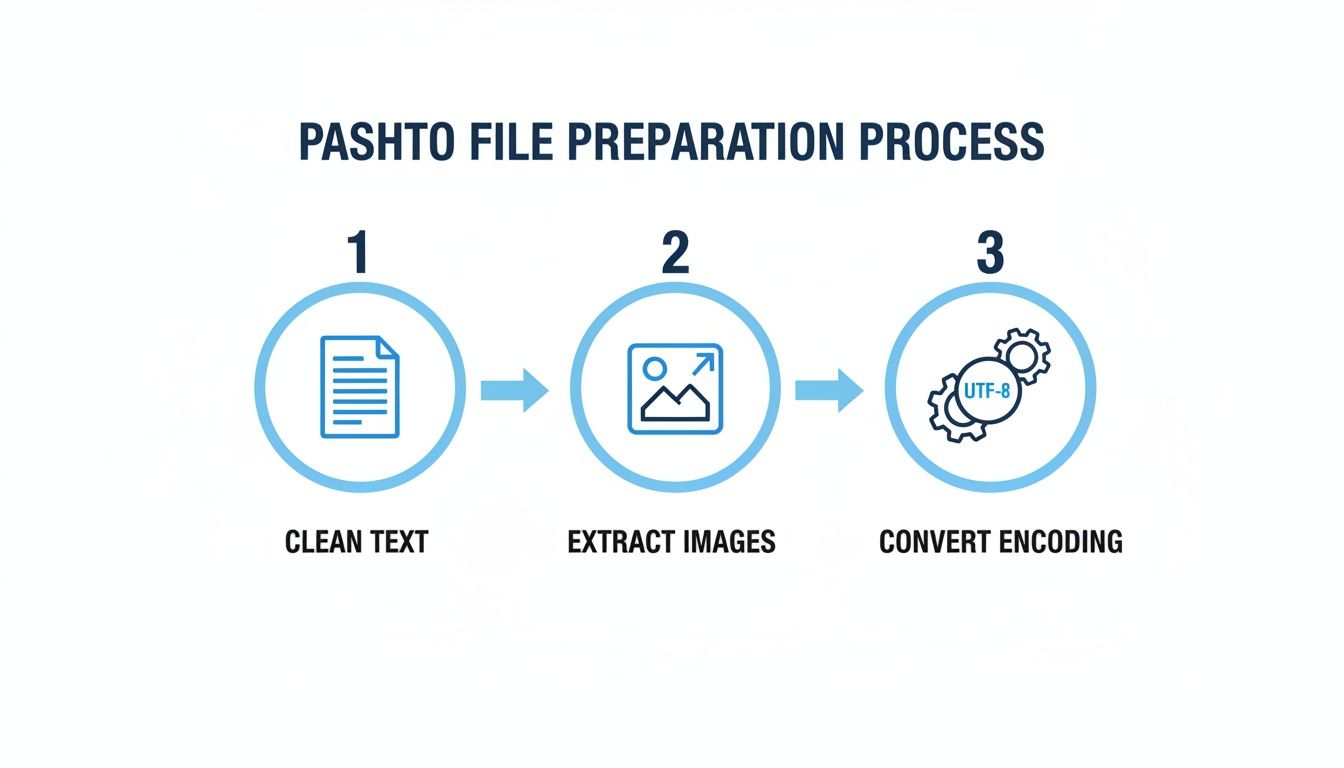
This initial prep work—cleaning up the text, making sure it’s accessible, and setting the right encoding—is the foundation of a successful translation.
Machine Translation: A Powerful (But Imperfect) Start
Let's face it, modern Machine Translation (MT) engines like Google Translate and DeepL have come a long way. For major world languages like Spanish or French, they can spit out text that sounds incredibly human. But for Pashto, the story is a bit different.
The problem is data. These engines learn from massive libraries of existing translations, and Pashto just doesn't have the same digital footprint. Because of this smaller data set, the raw MT output for Pashto often gets tripped up by:
- Dialectal Confusion: It might mix up Kandahari and Peshawari words, creating a jumbled and inconsistent voice.
- Idiomatic Mishaps: It tends to translate cultural sayings literally, which often results in pure nonsense.
- Garbled Syntax: The unique sentence structure of Pashto can easily be misinterpreted, completely changing the intended meaning.
Does that mean MT is useless? Absolutely not. It’s an amazing tool for a first pass, handling the sheer volume of text and saving you a ton of time and money. It just can't be the only tool you use.
The Hybrid Workflow: Where Machines and Humans Meet
The gold standard in the translation industry today is a process called Machine Translation Post-Editing (MTPE). This workflow gives you the best of both worlds, creating a process that’s both high-quality and budget-friendly.
First, the entire Pashto text is run through a sophisticated MT engine. In minutes, you have a complete English draft. It won't be perfect, but it's a solid starting point.
Next, a professional human translator—a native speaker of both Pashto and English—takes over. They meticulously go through the machine-generated text, correcting errors, polishing the phrasing, and adapting cultural references so they make sense to an English-speaking audience.
Finally, a second linguist often steps in for a final proofread, acting as a fresh pair of eyes to catch any lingering typos or grammatical slip-ups. This human-in-the-loop model is essential for achieving true accuracy with a language like Pashto.
To give you a better idea of the options, here's a look at how different workflows stack up.
Comparing Pashto Translation Workflow Models
Deciding on the right approach often comes down to balancing your project's specific needs for speed, cost, and quality. This table breaks down the most common models to help you choose the one that fits your goals.
| Workflow Model | Best For | Pros | Cons |
|---|---|---|---|
| Raw Machine Translation | Gist translations, internal documents where quality isn't critical. | Extremely fast and cheap (often free). | Highly inaccurate, unreliable, misses all nuance, and sounds robotic. |
| MT + Post-Editing (MTPE) | Professional publications, books, websites, and most commercial projects. | Balances speed, cost, and high quality. The industry standard. | Requires skilled human post-editors and professional MT tools. |
| Human Translation Only | High-stakes legal documents, literary works, or marketing copy where every word matters. | Highest possible quality and nuance. | Very expensive and time-consuming. |
Ultimately, for most authors, publishers, and businesses, the MTPE model offers the most practical and effective path to a professional-grade translation.
The Secret Weapons: Consistency Tools
Beyond the core MTPE process, a couple of other tools are non-negotiable for maintaining consistency, especially in a long-form project like a book.
- Translation Memory (TM): Think of this as a smart database that remembers every sentence you translate. If a similar Pashto sentence pops up again, the TM instantly suggests the approved English version. This keeps your terminology consistent and saves a ton of repetitive work.
- Glossary (or Termbase): This is your project's custom dictionary. Here, you define exactly how to translate key terms—things like character names, recurring locations, or specialized jargon. It’s the best way to prevent a character’s name from being spelled three different ways across your book.
Your choice of platform also plays a huge role in how easily you can manage your files. When you're comparing various Content Management Systems (CMS), you'll find that some are much better suited for multilingual content and translation workflows than others. For authors, finding a tool that handles all these moving parts is crucial. You can see how different platforms integrate these features by exploring the best EPUB translator tools for 2025.
By building a workflow that uses MT for speed, a human editor for nuance, and consistency tools like TM and glossaries, you create a robust system that delivers a professional and readable Pashto to English translation.
The Human Touch: Why Editing and Review Are Non-Negotiable
Let's be clear: an AI-generated translation is a fantastic first draft, but it's never the finished product. The real work—the part that turns a clunky, machine-made text into a polished and natural Pashto to English translation—happens when a skilled human expert steps in.
This post-editing and proofreading stage is where the magic happens. It’s where raw output is shaped into something that’s not just understandable, but genuinely resonant and culturally intelligent.
Think of the initial AI draft like a rough sketch. All the basic shapes are there, but it lacks depth, emotion, and finesse. Without a human editor's touch, you risk publishing something filled with awkward phrases, subtle mistakes, and cultural blunders that will immediately turn off your English-speaking readers. The editing process is what breathes life back into the words, making sure the author's original voice makes the journey intact.
Light vs. Full Post-Editing: Knowing What You Need
Not all editing projects are the same, and your budget and quality goals will determine the level of effort required. The two main approaches here are what we call "light" and "full" post-editing.
A light post-edit is all about the fundamentals. The editor’s job is to make the text accurate and easy to understand by fixing the most obvious errors. It’s a quick pass to catch the big stuff.
This usually involves:
- Fixing major grammar mistakes and typos.
- Correcting any glaring mistranslations that change the meaning.
- Making sure sentence structures aren't completely nonsensical.
This is a great option for internal documents or content where you just need to get the basic information across quickly and cheaply. It’s fast and budget-friendly, but it won't feel like polished, professional prose.
A full post-edit, however, is a different beast entirely. This is a deep, comprehensive review and should be your default for anything public-facing—books, academic articles, websites, you name it. The editor goes far beyond simple fixes to refine the style, tone, and cultural relevance. The goal is to make the final text read as if it were originally written in English.
A full post-edit doesn't just fix what's wrong; it elevates what's right. The editor's goal is to make the machine's work invisible, leaving behind only the author's authentic voice and intent.
This is an intensive process. It means rewriting clunky sentences, finding elegant solutions for idioms, and making sure the emotional core of the original Pashto text comes through loud and clear. For a high-quality translation, a full post-edit is simply essential.
The Editor's Checklist: A Blueprint for Quality
To get the best results, you need to give your human editor a clear roadmap. A solid checklist helps them zero in on the unique challenges of Pashto-to-English projects and ensures nothing important gets missed.
Here’s a practical checklist you can give your reviewer:
Hunt Down and Fix Awkward AI Phrasing: Machine translation is notorious for producing sentences that are grammatically correct but sound completely unnatural. The editor's first job is to smooth these out. For instance, a literal translation might produce something like, "He put a stain on his heart," which a good editor will instinctively adapt to a more natural English idiom like, "He carried a heavy heart."
Maintain Dialectal Consistency: The AI might not know the difference between Kandahari and Peshawari Pashto, sometimes mixing vocabulary from both. Your editor needs to spot the primary dialect in the source text and ensure the English translation maintains a consistent voice, avoiding a confusing mashup of terms.
Bridge the Cultural Gap: This is probably the most critical job of all. Pashto is woven with cultural, historical, and religious references that often have no direct English counterpart. The editor must be a cultural interpreter, finding smart ways to explain or adapt these concepts so they make sense to an English-speaking audience without being stripped of their original meaning.
Verify All Key Terminology: If you're translating non-fiction, academic work, or even fiction with its own lore, a glossary is your best friend. The editor has to religiously check the translation against this list to ensure that every key term—whether it's a character's name, a location, or a technical concept—is handled the same way every single time. Consistency is key.
Preserve the Author's Tone and Voice: This is the editor's most artistic task. Is the original Pashto text formal and academic? Or is it poetic and lyrical? The editor makes the final stylistic choices that ensure the English version feels the same as the source.
By putting a structured, human-led review process in place, you’re doing more than just swapping words. You are actively preserving the soul, art, and impact of the original Pashto text for a whole new audience.
Getting Your Layout and Formatting Ready for Publication
You've made it through the heavy lifting of translation and editing. Now for the final, crucial step: making sure your English ebook looks every bit as polished as the Pashto original. A flawless translation can be instantly torpedoed by clumsy formatting, so this last mile is all about visual presentation and creating a smooth reading experience.
The biggest hurdle you'll face is the fundamental switch in reading direction. Pashto is a right-to-left (RTL) script, while English is left-to-right (LTR). This isn't a simple text flip; it completely changes the visual architecture of every single page, from how paragraphs are aligned to where images and tables sit.
Handling the Right-to-Left to Left-to-Right Shift
When you convert a Pashto book to English, you have to expect the layout to break. It's just part of the process. For one thing, Pashto sentences can be incredibly concise, and their English equivalents often take up more space. This text expansion alone causes a cascade of formatting headaches.
Keep an eye out for these common issues:
- Awkward Page Breaks: A chapter that ended perfectly at the bottom of a page in Pashto might now push a single, lonely line onto the next page in English. These are called "widows" and "orphans," and they look unprofessional.
- Misplaced Graphics: Images that were neatly anchored to the right margin in the Pashto version will now need to be repositioned to work with the left-aligned English text.
- Mangled Tables: Tables are almost always a casualty. Columns that made perfect sense for an RTL reader will look completely scrambled in an LTR layout unless you go in and manually reorder them.
Fixing this stuff requires a careful, page-by-page review. You'll need to get hands-on with your ebook software, whether that’s Calibre or Scrivener, to tweak the settings and make sure every element looks like it belongs there.
A Simple Quality Check Before You Publish
Before hitting that "publish" button, you need to run a final quality assurance (QA) check. This is your last line of defense against rendering bugs and formatting glitches that will absolutely frustrate your readers. I've seen authors rush this part, and it almost always comes back to bite them in the form of bad reviews.
A thorough QA process isn't optional. Your goal is to see what your reader will see, testing the final file on the same kinds of devices they'll be using.
You don’t need a complicated plan. The key is simply to check your final EPUB file on a few different e-readers, because each one renders formatting just a little differently.
Here’s a quick checklist I use:
- Test on Different Devices: Load your translated EPUB onto at least two kinds of e-readers. I always suggest an Amazon Kindle (the "Send to Kindle" function is great for this) and something with a different engine, like a Kobo or the Apple Books app.
- Check Your Table of Contents: Go through and click every single link. Does it jump to the right chapter? Broken navigation links are a rookie mistake and are so easy to fix.
- Scan Every Page: Quickly scroll through the entire book. Look for text running off the screen, images that are weirdly sized or positioned, and tables where the columns are out of whack.
- Confirm Special Characters: Make sure any special characters, like those in names or unique terms, are showing up correctly. You don’t want them defaulting to a generic square box (□).
This final formatting and QA pass is what turns your excellent Pashto to English translation from a raw text file into a professional-grade ebook. It’s the finishing touch that shows respect for both the original work and your new English-speaking readers.
Budgeting Your Project and Finding the Right Talent
Alright, let's talk money and people. Getting your Pashto book into English isn't just a technical exercise; it's an investment that needs a clear budget and the right expert behind the keyboard. Figuring out the financial side first is crucial—it saves you from nasty surprises and ensures you can afford the quality your work deserves.
When you're forecasting costs, the first thing to know is that professional Pashto to English translation is almost always priced by the word. This is standard practice in the industry, and it's actually great for you. It provides total transparency and makes it easy to scope out the project, whether you're working on a short story or a massive novel.
Understanding Per-Word Translation Rates
So, what can you expect to pay? A professional Pashto linguist will typically charge somewhere between $0.08 and $0.15 per word. That range depends on a few things: how complex the text is (a technical manual will cost more than a simple narrative), how quickly you need it done (rush jobs always add a premium), and the translator's own experience. Thanks to high demand in fields like humanitarian aid and legal services, these rates are pretty well-established. For a deeper dive, you can always check out industry analyses on Pashto language work and market rates.
Now, if you're going with the Machine Translation Post-Editing (MTPE) workflow we discussed, you'll also need to budget for the human editor. The good news is that post-editing rates are significantly lower, usually landing between $0.04 and $0.08 per word. This is what makes the hybrid MTPE approach such a smart, cost-effective option for most authors.
Vetting and Hiring the Right Pashto Linguist
Finding the right person for the job is just as critical as the budget. You're not just looking for a bilingual typist; you need a linguist who gets the cultural subtleties that make your story breathe.
Here’s my advice for vetting potential translators or editors, based on years of doing this:
- Check their portfolio. Always ask to see samples of past work, preferably in a genre close to your own. This is your first real glimpse into their style and the quality you can expect.
- Insist on a paid sample edit. This is the single most effective way to vet someone. Pull a 500-word section from your book, pay them their per-word rate to edit it, and see what you get back. It's a small upfront investment that tells you everything about their skill, communication, and attention to detail before you commit.
- Write a crystal-clear project brief. Don't make them guess. Your brief should lay out a project summary, define the target audience for the English version, and include a style guide or glossary of key terms if you have one. The more clarity you provide, the better the result will be.
A paid sample edit is non-negotiable for me. It’s like a test drive—it tells you everything you need to know about how well you'll work together and what kind of quality you can expect for your full manuscript.
Frequently Asked Questions About Pashto Translation
If you're gearing up for a Pashto to English translation project, you probably have a few practical questions. Let's tackle some of the most common ones we hear from authors, academics, and publishers.
How Long Does a Pashto Translation Take?
The timeline really comes down to the book's length and complexity. A professional human post-editor typically gets through about 2,000 to 4,000 words of polished text per day. For a 60,000-word manuscript, that means the post-editing alone could take anywhere from three to six weeks.
The good news is that a modern hybrid workflow—where a machine does the initial heavy lifting—changes the game entirely. The first machine-translated draft can be ready in just a few minutes, freeing up the human expert to dive straight into the crucial work of refining and perfecting the text.
Can I Just Use Free Online Tools for My Book?
While tools like Google Translate are handy for a quick check or getting the general idea of a sentence, they are absolutely not up to the task of translating a full book. They simply can't handle the specific hurdles Pashto presents.
- Dialectal Blind Spots: They usually can't tell the difference between major dialects, which can leave you with a messy, inconsistent tone.
- Lost in Translation: Idioms and cultural sayings get translated literally, often resulting in phrases that are complete nonsense in English.
- Formatting Nightmares: They aren't built to manage the complex right-to-left script and formatting inside an EPUB file, which can break your book's layout.
For any work where quality, accuracy, and readability are important, you need a professional setup.
Relying on free tools for a book translation is like using a dictionary to write a novel. You'll get all the words, but you'll miss the story, the emotion, and the author's true voice.
What’s the Single Most Important Quality in a Translator?
Beyond just speaking both languages, the most critical trait is cultural fluency. A truly great translator isn't just bilingual; they're bicultural.
They need a deep understanding of the social cues, historical context, and subtle references woven into the Pashto text. Without that, it’s impossible to convey the author's intended meaning and feeling to an English-speaking audience.
Ready to bring your Pashto book to a global audience? With a service like BookTranslator.ai, you can translate entire EPUB files in a single click, keeping the original layout and nuance intact. Our AI-powered platform delivers professional-quality results quickly and affordably.