
When you hear the phrase “legends of localization,” what comes to mind? We’re not just talking about a good translation. We're talking about masterful adaptations that do more than just swap out words—they translate the very soul of a story for a whole new audience.
It's the delicate art of keeping a creator's original intent, their unique humor, and the cultural heart of their work alive, making it feel like it was born and raised in another language. These are the projects that set the gold standard for how to tell stories globally.
Understanding the Art of True Localization
Let’s be clear: we're moving far beyond a simple, literal translation here. Think of it like this: a standard translator is like a musician who plays every note on the sheet music perfectly. A legendary localizer is the one who interprets that music, pouring their own emotion and cultural understanding into every chord to make the audience feel something.
One tells you what was said. The other makes you feel what was meant.
This whole concept really found its footing in the video game industry. Early localizers were faced with complex stories, quirky characters, and cultural in-jokes that simply had no direct equivalent in English. Instead of throwing their hands up or leaving a clunky line of dialogue, they got creative. They invented new phrases and jokes that captured the spirit of the original, making it land perfectly with a Western audience.
More Than Just Words
The real goal here is to craft an experience that feels completely authentic and purpose-built for its new home. It demands a deep, genuine understanding of both the source and target cultures.
A truly great localization ensures that:
- The author's voice is preserved: Your unique style and tone should shine through, not get flattened into something generic.
- Cultural nuances are adapted, not erased: Idioms, humor, and social references need to be thoughtfully reimagined to connect with the new audience. A literal translation just won’t work.
- The emotional impact hits just as hard: The moments that make readers gasp, laugh, or cry should deliver the same punch, no matter the language.
True localization is about empathy. It's the ability to step into another culture's shoes and retell a story in a way that connects with their hearts and minds, creating a shared experience across borders.
This isn't just a "nice-to-have" anymore, especially for authors and publishers. The global book market is exploding, with projections showing it will climb from US$148.76 billion in 2024 to an incredible US$213.02 billion by 2033. To tap into that growth, you have to get localization right.
Core Principles of Legendary Localization
To really grasp the difference, let’s break down the core pillars of what separates a standard job from a legendary one.
| Principle | Standard Translation Focus | Legendary Localization Focus |
|---|---|---|
| Cultural Context | Translates idioms literally or with simple footnotes. | Reimagines idioms and references to feel native to the culture. |
| Authorial Voice | Focuses on grammatical accuracy, often losing the tone. | Prioritizes preserving the author's unique style and personality. |
| Emotional Resonance | Conveys the basic plot points and dialogue. | Ensures emotional beats land with the same impact. |
| Audience Experience | Creates a readable but foreign-feeling text. | Delivers a seamless experience that feels written for them. |
This table highlights a shift in mindset: from simply converting words to recreating an entire experience. It’s about being an artist, not just a technician.
Thankfully, you no longer need a massive team to apply these principles. Modern tools are bringing this level of quality within reach for independent authors and smaller publishers. With AI-powered platforms like BookTranslator.ai, you can capture the original magic of your work for a global readership and avoid the all-too-common pitfalls of what happens when your favorite saga goes untranslated.
Learning From Gaming's Localization Pioneers
The whole idea of legends of localization was really born in the trenches of the early video game industry. Back then, translators were up against impossible deadlines, crushing technical limits, and cultural jokes that just didn't have a parallel in the West. Instead of just doing a straight, word-for-word translation, these pioneers took creative risks. They basically became co-writers, reshaping the core experience to make sense for a brand-new audience.
Their work is a fantastic blueprint for any creator—especially authors—who wants their stories to connect with people all over the world. It’s living proof that capturing the feeling of a story matters so much more than literal accuracy.
The EarthBound Example: A Masterclass in Tone
One of the all-time great examples is the 1994 Nintendo game EarthBound. The original Japanese version, Mother 2, was packed with a quirky, almost surreal humor that was very specific to its home audience. Translate it directly, and it would have just been weird and confusing, not funny.
So, the localization team, headed by Marcus Lindblom, made a brilliant move. They leaned into a distinctly satirical, off-kilter American voice. They didn't just swap Japanese words for English ones; they captured the game's oddball spirit and planted it firmly in a context that Western players would immediately get.
Take one of the enemies, for instance. In Japan, it was just a "gruff-looking man." For the English release, it became the now-iconic "New Age Retro Hippie"—a perfect little jab at 90s American counter-culture. This wasn't just about changing a name; it injected a specific, relatable personality that became a huge part of the game's charm.
This approach gets to the heart of what makes localization legendary: adaptation isn't a failure of translation. It's the ultimate success. The real goal is to make a new audience feel the same thing the original audience felt, even if the words are completely different.
Final Fantasy's Poetic License
The Final Fantasy series is another pillar in the history of localization. In the early days, the localizer Ted Woolsey was boxed in by incredibly restrictive text limits. He had to be a translator and a poet at the same time, condensing sprawling Japanese dialogue into short, powerful English lines that would actually fit on the screen.
There's a classic example from Final Fantasy VI with the villain, Kefka. A simple, dismissive line in Japanese was completely reimagined into the theatrical and unforgettable quip, "Son of a submariner!" It’s not a literal translation by any stretch, but it perfectly captured Kefka's flamboyant, unhinged personality for anyone playing in English.
Looking back at these examples, a few key lessons for all storytellers jump out:
- Dig for the Intent: What was the original creator trying to make the audience feel or understand in that moment?
- Find the Cultural Bridge: What phrase, joke, or cultural touchstone will spark that same feeling for your new audience?
- Be Brave: Don't be afraid to step away from the original text if it means you're preserving the story's soul.
The struggles faced by these early gaming legends of localization are the very same ones that pop up in book publishing. How do you maintain an author's unique voice? How do you adapt intricate world-building? How do you make a joke land in a different culture? By studying the creative solutions from gaming's past, authors and publishers can learn how to make sure their stories don't just get translated, but truly come alive for readers everywhere.
Applying Legendary Principles to Your Book
It might seem like a huge leap from video games to novels, but the heart of the localization challenge is exactly the same. Whether you’re crafting dialogue for a fantasy hero or a chapter in a historical epic, the mission is identical: protect the creator’s unique voice, skillfully adapt cultural nuances, and deliver an experience that pulls the reader in completely.
Think of it this way. That clever Japanese pun in a game needs the same creative spark to be reimagined for an English-speaking audience as a deeply rooted cultural idiom in a Spanish novel. In both situations, a dry, literal translation falls flat. It misses the entire point, stripping the work of its magic and leaving the audience either confused or, worse, disconnected.
The real goal is to make the new audience feel what the original audience felt. This is the biggest lesson authors can take from the legends of localization in gaming—they teach us that smart adaptation isn't a failure, but the highest mark of success.
Bridging the Narrative Gap
The best literary translators have always worked with this mindset. They don’t just see words on a page; they hear the rhythm, catch the subtext, and understand the author's intent. When an author uses a specific regional dialect to build a character, a great localizer won't just translate the words. They'll find a cultural equivalent that conjures a similar personality or social standing for the new audience.
This is absolutely critical because for authors, their voice is their everything. A localization that sands down that voice into something generic isn't just a poor translation; it's a profound loss of the work's soul.
A legendary localization makes your book read as if it were born in the target language. The reader shouldn't ever feel like they're reading a translation; they should only feel the story.
Committing to this level of quality unlocks a massive opportunity. It's wild to think about, but only 3% of books available in English-speaking markets are translations. That's a tiny slice of the pie, especially when you consider the global book market is valued at USD 138.38 million. This gap represents billions in untapped potential for authors ready to embrace true localization. If you're curious about the numbers, you can explore detailed book translation statistics and trends to see the full picture.
The Mindset of a Localization Legend
So, how do you actually apply this thinking to your own work? It all starts with a shift in perspective.
Stop asking, "How do I say this in another language?" Instead, start asking, "How do I make my new readers feel this?"
Here are the core principles to guide you on that path:
- Prioritize Intent Over Literal Text: Get to the heart of what you're trying to achieve in each scene. What is the emotional and narrative purpose behind your words?
- Embrace Creative Adaptation: Don't be afraid to change specific cultural references, jokes, or idioms. Swap them for something that will land with the same impact for your new audience.
- Champion Your Authorial Voice: Make sure your stylistic signature—whether it's witty, sparse, or poetic—survives the journey into a new language.
When you internalize these principles, you start thinking like a localization legend. You'll see translation not as a mechanical chore, but as a creative act—one that ensures your story connects with readers on a deeply human level, no matter where they are in the world.
How Modern AI Helps You Create a Localization Legend
Achieving the kind of quality we see in the legends of localization used to demand enormous budgets and dedicated teams. For most independent authors, it was simply out of reach. That's not the world we live in anymore. Advanced AI has completely changed the game, putting the power to create your own localization legend right at your fingertips.
AI-powered platforms like BookTranslator.ai aren't just swapping words. They've been trained on vast libraries of literature, which means they get the nuances—the context, the stylistic choices, and the unique authorial voice that makes your work yours. The AI can tell the difference between a character's sarcastic jab and a serious narrative moment, and it adjusts the translation to keep the original emotional weight intact.
This couldn't have come at a better time. The online book services market, valued at a staggering USD 23.38 billion in 2024, is expected to soar to USD 32.45 billion by 2030. A huge part of that growth is coming from places like China and India, where localized content isn't just a nice-to-have; it's a must. You can discover more insights about online book services market trends on grandviewresearch.com to see just how big this opportunity is.
Making Global Publishing Accessible
One of the biggest headaches with traditional translation has always been the technical stuff—especially formatting. Modern AI tools are built specifically to tackle this.
Platforms like BookTranslator.ai, for example, are designed to work directly with EPUB files. This means your translated book keeps its original layout perfectly. Chapter breaks, headings, italicized thoughts, bolded exclamations—it all stays exactly where it should be. You end up with a professionally formatted, ready-to-publish file for every new market.
The emergence of specialized tools like an Auto Localize platform is a perfect example of how AI makes localization so much more manageable.
Just look at this user-friendly dashboard. It's designed to let you manage multiple languages from one clean, simple interface.
What you're seeing is the magic of one-click translation. You can take a single manuscript and get it ready for readers in over 50 languages at once.
Your Path to a Global Legacy
By sidestepping the traditional gatekeepers and their high costs, AI gives you the power to build your own global legacy, even without a legendary budget. The old financial and logistical walls have come down. Now, you can focus on what you do best: sharing your story with readers all over the world.
This technology provides a clear, direct path to creating your own localization legend. It gives you the tools to make sure your work isn't just translated but truly adapted, connecting with new audiences in a way that feels authentic and real. And with AI simplifying translation workflows, you can handle the entire process yourself, turning what was once an overwhelming challenge into a genuinely exciting opportunity.
A Practical Guide to Localizing Your Book
Alright, let's move from theory to action. This is where you put all those lessons into practice and start your own journey to becoming a publishing legend in new markets. Here’s a straightforward guide for independent authors ready to take their stories global.
First things first: prepare your manuscript. Before you even think about translation, make sure your original text is as clean and polished as possible. A well-edited book is the bedrock of a great translation because it leaves no room for the kinds of ambiguities that can confuse even the best AI.
With your manuscript prepped and ready, it's time to pick your tools. Not all books—or translation projects—are created equal.
Selecting Your Translation Tier
If your book has a straightforward narrative, or if you’re just testing the waters in a new country, a standard AI translation can deliver impressive quality for a fantastic price. It gets the job done well.
But what if your book is full of literary flair, unique character voices, or humor that relies on clever wordplay? For those, a Pro-level service is almost always the right call. These more advanced AI models have been trained on vast libraries of literature, giving them a much stronger feel for style and the subtle nuances that make your writing yours.
This flowchart breaks down the basic AI localization workflow into three simple stages.
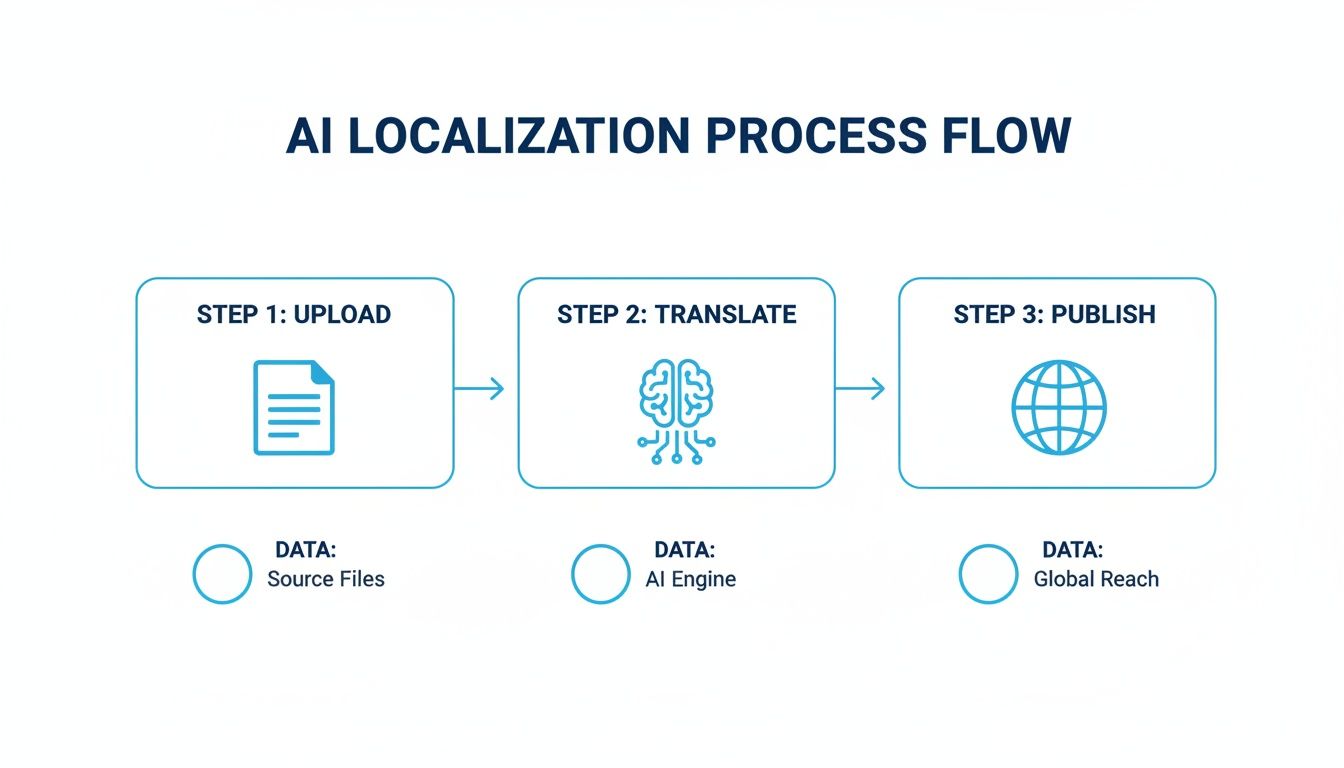
As you can see, the path from your original manuscript to a globally published book is surprisingly direct.
Tools like BookTranslator.ai make this incredibly easy. You just upload your EPUB, pick your languages, and the AI does the heavy lifting. The system is built to keep your original formatting—chapters, headings, and all—perfectly intact, so you get back a file that’s ready to go. You can dive deeper into the specifics of this workflow by reading about how to translate a book.
Choosing the right plan on a platform like BookTranslator.ai comes down to your book's specific needs.
Choosing Your BookTranslator.ai Plan
To help you decide, here’s a quick comparison of the two main tiers. Think about the complexity of your writing and your goals for each market.
| Feature | Basic Plan ($5.99/100k words) | Pro Plan ($9.99/100k words) |
|---|---|---|
| Best For | Straightforward narratives, non-fiction, initial market testing. | Literary fiction, complex characters, stylistically rich prose. |
| Translation Engine | High-quality standard AI model. | Advanced, context-aware AI trained on literature. |
| Voice & Nuance Preservation | Good fidelity to the original text. | Superior preservation of unique authorial voice and cultural nuance. |
| Idiom Handling | Strong general accuracy. | More adept at interpreting and adapting complex or subtle idioms. |
Ultimately, the Pro plan is designed for authors whose voice is a central part of the reading experience, while the Basic plan offers a powerful and affordable option for a wide range of genres.
The Final Polish
The last step is also the most important: refinement. AI gets you 95% of the way there with astonishing speed and accuracy, but that final 5% is where the human touch makes all the difference. This is when you bring in a native-speaking editor for a final review.
The goal of this final review isn't to re-translate anything. It's to add that final layer of polish, catching subtle turns of phrase or cultural references that can be tweaked to feel perfectly natural to a native reader.
This hybrid approach gives you the best of both worlds: the speed and efficiency of AI combined with the irreplaceable expertise of a human. It’s the secret to making sure your book doesn’t just read like a good translation, but feels like it was written for that audience from day one.
As you get ready to take these steps, it helps to understand the business side of things. If you're planning to manage your own global releases, learning how to become a publisher is a great place to start. With this process, you can confidently bring your story to a whole new world of readers.
Common Questions on Taking Your Book Global
Dipping your toes into book translation can feel a bit overwhelming, especially with all the new technology popping up. Let's walk through some of the questions I hear most often from authors who are thinking about reaching an international audience.
Can AI Really Handle Cultural Nuance Like a Person Can?
This is the big one, isn't it? For years, the answer was a hard "no." But the AI of today is a completely different animal from the clunky machine translation of the past. Professional-grade services are trained on vast literary and cultural libraries, which means they can actually understand context, idioms, and the subtle shades of meaning that used to get lost.
For many books, AI can produce a translation that genuinely captures the author's original voice. The sweet spot for a lot of authors, especially with highly stylized prose, is a hybrid approach. You can use AI to do the heavy lifting and create a rock-solid draft, then bring in a native-speaking editor to give it that final, human polish. This approach saves a ton of time and money but still gets you a legendary result.
Am I Going to Lose My Book's Formatting in the Process?
It's a completely valid fear—you spent ages getting your layout just right. Thankfully, modern platforms were built to solve this exact problem. Specialized tools like BookTranslator.ai are designed from the ground up to work with EPUB files, the industry standard for ebooks.
The technology is smart enough to read your original document and make sure the translated version is a perfect mirror of the original layout.
That means all your headings, chapter breaks, paragraph spacing, and even your italics and bolding stay right where they belong. You get a file that’s ready to publish without the nightmare of rebuilding an entire book.
What Does It Actually Cost to Translate a Full-Length Novel?
This has always been the single biggest hurdle for indie authors. A professional human translation can easily cost thousands of dollars for just one language, putting it way out of reach for most. This is where AI-powered services have truly changed the game.
With a simple pay-per-book model, the cost is clear from the start. For example, translating a 100,000-word novel can be as little as $5.99. That kind of price point makes it possible to localize your work into several languages for what used to be a fraction of the cost for one, opening up markets you might have thought were impossible to enter.
Which Languages Give the Best Bang for Your Buck?
The right answer always depends on your genre, but a few key markets are consistently strong performers for authors.
- Spanish: Opens the door to a massive readership in Spain and most of the Americas.
- German and French: These are mature, stable European markets filled with millions of dedicated readers.
- Simplified Chinese and Hindi: If you're looking for pure growth potential, you can't beat these. The sheer number of readers and the explosion in digital book sales in China and India are staggering.
A good strategy is to start with one or two languages where your genre is already popular. Watch your sales data, see what works, and then you can reinvest and expand into new territories. It's how you build a global author platform, one market at a time.
Ready to create your own localization legend? With BookTranslator.ai, you can translate your entire book into over 50 languages with just one click, all while preserving your unique voice and formatting. Start your global journey today.