
When you need to translate a French document into English these days, you’re basically looking at two main paths: a lightning-fast, purely automated translation or a hybrid approach that pairs AI with a human touch. For something substantial, like a whole book or a dense academic paper, you'll want to use a tool built for the job—one that won't butcher your layout or lose your unique voice. This is a far cry from the old days of slow, expensive manual services.
A Modern Take on French to English Document Translation
Getting a French document into English is no longer just about running it through some clunky software or hiring a pricey freelancer. The tools available now offer a fantastic balance of speed, cost, and quality. But the fundamental challenge hasn't changed: how do you make sure the nuances of French culture and language don't get lost along the way?
Idiomatic expressions are always a classic trip-up. If you literally translate "tomber dans les pommes" (to fall into the apples), you completely miss the point that someone is about to faint. The same goes for the subtle but critical difference between the formal "vous" and the informal "tu," which dictates the entire tone of the conversation.
The Two Main Paths for Translation Today
In my experience, modern translation projects almost always fall into one of two buckets. Figuring out which one is right for you is the best first step you can take.
Pure AI Translation: This is your speed-and-efficiency play. You upload your file, and an AI model spits back a translation in minutes. It's brilliant for internal drafts, getting the gist of an article for research, or any situation where a perfect polish isn't the priority.
AI Translation + Human Review: This hybrid model gives you the best of both worlds. An AI does the heavy lifting to create a solid first draft, and then a professional human translator comes in to refine it. This is the go-to for anything public-facing—novels, marketing materials, academic papers—where every word matters.
The real aim here isn't just swapping French words for English ones. It’s about transferring the meaning, intent, and style so the document works just as well for its new audience as it did for the original one.
The Right Tools for Big Projects
If you're an author, researcher, or publisher working with something hefty like a manuscript or a dissertation, your standard, everyday translation tools are going to let you down. They often choke on large files, mess up complex formatting, or completely scramble the chapter structure in an EPUB file.
This is exactly why specialized platforms like BookTranslator.ai were created. They are built from the ground up to handle long-form content, making sure your original layout—from chapter breaks to paragraph styles—stays exactly as you intended. Using this kind of purpose-built document translation software means you can tackle a French to English project of any size and be confident that the final product will honor the original work.
Getting Your French Document Ready for Translation
A top-notch french to english document translation really begins long before you hit the "upload" button. The quality of your original French document has a massive impact on the final English version, particularly when you're working with advanced AI tools. It's all about setting the stage for a great performance.
This initial prep work is more than just a quick spell-check. It’s about fine-tuning your French text so it's crystal clear. For example, long, winding French sentences packed with multiple clauses can sometimes trip up even the best translation models. My advice? Break them down into simpler, more direct sentences. This small change helps ensure the AI nails the core meaning every time.
Now is also the time to hunt down and eliminate any ambiguities. A phrase like "l'ancien ministre" could be translated as "the former minister" or "the old minister." A human translator might figure it out from the surrounding text, but why leave it to chance? Clarifying these little things in the source document prevents the AI from making the wrong call.
Nail Down Your Key Terms and Concepts
When it comes to professional-grade translation, consistency is everything. If you're an author translating your novel, you can't have character names or key terms changing halfway through—it yanks the reader right out of the world you've built. The simplest, most effective tool to combat this is a glossary.
Just create a quick list of your most important terms and how you want them to appear in English. It doesn't have to be complicated.
- Character Names: Make sure Élodie stays Élodie and doesn't morph into Elody.
- Big Ideas: If your non-fiction book is about "la laïcité," you need to decide if the English version should use "secularism," "state secularism," or maybe just keep the French term and explain it.
- Specific Places: Lock in the names of unique locations to keep your setting consistent from start to finish.
Putting in this little bit of effort upfront gives the AI a clear roadmap, and the result is a much more cohesive and professional-sounding final document.
The Technical Side: Prepping Different File Types
The type of file you're working with also needs some attention. A clean, well-structured document is your best friend for keeping all your formatting and layout intact.
If you’re starting with a scanned PDF, you’ll probably need to run it through an Optical Character Recognition (OCR) process to turn the image into editable text. Our guide on how to OCR and translate a document shows you exactly how to do this to get clean text ready for translation. For EPUBs, double-check that your chapter breaks and headings are properly formatted, because that's the structure the AI will follow for the English version.
The sheer scale of translation work being done today shows just how important this prep is. In 2023, the European Parliament's translation service handled nearly 2.96 million pages, according to their official 2023 report. Most of these were complex documents where accuracy was non-negotiable. While that’s an institutional level, tools like BookTranslator.ai give individuals the power to get similar quality and scale for as little as $5.99 per 100,000 words, easily managing huge files while keeping the original layout and style.
Taking time to prepare your French document isn't just an extra step; it's the foundation of the entire translation process. A clean, clear, and well-structured source file is the single biggest factor in getting a flawless English output.
Picking Your Path: AI Translation vs. Human-Edited AI
One of the first big decisions you'll make in any french to english document translation project is choosing your workflow. Are you going to let the AI do all the heavy lifting, or will you bring in a human expert to polish the final product?
There’s no single "right" answer here. The best choice really hinges on what you need the translated document for. Think of it as a fork in the road—one path prioritizes raw speed and cost, while the other is all about achieving publishable, nuanced quality.
A straight AI translation is a fantastic tool when you just need to understand something fast. It’s perfect for internal documents, preliminary research, or even just translating a French novel for your own enjoyment. In these situations, the goal is comprehension, and a few slightly awkward phrases aren't going to derail the whole project.
But when your document is going public? That's when the hybrid approach—AI plus a human editor—becomes essential. For novels you intend to publish, academic papers you're submitting, or marketing materials for a global audience, you need that human touch. The AI gives you a solid first draft, and a professional editor then steps in to perfect the nuance, nail the cultural context, and ensure the stylistic voice is just right.
When to Go with Pure AI Translation
Pure AI really shines when speed and budget are your top priorities. It's the ideal choice for projects where perfect polish isn't the main goal.
Consider using it for:
- Internal Business Memos: Need to get your French team's update to the English-speaking execs ASAP? This is the way.
- Personal Reading: Can't wait for the official English release of a new French bestseller? Translate that EPUB for yourself in minutes.
- Initial Research: Sifting through French academic articles or source materials? AI can give you the gist quickly so you know what's relevant.
The real advantage here is immediacy. You get a functional, understandable English version of your document almost instantly, letting you act on the information right away. It’s all about fast, accessible comprehension.
Thinking about how AI fits into your workflow is a smart move, much like exploring how generative AI in content optimization is changing broader content strategies.
When a Human Editor Is a Must-Have
If the final document is going to represent you, your research, or your brand, investing in a human post-edit is non-negotiable. A skilled editor catches the subtle things an AI might miss, from idiomatic phrases that don't translate literally to the delicate tone of dialogue in a novel.
We dive deeper into this topic in our comparison of AI vs. human book translation pros and cons.
This flowchart gives you a good visual of how to think through the initial stages, starting with your source document.
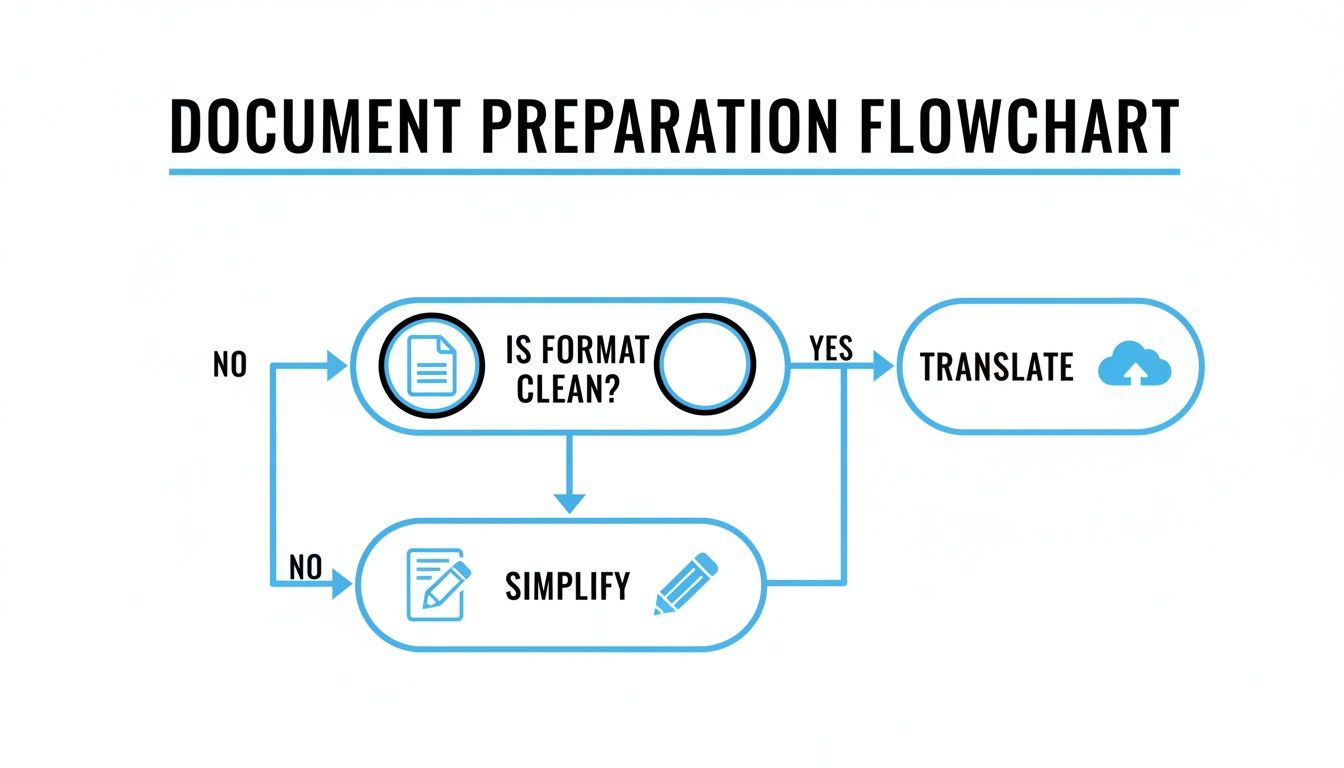
As you can see, a clean, well-formatted source file is the foundation for a great translation, no matter which path you take.
AI Translation vs Human-Edited AI: Which Is Right for You?
To make the decision clearer, let's break down the key differences between a pure machine translation and one that gets a final review from a human expert.
| Factor | Pure AI Translation (e.g., BookTranslator.ai Basic Plan) | AI Translation + Human Post-Edit |
|---|---|---|
| Cost | Extremely low. A 100,000-word EPUB can be as little as $5.99. | Higher. You pay for the AI's speed plus the editor's time and expertise. |
| Speed | Blazing fast. Translation is completed in minutes. | Slower. The human review process adds hours or days to the timeline. |
| Accuracy & Nuance | Generally high for literal meaning, but can miss idioms and cultural context. | The highest level of accuracy, capturing nuance, tone, and style perfectly. |
| Best For | Internal docs, personal reading, research, getting the gist of a text. | Publishing, marketing materials, academic papers, legal documents, any public-facing content. |
Ultimately, pure AI is about efficiency, while the human-edited approach is about excellence.
The AI translation market is growing incredibly fast, projected to jump from $1.88 billion in 2023 to a staggering $23.53 billion by 2032. It’s easy to see why. Professional human translation can cost anywhere from $0.09 to $0.35 per word. An AI tool like BookTranslator.ai offers a massive economic advantage, making translation accessible for projects that would have been prohibitively expensive just a few years ago.
Using AI for Your French to English Translation
Alright, let's get our hands dirty and walk through how this actually works with a modern AI tool. The whole process is designed to be incredibly simple, taking you from your original French file to a polished English version without a lot of technical fuss. We'll use BookTranslator.ai as our example because its drag-and-drop interface is a perfect illustration of how user-friendly these platforms have become.
It starts with just uploading your document. For anyone who's ever worked with large manuscripts or research papers, you'll appreciate that it can handle EPUBs up to 50MB. After the upload, you just tell it what you need: source language (French) and target language (English).
The interface is clean and gets straight to the point, which is exactly what you want.
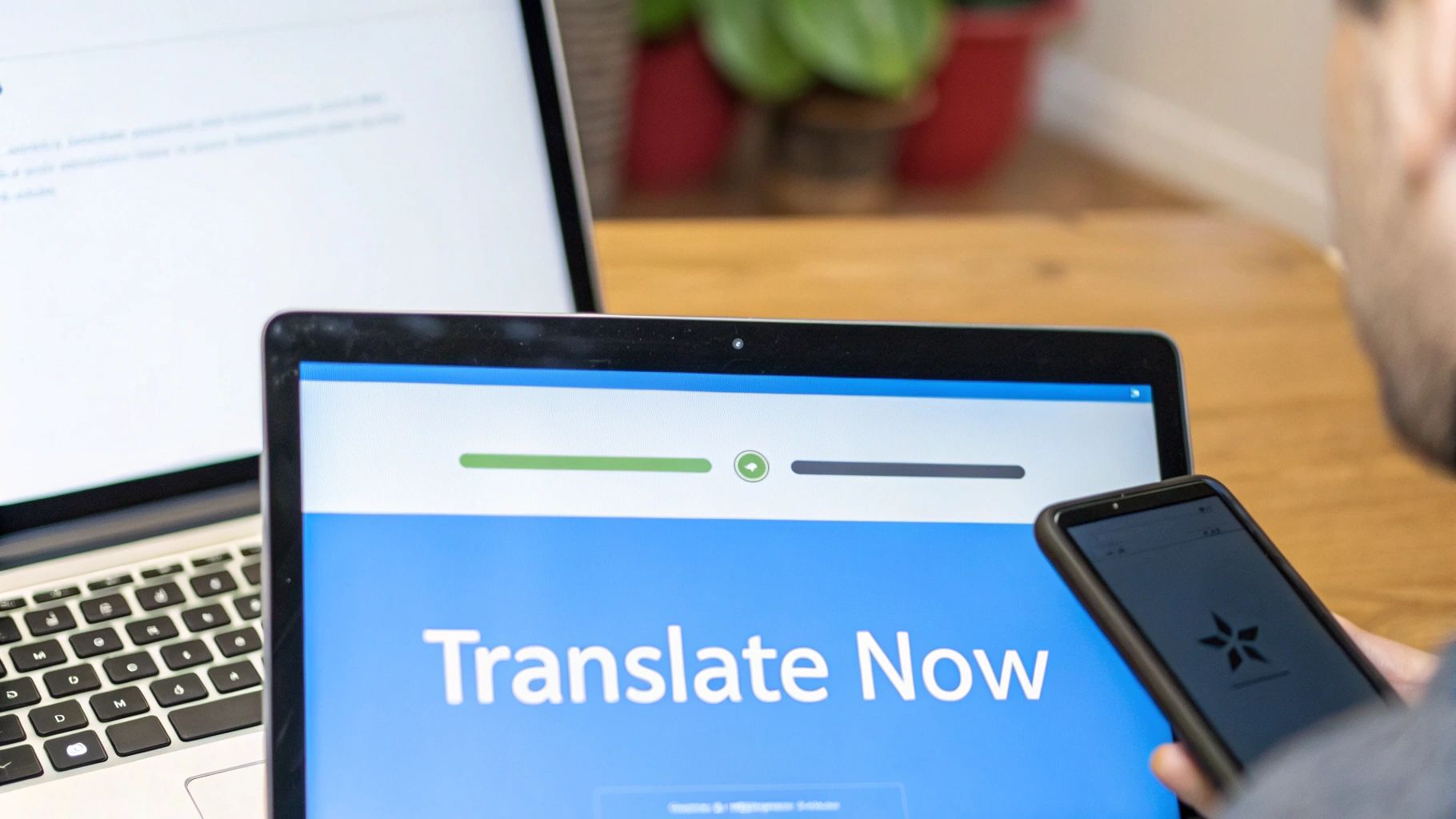
This kind of simplicity means you can stay focused on the content itself instead of getting bogged down in a complicated tool. The next part is just as straightforward.
Kicking Off the Translation
Once your file is in the system, you pick a plan. I'm a fan of BookTranslator.ai's pay-per-book model because it's transparent—no subscriptions to worry about. The platform calculates the cost based on your word count before you ever have to commit, so there are no surprises.
You click the button, and the AI takes over. But this isn't just a simple word-for-word swap. The real magic is how it’s built to understand and maintain the structure of long-form content.
The biggest win here is format preservation. If you're an author translating an EPUB, this is a game-changer. It means all your chapter breaks, headings, and paragraph styles from the French original are perfectly mirrored in the new English file.
That's the kind of detail that separates a specialized tool from a generic copy-paste translator.
Why This Approach Works So Well for French
French is one of the most translated languages in the world, which is great news for us. It means AI models have been fed a massive amount of French-to-English data, making them exceptionally good at catching the nuances between the two. In fact, French was the top target language for translations globally in 2023.
For a tool like BookTranslator.ai, this translates into remarkably accurate output, especially with the advanced models on their Pro plan. We're talking high-fidelity translation for just $9.99 per 100,000 words.
If you're really into the weeds of this stuff, learning about training AI models like ChatGPT on custom data can give you some powerful insights into optimizing these tools even further.
After the AI has done its work, you'll get an email with a download link. Your English document will be waiting, fully formatted and ready for your final review.
Reviewing and Polishing Your Translated Document
Once the AI delivers your translated file, it’s time for the final, and most crucial, phase: the human touch. This review is what separates a decent draft from a truly polished document. It’s an essential quality check for any professional french to english document translation, ensuring the final text reads naturally and actually connects with your target audience.
Think of this less as a re-translation and more as a refinement. Your first read-through should be all about flow and tone. Does the English version feel like the French original? AI can sometimes flatten the tone, translating a formal business proposal and a casual blog post with the same robotic voice. This is your chance to inject the right personality back into the text.
From there, you need to hunt for those classic tripwires where even the most advanced AI can get tangled.
Your Post-Translation Review Checklist
I've learned that a systematic check helps catch the most common issues without getting bogged down. As you read through the English text, keep an eye out for these specific snags.
Literal Idiom Translations: French is full of colorful idioms that make no sense when translated word-for-word. If you come across a phrase like "it costs an arm," the AI has probably misinterpreted the French idiom coûter un bras. The natural English equivalent is, of course, "it costs an arm and a leg."
Cultural Blind Spots: A passing mention of a specific French holiday, a political figure, or a pop culture reference might leave an English-speaking audience scratching their heads. You may need to add a short, clarifying phrase to give the reference its intended weight.
Awkward Phrasing: This is where your human intuition really shines. Some sentences might be grammatically perfect but just sound… off. They feel clunky or unnatural. Trust your gut and rephrase them so they sound like something a native speaker would actually say.
For anyone working with creative text—authors, screenwriters, you name it—my best advice is to read the translated document out loud. It’s an incredibly simple but powerful trick. Your ear will immediately catch awkward rhythms and clunky sentences that your eyes might have glossed over.
A great translation shouldn’t feel like a translation at all. It should read as if it were originally written in English, capturing the spirit and intent of the source text, not just the words.
Using Tools to Finalize Your Document
After you’ve done your manual review, the last step is to let technology do some of the grunt work. Running the document through a dedicated proofreading tool like Grammarly or ProWritingAid is a fantastic final check. These tools are brilliant at catching the little things a human eye can easily miss—a misplaced comma, a subtle typo, or a minor grammatical inconsistency.
This two-step process is my go-to for a comprehensive final polish: first, a thoughtful human review for tone and meaning, followed by an automated grammar check for technical perfection. This ensures your french to english document translation isn't just accurate, but also professional, articulate, and ready for whatever comes next.
Common French to English Translation Mistakes to Avoid
Knowing where translations can go wrong is half the battle. Even with a powerful tool, certain classic slip-ups can turn a great French document into a confusing English one. If you know what to look for, you can save yourself a lot of time, money, and headaches down the road.
One of the biggest culprits I see time and again are faux amis, or "false friends." These are sneaky words that look almost identical in French and English but mean something completely different.
A classic example is the word actuellement. It looks like "actually," but it really means "currently." You can imagine how that simple mix-up could completely alter the meaning of a legal contract or a business proposal.
Navigating Nuance and Formality
It’s not just about single words, either. The broader context is where things can really get tricky. A major one is formality. French has two ways to say "you": the informal tu and the formal vous. A straight translation into English loses that distinction, defaulting to a generic "you." Suddenly, your formal business letter sounds way too casual, or a friendly chat comes off as stiff and impersonal.
Grammatical gender is another subtle hurdle. French assigns gender to inanimate objects, which English doesn't. Sometimes, the context of a sentence hinges on knowing whether "it" refers to a masculine or feminine noun, and a machine translation can easily get confused, leading to ambiguity.
Here's a pro tip: create a simple glossary before you even start. List out your key terms, especially industry jargon or words with no perfect English equivalent. This little bit of prep work acts as a guide for the AI and keeps your translation consistent.
Technical and Formatting Pitfalls
The traps aren't just linguistic; technical glitches can completely derail a project, especially if you're working with tricky file formats.
Here are a few common ones to watch out for:
- PDF Conversion Artifacts: Translating directly from a PDF is asking for trouble. You often end up with broken sentences, messed-up tables, or just plain weird formatting. It's always better to convert the file to DOCX or EPUB first to keep the layout intact.
- Special Character Errors: French is full of accents and special characters (like ç, é, à). Sometimes, these get mangled during the translation or file conversion process, leaving you with garbled nonsense.
- Lost Hyperlinks and Styling: It’s easy to lose things like embedded links, bold text, and italics during the process. This doesn't just look sloppy; it can break the reader's experience and remove important emphasis.
By keeping an eye out for these common linguistic and technical traps, you’ll be in a much better position to review the AI’s work. Your goal isn't just a translated document—it's a document that feels natural and accurate to an English-speaking reader.
Questions We Hear All the Time
Just How Good is AI for French to English Translations?
Honestly, it’s incredibly good, especially for well-written French documents. Both French and English are what we call "high-resource" languages, meaning the AI models have been trained on literally billions of words. This makes the raw output surprisingly reliable.
That said, if you're working on a novel, a script, or any creative piece, you'll still want a human to do a final pass. A person can catch the subtle cultural jokes, the wordplay, and the specific voice that an AI might miss. For anything going to print or publication, that human touch is non-negotiable.
Can I Just Translate a French PDF Directly to English?
You can, but I wouldn't recommend it for anything important. The best practice is always to convert that PDF into a DOCX or EPUB file first.
Why? PDFs can be finicky. A direct translation can scramble your formatting, misplace images, or completely break tables. Taking a minute to convert the file beforehand saves you a massive headache later on by keeping the original layout intact.
For anyone serious about their work, like authors or academics, starting with a clean, editable format is the single most important step you can take. It ensures your translated document looks just as professional as the original.
What’s the Best Tool for Translating a French EPUB?
When it comes to translating an entire book in EPUB format, you need a specialized tool. Generic translators often choke on large files or mangle the formatting.
This is where a dedicated service like BookTranslator.ai really shines. It's built from the ground up to handle long-form content. It understands chapter breaks, paragraph styles, and all the little formatting details that are essential for a professional, readable ebook.
How Long Does It Realistically Take to Translate a 100-Page Document?
With a modern AI tool, a 100-page document (which is typically around 25,000-30,000 words) can be translated in a matter of minutes. It's a game-changer.
To put that in perspective, a professional human translator would likely need several days, if not a week or more, to turn around a project of that size. The speed difference is just staggering.
Ready to see how fast you can get a professionally formatted English version of your French book? At BookTranslator.ai, you can upload your EPUB and have it back in minutes. Start your translation today!