
Creating a great English to Bengali voice translator workflow isn't just about running text through an app. It's about combining smart AI translation with top-notch text-to-speech generation to turn an English ebook into something that genuinely sounds like natural Bengali audio. The goal is to make your content feel right for a whole new audience, and that means using tools that respect your original work and deliver a clean, professional result.
Bringing English Books to Life in Bengali Audio
So, you're ready to take your English book and give it a voice in Bengali? This guide walks you through the entire process, from start to finish, using AI tools that make it both accessible and affordable. We're not just talking about a robotic copy-paste job. I'll show you how to produce an audiobook that sounds authentic and keeps listeners hooked. For authors and creators, this is a powerful way to connect with the massive Bengali-speaking market.
First, we’ll tackle preparing your source file—whether it's an EPUB or a simple text document—to avoid any hiccups down the line. Then, you’ll see how a specialized tool like BookTranslator.ai does the heavy lifting, translating complex text while perfectly preserving your layout. Finally, we'll dive into using modern Text-to-Speech (TTS) engines to generate a professional-sounding Bengali voiceover.
This flowchart breaks down the entire project into three straightforward stages.

As you can see, the journey from an English document to Bengali audio comes down to three core actions: Prepare, Translate, and Generate.
Why This Workflow Matters Now
The appetite for high-quality translated content is bigger than ever. The global language services market is booming, hitting an estimated USD 71.7–75.5 billion in 2024. A huge part of that growth is in South Asia, where Bangladesh alone has a Bengali-speaking population of around 170 million people. A solid English-to-Bengali voice workflow gives you a direct line to this massive audience.
This process is designed to sidestep common translation pitfalls, like losing the original nuance or breaking the document's structure. It's a practical solution for anyone who needs to create high-quality audio content. If you're looking to broaden your audience, understanding how AI makes bilingual books accessible can give you a deeper appreciation for the technology's impact.
Key Takeaway: The real win with this AI-driven approach is how it balances accuracy, speed, and cost. It effectively bypasses the high price tags and long waits that come with traditional manual translation and hiring voice actors.
To give you a clearer picture, here's a quick summary of the workflow we'll be following.
Workflow Snapshot: English to Bengali Voice Translation
| Stage | Objective | Primary Tool/Method |
|---|---|---|
| Preparation | Clean and format the source English text (EPUB or TXT) for accurate translation. | Manual review, text editor, or EPUB editor. |
| Translation | Translate the text into Bengali while preserving the original layout and structure. | BookTranslator.ai for document translation. |
| Generation | Convert the translated Bengali text into a natural-sounding, high-quality audio file. | High-quality Text-to-Speech (TTS) service. |
This table lays out the essential steps, each playing a crucial role in achieving a professional-grade final product.
This approach is especially useful for:
- Independent Authors: Localize your work for new markets without breaking the bank.
- Publishers: Quickly gauge international demand for your titles with a small initial investment.
- Educators and Students: Make academic materials and resources accessible across language barriers.
Preparing Your English Source Text for Translation
Let's start with a foundational truth: the quality of your final Bengali audio is directly tied to how clean your English source file is. If you get this first part right, everything that follows becomes exponentially easier. Think of it as mise en place for a recipe—good preparation prevents a mess later.

You're likely starting with one of two formats: a structured EPUB file from an ebook or a raw text document, maybe from a video transcript. Each one needs a slightly different kind of prep work.
Handling Structured EPUB Files
An EPUB isn't just a block of text; it's a neatly organized package. It has built-in code that tells a tool like BookTranslator.ai where chapters start, what text is a headline, and where paragraph breaks occur. You absolutely want to keep that structure intact.
Before you even think about uploading, do a quick spot-check. Open the EPUB in an e-reader app and look for these key things:
- Chapter Breaks: Make sure chapters are clearly separated. The AI relies on these markers to keep the book's flow logical.
- Headings: Are your main headings and subheadings formatted correctly (like H1, H2, etc.)? This ensures they stay as headings in the Bengali version and don't just become part of a regular paragraph.
- Special Formatting: Check if any bold or italicized text shows up properly. These little details often carry crucial emphasis that you don't want to lose in translation.
Getting this right means the AI has a perfect blueprint to follow, saving you a ton of time fixing the layout later.
Cleaning Up Raw Text Documents
Working with raw text from a transcript or a simple .txt file is a different game. Here, your job is to play janitor and remove all the junk that isn't part of the actual content. An english to bengali voice translator will read every single character you give it, so stray text can throw the whole thing off.
Your main task is hunting down and eliminating digital artifacts. You can get most of this done in minutes with a simple "Find and Replace" function.
Here's what I always look for:
- Timestamps: Search for patterns like
[00:10:45]or(10:45)and replace them with nothing. - Speaker Labels: Get rid of things like "Speaker 1:" or "Interviewer:" unless those labels are critical to understanding the dialogue.
- Action Notes: Delete any descriptions in parentheses, such as
(sound of door closing)or[crosstalk], that you don't want the final voiceover to read out loud.
The principles behind this are pretty universal. In fact, learning about converting scripts for multi-language voiceovers can give you a deeper understanding of how to prep text for audio production, as many of the same rules apply.
My Personal Tip: I always start by searching for square brackets
[and parentheses(. This is a fast way to find almost all the non-narrative clutter in a transcript. It’s a simple trick, but it works every time.
After the clutter is gone, give the paragraph breaks a quick scan. You don't want a massive wall of text. Clean, logical paragraphs not only produce a better translation but also make for a much more natural-sounding audiobook. It might feel like tedious work, but trust me, this prep step pays dividends down the line.
Getting Your Book Translated with BookTranslator.ai
With your source file prepped and ready, it's time for the main event: turning your English text into fluent Bengali. This is where a specialized tool like BookTranslator.ai really comes into its own, doing a whole lot more than a simple copy-and-paste translator ever could. The real goal isn't just swapping out words; it's to carry over the entire reading experience, layout and all.
Getting started is as simple as uploading your cleaned-up file. Once the platform works its magic, you'll face a decision that will shape the entire project's quality and feel.
Choosing Your Translation Engine: Basic vs. Pro
BookTranslator.ai gives you two different translation tiers, and picking the right one really boils down to what kind of book you've written. This isn't just a minor choice; it's a critical step for creating a high-quality English to Bengali voice translator output.
- The Basic Plan: This is a fantastic, wallet-friendly option for more direct content. If you've written non-fiction, technical manuals, or academic papers where clarity is king, this plan delivers a highly accurate translation that gets the job done perfectly.
- The Pro Plan: Now, if you're translating fiction, a memoir, or anything packed with idioms, subtext, and a unique authorial voice, the Pro plan is a no-brainer. It taps into more sophisticated AI models that are trained to catch the subtle nuances that give a story its personality, making sure the Bengali version feels just as authentic as the original.
For a novel, that small extra investment in the Pro plan can be the difference between a translation that's just correct and one that's truly captivating.
The Magic of Smart Formatting
One of the most common headaches with generic translation tools is how they completely obliterate your formatting, leaving you with a messy wall of text. BookTranslator.ai has a built-in solution for this called Smart Formatting.
This isn't just a gimmick. The technology is specifically designed to identify and protect the structure of your original document. When you translate your book, it automatically keeps:
- Chapter breaks and titles
- All your headings and subheadings (H1, H2, H3, etc.)
- Paragraph breaks
- Bold and italic styling
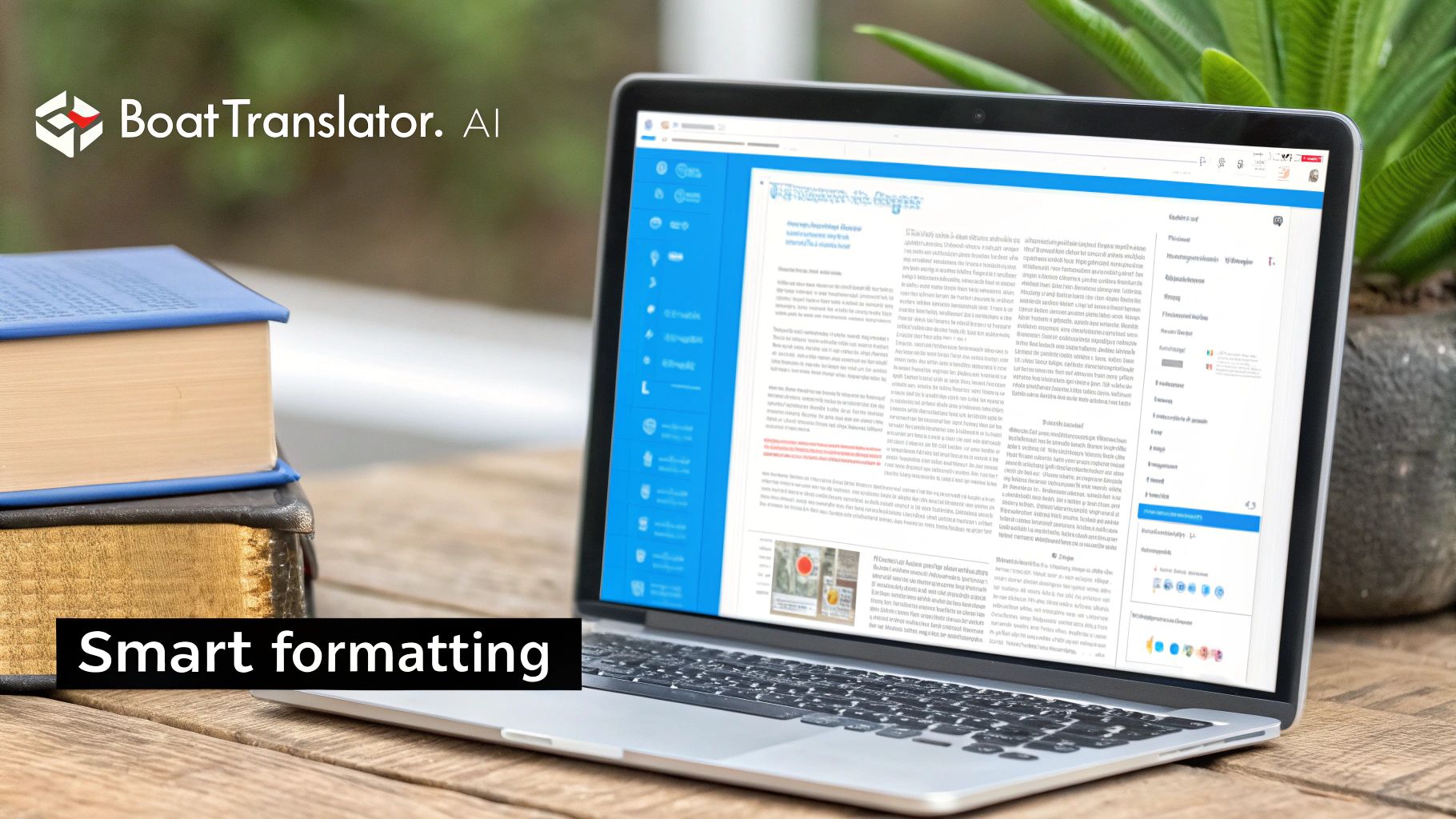
The image above shows not only the powerful features but also the clear, upfront pricing—a simple, per-book cost that takes the guesswork out of budgeting.
A Quick Tip from Experience: Preserving your formatting is more than just about looks. It’s absolutely essential for the text-to-speech stage. A properly structured document helps the TTS engine understand pauses, differentiate between headings and body text, and ultimately create a much more natural-sounding audiobook.
This one feature alone can save you dozens of hours of mind-numbing manual reformatting. If you're curious about the tech behind it, our guide on the modern AI book translator offers a deeper look. The bottom line is your translated EPUB will look just like the original, setting you up perfectly for the next step.
Weighing the Cost and Benefit
The choice to use a tool like this often comes down to a simple balance of cost, speed, and quality. Today, you generally have two options: high-cost, premium human localization or affordable, AI-powered workflows. BookTranslator.ai fits squarely in that second camp with its transparent, per-project pricing, offering a powerful option for big projects.
To put it in perspective, translating an 80,000-word ebook can cost less than USD 10 with this service. Compare that to traditional human translation rates, which could run anywhere from USD 2,400 to USD 16,000 for the same manuscript. That's a massive difference.
This level of cost-effectiveness opens up global audiences to independent authors and small publishers who were previously blocked by prohibitive expenses. You're not just buying a translation; you're buying an affordable ticket to a brand-new market.
Refining and Polishing Your Bengali Translation
After BookTranslator.ai works its magic, you'll have a very solid Bengali draft in your hands. But even the best AI translation needs a human's final touch. This isn't about starting over; think of it as polishing a diamond to make it truly shine.
This last pass is what separates a technically correct translation from one that feels genuinely natural to a native Bengali speaker. It’s the final, critical step to creating a seamless english to bengali voice translator experience that truly connects with your audience.
The Polishing Checklist: What to Look For
Your job here isn't to hunt for huge mistakes. Instead, you're looking for the small details that make a big difference in flow, tone, and cultural connection.
Here’s what I always check for:
- Cultural Fit: Do the idioms and metaphors actually land in Bengali? An English phrase like "it's raining cats and dogs" has a direct equivalent, but many don't. You need to make sure these are swapped out for expressions a Bengali listener would instantly recognize.
- Consistent Tone: Is the voice consistent with the original author's? If the English was formal and academic, the Bengali needs to feel the same. If it was casual and conversational, that vibe has to come through.
- Proper Nouns: This is a big one. Double-check how names, places, and brands have been transliterated. AI sometimes makes an educated guess that’s just slightly off, and getting these right is crucial for your credibility.
- Natural Flow: Read a few paragraphs out loud. Seriously. Do the sentences roll off the tongue, or do they sound stiff and robotic? Sometimes, just shuffling a few words around can dramatically improve how natural it sounds.
What If You Don't Speak Bengali?
Don't worry, you can still do a very effective quality check. My go-to method is back-translation.
Grab a few important paragraphs from the Bengali text and pop them into a different online translator to convert them back to English. It won’t match your original text word-for-word, but it absolutely should convey the same core meaning and tone. If the back-translated English seems weird or misses the point, that’s your signal to have a native speaker take a closer look at that section.
Key Insight: The goal of back-translation isn't to check for perfect grammar. It’s a sanity check to ensure the fundamental message and feeling of your content survived the translation process.
For that final layer of confidence, I highly recommend bringing in a native Bengali speaker. You don't need to hire a full-blown editor. Just find a freelancer on a platform like Upwork or Fiverr for a quick proofread. Ask them specifically to check for cultural appropriateness and natural phrasing, not to re-translate anything. It's a surprisingly affordable way to get an expert's seal of approval.
The Final Audio-Ready Proofread
Before you hand your text over to a Text-to-Speech (TTS) engine, one last read-through is non-negotiable. The goal is to make sure the text will sound as good as it reads. Many of the same principles in proofreading techniques for transcribed content apply here.
You're scanning for anything that might trip up an AI voice—awkward phrasing, a comma in the wrong place that creates a weird pause, or typos that could lead to mispronunciations.
This final check ensures your script is perfectly prepped for audio. A clean, polished text is the bedrock of a professional-sounding audiobook, so don't skip this step. It's your guarantee of a smooth, engaging listening experience for your audience.
Alright, your translated Bengali text is looking sharp. Now for the fun part: bringing it to life. This is where we turn that polished manuscript into an audiobook, and the magic ingredient is a top-notch Text-to-Speech (TTS) engine. Our goal isn't just to get the words read aloud; it's to find a voice that genuinely captures the spirit of your work, leaving that robotic sound far behind.
The demand for this kind of technology is surging. The market for language-translation devices shot past USD 990 million back in 2022 and is still climbing. When you realize that three out of every four internet users don't have English as their first language, a solid english to bengali voice translator workflow is more than a novelty—it's a gateway.
This isn't just about reaching the nearly 170 million native speakers in Bangladesh. It's about connecting with massive Bengali-speaking communities all over the world, opening your work up to entirely new audiences who are eager for quality content in their own language.
Choosing the Right Text-to-Speech Platform
Let’s be clear: not all TTS services are built the same, particularly when you're working with a language like Bengali. You have to look past the basic features and zero in on platforms that deliver incredibly natural, high-fidelity voices. The best ones use sophisticated AI to really mimic human pacing, intonation, and even emotion.
When you're trying to decide, the first thing you should do is listen to their Bengali voice samples. Do they sound engaging and clear, or are they flat and mechanical? That simple audio test will tell you almost everything you need to know.
Beyond the voice itself, you need solid customization options. The power to fine-tune the audio is what separates a decent audiobook from a truly professional one. Many of the same principles for choosing a translation tool apply here, as both require a keen eye for quality and detail. You can find some good guiding ideas among the best tools for translating foreign language books.
My Personal Tip: Before I commit to any service, I run the first chapter of my book through it. This gives me a real-world sample of how the AI voice handles my specific writing style and vocabulary. It’s a much better test than listening to a generic, pre-made demo.
To help you narrow down the options, here’s a look at some of the top contenders for generating high-quality Bengali audio.
Comparing Top Text-to-Speech Services for Bengali
When evaluating TTS platforms, it's helpful to compare them based on the features that matter most for creating a compelling audiobook. Here's how some of the popular services stack up.
| TTS Service | Bengali Voice Quality | Customization Options (Pitch, Speed) | Pricing Model | Best For |
|---|---|---|---|---|
| Google Cloud Text-to-Speech | Excellent, very natural with WaveNet voices. | Extensive control via SSML tags. | Pay-per-character after a free tier. | High-quality projects where naturalism is key. |
| Amazon Polly | Good, with clear and consistent neural voices. | Good, supports SSML for fine-tuning. | Pay-per-character, generous free tier. | Scalable projects and integrating with AWS. |
| ElevenLabs | Industry-leading, human-like and emotive. | Granular control over stability and clarity. | Subscription-based tiers with character quotas. | Projects needing top-tier voice realism and emotion. |
| Murf.ai | Solid, with a focus on studio-quality output. | Good, with an intuitive editor for adjustments. | Subscription-based. | Creators looking for an all-in-one voiceover studio. |
This comparison should give you a solid starting point. Your final choice will likely come down to balancing your budget against the level of voice quality and control your project demands.
Preparing Your Text for Voice Conversion
Just like you prepped your source file for translation, your Bengali text needs a little tidying up before it meets the TTS engine. A bit of organization at this stage saves a ton of headaches later.
My advice? Break your book down into smaller files, usually chapter by chapter. Trying to upload an 80,000-word manuscript in one go is asking for trouble—it can be incredibly slow and clunky. Working in chapters gives you manageable audio files and makes it so much easier to go back and fix a small section if you need to.
- Process Chapter by Chapter: Create a separate text file for each chapter before feeding it into the TTS platform.
- Use Consistent Filenames: Keep your audio files organized with a simple naming convention like
Chapter_01.mp3,Chapter_02.mp3, etc. - Scan for AI Tripwires: Do one last read-through. Look for anything that might confuse an AI voice, like weird abbreviations or unusual punctuation.
Fine-Tuning the Audio Performance
This is where you put on your director’s hat. Most advanced TTS platforms give you the tools to adjust the final audio, creating a much more dynamic and polished listening experience.
Don't be afraid to play with the settings for pitch, speed, and pauses. For an intense action scene, you might bump up the reading speed just a touch. For a reflective or dramatic moment, adding a half-second pause after a powerful sentence can add a surprising amount of emotional weight.
Listen carefully for any mispronunciations, especially with character names or unique terms. The best services have a feature that lets you input the phonetic spelling for specific words, ensuring they're pronounced correctly every single time. Finally, make sure the audio levels are consistent across all your files. A smooth, even volume is the hallmark of a professionally produced audiobook.
Your Questions Answered: What to Expect from This Workflow
Diving into a new process like this naturally brings up a few questions. As you get ready to take your English manuscript and turn it into a polished Bengali audiobook, you're probably wondering about accuracy, cost, formatting, and just how good the final product will sound.
Let's walk through the most common questions I hear. This isn't about guesswork; it's about giving you the real-world answers you need to move forward with confidence.
Just How Accurate is AI for Translating a Book into Bengali?
Modern AI, especially a tool built specifically for long-form content, is impressively accurate. For most non-fiction and a good deal of general fiction, you can realistically expect the first draft to be 95-99% accurate. These systems are fantastic at grasping the core context and keeping sentence structures intact.
Now, where it gets tricky is with highly creative or literary works. If your book is packed with cultural nuances, subtle wordplay, or unique idioms, a human touch in post-editing is non-negotiable. That’s how you’ll capture the author’s true voice. But here’s the key: the AI gives you an incredibly solid foundation to work from, slashing the time and money you’d spend on a traditional translation project.
The Bottom Line: The AI does the heavy lifting with remarkable precision. Your job during post-editing is to add that final layer of cultural polish and finesse, not to translate the whole thing from scratch.
This hybrid approach really does offer the best of both worlds—the speed of AI with the irreplaceable touch of human insight.
Can I Really Keep My Book's Formatting?
Yes, absolutely. This is one of the biggest wins of using a specialized tool. When you upload a well-structured EPUB to a platform like BookTranslator.ai, its 'Smart Formatting' technology is designed to recognize and preserve the entire layout.
Think about all the tedious work this saves. The system automatically protects:
- Chapter breaks and their titles
- All your headings and subheadings (H1, H2, etc.)
- Paragraph structure and even specific line breaks
- Text styling like bold and italics
Without this, you’d be stuck with a wall of text from a generic online translator, facing hours of manual reformatting. This feature ensures your translated e-book looks just as professional as the original and is ready for distribution right away.
What's the Real Cost of This Entire Process?
The total investment really comes down to two things: translating the text and generating the voice. Thankfully, both are more affordable than you might imagine.
First, the translation itself. A service like BookTranslator.ai is incredibly cost-effective. Translating a full 80,000-word novel can often cost less than $10. It’s a tiny investment to test your book in a massive new market.
Second is the Text-to-Speech (TTS) service. While most have free tiers to get you started, producing a full audiobook will almost certainly require a paid plan. Depending on the platform and the length of your book, this could run anywhere from $20 to $100+. But even when you add it all up, the total cost is a tiny fraction of the thousands you would spend on a human translator and professional voice actor.
How Natural Will the Bengali AI Voice Actually Sound?
AI voices have come a long way. The robotic, monotone sound is a thing of the past. Today's top-tier TTS services offer Bengali voices with surprisingly realistic intonation, pacing, and emotional range. The technology has advanced so much that you can generate genuinely engaging, podcast-quality audio from a simple text file.
Will it capture every last subtle nuance of a seasoned voice actor? Maybe not. But the leading AI voices are incredibly listenable and more than suitable for audiobooks, especially in the non-fiction and educational spaces.
My advice is to always listen to samples from a few different providers before you commit. This lets you find a voice that truly matches the tone of your book, ensuring the final product feels right.
Ready to bring your book to a new audience? With BookTranslator.ai, you can translate your entire EPUB into Bengali while keeping your original formatting perfectly intact. Get started in minutes and see how easy it is to reach readers around the world.