
So, what exactly is an AI book translator? Think of it as a highly specialized tool that uses a specific kind of artificial intelligence—neural machine translation—to convert your entire book from one language to another. The magic is that it's built to handle large files like EPUBs while carefully preserving all the formatting that makes your book readable, offering a much faster and more affordable path to global readers than traditional methods.
How AI Book Translators Actually Work
Ever wondered what's happening under the hood when you upload your manuscript? It’s not just a simple word-for-word swap. It’s more like a digital brain rapidly recalling patterns from billions of translated texts it has already studied. This whole process is powered by a technology known as Neural Machine Translation (NMT).
Imagine an NMT model as a brilliant student who has spent years devouring literature, technical manuals, and articles in hundreds of languages. Instead of just memorizing vocabulary, this student learned the relationships between the words—understanding context, grammar, and even stylistic nuances. This is what allows the AI to translate entire sentences and paragraphs as a whole, avoiding the clunky, literal translations of the past.
The Core Engine: Neural Machine Translation
At the heart of any AI book translator is its NMT engine. These systems are "trained" on enormous datasets of parallel texts, which are simply documents that already exist in two different languages. By analyzing these pairs, the AI learns to predict the most likely sequence of words in the new language that captures the meaning of the original text.
This predictive power is why modern AI translations feel so much more natural. The AI doesn't just know that "libro" means "book"; it understands that "un buen libro" is the correct way to phrase it in Spanish, not "a book good." You can get a much deeper look into the mechanics in our guide on how AI translation for books works.
To get a sense of how powerful these models can be, consider the process of training an AI on your proprietary data, which shows how feeding specific information to a model can sharpen its skills for specialized tasks.
The demand for this technology is skyrocketing. The AI language translation market is on track to hit USD 2.94 billion in 2025, a clear sign of how quickly it's being adopted. This growth is being pushed by major shifts, like AIs that can interpret both text and images and the fusion of generative AI with NMT to produce more creative, context-aware translations.
To break it down, here’s a quick look at the core components.
AI Book Translation at a Glance
| Core Technology | What It Does | Example Application |
|---|---|---|
| Neural Machine Translation (NMT) | Acts as the "brain," analyzing sentence context to produce natural-sounding translations. | Translating the phrase "it's raining cats and dogs" into a culturally appropriate equivalent, not a literal one. |
| File Parser (e.g., EPUB, DOCX) | "Reads" the book's structure, identifying chapters, headings, and text styles. | Recognizing that Chapter 3 starts on page 42 and has a title in a specific font. |
| Formatting Preservation Engine | Reapplies the original styles and structure to the newly translated text. | Ensuring a character's italicized inner thoughts remain italicized in the Spanish version. |
| User Interface (UI) | Provides the simple dashboard where you upload files, select languages, and download the finished product. | A clean "drag-and-drop" area for your book file and a dropdown menu to pick your target language. |
These pieces all work together to deliver a book that not only reads well but also looks right.
Preserving Your Book's Formatting and Structure
A book is so much more than a wall of text. It has chapters, italicized thoughts, bolded warnings, and paragraph breaks that you've put there for a reason. A generic translation tool might just obliterate all that, leaving you with a messy, unreadable document.
A specialized AI book translator is built differently. It's designed to parse the underlying code of files like EPUB or DOCX. Here’s what that actually means for your book:
- Chapter Integrity: Your chapter breaks and titles stay exactly where they belong, keeping the narrative flow intact.
- Text Styling: Crucial formatting like italics, bold text, and underlines are recognized and carried over to the translated version.
- Layout Consistency: Paragraphs, line breaks, and other structural elements are preserved, so the translated e-book looks just like the original.
Key Takeaway: An effective AI book translator is both a linguist and a typesetter. It translates the words while respecting the carefully crafted structure of your manuscript, saving you countless hours of tedious reformatting.
This dual capability is what separates a professional tool from a simple copy-paste job. It understands that how your story is presented is just as important as the words themselves, delivering a file that is ready for a final human polish and publishing.
Your Practical Guide to Translating a Book with AI
So, how does this all work in the real world? Getting your book translated with AI is surprisingly straightforward. It’s not some abstract, techy process—it's a practical workflow that breaks down into a few manageable steps.
Think of it less as handing your book over to a robot and more as directing a highly efficient assistant. Let's walk through the four phases you'll encounter.
Step 1: Prep and Upload Your Manuscript
Everything starts with your original book file. For the smoothest translation, you’ll want to give the AI a clean, well-structured manuscript to work with. While standard DOCX files are usually fine, the EPUB format is often the gold standard. Why? Because it’s built to preserve everything from chapter breaks and headings to embedded images, exactly as you intended.
Before you upload, take a moment for a quick check-up:
- Zap any typos. The AI translates what it sees, so a typo in your source text will become a confusing mistake in the translation.
- Keep formatting consistent. Simple things like using proper heading styles (H1 for the book title, H2 for chapters) give the AI crucial clues about your book's structure.
- Simplify complex visuals. If you have intricate charts or graphics with lots of text, you might want to handle those separately after the main translation is done.
Once your file is polished and ready, uploading is as simple as dragging and dropping it onto the platform.
Step 2: Set Your Translation Preferences
With your book uploaded, it’s time to play director. This is where you tell the AI exactly what you need.
First, you'll pick your source and target languages—say, from English into German. Then, you might get a choice of AI models. Many services offer a standard model for general-purpose translation and a "Pro" or advanced model that delivers more nuance and accuracy, which is perfect for fiction or complex non-fiction.
This is also your chance to set up a glossary. This is just a simple list of key terms and how you want them translated. It's a lifesaver for keeping character names, fantasy world locations, or specific technical terms consistent from start to finish.
Getting these settings right from the beginning helps steer the AI, ensuring the first draft is as close to your vision as possible.
Step 3: Let the AI Do the Heavy Lifting
Once you’ve confirmed your settings, the AI gets to work. This is the part where you can grab a coffee and relax. The system meticulously goes through your entire manuscript, translating it sentence by sentence while working to reconstruct your original formatting on the other side.
This is where the speed is just astounding. A process that would take a human translator months can be completed in a matter of minutes or, for a full-length novel, maybe a few hours. The AI is generating a complete first draft for you. While it works, you can get ready for the final, most important phase. If you're curious about different platforms, you can find a great breakdown in this comparison of five AI book translation services tested from free to premium.
Step 4: The Human Touch—Review and Post-Edit
The AI-generated translation is a fantastic starting point, but it's not the finished product. The final step is what the industry calls Machine Translation Post-Editing (MTPE), and it’s where a human expert makes the text truly sing.
This isn’t just about fixing mistakes. It’s about breathing life and soul into the translation. A skilled human editor, ideally a native speaker of the target language, will:
- Smooth out the nuances. They’ll catch and rephrase sentences that are technically correct but just sound "off" or culturally awkward to a native reader.
- Preserve your authorial voice. The editor ensures that your unique style—your humor, your tone, your rhythm—comes through loud and clear in the new language.
- Ensure consistency. They'll double-check that all the key terms from your glossary are used correctly and that character names don't change halfway through the book.
This final, collaborative step is what makes the whole process work so well. You get the incredible speed and efficiency of AI combined with the irreplaceable artistry of a professional human linguist. After this polish, your book is finally ready to meet its new global audience.
Weighing the Pros and Cons of AI Translation
An AI book translator is an incredibly powerful tool, but it's important to be realistic about its strengths and weaknesses. It isn't a magic wand for a perfect, final manuscript. Think of it more as a remarkably efficient "first-draft" machine that creates new opportunities for authors and publishers everywhere.
Understanding this balance is the key to using AI translation the right way.
The Good: Speed, Cost, and Accessibility
The biggest win, without a doubt, is speed. A human translator could easily spend months carefully working through a novel. An AI, on the other hand, can generate a complete, formatted draft in just a few hours—sometimes even minutes. That kind of velocity completely changes the game for global publishing, turning a long-term goal into a project you can finish this week.
Right alongside speed is the massive cost reduction. Let's be honest, professional human translation is a serious investment, often running into thousands of dollars for a single book. AI shatters that financial barrier. It makes it genuinely possible for indie authors, small presses, and academics to reach international readers without needing a huge budget.
This simple, four-step journey is how you get from your original manuscript to a translated first draft.
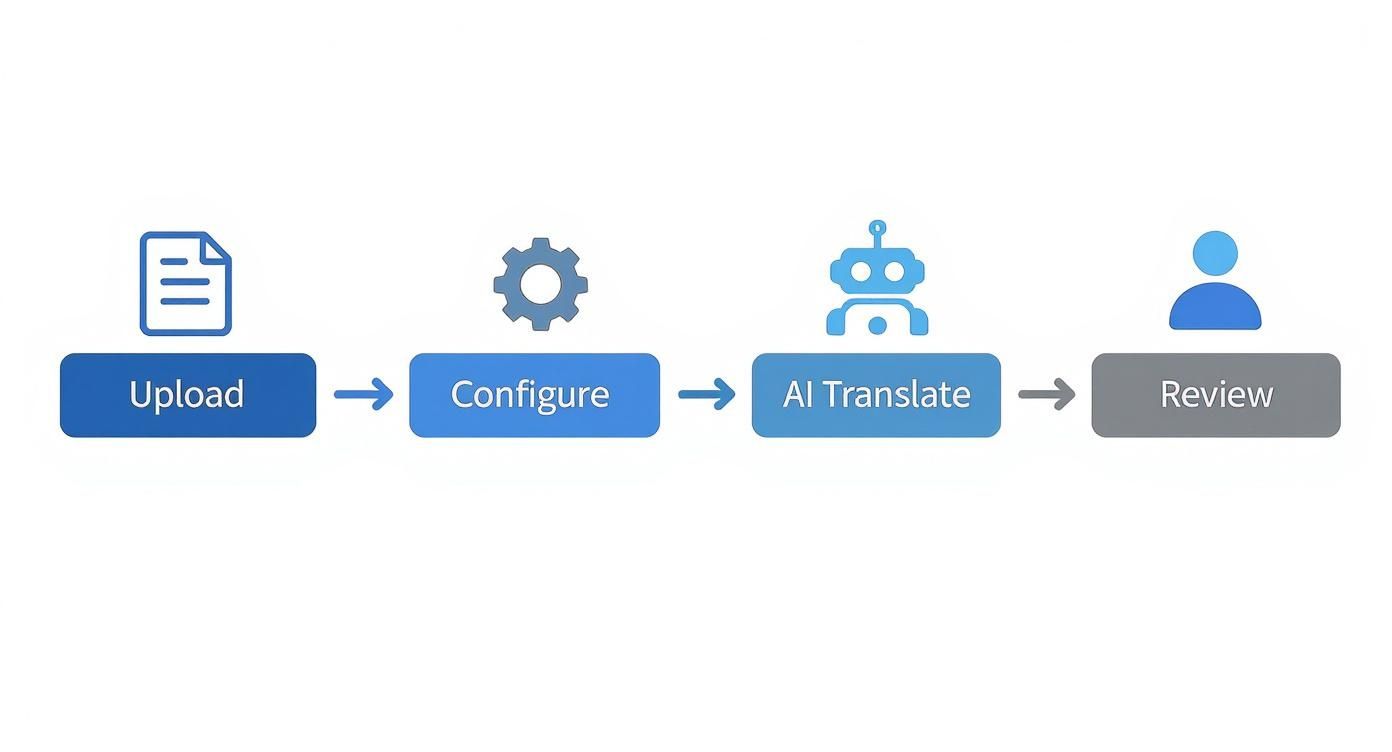
As you can see, the heavy lifting is automated. This frees you up to focus on the important parts: the initial setup and the final, crucial review.
The Not-So-Good: Where AI Still Falls Short
For all its technical prowess, AI has its limits, especially when it comes to the true art of language. This is where the machine’s logic bumps up against the beautiful, messy, and sometimes irrational nature of human creativity.
An AI often struggles to capture the soul of a story. It can translate the words, but it doesn't always understand the intent behind them. You'll notice this in a few key areas:
- Literary Nuance: Poetic language, clever wordplay, and subtle bits of foreshadowing can get lost in translation. The AI might give you a literal meaning but miss the artistry completely.
- Cultural Context: Humor, idioms, and cultural references are a minefield for machines. A joke that’s hilarious in English might become confusing or just plain weird in Japanese if translated word-for-word.
- Authorial Voice: Every writer has a unique rhythm and tone. While the latest AI models are getting much better at mimicking style, they can still produce text that feels a bit flat or generic, stripping the prose of its personality.
This is precisely why you should treat the AI's output as a first draft. It gives you a structurally sound and grammatically solid base to work from, but it needs a human touch to shape it into a true work of art. For a closer look at this dynamic, check out our detailed comparison of AI vs. human translation.
Finding the Smart Balance: AI + Human
So, what’s the answer? It’s not about choosing between AI and a human translator. The smartest approach is to combine their strengths.
To help you decide what's right for your project, here’s a quick breakdown of how AI and human translation stack up against each other.
AI vs. Human Translation for Books
| Factor | AI Book Translator | Human Translator |
|---|---|---|
| Speed | Extremely fast (minutes to hours) | Slow (weeks to months) |
| Cost | Very low, often a small flat fee or subscription | High, often priced per word |
| Nuance & Context | Struggles with idioms, humor, and cultural references | Expertly handles cultural and literary nuances |
| Authorial Voice | Can be generic; may "flatten" the author's style | Preserves and adapts the unique authorial voice |
| Consistency | Perfectly consistent with terminology | Can have inconsistencies without a glossary |
| Best Use Case | Generating a high-quality first draft quickly | Final polishing, literary works, marketing copy |
As the table shows, each has a clear role to play. The best strategy is to use an AI book translator to generate the initial draft and then bring in a professional human editor for the final post-editing. This hybrid model gives you the best of both worlds: you get the incredible speed and affordability of the machine, paired with the nuance and cultural fluency of a human expert.
The Best Practice: Think of the AI as your incredibly fast assistant who prepares all the raw material. The human editor is the master craftsperson who provides the final polish, making sure the translation truly connects with its new audience.
This hybrid workflow, often called Machine Translation Post-Editing (MTPE), is quickly becoming the new industry standard for good reason. It’s efficient, it’s cost-effective, and it produces fantastic results. The broader translation market reflects this shift; the global machine translation market hit over USD 1.1 billion in 2022 and is on track to reach USD 3 billion by 2027.
This trend isn't just happening in publishing. In the academic world, for instance, researchers are using other powerful AI tools for academic research to analyze data and speed up their work. By understanding both the amazing capabilities and the current limitations of AI, you can build a translation process that works perfectly for your book.
Who Should Use an AI Book Translator
So, is an AI book translator actually the right move for you? It really boils down to your goals, your budget, and the kind of book you've written. This technology isn't some magic bullet for everyone, but for certain authors and publishers, it’s swinging open doors that were previously bolted shut.
Let's walk through a few of the people who stand to gain the most from this. Seeing their situations might just feel a bit familiar.
The Budget-Conscious Indie Author
Picture this: you're an independent author. You've bled for your book—writing, editing, cover design, the whole nine yards. You're running a lean operation, and the idea of spending thousands of dollars on a traditional human translator has kept your global ambitions on the back burner. It just feels too risky.
This is where an ai book translator completely changes the equation. It gives you a low-cost, low-risk way to dip your toes into a new market. Instead of betting the farm on one language, you can get a surprisingly solid first draft for a tiny fraction of the cost. From there, you can see if readers are biting before you decide to invest in a human editor for that final, crucial polish.
Your Game Plan:
- Test the Waters: Pick a market you've had your eye on—maybe German or Spanish—and launch your translated book to see if it finds an audience.
- Edit Smarter: Put your money where it counts. Hire a professional editor who specializes in cleaning up AI translations (a process called MTPE). They'll know exactly how to make it shine.
- Grow on Your Own Terms: If the book takes off, you can roll the profits into translating it into more languages. Suddenly, you're building a global brand, one step at a time.
This strategy turns international publishing from a terrifying financial leap of faith into a smart, data-backed business move.
The Small Publisher with a Backlist
Now, let's look at the small press. You're likely sitting on a goldmine—a backlist of dozens, maybe even hundreds, of fantastic titles. But the thought of translating that entire catalog the old-fashioned way is a non-starter. The cost would be astronomical and the timeline would stretch for years.
An AI book translator makes unlocking that hidden value a realistic goal. It brings mass translation projects from the "impossible" pile to the "let's do this" pile. You can create a workflow where the AI handles the heavy lifting, generating initial drafts that a small team of editors can then perfect. Your backlist is no longer gathering dust; it's becoming a new source of international income.
The Big Picture: For publishers, AI is all about scale. It empowers you to run a global content strategy that would be completely out of reach otherwise, squeezing every last drop of value from the books you already own.
The Genre Fiction Author
Do you write thrillers, romance, or sci-fi? Your writing is probably tight, fast-paced, and driven by plot. While there's absolutely an art to it, your prose likely doesn't lean on the kind of dense metaphors, cultural nuance, or lyrical wordplay you'd find in a literary novel.
This is the sweet spot for an ai book translator. The AI is fantastic at processing clear, direct language. It can also keep perfect track of character names, made-up technologies, and all the little details that keep your world consistent. What you get is a first draft that's often incredibly close to the finish line, requiring much less heavy editing to get it ready for eager readers.
The Non-Fiction and Academic Author
Finally, consider the non-fiction author. You’ve written a technical manual, a historical deep-dive, or an academic paper. Your number one job is to transfer information clearly and accurately. The language is functional; it’s there to educate, not to create a specific literary mood.
This is another area where AI translation just makes sense. The technology is exceptionally skilled at handling complex terminology and factual statements. For a student, a researcher, or a professional who just needs to understand information written in another language, AI delivers a translation that is reliable, readable, and perfectly suited for the task at hand.
Choosing the Right AI Translation Plan

When authors first look into AI translation, the price tag is usually a pleasant surprise—it’s far more affordable than many expect. But to get the most out of your budget, you need to understand how the pricing works. You'll generally run into two common models, each built for a different kind of author or publisher.
Figuring out which one is right for you boils down to your publishing goals and how many books you plan to translate. Let’s walk through the options so you can pick the smartest path for your project.
Pay-Per-Book for Ultimate Flexibility
The most straightforward option is the pay-per-book model. It's exactly what it sounds like: you pay a one-time fee to translate a single manuscript. The cost is usually based on the total word count, so you know precisely what you're paying before you commit.
This approach is perfect for authors who are just dipping their toes into the global market.
- One-Time Projects: Got a single book you want to translate to test the waters in a new country? This model is your low-commitment entry point.
- Infrequent Needs: If you only plan to translate a book every year or so, paying as you go makes a lot more sense than a recurring fee.
- Clear Budgeting: The cost is locked in upfront. No monthly charges, no surprises—just a simple, predictable expense.
For instance, a service like BookTranslator.ai uses this exact model. You can get a full-length, 100,000-word novel translated for as little as $5.99. It’s a transparent and incredibly accessible way to get started.
Subscriptions for Prolific Publishers
On the other end of the spectrum are subscription models. With these, you pay a recurring monthly or annual fee for a set number of words or book translations. Think of it like a cell phone plan, but for your global publishing ambitions.
This structure is built for authors and publishers who are working at scale.
The subscription approach is ideal for small publishers aiming to translate their entire backlist or for prolific authors who release multiple books a year and want to launch them in several languages simultaneously.
Over time, this consistency can lead to a much lower per-word cost, turning your translation efforts into a well-oiled machine for global growth.
Factors That Influence the Final Price
Beyond the basic pay-per-book versus subscription choice, a few other things can move the needle on your final cost. It pays to look past the headline price and see what’s included.
The global AI language translator tool market is absolutely exploding. It was valued at around USD 2.8 billion in 2024 and is on track to hit USD 12.1 billion by 2033. This incredible growth, detailed in a recent market intelligence report, means more competition and more features, all of which affect pricing.
Here are a few key features to look for:
- AI Model Quality: Does the plan give you a standard AI engine, or can you access more advanced, premium models? A "Pro" plan might cost a little more, but a better AI can produce a much cleaner first draft, saving you a ton of time on post-editing.
- Collaboration Tools: Some platforms offer side-by-side editors where you can work directly with a human translator. This is a huge plus for streamlining the review and editing process.
- Support and Guarantees: A money-back guarantee and real customer support aren't just nice perks; they’re a safety net. For your first project, knowing you have that backup can make all the difference.
By balancing how often you publish with the features that matter most to you, you can make a truly informed choice. Whether you're a first-timer testing a new market or a publisher ready to go global, the right ai book translator plan is out there to fit your needs and budget.
Got Questions About AI Book Translators?
It's smart to have questions. You've poured your heart and soul into your book, and handing it over to new technology can feel like a leap of faith. Most authors and publishers I talk to have similar concerns about quality, who owns the final product, and how it all really works.
Let's tackle those big questions right now so you can move forward with confidence.
Can AI Really Translate Complex Literary Fiction?
This is the big one, isn't it? The honest answer is: it depends on what you expect. AI translation has come a long way, but it still struggles with the soul of a story—the subtle metaphors, the unique rhythm of an author's voice, and the clever wordplay that makes literary fiction special.
For a complex novel, think of the AI as a brilliant but very literal assistant. It can generate a solid first draft, but it can't replicate human artistry. You absolutely need a skilled human translator to step in and breathe life into that draft, capturing the cultural nuances and emotional depth.
The Bottom Line: For literary fiction, AI is a fantastic starting block, not the finish line. The magic happens when a human expert takes the AI's foundation and sculpts it into a work of art.
If you go in expecting a perfect, ready-to-publish literary translation straight from the machine, you'll be disappointed. But use it as a tool? That's where you'll find its power.
Do I Own the Copyright to the AI-Translated Book?
Yes, absolutely. You retain 100% full copyright ownership.
Using an AI translator is like using any other tool, whether it's Microsoft Word to write your manuscript or Vellum to format it. The AI is helping you create what's legally known as a "derivative work" based on your original intellectual property.
The rights to that new, translated version of your book belong to you and you alone. That said, always, always read the terms of service for any platform you use. Any reputable service will state this clearly, but it's your job to double-check. Your IP is your business, so make sure it's protected.
How Do I Find a Great Editor for an AI Translation?
This is probably the most crucial step in the whole process. Don't just look for a good editor; you need a specific kind of specialist to polish an AI-generated text.
You're looking for someone who is a native speaker of the target language (the language you're translating into) but also fluent in the original language. The key phrase to search for is "machine translation post-editing" (MTPE). This is a unique skill that involves refining raw AI output into something that reads naturally.
Here's how to track down the right person:
- Search Specialized Marketplaces: Websites like Reedsy, Upwork, and Fiverr Pro are great places to find professionals with this specific experience. Use "MTPE" in your search.
- Check Their Experience: Ask potential editors for samples of their MTPE work. You want to see that they have a track record of transforming machine translations into polished books.
- Do a Paid Sample Edit: Once you've narrowed it down, give your top two or three candidates a single chapter as a paid test. This is a small investment that will show you exactly who can best capture your voice and make your book shine.
Is This Really Better Than Just Using Google Translate?
Without a doubt, yes. Using a dedicated AI book translator is a world away from a free tool like Google Translate. While Google is fine for translating a quick email or a menu, it's simply not built for the heavy lifting of a full-length book.
Professional AI book translators are designed for one job, and they do it well. Here’s what sets them apart:
- They Preserve Your Formatting: These tools are built to handle book files like EPUB or DOCX. They keep your chapters, headings, italics, and line breaks exactly where they belong, saving you dozens of hours of painstaking reformatting.
- They Use Better AI Models: Pro platforms pay for access to premium AI engines, like the APIs for DeepL Pro or GPT-4. These models are far more sophisticated and produce translations with better flow and contextual accuracy.
- They Provide a Full Workflow: You get essential tools built right in, like glossaries to keep character names and key terms consistent, and side-by-side editors that make the post-editing process smooth and efficient.
It’s the difference between trying to build a house with a pocket knife versus a full set of power tools.
Ready to see how AI can help you reach readers around the world? At BookTranslator.ai, we provide professional-grade EPUB translation that protects your formatting and gives you a high-quality first draft in minutes. Start translating your book today!