
When you start looking for the best way to translate a book, you quickly realize that the usual tools just don't cut it. You're not just swapping words; you're trying to preserve an entire world built on contextual accuracy, stylistic nuance, and careful formatting.
For authors and publishers translating EPUBs, a generic program is a recipe for disaster. You need a tool built from the ground up to understand and maintain the integrity of a book's structure and, most importantly, the author's voice.
What to Look for in the Best Translation Program
Choosing the right translation program for an entire book is a big decision. It's about much more than just converting words from one language to another. The goal is to produce a translated ebook that feels just as authentic and professionally crafted as the original.
Translating a 300-page novel is a world away from translating a quick email. This is where specialized features become absolutely essential.
The market for AI translation software is booming to meet this exact need. In fact, the industry is expected to more than double, growing from USD 2.2 billion in 2023 to an estimated USD 4.9 billion by 2033. This explosion of options is great, but it also means you need to be laser-focused on what really matters for your project.
Core Feature Checklist for Ebook Translation
To cut through the noise, I always recommend focusing on a handful of core features that have the biggest impact on the final product. Think of this checklist as your essential guide to finding a tool that won't let you down.
| Feature | Why It Matters for Ebooks | What to Look For |
|---|---|---|
| Contextual Understanding | Preserves the author's tone, character voice, and tricky idioms by looking at the bigger picture, not just isolated sentences. | Look for programs that analyze entire chapters or documents at once, not just sentence-by-sentence. |
| Formatting Preservation | Your EPUB file shouldn't fall apart. It must retain chapter breaks, headings, paragraph spacing, and text styles. | Check if the tool specifically supports EPUB/DOCX and has a reputation for clean, unbroken file output. |
| Language Pair Nuance | Every language combination has unique challenges. A tool great for French-to-English may struggle with Japanese-to-German. | Seek out platforms that excel in your specific language pair, often backed by user reviews or case studies. |
Ultimately, what you're looking for is a tool that acts less like a cold dictionary and more like a dedicated literary partner. You can dive deeper into the technical side of this in our guide to document translation software.
For authors, the goal is to find a translation tool that acts less like a dictionary and more like a literary partner—one that respects the narrative flow and stylistic choices that define your work.
Beyond the Basics: What Separates Good from Great
A truly great translation program goes a step further. Once you've covered the basics, look for the differentiators that show a platform is serious about quality and the user experience.
This could be access to the very latest AI models for unmatched accuracy or a refreshingly transparent pricing model that doesn't force you into a subscription you'll barely use.
It also helps to see what tools other creators trust. For example, roundups of the best platforms for writers often highlight features that are just as vital for translation, like a simple workflow and high-quality output. This gives you a good sense of which tools are truly built with a writer's needs in mind.
Why AI Accuracy and Context Are Non-Negotiable
What's the real difference between a clumsy, literal translation and one that actually captures the soul of a book? It almost always comes down to the intelligence of the technology doing the work. If you're serious about translating long-form content, you absolutely have to understand the gap between old-school systems and modern AI.
The big leap forward came with Neural Machine Translation (NMT). Older systems, which we now call statistical machine translation, basically worked by chopping up sentences and translating little phrases in isolation. The result was often that awkward, disjointed text that completely misses the author's tone and meaning.
NMT, on the other hand, is built to think more like we do. It looks at entire sentences—sometimes even the surrounding paragraphs—to figure out the broader context before it even thinks about choosing a word. This is precisely why it has taken over the industry.
The Power of Context in Action
Let's get practical. Imagine you're translating a heated argument between two characters in a novel. The dialogue is packed with sarcasm, cultural idioms, and all sorts of subtle emotional tells. A phrase-based system would just translate the words literally, turning a tense scene into something that feels robotic and frankly, a bit nonsensical.
An NMT-powered program gets it. It picks up on the contextual clues and understands that a phrase like "you've got to be kidding me" isn't a genuine question—it's an outburst of disbelief. This ability to grasp nuance is what keeps the story's emotional core intact and makes the characters feel real in another language.
This is the bedrock of any tool that can claim to be the best translation program for books. It's not just a nice-to-have; it's a must-have for anyone who respects the art of storytelling. The proof is in the numbers, with NMT holding a massive 48.67% market share in translation technology as of 2024. If you want to dig deeper into this shift, you can find more in the full industry report on translation services.
Why Your Content Type Dictates Your Tool
The need for deep context isn't universal. Translating a straightforward technical manual is a completely different challenge than translating a piece of literary fiction.
- Technical Manuals: Here, it's all about precision. The translation has to be spot-on and unambiguous, but the language is usually direct and free of flowery prose.
- Fictional Novels: This is where context is king. The software has to navigate complex dialogue, preserve a consistent narrative voice, and figure out what to do with idioms that have no direct equivalent.
- Academic Papers: These are a hybrid, demanding both technical accuracy and an understanding of sophisticated sentence structures and jargon specific to a field of study.
A one-size-fits-all tool just won't cut it. A generic online translator might do a decent job with the technical manual, but it would almost certainly butcher the novel.
The best translation programs don't just swap words; they interpret intent. They are fine-tuned to recognize that the same sentence can mean entirely different things, depending on whether it's spoken by a scientist in a lab or a wizard in a fantasy epic.
This is why specialized tools often win, especially those that offer different quality settings (like a "Pro" plan using a more advanced AI model). They're built on the understanding that for a translated book to truly land with a new audience, it must do more than just inform—it has to resonate.
Preserving Formatting for a Seamless Reader Experience
An accurate translation is only half the battle. Just picture it: you open your newly translated ebook, and it's a disaster—a solid wall of text. Chapter headings have vanished, paragraphs have merged, and all your carefully placed italics are gone. The words might be right, but the reading experience is completely broken.
This is exactly why formatting preservation is a non-negotiable feature. A translated book with a jumbled layout is functionally unreadable. It screams unprofessionalism and will turn readers off instantly. The best translation program for authors and publishers has to be smart enough to handle the complex internal structure of an EPUB or DOCX file.
It's not just about keeping the text; it's about respecting the very architecture of the book. True formatting retention ensures that every element guiding the reader's eye—from chapter breaks to indented paragraphs—is perfectly mirrored in the translated version. Without it, you're left with a digital mess that will take you hours to manually fix.
What Smart Formatting Actually Looks Like
So, what does this look like in practice? A tool with strong formatting capabilities will flawlessly manage the technical metadata embedded within your book file. This means it can identify and protect specific structural and stylistic elements throughout the entire translation process.
Here are the key things to check for:
- Chapter and Section Breaks: Does the software correctly identify and maintain the separations between chapters?
- Headings and Subheadings: Are H1, H2, and H3 tags preserved, keeping the book's hierarchy intact?
- Text Styling: Does it retain crucial emphasis like bold, italic, and underlined text?
- Paragraph Integrity: Do paragraphs stay distinct, or do they bleed into each other, creating unreadable blocks of text?
This level of detail is everything. The demand for high-quality document translation has pushed the industry forward, making it a dominant segment in the language software market. Valued at USD 10.1 billion in 2023, this market is projected to hit USD 16.2 billion by 2032, largely because of AI advancements that make this kind of sophisticated formatting preservation possible.
A perfectly translated sentence means little if it's lost in a chaotic layout. Smart formatting is the silent feature that ensures your book feels as good to read as the original, not just sounds like it.
Testing a Tool's Formatting Capabilities
Before you commit to any translation program, you need to run a small test. Pick a chapter from your book that has a variety of formatting elements—dialogue, a new chapter heading, some italicized inner thoughts, and maybe a section break.
Translate just that sample chapter. Then, open the output file and compare it side-by-side with your original. Is everything exactly where it should be? If not, that's a huge red flag. For anyone wanting a better grasp of what these tools are trying to preserve, learning how to format a book provides fantastic context.
While EPUB is the gold standard for ebooks, many of us start our writing journey in other formats. If you're working with a manuscript before it becomes an ebook, you might find our guide on https://booktranslator.ai/blog/translation-in-microsoft-word helpful.
Decoding Pricing Models: Subscriptions vs. Pay-Per-Book
Figuring out the cost of a translation program can feel like navigating a maze. You'll run into everything from monthly subscriptions and confusing credit systems to simple pay-per-use models. The goal is to find a structure that actually fits your workflow, not someone else's.
A recurring subscription can look tempting on the surface, but for many authors, it's a financial drain. If you're an indie author planning to translate just one or two books a year, you'll end up paying for months where the service just sits there, unused. It's a classic trap for creators with big, but infrequent, projects.
Now, if you're a small publisher with a constant pipeline of books to translate, a subscription might make perfect sense. That predictable monthly fee can be a lifesaver for budgeting when you know you have a steady workflow. It all boils down to how often you'll actually be hitting that "translate" button.
The Simplicity of Paying Per Book
A transparent, pay-per-book model cuts through the noise. It's a straightforward approach with no long-term strings attached, which is ideal for anyone who needs flexibility and hates paying for services they aren't using. You pay for exactly what you need, right when you need it.
For instance, a tool like BookTranslator.ai calculates the cost based purely on your book's word count. You get the final price right upfront—no hidden fees, no surprises. That kind of clarity is invaluable when you're trying to manage a project budget.
Choosing a pricing model isn't just about cost—it's about control. A pay-per-book structure puts you in the driver's seat, ensuring your investment directly ties to a finished product, not just access to a tool.
Matching the Model to Your Projects
To make the right call, you have to be honest with yourself. Take a realistic look at how many books you'll actually translate over the next year.
- For occasional projects (1-3 books per year): A pay-per-book model is almost always going to be the more cost-effective choice. It keeps you from throwing money away on a subscription you're barely touching.
- For a consistent workflow (1+ books per month): A subscription could offer better value if the numbers add up. Just be sure to compare the total annual subscription cost against what you'd pay for each book individually.
At the end of the day, the right translation program is one that fits your budget just as well as it fits your workflow. For a more detailed breakdown of what to budget, check out our guide on what to expect from AI translation costs.
Translating Your Ebook in Just a Few Clicks
Alright, enough with the theory. Understanding the nuts and bolts of things like context preservation and smart formatting is important, but what really matters is seeing it all come together in a simple, real-world process. A great translation program should feel less like a complex piece of software and more like an intuitive assistant.
The whole point is to take your finished EPUB file and, in just a few minutes, get back a professionally translated and perfectly formatted new edition. Let's walk through what that actually looks like.
I'll use BookTranslator.ai as our example because it's designed specifically for authors and publishers who need to do exactly this.
This screenshot shows the entire first step on one screen. That's a good sign. It tells me the designers focused on getting you from A to B without a bunch of confusing menus or jargon.
Starting the Translation
First things first, you have to get your book into the system. Any tool built for this job will ask for an EPUB file, since that format holds all the rich formatting—the italics, the chapter breaks, the images—that we need to preserve.
Here's how it usually breaks down:
- Upload Your EPUB: You'll find a simple drag-and-drop box or an upload button. Just drop your file in, and the system should start analyzing it right away.
- Pick Your Languages: Next, tell it the book's original language and where you want to go with it—the target language.
- Check the Word Count and Cost: Before you click "go," any trustworthy program will show you the total word count and give you a firm price. Transparency is everything here; you should never have to guess what the final bill will be.
Honestly, this part shouldn't take you more than a minute. The goal is to get you from upload to a clear, actionable quote without any friction.
The best workflows don't make you think. They guide you through the essentials—language, quality, cost—and handle the heavy lifting in the background so you can focus on the creative decisions.
Choosing Your Quality Tier
This next decision is a big one: selecting the quality of the translation. The best tools don't just use one AI model; they offer different tiers, which directly affects how nuanced and accurate your final book will be.
You'll often see a couple of choices, something like this:
- A Standard or Basic Tier: This is usually a powerful, high-quality translation model that works wonderfully for more direct content. Think non-fiction, technical manuals, or projects where the budget is the main concern. The result is solid and very readable.
- A Premium or Pro Tier: This option taps into a more advanced, next-gen AI. It's what I'd recommend for fiction, poetry, or any book where the author's voice is the main event. It's much better at capturing subtle tone, wordplay, and those tricky literary devices.
My advice? If you're translating a novel for the first time, go with the Pro option if you can. The small extra investment up front almost always pays for itself by dramatically cutting down the time you'll need for post-translation edits.
Once you've made your choice and kicked things off, the AI takes over. All that's left for you to do is wait for that little notification telling you your brand-new, translated ebook is ready for download.
Common Questions About Ebook Translation
Even with the best tools laid out, you're bound to have questions. Let's be honest, handing your book over to a machine can feel like a leap of faith. From worrying about accuracy to the nightmare of broken formatting, it's smart to tackle these concerns head-on. Getting clear answers is the key to picking the right translation program with total confidence.
How Accurate Is AI for Translating an Entire Book?
This is the big one, isn't it? The good news is that modern AI, specifically Neural Machine Translation (NMT), has gotten scarily good. We've moved way beyond simple word-for-word swaps. Today's systems analyze entire sentences to understand context, tone, and subtle nuances. That's a game-changer for preserving an author's unique voice.
Of course, accuracy isn't a simple yes or no. It often depends on the source material's complexity and the specific language pair. That's why you'll see specialized tools offering different quality tiers. A "Pro" plan, for instance, isn't just a marketing gimmick; it usually taps into a more sophisticated AI model to deliver much higher fidelity. This is absolutely critical if you're translating fiction, poetry, or any non-fiction with a distinct stylistic flair.
Will My Ebook's Formatting Be Preserved?
This is a make-or-break issue, and with many generic tools, the answer is a frustrating "no." They'll strip out your formatting and leave you with a digital mess. The best translation programs, however, are built specifically for authors and publishers, which means they include what I call "smart formatting." They are engineered to recognize and protect the delicate internal structure of an EPUB file.
This means all your hard work stays put. You can expect key elements to remain perfectly intact:
- Chapter Breaks: Preserving the intended pacing and reader experience.
- Headings and Subheadings: Keeping your book's hierarchy logical and easy to navigate.
- Text Styling: Maintaining every last italicized thought and bolded statement.
A dedicated tool simplifies this entire headache into a straightforward workflow.
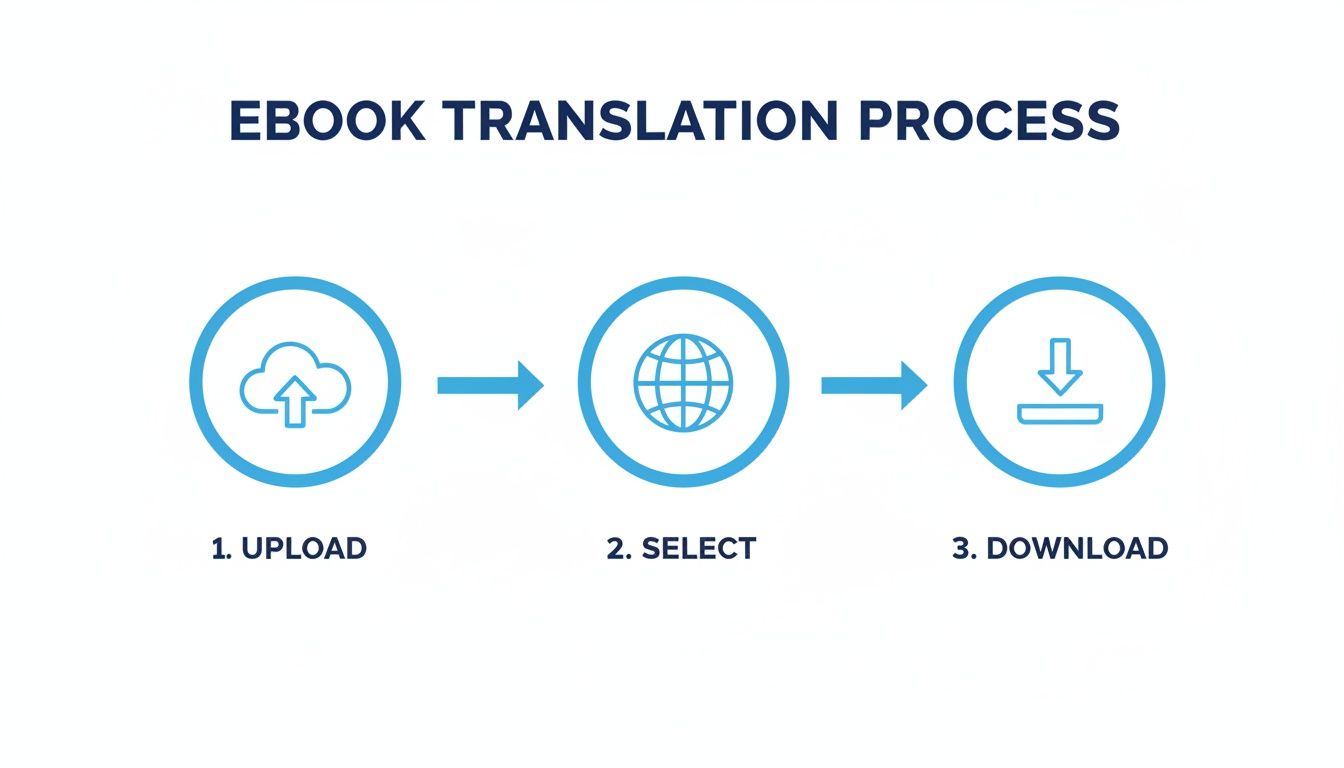
The real takeaway here is that a specialized program handles all the complex formatting preservation in the background, boiling the process down to just a few clicks for you.
Can I Edit the Final Translation?
Yes, you can—and frankly, you absolutely should. Any professional service worth its salt will export your translated book into a standard format like EPUB or DOCX, giving you full editing access. You can pop the file open in common ebook editing software like Calibre or Sigil to start refining the text.
The ability to perform a final human review is non-negotiable. It's your chance to have a native speaker—or yourself, if you're able—polish specific passages, fix subtle machine-generated quirks, and ensure the translation truly captures the heart of your original work.
This final human touch is what elevates a very good AI translation into a phenomenal one.
Is It Better to Pay a Subscription or Per Book?
The right pricing model comes down to one thing: how often you'll be translating. If you're a publisher churning out multiple translated titles every month, a subscription plan could save you a lot of money in the long run.
But for the vast majority of independent authors or even just avid readers, a pay-per-book model is almost always the more practical choice. It gives you complete transparency over your costs and lets you manage your budget without getting roped into a recurring fee you might not use. You only pay for what you need, when you need it.
Ready to translate your book with professional accuracy while keeping your formatting perfect? With BookTranslator.ai, you can upload your EPUB and get a high-quality, ready-to-read translation in minutes. Try it now and share your story with the world.