
If you're looking for a top-notch translator from Farsi to English for your books or other long-form content, the smartest path forward is a blend of technology and human skill. The modern gold standard combines the raw power of AI for an initial translation pass with the finesse of a skilled human editor who can handle nuance, cultural accuracy, and the author's unique voice. This hybrid approach is not only faster but also significantly more affordable than relying on traditional translation agencies alone.
Bringing Farsi Stories to a Global Audience

Have you ever finished a book in Farsi and thought, "More people need to read this"? You're not alone. It's a common challenge for authors, publishers, and passionate readers—how to bridge the language gap without the story losing its soul. The biggest hurdles have always been preserving the delicate cultural layers and the distinct voice of the original author.
This guide is all about a practical, modern workflow that makes this goal more realistic than ever before. By pairing sophisticated AI tools with essential human expertise, translating novels and other long-form content is becoming faster and much more budget-friendly. We're finally moving past the slow, expensive methods that held so many great stories back.
The Growing Demand for Farsi Content
This isn't just a niche interest; it's a reflection of a major global trend. The demand for Persian-to-English translation has surged right alongside the growth of cross-border business and digital publishing. Just look at the numbers: between 1980 and 2010, the number of translated books published in Iran exploded from 401 to over 13,000. That's a massive increase in translation activity and a clear market opportunity.
This incredible growth points to a real hunger for Persian literature and knowledge among English speakers. For authors and publishers, this is a golden opportunity to tap into entirely new markets.
A great translation does more than just switch words from one language to another; it opens a window into a different culture, allowing readers to experience new perspectives and stories.
A Modern Path to Publication
Think of this guide as a practical roadmap for getting incredible Farsi literature into the hands of a global, English-speaking audience. We'll walk through a process that puts you in control of your project, from start to finish. You’ll get real-world insights into:
- Prepping Your Manuscript: How to set up your EPUB file correctly right from the start.
- Choosing the Right Workflow: Deciding between AI-only, human-only, or a powerful hybrid model.
- Mastering the Human Touch: The art of refining an AI-generated draft to capture the author’s true voice.
- Finalizing for Publication: How to adapt layout and cultural references for a seamless reading experience.
Whether you're an author eager to grow your readership or a publisher looking to diversify your catalog, this modern approach can get you there. You can learn more about how AI book translation is connecting with global readers in our detailed article. This is your starting point for bridging cultural divides, one book at a time.
Getting Your Farsi Manuscript Ready for a Smooth Translation
Before a single word of your Farsi manuscript gets translated into English, a little prep work can make a world of difference. Trust me, spending a bit of time on this now will save you a ton of headaches, rework, and extra costs later. A clean, well-structured source file is the absolute foundation for a high-quality translation.
Think of it like giving a map to your translator, whether that’s a person or a sophisticated AI. The clearer the map, the better the journey. Any confusion in the original Farsi text—weird formatting, inconsistent terms, typos—will only get magnified in the English version. These pre-flight checks are your best insurance for an efficient and accurate project.
First Things First: Convert Your Manuscript to EPUB
Your manuscript needs to be in the right format, and for professional translation, that format is EPUB (Electronic Publication). While you probably wrote your book in a Word doc, EPUB is the industry standard for digital books and the format that advanced tools are built to handle. It perfectly preserves the structure of your book—all the chapters, headings, and paragraphs—so the translation software knows exactly what it's looking at.
Getting your file into EPUB is pretty simple. I recommend using a tool like Calibre, a fantastic free e-book manager that can convert your DOCX file into a clean EPUB with just a few clicks. Don't skip this step; it’s essential for a professional workflow.
Here’s a peek under the hood of an EPUB file. It organizes everything into web-standard files like XHTML and CSS.
This clean structure is precisely why a platform like BookTranslator.ai can maintain your book's original layout so well. It’s not just translating a wall of text; it's translating a fully structured document.
Next, Clean and Standardize Your Text
With your book in EPUB format, it’s time for some digital housekeeping. Stray characters or inconsistent formatting can easily trip up translation algorithms, leading to small but annoying errors.
A quick cleanup checklist:
- Standardize Punctuation: Make sure you're using Farsi punctuation marks like the comma (،) and period (.) consistently.
- Zap Extra Spaces: Run a search-and-replace to get rid of any double spaces between words or extra line breaks between paragraphs.
- Check Character Encoding: Your file should be using a standard encoding like UTF-8. This prevents your characters from turning into garbled symbols (the dreaded mojibake).
This might seem like minor stuff, but it stops a cascade of tiny errors from polluting your English translation. A clean source file really does lead to a clean output.
Create a Simple Glossary (Your Secret Weapon)
Every book has its own unique language. Think about it—character names, made-up places, or specific recurring terms. An AI won’t intuitively know how to handle these, which is where a simple glossary becomes your secret weapon for consistency.
A glossary is basically a rulebook for your translator. When you define key terms upfront, you're telling the AI exactly what to do every single time. This prevents maddening inconsistencies that you'd otherwise have to fix by hand later on.
Just create a simple two-column list. Put the Farsi term in one column and the English translation you want in the other.
| Farsi Term (Original) | English Term (Translation) |
|---|---|
| امیررضا (Amirreza) | Amirreza |
| دیار نور (Diyar-e Noor) | The Land of Light |
| کلید سرنوشت (Kelid-e Sarnevesht) | The Key of Destiny |
Taking a few minutes to do this is a game-changer, especially if you're writing a series where consistent terminology is everything to the reader's experience.
Finally, Flag Idioms and Cultural Nuances
Last but not least, you need to hunt down the phrases that just won't translate literally. Farsi is packed with beautiful idioms, proverbs, and cultural references that a machine will almost certainly misunderstand. For example, the common phrase "جای شما خالی" (jā-ye shomā khāli) literally means "your place is empty," but what it really expresses is "we missed you."
Comb through your manuscript and just highlight these kinds of expressions. You don’t have to provide the translation yourself, but flagging them gives the human post-editor a crucial heads-up to pay special attention to those spots. This is how you ensure the heart of your story makes it into English, not just the literal words.
Choosing the Right Farsi to English Translation Workflow
When you're ready to find a translator from Farsi to English, you're not just picking a person or a tool—you're choosing a process. The right workflow really depends on your book's specific needs. After all, every project has a different timeline, budget, and end goal.
There’s no single "best" option here, only the one that’s right for your manuscript. A quick, low-cost translation might be all you need for an internal review. But if you're translating a literary novel for publication, you'll need a much higher level of polish and human insight. The trick is to find that perfect balance between speed, cost, and quality.
Before you even start, though, preparing your manuscript is a critical first step. A clean file with clear instructions always leads to a better result, no matter which path you take.
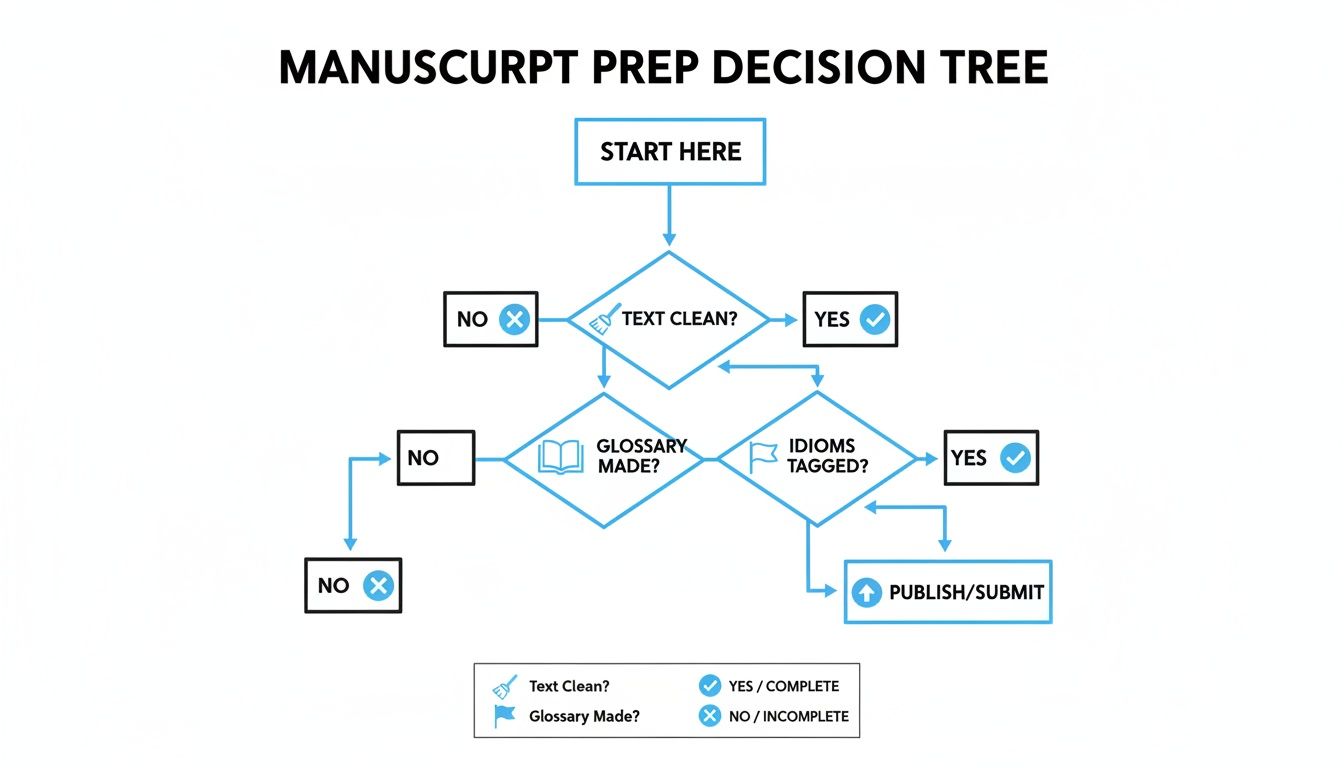
This flowchart just gives you a sense of how a little prep work—like cleaning up the text and flagging idioms—can make a world of difference downstream.
A Look at Your Main Options
So, what are the real-world choices? Let's break down the three main workflows you'll encounter. Each has its own set of pros and cons, making them suitable for different kinds of projects.
Pure Machine Translation (MT): This is your lightning-fast, budget-friendly option. You simply upload your Farsi EPUB, and an AI model spits out an English version in minutes. It's fantastic for getting the gist of a text or creating a rough first draft. The downside? It's going to lack nuance, stumble over cultural idioms, and often produce clunky, unnatural sentences.
Machine Translation + Human Post-Editing (MTPE): This hybrid model has quickly become the industry go-to, and for good reason. An AI does the initial, heavy-lifting translation, and then a professional human editor steps in to refine the text. They fix errors, smooth out the prose, and make sure the author's original voice shines through. It’s a powerful combination of speed, quality, and affordability.
Traditional Human Translation: This is the classic approach where a professional translator handles everything from start to finish. It delivers the absolute highest quality, capturing every bit of cultural nuance and literary flair. But that expertise comes at a price—it's by far the slowest and most expensive method, often putting it out of reach for many authors and publishers.
Farsi to English Translation Workflow Comparison
To make the choice clearer, I've put together a simple table that lays out the trade-offs between speed, cost, and the final quality you can expect.
| Workflow Type | Best For | Typical Speed | Cost Level | Quality Outcome |
|---|---|---|---|---|
| Machine Translation (MT) | Quick gists, internal review, initial drafts | Minutes to hours | Lowest | Functional but lacks nuance |
| Hybrid (MTPE) | Published books, commercial content, novels | Days to weeks | Moderate | High, publication-ready |
| Human Translation | High-stakes literary works, legal documents | Weeks to months | Highest | Exceptional, nuanced |
This table helps visualize why the hybrid MTPE model has become so popular—it hits that sweet spot for most professional projects.
Making the Call for Your Book
So, which one is for you? It really comes down to your end goal. If you're translating a contemporary Farsi novel for a global readership, the hybrid MTPE workflow is almost certainly your best bet. You get a polished, professional result without the staggering cost and long timeline of a purely human translation.
The economics have changed the game. The global machine translation market jumped from around $650 million in 2020 to $1.1 billion in 2022, and that explosion in technology is what makes these powerful hybrid workflows possible.
For most authors bringing Farsi books to an English-speaking audience, the hybrid MTPE model is the answer. It uses AI for what it's good at—speed and efficiency—while reserving human expertise for the things that truly matter in storytelling: voice, tone, and cultural connection.
This modern approach makes professional-quality translation accessible to a much wider circle of creators. To see how this process works in practice, take a look at our guide on using an AI book translator for your projects. It's all about working smarter to bring your story to the world.
The Human Touch: Mastering Post-Editing for AI Translations
Let's be clear: an AI translator gives you a starting point, not a finished product. The real magic happens during the post-editing phase. This is where you take a mechanical, word-for-word draft and breathe life into it, transforming it into a text that truly connects with English-speaking readers.
This process, which we call Machine Translation Post-Editing (MTPE), isn't just about fixing mistakes. It’s about nuance. It’s about capturing the rhythm and emotion of the original Farsi, ensuring the author's soul isn't lost in translation. This is where the speed of AI meets the essential touch of human expertise.
Spotting Common AI Translation Stumbles
Even the best AI models tend to make the same kinds of mistakes. As an editor, learning to spot these common issues is the first step to working efficiently. Once you know what to look for, you can fly through the initial clean-up.
Here are the big ones to watch out for:
- Literal Idiom Translations: Farsi is filled with beautiful, expressive idioms that AI just doesn't get. It might translate "دلم برات تنگ شده" (delam barât tang shode) as "my heart has become tight for you." That’s gibberish in English. A human editor instantly knows the real meaning is simply, "I miss you."
- Awkward Phrasing and Syntax: Farsi and English sentence structures are worlds apart. AI often produces grammatically "correct" sentences that just sound off to a native English speaker. They feel clunky and unnatural.
- Inconsistent Terminology: An AI might translate a key term one way in chapter one and then use a completely different word for it in chapter ten. This kind of inconsistency is jarring for the reader and a dead giveaway of an unedited machine translation.
Fixing these initial red flags is your first pass to creating a polished, professional manuscript.
Preserving the Author's Unique Voice
Once you've cleared the mechanical hurdles, your most important job begins: preserving the author's voice. Is the original text academic and formal? Or is it sharp, witty, and conversational? A raw AI translation tends to flatten these distinctions, leaving you with a generic, monotone text.
To make sure the translation feels authentic, you have to humanize your AI-generated translations. A great tip is to read passages out loud. Your ear will catch awkward rhythms and clunky phrasing that your eyes might miss. This helps you choose words that truly align with the original author's style.
The ultimate goal of post-editing is to make the translation invisible. The reader should feel like they are reading a book originally written in English, completely unaware of the complex process that brought it to them.
Let’s look at a quick example of this in action.
- Original Farsi: "او با قدمهای سنگین به سمت در رفت، انگار تمام غم دنیا را بر دوش میکشید."
- Literal AI Translation: "He went to the door with heavy steps, as if he was carrying all the world's sorrow on his shoulder."
- Edited for Voice: "He trudged toward the door, his steps heavy, as if carrying the weight of the world on his shoulders."
See the difference? The edited version uses a much stronger verb ("trudged") and a more natural English idiom ("weight of the world") to deliver the same meaning with far more emotional punch.
Your Post-Editing Quality Checklist
To keep your work consistent and high-quality from start to finish, a checklist is your best friend. This ensures you've covered all your bases, from grammar to cultural nuances. Every step you take refines the raw output from a translator from Farsi to English into a polished piece of literature.
Here’s a practical checklist to guide your review:
- Grammar and Syntax: First things first—correct all typos, grammatical errors, and punctuation mistakes. Rework any sentences that don't flow naturally in English.
- Consistency: Do a search for key terms, character names, and locations. Make sure they are translated the exact same way every single time they appear.
- Cultural Localization: Adapt any cultural references, jokes, or metaphors that won't make sense to an English-speaking audience. Sometimes this means adding a quick explanation; other times it means finding a close cultural equivalent.
- Tone and Style: Does the translation feel like the original? Adjust word choice and sentence structure to match the source text, whether it’s poetic, technical, formal, or informal.
- Readability: Read the final text aloud one last time. This is the ultimate test. It should sound smooth, engaging, and completely natural to the ear.
This hands-on review process is what makes a human editor invaluable. Not only does it perfect the book you're working on, but it also creates a feedback loop that can make future AI translations even better. You can dive deeper into how feedback improves AI book translations in our dedicated guide.
Finalizing Your Book for an English-Speaking Audience
A great translation is so much more than getting the words right. It's about crafting a reading experience that feels completely natural and immersive. Once the heavy lifting of translation and editing is behind you, these final steps are what elevate your book from a clunky, word-for-word effort to a professional publication that feels native to an English-speaking audience.
This finishing stage really boils down to two critical parts: managing the book's physical layout and mastering the delicate art of localization. Get these right, and your book will be ready for its new market.
Managing Layout and Text Expansion
Here’s a practical challenge you'll hit almost immediately: Farsi script is incredibly efficient with space. When you translate that compact script into the Latin alphabet used for English, the text expands, often by as much as 20-30%.
This "text expansion" can completely wreck your original layout. Paragraphs get longer, page breaks land in awkward spots, and the rhythm of your chapters gets thrown off. This becomes a real headache in books with careful formatting, especially those with images, tables, or poetry.
You’ll need to go back into your EPUB and adjust the layout. The goal is to make sure the book is still easy on the eyes.
- Adjust Margins and Spacing: You might need to widen the margins or tweak the line spacing just enough to accommodate the extra text without the pages looking cramped.
- Review Page Breaks: Go through and manually check where your chapters and sections end. A chapter that finished perfectly at the bottom of a page in Farsi might now spill over by a few lines, leaving an orphan heading or a weird break.
- Check Image and Table Placement: Make sure visuals are still where they belong. Text expansion can easily push an image or table to the next page, completely disconnecting it from the text that's supposed to explain it.
These tweaks are crucial for a professional finish. After getting your translated Farsi manuscript ready, the next step is often figuring out the logistics of printing. For a great guide on that, check out this resource on how to print a book from Word, which covers a lot of these formatting details.
The Art of Localization and Cultural Adaptation
Beyond the technical layout, localization is where the real magic happens. This is how you make a Farsi book truly connect with English-speaking readers. It's the process of adapting cultural references so they land with the right emotional impact. A direct, literal translation can easily fall flat or, even worse, just be confusing.
Take a Farsi proverb like "هر که بامش بیش، برفش بیشتر" (Har ke bâmash bish, barfash bishtar). A literal translation gives you, "He who has a bigger roof gets more snow." An English reader might figure it out, but it doesn't have the instant cultural punch of an equivalent idiom like "Mo money, mo problems."
The key question to ask yourself during localization is always: "Does this reference create the same feeling and understanding for an English reader as it did for the original Farsi reader?" If not, it’s time to adapt.
This is where you have to make some smart, strategic calls. There isn't one perfect answer; the right choice always depends on the context of the story and the author's voice.
To Footnote or To Adapt: That Is the Question
When you run into a culturally specific Farsi reference—a historical event, a traditional food, a line of poetry—you basically have three paths you can take.
- Keep the Original Term and Add a Footnote: This is your best bet when the term is central to the story and you want to educate the reader. For instance, keeping the word Nowruz and adding a quick footnote explaining the Persian New Year preserves the book's authenticity.
- Find a Close English Equivalent: This works beautifully for concepts that have a counterpart in Western culture. Instead of a specific Farsi dish that needs a long explanation, you could substitute a more general term like "a festive stew" if the exact recipe isn't vital to the plot.
- Explain It Briefly In-Text: Sometimes, the smoothest option is to weave a quick explanation right into the sentence. Instead of just dropping in hafez-khani, you could write, "They gathered for hafez-khani, a tradition of seeking guidance by opening a book of Hafez's poetry at random."
Picking the right approach requires a deep feel for both cultures. You want to keep the story's unique Persian flavor without putting up walls for the new reader. This final layer of cultural polishing is what makes a great translator from farsi to english so invaluable—they ensure your book truly finds a new home in a new language.
Common Questions About Farsi to English Book Translation
Taking on a book translation project is a big step, and it's only natural to have a few questions swirling around. Especially when it’s something as personal and nuanced as a Farsi novel, you want to get it right. Let's walk through some of the most common concerns I hear from authors and publishers.
Think of this as a quick FAQ, built from years of seeing what works and what doesn't when using a translator from farsi to english.
How Accurate Is an AI Translator for Farsi Literature?
This is usually the first thing people ask. Can a machine really grasp the soul of Farsi literature? The honest answer is that modern AI is shockingly good at producing a solid first draft, but it’s far from perfect. It's fantastic for nailing the literal meaning and getting the grammar mostly right, very quickly.
Where it tends to fall short, though, is in the very things that make a book feel alive. These are the human touches:
- Cultural Nuances: An AI simply doesn't get the deep-seated cultural context behind a specific turn of phrase or a custom that’s second nature to a native speaker.
- Literary Devices: Metaphors, allegories, and the beautiful complexity of poetic language often get flattened into something technically correct but emotionally hollow.
- Authorial Voice: An author’s unique rhythm, tone, and style—their signature—can easily get lost, leaving you with a translation that sounds generic.
This is exactly why a human review isn’t just a nice-to-have; it's a must. The AI gives you an incredible head start, but a human editor brings the artistry, cultural fluency, and soul back into the text.
Can You Translate Books with Complex Formatting?
What about books that are more than just a wall of text? Farsi literature is filled with beautiful poetry, and non-fiction works often rely on tables, charts, or specific layouts to make their point. The good news is, yes, you absolutely can translate these—as long as you start with the right foundation.
This is where working with a structured format like EPUB makes all the difference. An EPUB file isn't just text; it contains the book's entire architecture. Chapters, headings, blockquotes, image placement—it's all preserved. When a smart tool processes it, it understands that structure.
A good translation platform reads the underlying code of the EPUB, which allows it to translate the content inside the existing layout. Poetry keeps its line breaks, and tables hold their shape. This alone can save you dozens of hours of painstaking reformatting.
You might still need to make a few small tweaks to account for text expanding or contracting, but the core structure of your book remains solid. It makes tackling visually complex books so much more manageable.
What Is the Most Cost-Effective Path to a Quality Translation?
For most creators, the ultimate goal is a professional, publishable translation that doesn't drain their entire budget. Hands down, the most efficient way to achieve this without compromising on quality is the hybrid model: Machine Translation + Human Post-Editing (MTPE).
It really is the best of both worlds. The AI handles the heavy lifting—the initial, time-consuming pass—at a tiny fraction of what a human would charge. This step alone can slash your overall costs by 50-70% compared to a purely manual project.
Then, you can invest your budget where it truly counts: hiring a skilled human editor to polish that AI-generated draft. Their job isn't to re-translate from scratch but to focus on the high-level tasks—perfecting the tone, localizing cultural references, and making sure the prose sings. You’re paying for their expertise, not their typing speed. It's a balanced approach that makes professional-grade translation a realistic goal for almost any project.
Ready to bring your Farsi book to a global audience? With BookTranslator.ai, you can get a professional-quality AI translation in minutes, perfectly preserving your book's original layout. It’s the ideal first step in your hybrid translation workflow. Start your book translation today.