
Document translation software is a whole different beast compared to your standard copy-paste tool. It uses sophisticated AI and neural machine translation to convert entire files—like PDFs, Word docs, and even EPUBs—into another language.
The magic isn't just in the words. This kind of software is built to preserve the original layout. That means all your tables, images, and chapter formatting stay exactly where they should be, which is a lifesaver for long-form content.
The Shift to AI-Powered Document Translation
Not long ago, translating a book or a detailed manual meant one of two things: hiring a pricey translation agency or facing a mountain of clunky, manual work. For authors, researchers, and publishers, it was a constant battle against high costs, slow turnarounds, and the ever-present risk of your formatting getting completely mangled.
This is where modern translation software for documents has completely changed the game. Powered by huge leaps in neural machine translation (NMT), these platforms offer an alternative that’s powerful, fast, and far more affordable. They’re specifically designed to fix the real-world problems that generic tools just can't touch.
Why Specialized Software Matters
Ever tried translating a 300-page novel using a free online tool? It’s a nightmare. You’re stuck copying and pasting small chunks of text, and you lose all your chapter breaks, paragraph styles, and images along the way. A specialized platform is built to avoid this mess entirely.
Here's what makes the difference:
- Layout Preservation: Your document’s entire structure, from the main headings right down to the footnotes, is carefully kept intact in the final translated version.
- Voice Consistency: The best AI models are trained to maintain a consistent authorial voice and terminology across hundreds of pages, which is essential for both novels and technical guides.
- Speed and Scale: You can translate an entire book in a matter of minutes, not months. This allows creators to tap into global markets faster than ever. We dive deeper into this balance in our guide on AI translation quality and speed.
At its core, this technology is about empowerment. An indie author can now launch their book in ten languages at once without breaking the bank. A researcher can share critical findings with international peers, instantly.
A Market Driven by Efficiency
The rapid progress in AI has completely rewired how we approach document translation. If you want to see who's pushing the envelope, you might want to explore AI-powered solutions like lunabloomai.
This isn't just a niche trend; the data backs it up. Software-based translation has already blown past traditional, service-only models. In fact, software now drives 73.53% of all translation services revenue, and it’s the fastest-growing part of the market. It’s a clear signal that people want efficient, scalable tools that put them in the driver's seat.
Your Checklist for Choosing the Right Software
When you're trying to find the right translation software, it's easy to get lost in marketing fluff. The key is to cut through the noise and zero in on the features that actually solve your problems.
Think about it: an author translating an EPUB has completely different needs than a researcher working with dense PDFs or a business localizing DOCX manuals. A simple, generic tool might get you by with basic text, but long-form content is a different beast entirely. It demands a much smarter, more robust solution.
The choice you make here will have a direct ripple effect on your efficiency, your budget, and, most importantly, the final quality of your work. Let's walk through the absolute must-haves for your evaluation checklist so you can pick a platform that genuinely works for you.
What Really Matters: Key Features to Vet
Before you even think about pricing, you need to be sure the software can handle the job technically. This goes way beyond just listing supported languages. It's about whether the tool can maintain the integrity and structure of your original file. If it can't, you’ll end up wasting more time fixing its mistakes than you saved in the first place.
Here's what to look for on the technical side:
- File Format Support: Can the platform actually open your files? Don't just assume. Look for explicit, native support for EPUB, PDF (including scanned text via OCR), and DOCX. If the tool stumbles at this first step, nothing else matters.
- Layout & Formatting Preservation: This is the big one. For long-form content, you need software that understands and perfectly replicates your document's structure—chapters, headings, bullet points, tables, and even image placement. The goal is a translated document that’s a structural mirror of the original.
- Quality of the AI Engine: Not all AI is the same. Good providers are transparent about the translation models they use. Platforms that give you a choice between different models—like those from industry leaders like DeepL or the latest from OpenAI—put you in control, letting you balance cost with the need for nuance.
Choosing the right features from the start saves countless hours of manual correction later. To help you prioritize, here’s a quick comparison of what to look for based on what you’re translating.
Key Feature Comparison for Document Translation Software
| Feature | What to Look For | Why It Matters for Long-Form Documents |
|---|---|---|
| File Compatibility | Native support for EPUB, PDF, and DOCX. Bonus points for OCR (Optical Character Recognition) for scanned PDFs. | You need a tool that works with your specific format without requiring you to convert files, which often breaks formatting. |
| Layout Preservation | The ability to retain chapters, headings (H1, H2, etc.), tables, lists, and embedded images in their original positions. | Rebuilding a 300-page book's layout is a nightmare. This feature ensures the translated version is ready to use immediately. |
| AI Model Choice | Access to different AI engines (e.g., standard vs. advanced models) to balance cost and translation quality. | A technical manual might need absolute precision from a premium model, while a first draft of a novel might be fine with a more affordable one. |
| Glossary / Term Base | A feature to upload a custom glossary to ensure key terms (brand names, character names, technical jargon) are translated consistently. | Critical for maintaining consistency across a long document or a series of works. Avoids confusing readers with inconsistent terminology. |
| Security & Privacy | A clear policy stating your data will not be used for public AI training. End-to-end encryption is a must. | Protects your intellectual property, whether it's an unpublished manuscript, sensitive research, or a proprietary company manual. |
This table should give you a solid foundation for asking the right questions as you evaluate different platforms.
The Business End: Pricing and Security
Once you've nailed down the technical requirements, it’s time to look at the business side of things. Confusing pricing and flimsy security can quickly turn a helpful tool into a major headache, especially when your intellectual property is on the line.
A transparent pricing model is a sign of a trustworthy service. If you can't easily calculate your costs upfront, proceed with caution. Hidden fees and complex subscription tiers often conceal a much higher total cost.
Look for straightforward, pay-as-you-go options based on word count. This model is perfect for project-based work because it lets you scale your usage up or down without getting locked into a recurring subscription you might not always need.
Finally, take a hard look at the platform's security and privacy policies. Your unpublished book or confidential research is incredibly valuable. Make sure the provider explicitly states that your data will not be used to train public AI models. Secure connections and a clear data retention policy aren't just nice-to-haves; they are essential for protecting your work.
The market for these tools is booming. It's projected to grow from USD 67.49 billion in 2025 to USD 115.07 billion by 2035, with document translation leading the charge. You can dig into the numbers yourself in this Market Research Future report. This growth means more options, but also more reason to choose wisely.
A Real-World Document Translation Workflow
Checklists are great for comparing features, but what does it actually feel like to translate a full-length book or a dense research paper? Let's walk through the process, step-by-step, to see how modern translation software for documents handles a real project.
This isn't just about hitting a "translate" button and hoping for the best. It’s a deliberate workflow that, when done right, gives you a final document that's accurate, readable, and perfectly formatted. It's the difference between a quick-and-dirty translation and a professional-grade final product.
First, Get Your Source File Ready
The old mantra "garbage in, garbage out" has never been more true. A clean, properly structured source file is the single most important factor for getting a high-quality translation. Before you even think about uploading, spend a few minutes prepping your document.
If you’re an author with an EPUB novel, this means making sure your chapters are actually defined with heading styles (H1, H2), not just big, bolded text. For a researcher working on a DOCX paper, it means building tables and lists with your word processor’s tools, not faking them with tabs and spaces.
Why bother? Because the software reads the structure of your document to rebuild it in the new language. Messy formatting in, messy formatting out.
Uploading and Setting Up the Translation
Once your file is prepped, you upload it to the platform. A good tool will immediately recognize what you've given it—EPUB, PDF, DOCX—and get it ready. If you’re dealing with a scanned document or a PDF where you can't select the text, this is where a solid Optical Character Recognition (OCR) feature becomes a lifesaver. You can see exactly how to handle scanned documents in our guide on OCR and translation.
Next, you'll dial in a few key settings:
- Source and Target Languages: Pretty straightforward—tell it what the original language is and where you're going.
- AI Model Selection: Many platforms now offer different AI models. A "pro" or advanced model might cost a little more, but for creative work like a novel, the extra nuance and fluency it provides is almost always worth it.
- Glossary: This is your secret weapon for consistency. If you have a list of character names, branded terms, or specific technical jargon, you upload it here. This ensures "Proton Inhibitor" doesn't accidentally become "Proton Blocker" halfway through your manuscript.
Think of this stage as giving your AI translator a clear creative brief. By defining the model and terminology upfront, you’re setting the project up for a much more accurate and consistent first draft.
The Human Touch: Post-Editing and QA
Let's be clear: no machine translation is perfect. That's why post-editing isn't an optional step; it's essential for any serious project. The AI does the heavy lifting, getting you a draft that’s often 95-98% of the way there, but a human eye is what takes it over the finish line.
You’re not retranslating the document from scratch. You’re performing a strategic review. Skim through the translated file and hunt for things that just feel off—awkward phrasing, cultural misinterpretations, or idioms that were translated literally and now make zero sense.
Your goal is to make smart, high-impact edits that polish the text. Double-check that your glossary terms were applied correctly and that the original author's voice still shines through.
Exporting Your Final, Polished Document
Once your review and tweaks are done, it's time to export. The best translation software for documents will generate a brand new file in the original format—a perfectly laid-out EPUB, DOCX, or PDF.
This new file should be a mirror image of your source document, with every chapter, heading, image, and table right where it belongs. Give it one last visual check to be sure, and you’re ready to go. Your translated document is now ready for publication, distribution, or sharing with a whole new audience.
Understanding Pricing, Security, and Data Privacy
Once you've vetted the technical features, the decision often boils down to two very practical things: cost and trust. It's one thing to find a tool that works, but it's another to trust it with your new manuscript, sensitive research, or proprietary business documents. Transparent pricing and rock-solid security aren't just nice-to-haves; they're essential.
Many platforms push you into subscription models that can feel like a trap, locking you into recurring fees whether you're translating one document or a hundred. A much more flexible approach is pay-as-you-go pricing. This model, often calculated per word or in blocks like 100,000 words, gives you complete control. You pay for exactly what you need, which is perfect for authors, researchers, and smaller publishers whose translation needs come in waves, not on a fixed schedule.
For a closer look at how these different pricing structures can impact your bottom line, our guide on what to expect from AI translation costs breaks it all down.
Protecting Your Intellectual Property
Data privacy is more than just a buzzword; it's the bedrock of trust between you and your translation tool. The single biggest risk with free or sketchy online translators is what they do with your data behind the scenes. Some services actually use your uploaded documents to train their public AI models—a massive red flag if you're working with anything unpublished, confidential, or sensitive.
A reputable provider will be upfront and crystal-clear about their privacy commitments. Here’s what to look for:
- No Training on Your Data: There should be an explicit, unambiguous promise that your documents will never, ever be used to train any public AI.
- Secure Data Handling: All file transfers, both uploads and downloads, must be protected with end-to-end encryption. No exceptions.
- Clear Retention Policies: The service needs to tell you exactly how long your files are stored and, crucially, give you the power to delete them permanently.
This simple workflow shows the key stages, from preparation to final review, that a good, secure translation process should follow.
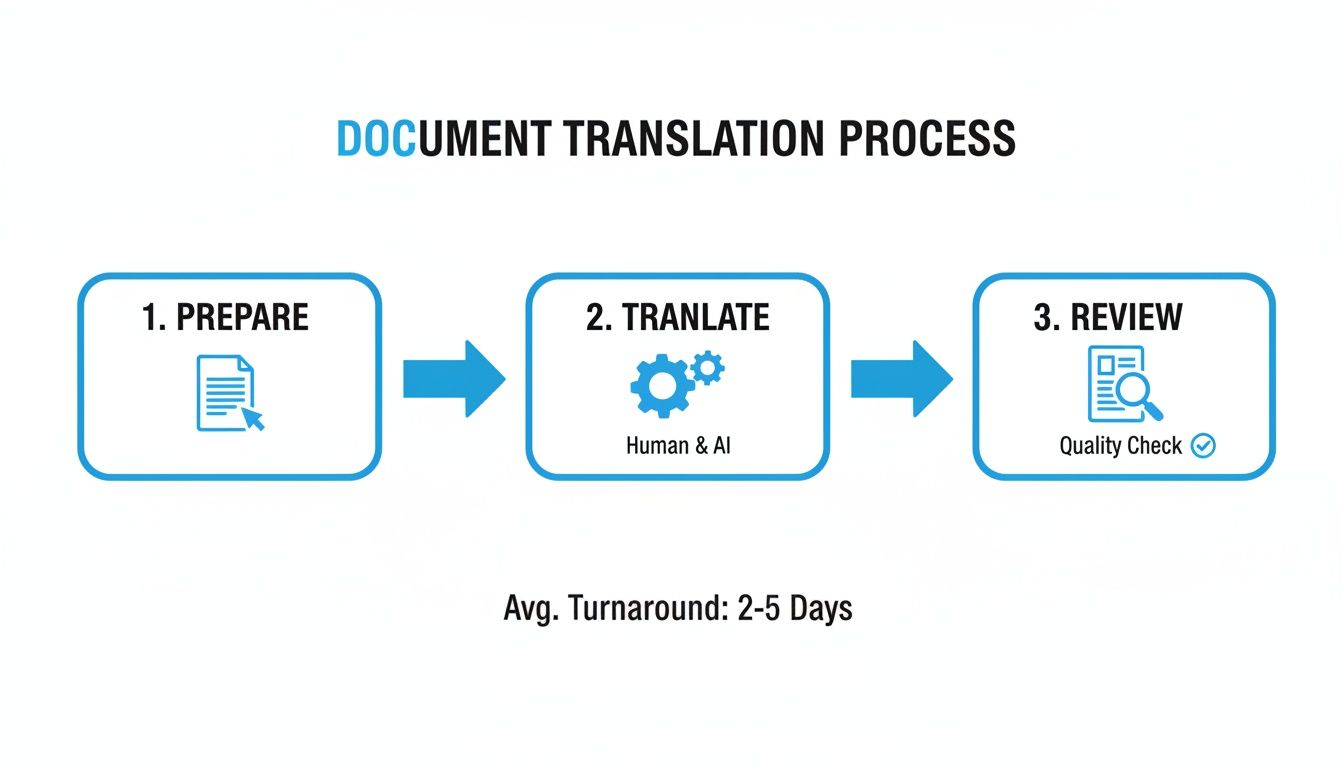
As you can see, translation isn't just a one-click affair. It's a multi-stage process, and your data needs to be secure every step of the way.
How to Verify a Provider's Security Claims
So, how can you be sure a platform is truly secure? Reading the privacy policy is your first move, but looking for external validation adds another layer of confidence. To get a sense of what best-in-class security looks like, it helps to understand rigorous security and privacy criteria like those found in SOC 2 Trust Services. This gives you a solid framework for judging whether a provider's security practices are just marketing fluff or the real deal.
Your intellectual property is your most valuable asset. The platform you choose to translate it must protect that asset with the same seriousness as it delivers translation quality. Peace of mind is non-negotiable.
In the end, the right software respects both your wallet and your work. It offers clear, fair pricing and backs it up with an uncompromising commitment to security. Getting these two things right lets you focus on the real goal: connecting with a global audience.
Real-World Use Cases for Authors and Researchers

It’s one thing to talk about features on a checklist, but how does this technology actually perform in the real world? Let's get practical and look at how document translation software helps authors and academics tackle the real challenges they face every day.
These examples show how the right tool can open up global opportunities, cutting through the old barriers of high costs and logistical headaches. It’s all about giving individuals and small teams the power to do things that used to be out of reach.
For the Indie Author Aiming for a Global Launch
Let's say you're an indie author with a novel that's doing well in English. You know there's a huge Spanish-speaking audience you could reach on platforms like Amazon KDP, but the thought of paying a literary translator for a 100,000-word manuscript is just not in the budget.
This is where a specialized EPUB translator becomes your secret weapon. Here’s how that plays out:
- Prep Your File: You start with your final, perfectly formatted EPUB. You've made sure all your chapter breaks and styling are clean and consistent.
- Translate in Minutes: You upload that EPUB to a service like BookTranslator.ai, choose an AI model built for creative text, and let it translate the entire book into Spanish. This part takes just a few minutes.
- Hire a Human Editor: Now, instead of hiring a translator, you find a skilled Spanish-speaking editor. Their job isn't to start from scratch; it's to do a post-editing pass to smooth out idioms and make sure your unique voice shines through. This costs a fraction of a full translation.
- Publish Worldwide: Once the editor sends back the polished Spanish EPUB, you can upload it directly to KDP and instantly expand your readership.
This hybrid workflow—AI for the heavy lifting and a human expert for the final polish—is a game-changer. It turns a project that would have taken months and five figures into an affordable, scalable strategy.
For the Academic Researcher Cutting Through Language Barriers
Now, picture a researcher trying to complete a literature review. They need to analyze dozens of international studies, but many of the key papers are in other languages, bogging down their progress.
Instead of painstakingly copying and pasting text into a basic online translator—and losing all the crucial formatting like citations and tables—they turn to a professional document translator. They can batch-upload all the academic PDFs, and the software gets to work, translating the text while preserving the original layout.
Suddenly, all the tables, figures, and footnotes are intact and understandable. This lets the researcher quickly scan and assess the findings from global studies, massively speeding up their own work.
This isn't just a niche problem. Europe accounts for about 49% of the global language services market, with North America following at 39.41%. These are hubs for digital publishing and higher education, where the demand for tools that can handle complex academic and literary content is incredibly strong. You can dig into more stats about the global translation market on redokun.com.
For small publishers, the same logic applies. They can use this workflow to translate an entire backlist of e-books, opening up new markets and revenue streams without the crushing overhead of traditional translation agencies. The right software turns a language barrier into a business opportunity.
Answering Your Top Questions About Document Translation Software
When you're thinking about using software to translate important documents, a few questions always seem to pop up. It's smart to get straight answers before you commit your work to any platform. Let's dig into the most common concerns I hear from authors and researchers.
Can an AI Really Handle Creative Content Like a Novel?
This is probably the biggest question on every author's mind. The latest AI models have gotten shockingly good at understanding nuance, tone, and even subtle humor. No, they don't have the soul of a seasoned literary translator, but their ability to faithfully render your plot, character dialogue, and key descriptions is stronger than ever.
For a lot of writers and publishers, the raw output is good enough to give readers a genuinely engaging experience. The key is to use a tool designed specifically for long-form content. These systems are much better at keeping your unique authorial voice consistent from chapter to chapter. A final read-through by a human post-editor is all it takes to polish that text into something truly professional and ready for publication.
Will It Keep My Original Formatting Intact?
This is where you can instantly tell a professional tool from a basic, free one. If you've ever tried a copy-paste translator, you know it absolutely obliterates your document's layout. It's a mess.
Dedicated document translation platforms, on the other hand, are built from the ground up to protect your formatting. They're designed to parse the structure of files like EPUB and DOCX, recognizing things like:
- Chapter breaks and headings
- Custom paragraph styles and indents
- Bulleted and numbered lists
- Where your images and captions belong
The software then carefully reconstructs the translated text inside that original framework. The result is a new file that looks almost identical to your source document. Before you choose a service, make absolutely sure layout preservation is a headline feature.
Here's the bottom line: Real document translation software doesn't just swap out words; it translates the entire visual and structural experience of your document. For books, manuals, or academic papers, this is non-negotiable.
Is It Actually Safe to Upload My Unpublished Manuscript?
Security isn't just a feature; it's a foundation. And you're right to be cautious. Any translation provider you consider must have a clear, easy-to-find privacy policy.
Scan their security page for explicit guarantees that your uploaded documents will not be used to train public AI models. That's a deal-breaker. Also, check for standard security practices like encrypted connections and clear policies on how they handle your data and for how long. The best platforms treat your intellectual property with the respect it deserves. As a rule of thumb, never, ever use a free, ad-supported tool for sensitive or confidential work.
Ready to translate your book with confidence? At BookTranslator.ai, we offer professional-grade AI translation that preserves your formatting and protects your work. Translate your first book today.