
Bringing your Spanish books to an Arabic-speaking audience is more than a simple word-for-word translation; it’s a way to connect two vibrant, historically linked cultures through the power of a good story. What was once a monumental task is now something any author can tackle, thanks to modern translation tools.
Why the Arabic Market is a Goldmine for Spanish Authors
For authors writing in Spanish, the Arabic-speaking world is one of the biggest growth opportunities in publishing right now. This isn't just a random market; it's a readership that shares deep historical, cultural, and even linguistic roots with the Spanish world.
That shared history means you’re not starting from scratch. When you translate Spanish to Arabic, you’re often presenting familiar themes and narrative styles to an audience that already gets it. This cultural overlap creates a natural pathway for your stories to resonate, making the connection with readers feel genuine and immediate.
The Numbers Speak for Themselves
The sheer size of this potential audience is hard to ignore. We're talking about two of the most widely spoken languages on the planet. By bridging this gap, you unlock a massive new pool of readers.
Let's look at the breakdown:
- Spanish Speakers: Around 550 million people worldwide.
- Arabic Speakers: Approximately 372.5 million speakers, concentrated in the Middle East and North Africa.
Bringing these two worlds together opens your work to a potential market of nearly 900 million readers. That’s a staggering number, representing a huge commercial opportunity that has been historically difficult to access for most authors. For more context on global languages, check out the latest report from Globalization Partners.
For years, the cost and complexity of professional translation kept this market walled off for all but the biggest publishers. The game-changer is that this massive audience is no longer just a theoretical number.
How Technology Closes the Distance
Not long ago, a Spanish-to-Arabic translation project was a massive undertaking. It was expensive, slow, and riddled with technical hurdles like right-to-left formatting and finding translators who could capture the right dialect and tone. It just wasn't practical for most independent authors or small presses.
That’s where specialized AI tools like BookTranslator.ai have completely flipped the script. These platforms are built for books, meaning they handle the heavy lifting of preserving your original formatting and layout while translating the text. What used to be a daunting challenge is now a manageable, affordable process. The door to this massive, eager audience is wide open.
Preparing Your Spanish EPUB for a Flawless Translation
Any good translation project starts long before you ever hit the "upload" button. The quality of your source Spanish EPUB file has a massive impact on the final Arabic output. Think of it like this: you wouldn't start painting on a dirty, crumpled canvas. The same principle applies here.
"Garbage in, garbage out" is an old saying in tech for a reason, and it's especially true when you translate Spanish to Arabic. Even tiny formatting mistakes in the original file—things like inconsistent chapter breaks or messy code hidden in the background—can spiral into major layout nightmares in the translated version. Honestly, spending a little time prepping your EPUB upfront is the single best thing you can do to save yourself hours of headaches later.
Cleaning Up Your EPUB's Code
Behind the scenes, every EPUB is just a collection of HTML and CSS files that control how everything looks. If the file was converted from another format, like a Word doc, this code can be a real mess. Cleaning it up is a non-negotiable step for a smooth translation.
For example, if one chapter title is tagged as an H2 and the next is an H3, the AI can get confused and mess up the book's structure. Another common problem is an overload of unnecessary <span> tags, which can split sentences in half and interfere with the AI's ability to make sense of the text.
Here's what I always check for:
- Standardize Headings: Make sure all your chapter titles use the same tag (like H2) and all subtitles use another (H3). Consistency is key.
- Remove Inline Styling: Hunt down any styling that's applied directly to the text instead of being managed in a central stylesheet. This stuff almost always breaks during translation.
- Fix Broken Paragraphs: Ensure every paragraph is wrapped neatly in a single
<p>tag. Get rid of any random line breaks (<br>) floating around inside them.
Tackling these issues gives the AI a clean, logical foundation to work from, which is vital for keeping your book's layout intact. To get your manuscript in perfect shape before you even create the EPUB, it's worth Mastering Conversion DOCX PDF to ensure the document's structure is solid from the very beginning.
Managing Images and Special Formatting
Images, tables, and custom fonts look great, but they can be tricky. Remember, Arabic is a right-to-left (RTL) language, meaning your book's entire layout gets flipped. Anything that isn't anchored properly is going to end up in the wrong spot.
The secret to a perfect translation lies in a pristine source file. By cleaning and standardizing your Spanish EPUB, you're not just preventing errors; you're setting up BookTranslator.ai for success and ensuring a professional final product.
Before you upload, double-check that your images are embedded correctly and centered. For complex tables, I often find it's easier to just convert them into a single high-resolution image. It’s a simple trick that guarantees the table's structure won't fall apart. If you want to get really into the weeds on file prep, our guide on the EPUB language compatibility checker has some great advanced tips. Trust me, a well-prepared file is the best insurance you can buy for a flawless translation.
A Practical Walkthrough of BookTranslator.ai
Alright, you've got your cleaned-up Spanish EPUB file in hand. Now for the fun part: putting BookTranslator.ai to work. This is where all that careful prep really pays off, transforming what used to be a headache of a process into a surprisingly straightforward workflow. Let's walk through what it's like to actually use the platform to translate Spanish to Arabic.
Think of it this way: you're about to translate a lush Spanish historical novel. Your mission is to preserve the soul of the story and make sure the Arabic version reads beautifully. First things first, you’ll just drag and drop your EPUB file right into the uploader. The system immediately gets to work, scanning the file, spitting out a word count, and giving you an upfront cost estimate. No surprises.
Configuring Your Translation Settings
With the file uploaded, you'll land on a dashboard with a few crucial options. This is your command center for the project.
- Source Language: The tool is smart and will likely detect Spanish on its own, but it never hurts to give it a quick glance and confirm.
- Target Language: This one's easy—just pick Arabic from the dropdown menu.
- Translation Plan: You’ll see a choice between Basic and Pro. Honestly, for a novel where voice and nuance are everything, the Pro plan is the way to go. It uses more sophisticated AI models, and in my experience, that extra investment makes a world of difference in the final quality.
Now, for the single most important setting for this language pair: text direction. You absolutely must enable the "Right-to-Left (RTL)" option. This is non-negotiable. Toggling this on tells the AI to do more than just swap words; it instructs it to completely re-engineer the book's layout for an Arabic audience, flipping everything from the page progression to how the paragraphs align.
This simple workflow diagram shows the core prep work I do before even thinking about uploading the file.
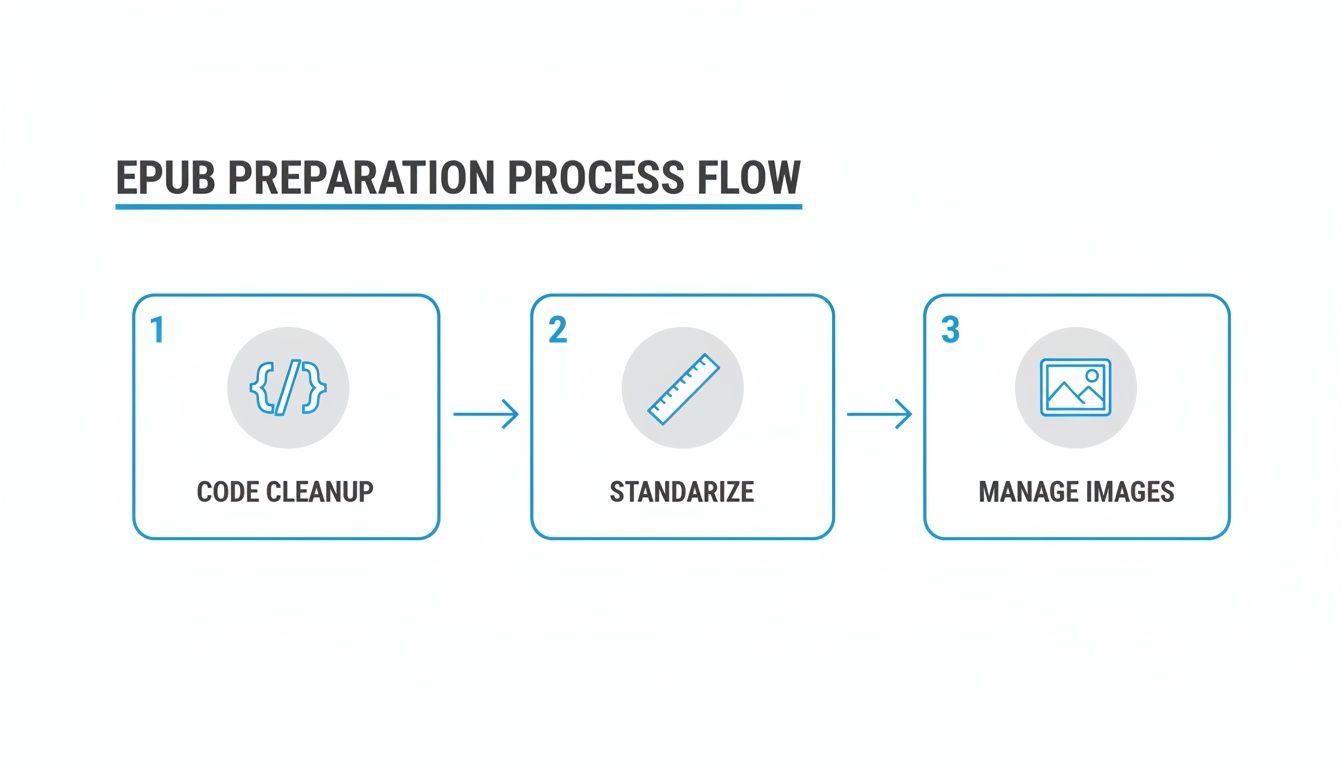
Getting this foundation right from the start is the key to preventing a mess of formatting errors down the line.
Launching the Translation and Final Steps
Once you've double-checked your settings and chosen your plan, you hit the "translate" button. The platform will start chugging away, processing your book chapter by chapter. You can watch its progress in real-time, though the total time will obviously depend on how long your book is.
This is where BookTranslator.ai really proves its worth. It’s not just running a find-and-replace on your text. It's rebuilding the very structure of your book to fit a completely different linguistic system. It handles all the tricky technical bits of RTL formatting so you can stay focused on the creative side of things.
The demand for tools like this is exploding. The global translation industry is on an incredible upward swing, ballooning from about $53 billion in 2020 and on track to hit a projected $96.21 billion by 2032. This growth is all about the global appetite for localized digital content—which is precisely the problem BookTranslator.ai was designed to solve.
You'll get a notification as soon as the translation is finished. From there, you can download your brand-new, fully translated Arabic EPUB. Of course, you're not quite done yet. A final quality check is always a good idea, which we'll get into later. For now, if you're curious about the engine under the hood, take a look at our deeper dive on what makes an AI book translator so effective. This whole process takes what was once a monumental, expensive task and makes it accessible to just about anyone.
Getting the Feel and Flow Right: From Spanish Culture to Arabic Formatting
A successful translation goes far beyond just swapping words. When you translate Spanish to Arabic, the real magic lies in making the story feel native to an Arabic reader. This involves navigating two significant challenges: preserving the original's cultural soul and mastering the technical flip to right-to-left (RTL) formatting.
Translating an idiom literally is a classic mistake that can leave readers scratching their heads. Thankfully, modern AI is smart enough to avoid most of these pitfalls, but the final polish from a human eye is what truly makes a translation shine.
Keeping the Author's Voice Intact
Think about a common Spanish phrase like "no tener pelos en la lengua" (literally, "to not have hairs on the tongue"). A crude translation would be nonsensical. A more advanced AI, like the engine behind BookTranslator.ai, correctly identifies the meaning—to be blunt or speak one's mind—and seeks a culturally relevant Arabic equivalent.
This is where your role as a post-editor becomes critical. Your job is to make sure the AI's choice fits the character's personality. Is the character a street-smart teen or a formal elder? The specific Arabic phrase for "being blunt" would differ dramatically between them.
Here are a few things I always check during my post-editing pass:
- Scan for Idioms: Flag any expressions that feel a bit off. Does the AI's choice capture the original flavor and fit the scene?
- Clarify Cultural References: A nod to a specific Spanish holiday might need a subtle tweak or a brief, non-intrusive explanation to connect with readers unfamiliar with it.
- Read Dialogue Aloud: This is my secret weapon. Does the conversation sound natural? Does it have the right rhythm and emotion for the characters?
Key Takeaway: The goal isn't just clarity; it's emotional resonance. You want your Arabic readers to experience the same feelings as your original Spanish audience. That’s what turns a good translation into a great one.
Mastering the Right-To-Left Flip
Beyond the linguistic challenges, Arabic introduces a fundamental structural shift: it reads from right to left. This impacts everything. The entire book's layout, from how pages turn to text alignment, needs to be inverted. A poorly formatted RTL book just feels broken and unprofessional, instantly pulling the reader out of the story.
This is a huge technical headache to do manually, but BookTranslator.ai is built to handle this automatically. When you select an RTL language, it doesn't just right-align the text; it reconstructs the EPUB's core structure.
Page numbers, chapter titles, blockquotes, and image placements are all intelligently repositioned to conform to Arabic reading standards. This leaves you with one simple task: a final visual check. Open the generated Arabic EPUB and just scroll through it. For a deeper dive into how AI approaches these issues, you can learn more about cultural nuances in AI book translation.
Does the book open on the "right" side (which is the left side for LTR)? Do the pages turn left? Is the text flush to the right margin? A quick five-minute flip-through is usually all it takes to confirm the technical side is perfect, freeing you up to focus on what matters most—the story itself.
Spanish vs Arabic Translation Considerations
To bring it all together, here’s a quick-reference table outlining the key differences you’ll encounter and how to approach them.
| Challenge Area | Spanish Convention (LTR) | Arabic Convention (RTL) | AI Handling & Post-Edit Tip |
|---|---|---|---|
| Reading Direction | Left-to-right text flow; pages turn right. | Right-to-left text flow; pages turn left. | AI Handling: BookTranslator.ai automatically re-engineers the EPUB. Tip: Do a visual flip-through. |
| Idiomatic Language | Rich with expressions tied to Spanish/Latin culture. | Has its own vast set of proverbs and culturally-rich idioms. | AI Handling: Translates intent, not literal words. Tip: Verify choices align with character voice. |
| Punctuation | Uses standard Latin punctuation (e.g., ?, !, .). | Uses mirrored punctuation (e.g., ؟, ،). | AI Handling: Automatically adapts punctuation marks. Tip: Spot-check dialogues for correct usage. |
| Cultural Context | References to specific foods, festivals, or history. | Different social norms, religious contexts, and history. | AI Handling: Provides direct translation. Tip: Add subtle explanations for non-obvious references. |
This table serves as a handy checklist during your quality control phase, ensuring both the technical formatting and cultural heart of your book make the journey from Spanish to Arabic successfully.
Making Sense of Translation Costs and Project Pricing
Let's talk about the bottom line: what does it really cost to translate a book from Spanish to Arabic using AI? One of the best things about a tool like BookTranslator.ai is its straightforward, pay-as-you-go pricing. There are no subscriptions to manage or weird hidden charges—you just pay for the work you need done.
The whole system runs on tokens. Think of tokens as the small pieces of text the AI "reads" to do its work. Your book's word count is converted into these tokens, which means the final price is directly linked to the length of your manuscript. This approach takes all the guesswork out of budgeting for your translation.
What Will Your Book Cost to Translate?
So, what does this look like in practice? Let's say you have a Spanish novel that's around 60,000 words. Here's a quick breakdown of the cost using BookTranslator.ai's two main plans, which should give you a solid idea of the investment.
- The Basic Plan: This one costs $5.99 per 100,000 words. It's incredibly affordable and delivers a high-quality translation that works great for many projects.
- The Pro Plan: At $9.99 per 100,000 words, this plan taps into the most sophisticated AI models out there. It's the right choice when you need to nail every bit of nuance and preserve a really specific authorial voice.
For that 60,000-word book, the calculation is simple. The Basic plan would run you about $3.59, and the Pro plan would be around $5.99. That’s it. This kind of pricing really opens up new possibilities for indie authors and smaller publishers. When you're looking at different AI tools, it's always a good idea to understand how to compare AI models based on their cost, quality, and speed to figure out what’s best for you.
This per-book pricing model completely demystifies translation costs. You see the exact price upfront, so you can confidently plan your expansion into new markets without any financial surprises.
This accessible pricing is a huge reason why AI translation is booming. The machine translation market was valued at $650 million back in 2020 and is on track to hit $3 billion by 2027. It's growing so fast because it offers a practical, quick alternative to the old way of doing things.
For authors, this means breaking into the vast Arabic-speaking market isn't some far-off fantasy anymore. It's a real, achievable goal.
Common Questions About Spanish to Arabic Book Translation
It's only natural to have a few questions, even when the path seems clear. Whenever I talk to authors about translating their work from Spanish to Arabic, a few concerns almost always pop up—usually around quality, formatting, and what AI can really do. Let's tackle those head-on so you can move forward with confidence.
One of the biggest worries I hear is whether a machine can truly grasp the poetic and structural nuances of these two incredibly rich languages. Arabic, for instance, isn't just one language; it has numerous dialects and a sentence structure that can be a world away from Spanish. This isn't just a word-for-word swap; it’s about rebuilding the very flow of a sentence so it feels right to a native speaker.
Thankfully, the AI models powering professional tools like BookTranslator.ai are not your average web translator. They've been trained on vast libraries of literature, historical texts, and modern writing from both cultures. This deep learning allows them to understand context, pick up on idioms, and adapt sentence structures in a way that feels surprisingly natural.
How Does the AI Handle Right-to-Left Formatting?
This is a fantastic and critical technical question. If the right-to-left (RTL) formatting is botched, the ebook is basically unreadable and looks incredibly amateurish. Getting it right is about more than just aligning the text to the right; it means fundamentally re-engineering the EPUB file itself.
The good news is that BookTranslator.ai was built to handle this automatically. The moment you select Arabic as your target language, the platform gets to work on the book's core code to ensure everything is perfect.
- Correct Page Progression: The book will open and flow from left to right, just as an Arabic reader expects.
- Proper Text Alignment: All your paragraphs, headings, and lists will naturally snap to the right margin.
- Mirrored Punctuation: It even swaps out standard punctuation for Arabic equivalents where needed, like the question mark (؟) and the comma (،).
Essentially, the system sweats the small technical stuff so you don't have to. Your book's layout is preserved, and the final product looks polished and professional.
Will the Translation Lose My Authorial Voice?
This is the big one. Preserving an author's unique voice is the ultimate test of any translation, human or AI. A basic translation might get the plot points correct, but it can easily flatten the prose, stripping it of its character and personality.
This is exactly why the choice of AI model matters so much. For creative works like novels or memoirs, I almost always recommend a "Pro" plan. The more advanced AI models used in these tiers are far better at capturing subtle nuances, tone, and stylistic choices.
The AI's job is to give you a high-quality, culturally resonant draft. Your role in the final review is to add that last 10% of human polish that makes the voice unmistakably yours.
Think of it this way: if your Spanish writing is known for its short, punchy sentences, a more sophisticated AI is much more likely to replicate that rhythm in Arabic instead of defaulting to a more generic, complex sentence structure.
The goal here is a partnership. The AI does the heavy lifting, and you provide the final artistic touch. This collaboration ensures that when you translate Spanish to Arabic, your new readers get an experience that is both authentic and completely faithful to your original vision.
Ready to bring your story to a new audience? With BookTranslator.ai, you can translate your Spanish book to Arabic quickly, affordably, and with professional results. Start your translation project today!