
If you need to translate French documents into English, you've probably realized that just dropping text into a basic online tool won't cut it. To get it right, you need a solid workflow. This means prepping your files, choosing a translation method that gives you both speed and accuracy, and, crucially, running a final quality check. Thankfully, modern AI solutions can handle this entire process, turning out professional-grade translations for everything from business contracts to entire novels.
Why High-Quality Document Translation Is No Longer Optional
The need to translate French documents into English is bigger than ever. France is a major player in global industries like luxury goods, pharmaceuticals, tech, and aerospace, and that means a constant flow of communication. For businesses, this isn't just about ticking a box; it's a strategic move to open up new markets. A perfectly translated technical manual or legal contract can mean the difference between a successful launch in an English-speaking country and an expensive, embarrassing flop.
It's the same story for academics, authors, and researchers. Top-tier translation is what allows their work to reach a global audience. It's the bridge that carries groundbreaking research, captivating novels, and vital studies across language barriers, sparking international collaboration and sharing knowledge.
The Growing Market for Translation Services
The numbers back this up. The global translation market was valued at a massive USD 956.81 billion in 2025 and is on track to hit USD 1.18 trillion by 2035. Europe is the engine driving much of this growth, holding a 53.9% share of the market, which makes sense given the 24 official EU languages. This creates a constant, high-stakes demand for precise translations in the legal, healthcare, and e-commerce fields.
The old way of doing things just can't keep pace. Traditional translation services are often slow, expensive, and can produce inconsistent results. Manually translating a 200-page book can take weeks and set you back thousands of dollars, putting it out of reach for many businesses and creators.
The Shift to Modern Solutions
This is where AI-powered platforms have completely changed the game. They offer a smart alternative that solves the biggest problems of old-school translation. Instead of waiting weeks for a draft, you can get a high-quality version back in minutes that perfectly preserves your document’s original layout, styling, and tone.
This shift makes professional-grade translation something anyone can access and afford. If you're curious about the mechanics, our guide on achieving AI translation quality at speed and scale breaks it down. Ultimately, using these tools is no longer a "nice-to-have"—it's a must for anyone who wants to communicate effectively in a global marketplace.
Getting Your Documents Ready for a Flawless Translation
Before you even think about hitting that "upload" button, a little prep work can save you a world of headaches later on. Think of it as a pre-flight check. A few minutes spent tidying up your source file is the single best thing you can do to get a high-quality translation when you need to translate French to English documents.
The reality is, the quality of your input file directly dictates the quality of the output. Even the most sophisticated AI will stumble over a messy, poorly structured document. A clean start is the foundation of a great result.
Pick the Right File Format
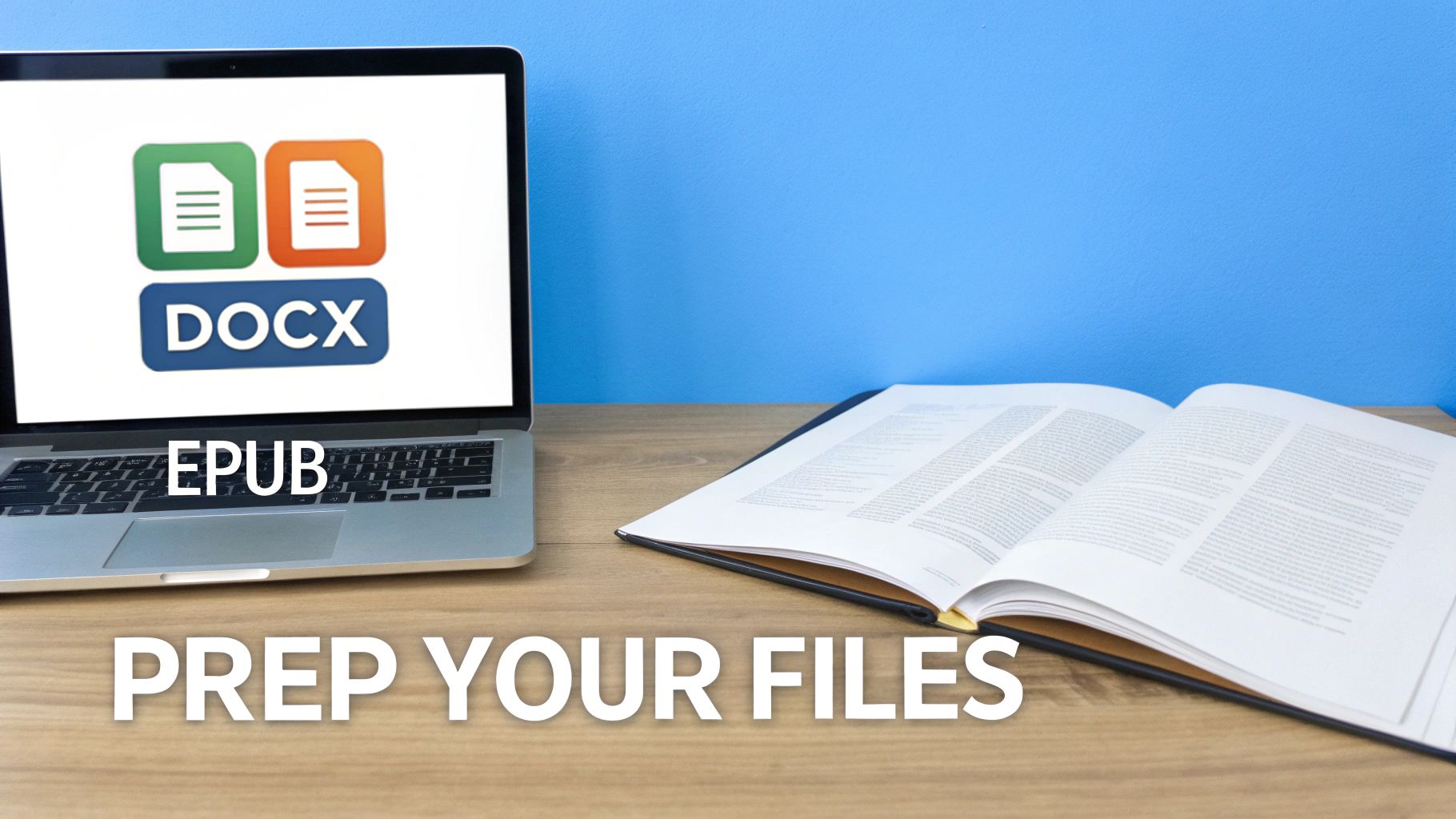
Let's be clear: not all file formats are created equal. Scanned PDFs, especially those filled with complex tables or handwritten notes, are a common nightmare for translation software. The text often isn't machine-readable, which can lead to garbled output and a lot of cleanup work for you.
Your best move is to get your document into a format that translation tools love. The top contenders are:
- DOCX (Microsoft Word): This is the gold standard. A DOCX file preserves a clear structure—headings, paragraphs, text flow—that makes it incredibly easy for an AI to understand and replicate accurately.
- EPUB (Electronic Publication): As the go-to format for e-books, EPUBs are built with clean formatting and clear chapter breaks. Platforms like BookTranslator.ai are designed to handle these perfectly, keeping your layout intact.
If you’re stuck with a scanned document, converting it first isn't just a suggestion; it's essential. For a deep dive, check out our guide on how to translate a scanned PDF without losing formatting: https://booktranslator.ai/it/blog/learn-how-to-translate-scanned-pdf-without-losing-formatting.
Nail Down Your Tone and Terminology
Next, think about the personality of your document. Is it a stuffy legal contract or a witty, conversational novel? The tone you're aiming for will completely change the vocabulary and sentence structure in the final English version.
Take a moment to define your desired tone: formal, informal, academic, or marketing-focused. This clarity helps guide both the AI and any human post-editor, ensuring the final text resonates with the intended audience.
Building a simple glossary is another pro move. Jot down any recurring brand names, technical jargon, or unique character names. This gives the AI a clear reference sheet, ensuring those key terms are translated consistently across hundreds of pages. If you're working with a team, knowing about adding comments to PDFs is also a great way to leave specific notes for editors right in the file.
By taking these steps, you're doing more than just uploading a file. You’re setting the entire project up for success from the very beginning.
Choosing the Right Translation Method for Your Needs
Picking the right way to translate French to English documents isn’t a simple choice. The best approach really boils down to what your project demands in terms of speed, budget, accuracy, and formatting. It’s always a balancing act.
A free online tool might look like a great deal for a quick email, but for anything more substantial, you'll quickly run into problems. These tools are notorious for wrecking your formatting, missing crucial context, and completely fumbling the nuances in a novel or a detailed technical manual. You often end up with a messy, unreliable document that takes hours to fix by hand.
Human Translators vs. AI Solutions
At the other end of the scale, you have professional human translators. They bring a deep cultural understanding and specialized knowledge that’s absolutely essential for sensitive material like legal contracts, creative fiction, or academic papers. But that level of expertise comes with a hefty price tag and a long turnaround time—think weeks or even months for a large book.
This is exactly where specialized AI translation platforms find their sweet spot. They offer a compelling middle ground, blending the rapid speed of machine translation with a much more sophisticated grasp of language and document structure. A tool like BookTranslator.ai, for instance, is built from the ground up to process large files while keeping the original layout—from chapter headings down to the last italicized word. You get a professional-looking result in a matter of minutes, not months.
The need for top-tier French-to-English translation is ballooning. As the third most-used language in the business world, the French language services market is on track to reach USD 6.67 billion by 2025. This surge is fueled by industries like biopharmaceuticals, where flawless translation of clinical trial documents is non-negotiable. You can dig deeper into this growing market and its effect on the global language services industry on fortunebusinessinsights.com.
Making the Right Choice for Your Document
So, how do you decide? Let's walk through the options with some real-world scenarios in mind. Your final choice will depend entirely on what matters most for your specific project.
The key is to match the tool to the task. Using a free tool for a 300-page manuscript is like trying to build a house with a screwdriver—it's the wrong tool for the job and will only lead to frustration.
When you're weighing your options, think about these common situations:
- Quick, informal needs: Got a casual internal memo or just need the gist of a French news article? A free online tool will do the trick just fine.
- Legally binding or high-stakes content: For a business contract, a patent application, or medical records, you can't take chances. A certified human translator is the only truly safe and reliable option.
- Long-form content with complex formatting: Translating an e-book, an academic thesis, or a detailed user manual? This is the perfect job for a specialized AI service that gives you the best mix of speed, cost, and quality while preserving your layout.
To make this even clearer, I've put together a table comparing the different methods side-by-side.
Translation Method Comparison French to English
| Feature | Free Online Tools | Manual Human Translation | Specialized AI (e.g., BookTranslator.ai) |
|---|---|---|---|
| Cost | Free | High ($0.10 - $0.25+ per word) | Low (around $5 per 100,000 words) |
| Speed | Instantaneous | Slow (days to months) | Fast (minutes for a full book) |
| Formatting | Almost always lost | Can be preserved, but adds time and cost | Preserved automatically |
| Accuracy & Nuance | Low; often misses context and cultural subtleties | Very high; expert-level | High; designed for long-form context |
| Best For | Short, informal text; getting the basic idea of a text | Legal contracts, literary fiction, marketing copy, medical | E-books, user manuals, academic papers, reports, documents with complex layouts |
Ultimately, understanding the strengths and weaknesses of each method allows you to make an informed decision. By choosing the right tool, you can ensure your French document is translated accurately and effectively, no matter the context.
Putting Your AI Translation Workflow Into Practice
Alright, let's get down to the brass tacks of how this actually works. I'll walk you through a repeatable workflow using a tool built for this exact purpose, BookTranslator.ai, so you can see how straightforward it is to translate French to English documents without the usual headaches.
The whole thing kicks off with a simple file upload. You just grab your prepared DOCX, EPUB, or PDF, and the platform is ready to handle it, even hefty files up to 50MB. This is a game-changer for anyone working with lengthy manuscripts, dense academic papers, or detailed business reports.
After your file is uploaded, you just need to confirm the languages—in our case, French to English. Then, you'll select the best AI model for the job, which is a key step in making sure the final translation has the right nuance and quality for your specific content.
Kicking Off the Translation
This is where the magic happens. The interface is designed to be as simple as possible, letting you get a project started in just a few clicks.
Once you hit "go," the AI gets to work, but it's not just translating words. It's meticulously preserving the entire structure of your document—chapters, headings, bold text, italics, everything. This is what separates a specialized tool from a generic one.
The demand for this kind of smart translation is exploding. The language services industry is on track to hit USD 75.7 billion by 2025, and the AI translation segment is growing at an incredible 24.9% per year. That growth is fueled by people just like you—authors, professionals, and businesses who need high-quality translations that don't just swap words but maintain the original's intent, voice, and visual layout.
Making Your Translation Process Even Smarter
While the AI does the heavy lifting, you can still find ways to make your overall process more efficient. For those handling a high volume of documents, it's worth exploring some document workflow automation techniques to manage files before they even get to the translation stage.
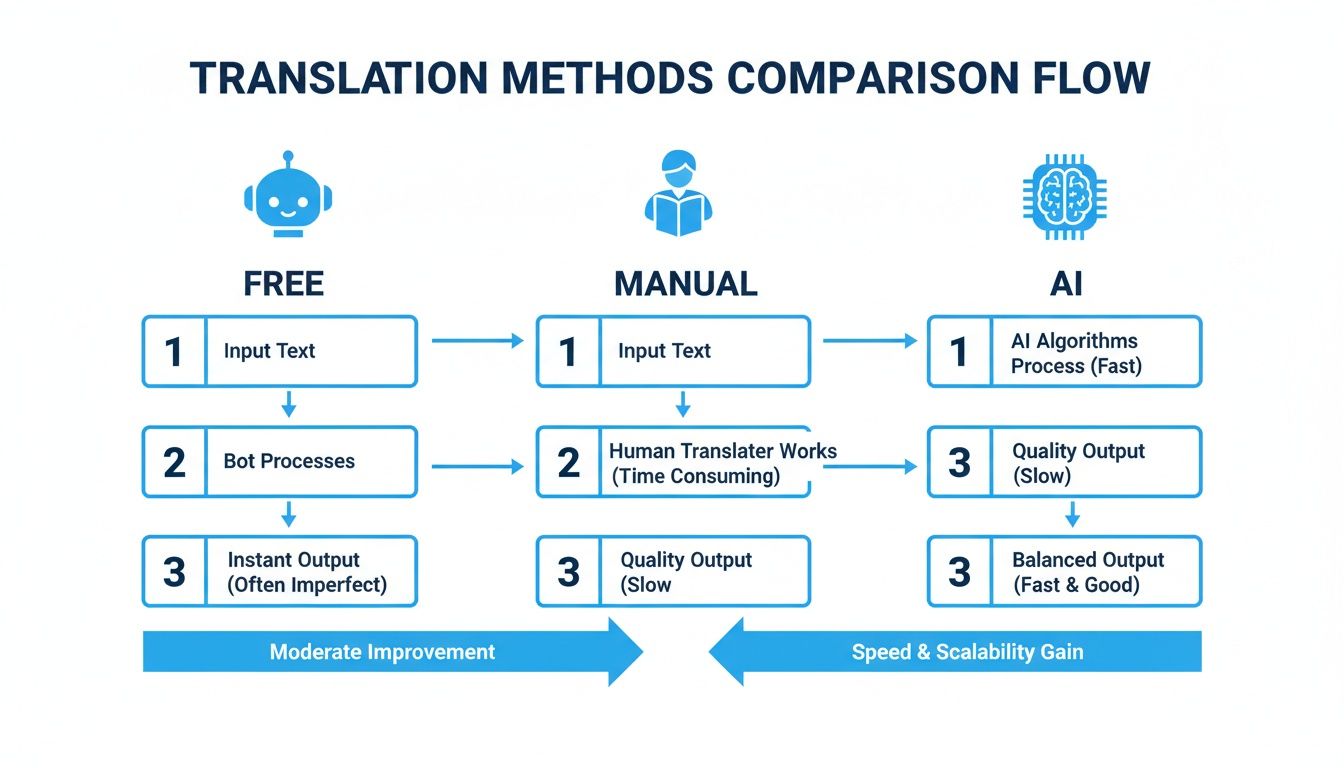
This approach finds the sweet spot between speed and quality. Free tools are fast but often butcher formatting and nuance. Manual translation is high-quality but slow and expensive. A specialized AI tool gives you the best of both worlds.
The real advantage here is predictability. You get a consistent, high-quality result every single time, turning what used to be a complex, time-consuming task into a simple, repeatable step in your workflow.
This reliable process is a lifesaver for anyone working with long-form content. Whether you're a business localizing a technical manual or an author trying to connect with an English-speaking audience, this is how you get it done effectively. For a deeper dive into making this process even smoother, check out our guide on how to automate translation workflows with AI tools. The end goal is simple: to make professional-grade translation fast, affordable, and accessible to everyone.
Fine-Tuning Your Translation: The Crucial Post-Editing Stage
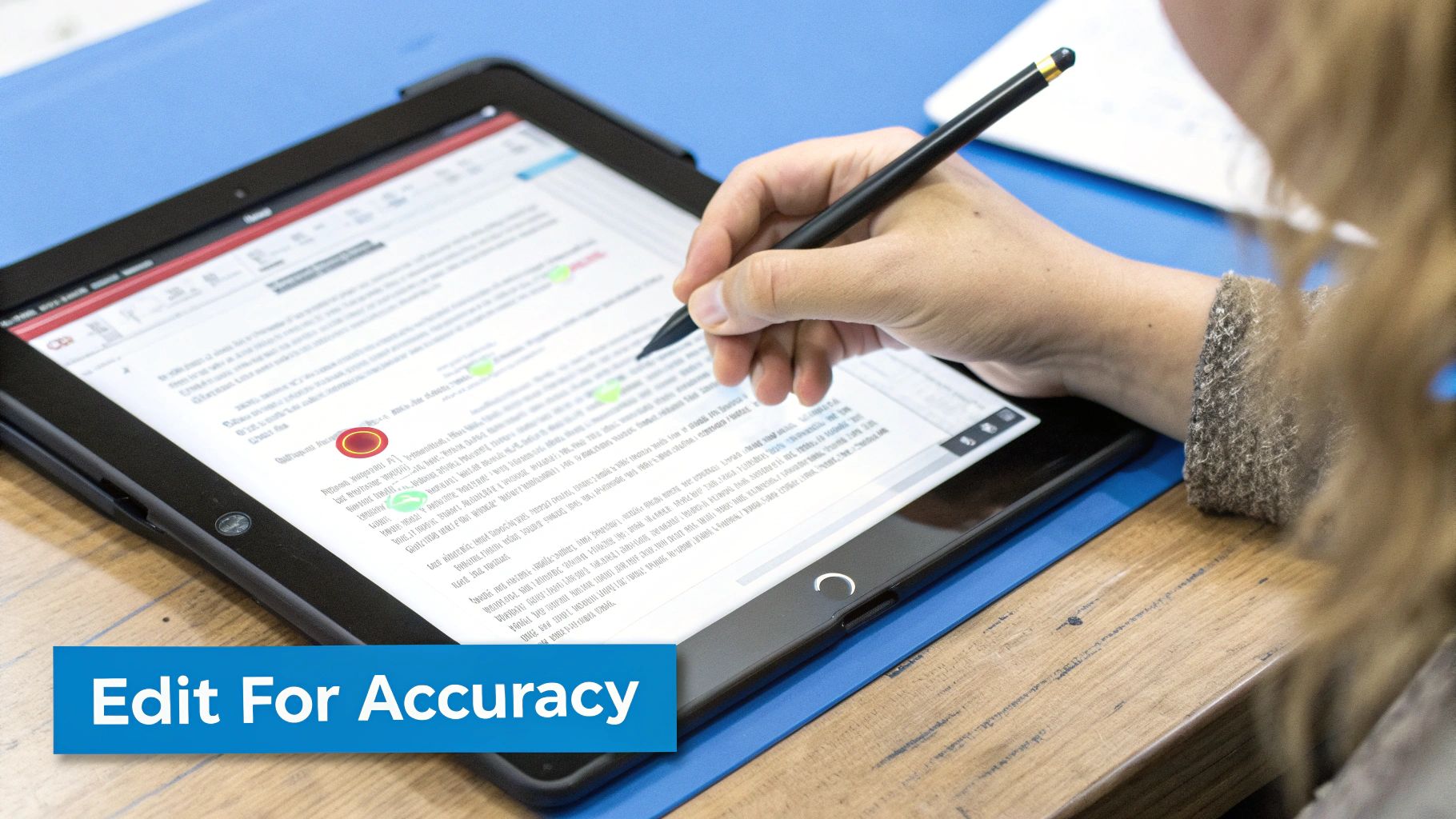
An AI translation from a tool like BookTranslator.ai can get you an impressive 95% of the way to a finished document. That last 5%, however, is where the magic happens. This is where human oversight turns a technically accurate translation into one that feels natural, polished, and truly professional.
Don’t think of this stage as just proofreading for typos. It's a critical quality assurance step. The AI gives you an excellent first draft, but your job is to infuse it with the cultural nuance and subtle context that a machine can't fully grasp. When you translate French to English documents, this human touch is absolutely essential for a high-quality result.
What to Look For: A Post-Editing Game Plan
To make your review efficient, you need to know what to hunt for. AI can sometimes be a bit too literal, so your first pass should focus on anything that reads as stiff or awkward. These are often dead giveaways of a mistranslated idiom or a cultural reference that didn't quite make the leap.
A classic example is the French phrase "poser un lapin à quelqu'un." A literal translation would be "to put a rabbit on someone," which is nonsense in English. Your check ensures it’s been correctly localized to its actual meaning: "to stand someone up."
Here’s a quick checklist to guide your review:
- Idioms and Cultural Flavor: Are there any phrases that just sound… off? Your goal isn't a word-for-word match but to find an English equivalent that carries the same intent and feeling.
- Consistent Terminology: Remember that glossary of key terms you set up? Now's the time to confirm they've been applied correctly and consistently throughout the entire document. This is a game-changer for technical or academic texts.
- Names and Proper Nouns: Meticulously check the spelling of every name, brand, and location. AI is good, but one small mistake here can really hurt your document's credibility.
- Localized Formatting: Make sure dates, currencies, and units of measurement fit your target audience. Think converting from DD/MM/YYYY to MM/DD/YYYY or from euros to dollars.
A huge part of this process is listening for the right tone. If the original French was formal and authoritative, the English version needs to carry that same weight. You have to ensure the AI didn’t accidentally slip into overly casual language that undermines the original intent.
The Final Polish: A Fresh Pair of Eyes
After you've run through the technical checks, it's time for one last, crucial step: a final read-through. The ideal person for this is a native English speaker, even one who doesn't know a word of French.
Why? Because they come in with a completely fresh perspective. Unburdened by the original French sentence structure, they can instantly spot any clunky phrasing or grammatical oddities that you might have missed. Their feedback is pure gold, helping you polish the document until it reads as if it were written in English from the very start.
Got Questions About Translating French Documents?
When you’re staring down a French document that needs to be in English, a ton of questions pop up. It gets even trickier with complex or sensitive files. Let's dig into some of the most common issues I see and get you some straight, practical answers.
Getting these details right is what separates a clumsy, awkward translation from one that’s polished and ready for its audience. It’s all about knowing what the tools can do and, just as importantly, when you need a real person to step in.
Can AI Really Handle My Legal or Technical French Files?
For super-specialized documents, modern AI is an incredible starting point. It can churn through dense, technical jargon in seconds, doing the heavy lifting with surprising accuracy. This first pass alone can save you a mountain of time and money.
But—and this is a big but—for legally binding contracts, patents, or sensitive technical manuals, you should always go for a hybrid approach. It's just smart practice.
- Let AI Do the First Draft: Use a dedicated tool like BookTranslator.ai to get a high-quality initial translation done fast. It will nail the core meaning and structure.
- Bring in a Human Expert: Once the AI is done, have a subject-matter expert—a lawyer, an engineer, a medical professional—review and sign off on the final version. This guarantees every nuance is perfect and the document is legally or technically sound.
This method truly gives you the best of both worlds: the raw speed and efficiency of AI, backed by the certified accuracy of a human pro.
How Do I Stop the Formatting from Getting Ruined?
Ah, the formatting nightmare. This is a huge concern, especially if you're working with PDFs or documents packed with tables, images, and specific layouts. My best advice? Start with the cleanest possible source file. A well-structured DOCX or EPUB gives the AI a much clearer roadmap to follow.
Today's AI platforms are built to recognize and preserve elements like chapter breaks, headings, and text styling. If you're stuck with a PDF, try converting it to a DOCX first. This creates a more stable foundation for the translation process and can save you a world of pain.
Taking a few minutes to prep your file can prevent hours of frustrating reformatting work on the other side. It ensures your final English document looks just as sharp as the original French one.
What's the Best Way to Handle French Idioms and Cultural Sayings?
This is where the post-editing process really shines. AI has gotten much better at grasping context, but it can still stumble over idioms by translating them too literally. It might correctly translate "coûter un bras" as "costs an arm," but more subtle cultural phrases often get mangled.
As you review the translated text, keep an eye out for anything that sounds unnatural or just plain weird in English. Your goal isn't to find a word-for-word match. Instead, you're looking for an English equivalent that captures the same feeling or intent. This is one of those human touches that makes the final text feel authentic and connect with your readers.
Is AI Actually Cheaper for Translating a Whole Book?
Absolutely, and it's not even close. For anything long-form—a novel, a dense user manual, an academic paper—traditional human translation can be prohibitively expensive. We're talking thousands of dollars and months of work. For many people, that's a non-starter.
This is where specialized AI services have completely changed the game. Instead of paying steep hourly rates, you use a pay-per-book or pay-per-word model. This allows you to get a professional-grade translation for a tiny fraction of the old-school cost. It’s what makes it possible for independent authors, researchers, and small businesses to reach a global audience without needing a massive budget.
Ready to translate your French documents with speed, accuracy, and preserved formatting? BookTranslator.ai offers a simple, powerful solution for authors, researchers, and businesses. Get started today at booktranslator.ai.