
So, you're ready to translate your French book into Arabic? Great decision. With tools like BookTranslator.ai, you can now convert your entire EPUB file, keeping your original layout and formatting intact. It's a game-changer for bridging a significant cultural and commercial gap, bringing French literature to a massive Arabic-speaking audience. The secret, as any seasoned author will tell you, is striking the right balance between the speed of AI and a careful human review for cultural nuance.
Why Translate Your Book From French To Arabic?

Let's be clear: translating your book from French to Arabic is more than just swapping out words. It's a strategic move to tap into one of the most vibrant and hungry reader markets on the planet. This decision opens your work to hundreds of millions of potential new readers across North Africa and the Middle East, unlocking huge opportunities for both cultural impact and sales.
Think about it in real terms. A self-published author with a historical fiction novel set in Paris can suddenly connect with a devoted readership in Cairo, Algiers, and Dubai. An academic who published their research in French can share their work directly with colleagues and students in a rapidly growing scholarly community.
Tapping Into a Growing Market
The link between the French and Arabic-speaking worlds isn't just a relic of history; it’s a living, breathing economic and cultural bridge that's getting stronger every day. The surging demand for quality French to Arabic translation is a direct reflection of these deep international ties.
- A Global Business Language: French is a heavyweight in international business, ranking third right after English and Chinese.
- Widespread Official Status: It's an official language in 29 countries, many of which share close cultural and economic bonds with the Arab world.
- Future Growth in Africa: By 2050, it's projected that over half of the world's French speakers will be in Africa, a continent with a huge and influential Arabic-speaking population.
This natural linguistic overlap creates a golden opportunity for authors and publishers. You can find more data on the growing demand for French-Arabic language services on polilingua.com.
When you translate your work, you're doing more than just converting text. You're building a direct line to a new culture, making your story, your ideas, and your voice accessible to readers who would have otherwise never found you.
Modern Tools Make It Possible
Not too long ago, translating a book was a slow, expensive process, usually reserved for big-name authors with major publishing deals. That's all changed. AI-powered platforms have leveled the playing field, putting professional-grade translation within reach for everyone.
Services like BookTranslator.ai do the heavy lifting, ensuring the core of your narrative and your book's formatting stay consistent. Gaining a better understanding of how AI book translation is key to global reader engagement will help you navigate these new tools effectively. This leaves you free to focus on what you do best: connecting with your new audience.
Preparing Your Ebook File For Translation
Before you dive into the exciting part—seeing your French book come alive in Arabic—a little prep work can make all the difference. Think of it as a pre-flight check for your manuscript. From my experience, a clean, well-structured file is the single most important factor in getting a great translation from any AI tool, and it can save you hours of headaches later.
The whole point is to give the translation AI the clearest possible source material to work with. If the file is messy or has complex formatting, the software can get confused, leading to strange errors or layout problems in the final Arabic version. By tidying up your file first, you let the AI do what it does best: focus on the words.
Tidy Up Your Source Document
Your first stop isn't the EPUB file itself, but the original manuscript you wrote in Microsoft Word or Google Docs. This is where most translation issues actually start.
- Resolve All Tracked Changes: Comments and suggestions floating in the margins can be accidentally pulled into the main text by the AI. Make sure to accept or reject everything to create a final, clean version.
- Hunt Down Hidden Formatting: Things like extra line breaks, double spaces, or a mix of font styles can throw off the translation's flow. A neat trick is to use your word processor’s "Show/Hide Formatting Marks" feature to spot and zap these little problems.
- Check for Text in Images: This is a big one. The AI can't read text that's part of an image file, so if a chapter title or a key quote is baked into a picture, it won't be translated.
Here's a look at the BookTranslator.ai interface, which really is built around the idea of starting with a clean file.
That simple "Upload EPUB" button is your cue—have a finalized, ready-to-go file for the smoothest process.
Finalize Your EPUB Structure
Once your manuscript is spotless, it's time to think about the EPUB structure. How well your EPUB is put together directly affects how the final Arabic version will look and feel. Properly tagged chapters and sections are absolutely essential. If you need some pointers, you can find great advice by exploring various tools for EPUB conversion and processing.
A well-prepared EPUB is like giving the AI a perfect blueprint. When your chapter breaks and headings are clearly defined, the AI can flawlessly replicate that structure in the right-to-left Arabic format. It's the key to preserving your book’s professional layout and making it easy to read.
For instance, make sure every new chapter starts with a real heading tag (like an H1 or H2), not just bolded text with a few extra spaces. This metadata tells the AI precisely where one section ends and the next begins. When you translate French to Arabic, that kind of structural clarity is critical because the entire reading direction flips. It’s these small technical details that truly make a massive difference.
Getting Your Book Translated With BookTranslator.ai
Okay, so you’ve got your French EPUB file prepped and polished. Now for the exciting part: turning it into a professionally translated Arabic ebook using BookTranslator.ai. Let's walk through this together, imagining we're translating a 150-page historical novel. I'll show you how the platform works in a real-world scenario, from the upload to choosing the right AI engine for your specific book.
The whole process is refreshingly straightforward. You're basically taking your clean source file and letting the AI do the heavy lifting, delivering a translated ebook in just a few clicks. First things first, you'll need to upload that EPUB.
Uploading Your EPUB And Selecting Languages
Once you land on the BookTranslator.ai site, you'll see a simple upload screen. You can either drag your French EPUB file right into the browser window or click to browse your computer for it.
After the upload, the system gets to work analyzing the file and asks for a couple of quick confirmations:
- Source Language: Make sure "French" is selected from the dropdown.
- Target Language: This is where you'll pick "Arabic."
- Word Count Analysis: The tool will automatically crunch the numbers and show you the total word count.
This initial step is more than just a formality. It confirms the platform can read your file correctly and gives you the exact word count, which is what determines the price. Now you have everything you need to make the most important decision of the process.
Choosing Your AI Translation Model
BookTranslator.ai gives you two different AI models to choose from: Basic and Pro. Each one is built for slightly different purposes, and for our 150-page novel, this choice will make a real difference in the final quality. The Basic plan is surprisingly good for straightforward text, but for creative writing like a novel, the Pro model is almost always the way to go. It’s just better at capturing the nuance, tone, and artistic flair of the original French.
It’s worth noting just how big the market is for this kind of work. For instance, translations from English to French account for 11.51% of all professional translation projects worldwide. The reverse, French to English, sits at 5.31%. This shows a huge appetite for translated books, so putting a high-quality version of your work out there is key to reaching a new audience.
When you're deciding between the Basic and Pro models, think of it as a trade-off between cost and nuance. For a novel where the author's voice and style are everything, investing a little more in the Pro model can save you hours of post-editing work later on.
The platform is very transparent with its pricing. It lays out the cost for both options right there on the screen before you have to commit to anything, so you can make a smart call based on your book and your budget.
To help you decide, here’s a quick breakdown of what you get with each plan.
Choosing Your AI Translation Model Basic vs Pro
Deciding between the two plans really comes down to the specific needs of your book. For a technical manual, Basic might be fine. For a literary novel, Pro is the better investment.
| Feature | Basic Plan ($5.99/100k words) | Pro Plan ($9.99/100k words) |
|---|---|---|
| Ideal For | Non-fiction, simple prose, first drafts | Fiction, poetry, complex narratives, final drafts |
| Nuance & Style | Good literal translation | Superior handling of tone, style, and cultural context |
| Idiomatic Expressions | Handles common phrases well | Excels at translating complex and subtle idioms |
| Post-Editing Effort | May require moderate editing | Minimal post-editing needed |
| Right-to-Left (RTL) Layout | Standard RTL formatting | Advanced RTL layout and punctuation handling |
Ultimately, the Pro plan is built for authors who need the translation to feel as natural and artful as the original.
The infographic below really drives home the importance of the prep work we did before even getting to this stage.
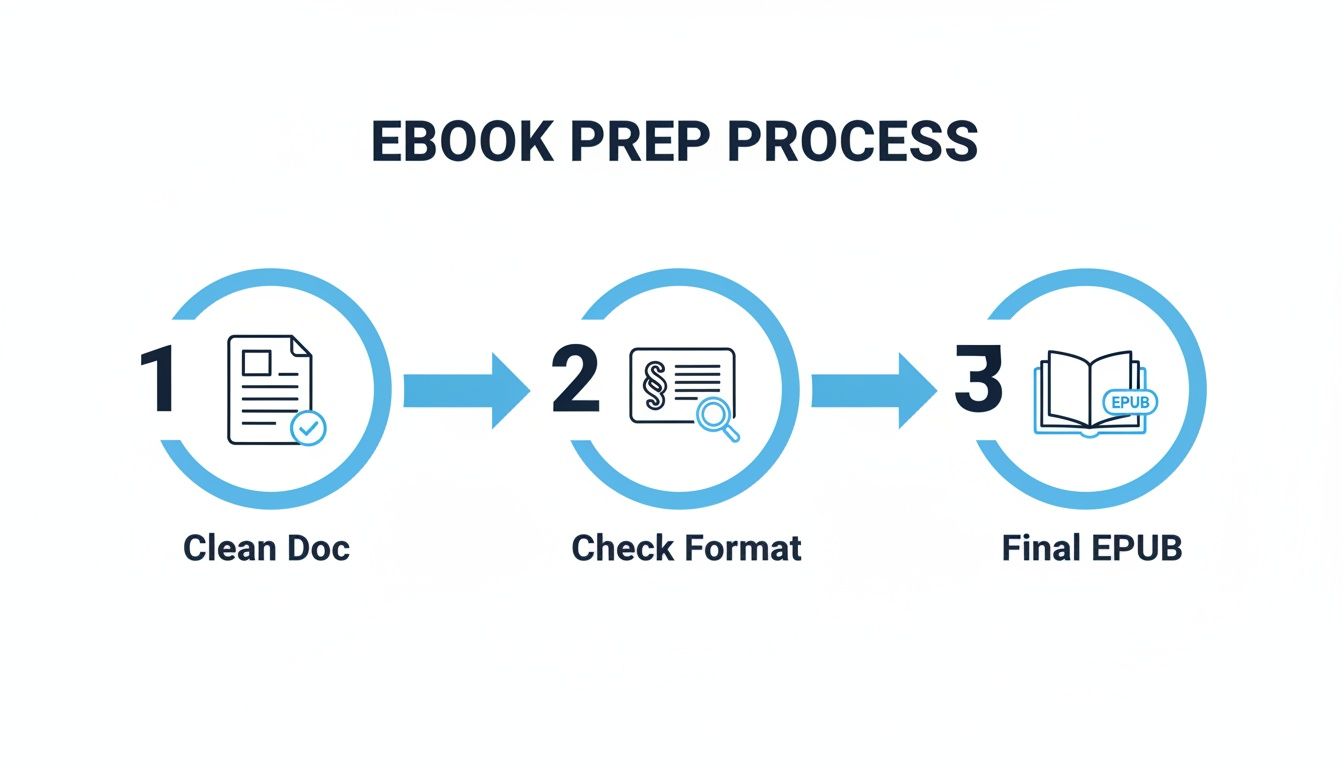
A clean document is the foundation for a great translation. And while BookTranslator.ai is a specialized tool, it's good to know about other resources out there. For quick checks or smaller jobs, something like Polychat's translator tool can also be a handy part of a translator's toolkit.
Once you’ve made your choice and confirmed the translation, the system takes over. It's impressively fast, and you'll get an email as soon as your newly translated Arabic EPUB is ready to download. The final file will not only have the text translated but will also have the formatting and layout correctly adjusted for the right-to-left reading experience—ready for you to review.
Keeping Your Book's Design Intact: From French to Arabic
One of the biggest hang-ups I see authors have when they decide to translate French to Arabic is the fear of losing their book’s design. After all the work you put into crafting a beautiful layout, the last thing you want is an automated tool scrambling your headings, messing up chapter breaks, and completely ruining the reading experience.
It’s a totally valid concern. The shift from a left-to-right (LTR) language like French to a right-to-left (RTL) one like Arabic is a massive technical hurdle.
Luckily, tools like BookTranslator.ai were built from the ground up to solve this exact problem. It uses what's called 'Smart Formatting' technology. Instead of just swapping words, the system intelligently reconstructs the entire document, making sure it fits perfectly with Arabic’s right-to-left orientation. The result is an ebook that feels completely natural to an Arabic reader, not just a clumsy, mirrored version of your original work.
What Stays the Same?
When you run your EPUB through the translator, the platform identifies and protects the core building blocks of your book's design. The whole point is to keep your authorial voice and visual branding consistent, even when crossing into a completely different script and layout.
Here’s a quick rundown of what you can expect to remain intact:
- Headings and Subheadings: Your H1s, H2s, and H3s are all recognized and applied to the newly translated Arabic text, keeping your book's structural hierarchy just as you designed it.
- Chapter Structure: The tool knows where one chapter ends and the next begins, so the flow of your book isn't interrupted.
- Basic Text Styling: Little things that add emphasis—like bold text, italics, and underlines—are carried over to the right words and phrases in the final Arabic version.
This attention to detail is what separates a professional-looking ebook from a sloppy one. It's a critical feature in the rapidly growing language services market, which is projected to hit a staggering $147.48 billion by 2034. Creators and businesses alike are demanding higher-quality translations that respect context and design. You can read more about the growth of the language services market on fortunebusinessinsights.com.
The Real Magic: Nailing the Right-to-Left Shift
This is where the technology really proves its worth. If you just translated the text but kept the French LTR formatting, you’d end up with a confusing, unreadable mess. The AI has to completely rebuild the layout for an RTL audience.
The most important part of preserving formatting isn’t just about keeping things the same—it's about knowing exactly what needs to change. The AI automatically flips the page orientation, right-aligns paragraphs, and adjusts punctuation to match Arabic conventions. This is what makes the final ebook feel truly native.
Take punctuation, for example. A French sentence ends with a period on the right. In the translated Arabic version, the AI correctly places the period on the left side of the sentence. This automatic adjustment also applies to page numbers, footnotes, and other layout markers, saving you what would otherwise be countless hours of tedious manual fixes.
The system is robust enough to handle even complex source files, although it really sings when you feed it a clean EPUB. If your book is in a more challenging format, you might want to check out our guide on how to translate a scanned PDF to get a better sense of the nuances involved.
Giving Your Translated Ebook That Human Touch
AI translation is an incredible starting point, but it's the final human review that truly makes your book sing. This is where the magic happens. We call it "post-editing," but it's really about taking the technically accurate translation and breathing your authorial voice into it for an Arabic-speaking audience.
Think of it this way: the AI did the heavy lifting, the meticulous conversion of words and sentences while keeping your formatting intact. Now, a human expert—a native Arabic speaker—steps in to add the artistry. This partnership is what separates a decent translation from a brilliant one when you translate French to Arabic.
Finding the Right Proofreader
You're not just looking for a proofreader; you need a cultural translator. The ideal person is a native Arabic speaker who doesn't just know the language inside and out but also gets the vibe of your genre. Someone who specializes in sci-fi is going to catch different things than an editor who primarily works on business books.
When you begin your search, be clear about what you need.
- Genre Experience: Does their portfolio show they understand the conventions of your style, whether it's fast-paced thrillers or lyrical prose?
- Dialect Awareness: Be specific about your target market. Are you aiming for readers in the Levant (Lebanon, Syria) or the Maghreb (North Africa)? This choice impacts vocabulary and phrasing, making the book feel local.
- Collaborative Spirit: Look for someone who provides feedback and explains their reasoning, not just a silent corrector. You want a partner in the process.
Great places to find these pros are platforms like Upwork or niche literary translation communities. I always recommend sending a sample chapter first. It’s the best way to see if their editing style clicks with your vision before you commit to the whole manuscript.
What to Focus On During the Review
This review is so much more than a simple spell-check. It's about making sure the story lands with the same emotional punch in Arabic as it does in French. You're turning a literal translation into a localized masterpiece.
The goal here isn't to re-translate from scratch. It's to find the soul of the text. You want to ensure a joke that's hilarious in French gets the same laugh in Arabic, and a tense scene has readers on the edge of their seats, regardless of language.
Here’s a checklist I give to my collaborators to guide their review:
- Idiomatic Expressions: French idioms almost never translate directly. A phrase like "coûter un bras" (to cost an arm) needs an equivalent Arabic expression that carries the same weight, not a word-for-word translation that would just sound bizarre.
- Cultural Nuances: Little things matter. References to specific French holidays, foods, or social norms might need a touch of context to make sense to an Arabic reader. Sometimes a quick, subtle explanation is all it takes.
- Character and Place Names: Does a name need tweaking? A French name that’s a mouthful in Arabic might be better served with a slightly different transliteration to keep the reading experience smooth.
- Narrative Flow and Pacing: This is a big one. Ask your reviewer to read passages aloud. It’s the single best way to catch clunky phrasing or sentences that just kill the rhythm of your story.
By zeroing in on these areas, you empower your editor to apply that final, crucial layer of polish. This is the human element that ensures your story isn't just understood—it's felt.
Answering Your Questions About French to Arabic Book Translation
Even with a tool as capable as BookTranslator.ai, I know that diving into a new language market can feel like a leap of faith. Whenever authors and publishers consider translating their French books into Arabic, a few common questions always pop up—usually about accuracy, file compatibility, and those tricky technical details. Let's clear those up so you can move forward with confidence.
A big one I hear all the time is about creative writing. Can an AI really get the feel of a novel or the flow of poetry right? You'd be surprised. The latest AI models are incredibly good at holding onto the original tone and artistic intent of your work.
Of course, for literature that's dense with cultural slang or really complex wordplay, it's always smart to have a native speaker give it a final look. Think of it this way: the AI does all the heavy lifting—the core translation and the nightmare of formatting—which makes that final human polish faster and way more affordable than starting from scratch.
Technical and Compatibility Questions
"What if my EPUB file is too big?" This is a classic, especially for books with a lot of illustrations. If you try to upload your French EPUB to BookTranslator.ai and find it's over the 50MB limit, the culprit is almost always oversized images.
Don't worry, the fix is simple. You can use a fantastic, free tool called Calibre to compress the images inside your EPUB before you upload it for translation. This usually shrinks the file down to size with no noticeable loss in quality. If your book is mostly text, you'll likely never run into this issue.
The most important thing to remember is that the EPUB format is your golden ticket. Once BookTranslator.ai generates your Arabic EPUB with the proper right-to-left (RTL) formatting, it's ready for prime time. It will work perfectly on all major e-readers and apps, including Kobo, Apple Books, Google Play Books, and even Kindle after a quick conversion.
The platform’s formatting engine is built specifically for this kind of universal compatibility, so your readers get a smooth, professional experience on any device they choose.
Getting the Language Nuances Right
Finally, there’s the question of the soul of the language. What about the complex grammar and unique idioms that make French, well, French? Can an AI really translate those subtleties into natural, flowing Arabic?
The answer is largely yes. The AI models are trained on massive libraries of text, so they can recognize and correctly translate sophisticated grammar, verb tenses, and a huge range of common idioms. The Pro model, in particular, is fine-tuned for an even deeper level of nuance.
That said, for those hyper-specific cultural phrases or deeply idiomatic expressions, a quick post-translation review is still the gold standard. This final check ensures your message isn't just translated—it resonates perfectly with your new Arabic-speaking audience.
Ready to see how easy this can be? Give BookTranslator.ai a try and convert your EPUB from French to Arabic in minutes, all while keeping the layout you worked so hard on. Get started at https://booktranslator.ai.