
If you've ever tried to run a line of Old English through a standard online translator, you know the feeling. The output is usually gibberish, a jumbled mess that makes even less sense than the original. That’s because Old English isn't just a quirky, older version of the English we speak today; it's a completely different language, with its own grammar, vocabulary, and logic. Getting a handle on why it's so tough is the first real step to translating it well.
Why Old English Is So Hard to Translate
Staring at a manuscript of Beowulf can feel like deciphering an alien script, and for good reason. The journey from Old English to Modern English was a seismic shift, fundamentally reshaping how over 1.5 billion people communicate. Spoken between roughly 450 and 1150 AD, Old English was a Germanic tongue with a grammatical framework that’s almost unrecognizable to us now. In fact, linguistic analyses suggest the mutual intelligibility between the two is under 5%.
The problem really starts with its Germanic roots. While Modern English still has some of that DNA, it’s been flooded with influences from French, Latin, and countless other languages over the centuries. Old English, on the other hand, is much purer in its origins, sitting closer to Old High German or Old Norse than to the English of Shakespeare, let alone our own. This has created a massive gap, though thankfully, the rise of AI-powered translation tools is starting to help us bridge it.
A Completely Alien Grammar
The single biggest hurdle is the grammar. In Modern English, word order is king. We know "the man bites the dog" is different from "the dog bites the man" simply because of the sequence. It's how we make sense of who did what to whom.
Old English threw that rulebook out the window. It was a highly inflected language, meaning the endings of words, not their position in a sentence, dictated their function.
- Noun Cases: Nouns had four distinct cases (nominative, accusative, genitive, and dative). The word's ending would change to show if it was the subject, direct object, possessor, or indirect object.
- Genders: Every noun had a grammatical gender: masculine, feminine, or neuter. These often defied logic. For instance, wīf (wife) was a neuter noun, while wīfmann (woman) was masculine.
- Complex Verbs: Verbs were a minefield of conjugations, changing their forms based on tense, mood, and person in ways more familiar to speakers of German or Latin.
This is why a word-for-word translation is destined to fail. It’s like trying to build a LEGO set using DUPLO bricks—the pieces just don’t fit together, no matter how you arrange them.
Unfamiliar Vocabulary and Word Meanings
Even if you could wrestle with the grammar, the vocabulary itself is a whole other challenge. An estimated 85% of Old English words have fallen out of use entirely. Worse, many of the words that did survive have completely different meanings today.
Take the Old English word sellan, which meant "to give," not "to sell." Or dēor, which referred to any kind of animal, not just the deer we picture. These "false friends" are traps waiting to catch the unwary translator, leading to bizarre and inaccurate interpretations.
To put it in perspective, let's look at a quick side-by-side comparison of the two languages.
Old English vs Modern English: A Quick Comparison
This table gives you a snapshot of just how profound the differences are, highlighting why a simple dictionary lookup will never be enough.
| Linguistic Feature | Old English | Modern English |
|---|---|---|
| Primary Influence | West Germanic | Germanic, French, Latin |
| Grammar System | Highly inflected (case endings) | Analytic (word order) |
| Noun Genders | Masculine, Feminine, Neuter | None (natural gender) |
| Vocabulary Overlap | Approximately 15% | 100% |
| Writing System | Included special characters (þ, ð, æ) | Standard Latin alphabet |
These deep-seated differences make it clear why your average translation app just can't cope. To successfully render Old English into modern, readable prose, you need a much more sophisticated approach—one that can reconstruct syntax, correctly interpret archaic words, and navigate a grammatical system that has been extinct for centuries.
Assembling Your Translation Toolkit
Translating Old English isn't something you can tackle with a single dictionary or a generic online tool. Think of it more like setting up a specialist's workshop. You'll need a mix of traditional, scholarly resources for accuracy and modern, powerful tools to handle the heavy lifting. Going purely manual is a recipe for a slow, frustrating project, but relying only on automation will almost certainly lead you astray. The magic happens in the middle, with a hybrid approach.
This combination allows you to dive deep into word meanings, understand how they were used in context, and ultimately produce a translation that flows naturally. The real goal isn't just a word-for-word swap; it's to capture the intent, the tone, and the soul of the original text.
The Foundation: Scholarly Dictionaries
Every translator's journey begins with a top-tier, specialized dictionary. Forget your standard web lookups; we're talking about comprehensive academic resources that give you the full story—etymology, subtle shades of meaning, and real examples from historical texts. These are the absolute bedrock of any serious translation.
Your first and most important tool is the Bosworth-Toller Anglo-Saxon Dictionary. It's available online for free and is, without a doubt, the most exhaustive lexicon of Old English out there. It doesn't just give you a definition; it provides grammatical notes and citations from actual manuscripts. This gives you priceless context for how a word was really used. It’s the ultimate authority for pinning down the precise meaning of a word like gār (spear) or untangling the many meanings of mōd (mind, spirit, courage).
Adding Context: Language Corpora
Dictionaries are brilliant for individual words, but they don't always show you how those words behaved in a full sentence or a line of poetry. That's where a language corpus comes in. A corpus is essentially a massive, searchable database of texts that lets you see words in their natural habitat.
With a corpus, you can find answers to crucial questions:
- Was a word used more in poetry or prose?
- What other words tended to show up alongside it?
- Did the meaning change over time?
The Dictionary of Old English Corpus is a fantastic resource for this. You can search for any term and see every instance of its use across a huge collection of Old English writings. This adds a layer of understanding that a simple definition just can't provide, helping you pick the perfect Modern English equivalent based on authentic historical usage.
The Accelerator: AI Translation Tools
While traditional resources give you scholarly depth, they're painfully slow for translating anything more than a few sentences. This is where a modern old english to modern english translator powered by AI can be a total game-changer. These tools can process entire documents in seconds, taking on the tedious work of parsing complex sentences and giving you a solid first draft to work with.
An AI translator is like having an expert assistant. It takes the tangled syntax of Old English and lays it out in a logical, modern structure. This saves you countless hours of manual work. Your job then becomes one of refinement and nuance, not brute-force translation.
I've found that advanced AI tools are especially good at spotting grammatical and vocabulary patterns that would take a human researcher ages to uncover. This initial AI draft is your starting point—the raw clay you’ll shape and refine using your dictionaries and corpora to perfect word choices and ensure historical accuracy. For a wider perspective, you can check out some of the best tools for translating foreign language books and see how different technologies tackle similar problems.
And if you're thinking about digital publishing, tools like specialized WordPress multilingual translation plugins like WPML can be incredibly helpful for managing and presenting your translated content online. By pulling all these different tools together, you create a powerful, efficient workflow that balances the need for speed with the demand for scholarly precision.
A Practical Workflow for Accurate Translation
Once you've assembled your toolkit, you're ready to get down to the real work. Translating Old English isn't a one-shot deal; it's a careful process that marries the raw power of automation with the nuance of human expertise. Following a structured workflow is the key to producing a translation that is not only accurate but also flows naturally and stays true to the spirit of the original text.
It all begins with a clean source text. Whether you're working with a digitized version or a freshly scanned manuscript, the quality of your input will make or break the quality of your output. Little errors, odd characters, or wonky formatting in the original file can send an AI translator completely off the rails, leaving you with a nonsensical mess.
Preparing Your Source Text
Before you even dream of translating, you need to prep your material. If you're starting with an old book or a PDF scan, the first step is to run it through Optical Character Recognition (OCR) software. This is what turns a static image of text into machine-readable characters the computer can actually understand.
After the OCR pass, you’ll have a raw text file that needs a thorough cleaning.
- Scrub the artifacts: Get rid of any page numbers, headers, footers, or marginal notes that aren't part of the core text.
- Fix the characters: OCR software often stumbles over unique Old English letters like thorn (þ) and eth (ð). You'll need to go through and manually correct these to make sure the AI knows what it's looking at.
- Standardize the format: Make sure your line breaks and paragraph spacing are consistent. A simple, clean text file is the perfect canvas for translation.
This process illustrates how your core tools—dictionaries, corpora, and AI—interact. It’s less of a straight line and more of a feedback loop.
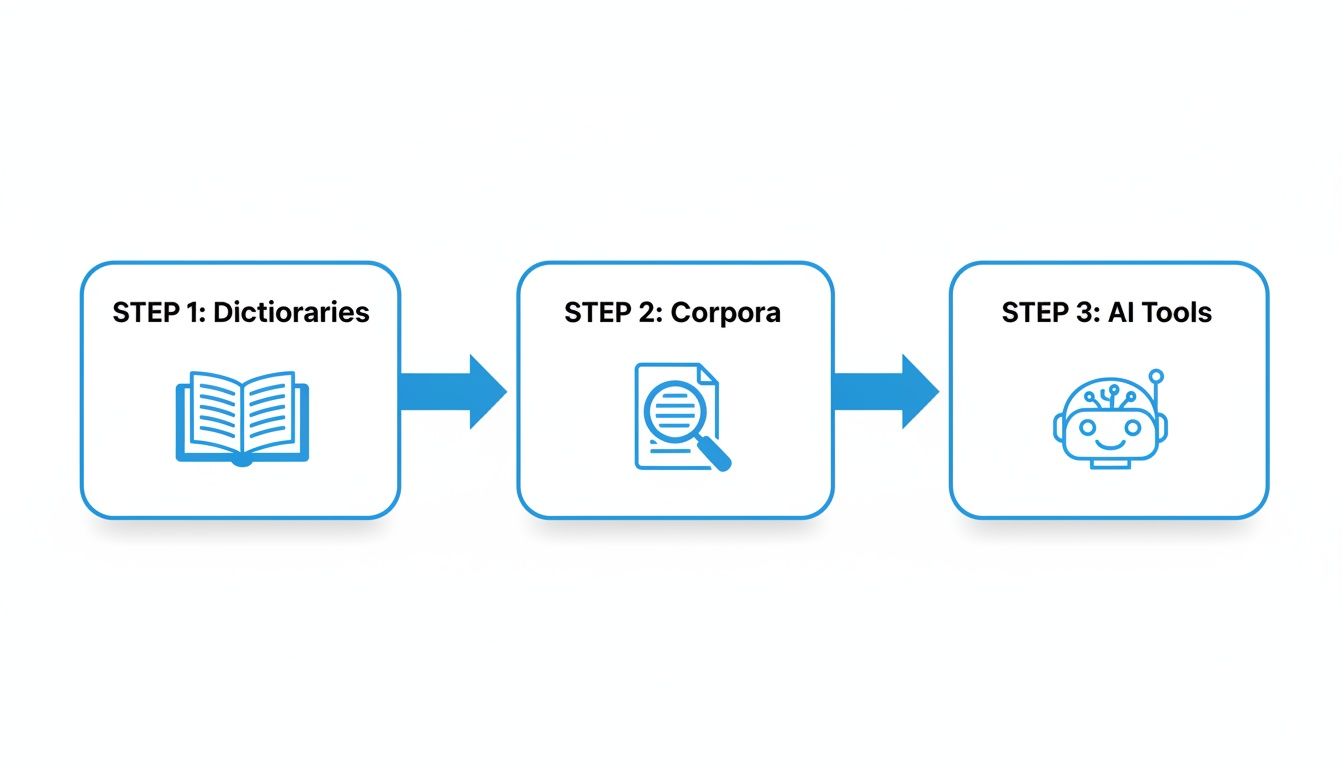
As you can see, the AI provides the initial draft, but that draft is then refined and corrected using scholarly resources. This cycle of drafting and checking is what ultimately pushes the translation toward true accuracy.
Generating the First Automated Draft
With a pristine source text in hand, it’s time to unleash the AI. Using a specialized old english to modern english translator will give you a massive head start by generating a complete first draft. Think of this as the heavy lifting. The AI will do its best to untangle the complex, inflected grammar of Old English and rearrange it into a logical Modern English structure.
This single step can save you countless hours of painstaking work. Instead of battling with basic sentence construction, you get a draft that's often 85-95% grammatically sound. Your job effectively shifts from being the primary translator to a highly skilled editor and polisher.
This technology is a small part of a much bigger picture. The ability to translate ancient texts is powered by the massive growth in the language services industry, which was valued at USD 71.7 billion in 2024. This market is what funds the development of tools that unlock history, turning once-inaccessible manuscripts into stories anyone can read. If you're interested, you can explore new trends reshaping the translation industry to see where things are headed.
The Crucial Manual Refinement Phase
Now, this is where your human expertise becomes invaluable. The AI draft is just your raw clay; it's up to you to sculpt it into a finished piece. With your toolkit at the ready—the Bosworth-Toller dictionary and language corpora—you'll comb through the AI's output, line by line.
The main focus here is on word choice and subtlety.
- Vet the key terms: Double-check how the AI translated important nouns, verbs, and adjectives. Look them up in the dictionary. Did it catch the right shade of meaning, or did it miss a crucial secondary definition?
- Spot the poetic devices: Old English poetry is famous for its literary flair, especially kennings (like calling the sea the "whale-road") and alliteration. An AI might translate these too literally, stripping them of their poetic power. It’s your job to find an equivalent that captures the original's artistic feel.
- Lean on the corpus: If a word just doesn't feel right, search for the original Old English term in a corpus. Seeing how that word was used in dozens of other texts will give you the context you need to pick the perfect Modern English equivalent.
Think of this stage as a conversation between you and the AI. The machine gives you a solid grammatical skeleton, but you provide the cultural, literary, and historical soul that makes the translation truly faithful.
Final Polishing and Formatting
The last lap is all about polish. Read your refined translation out loud. This is the best way to catch any clunky phrasing or rhythms that feel unnatural to the ear. You're also looking for consistency in tone and style across the entire work.
Finally, make sure the formatting is right for your final output. If you're creating an EPUB for an e-reader, this means preserving chapter breaks, headings, and the original line structure of any poetry. A well-formatted translation isn't just a matter of aesthetics; it respects the original work and gives the reader a much more authentic and enjoyable experience.
Using BookTranslator.ai for Entire Books
Translating a short Old English poem or a single manuscript page is one thing. But what if your project is a 300-page saga? Or a dense historical text? The sheer scale of a full book brings a whole new set of headaches—like keeping the tone consistent, preserving character voices, and making sure a specific term is translated the same way in chapter 20 as it was in chapter 1.
This is where a general-purpose old english to modern english translator just can't keep up. For long-form projects, you really need a tool built for that specific job. We designed BookTranslator.ai to handle these large-scale translations, managing the heavy lifting so you can focus on the important details.
Built From the Ground Up for Long-Form Content
The biggest advantage of a platform like BookTranslator.ai is that it processes the entire book at once. You’re not copying and pasting text chunk by chunk. Instead, you just upload your complete EPUB file, and the system takes it from there.
Because it's designed for books, the platform automatically understands and preserves the critical formatting that holds a book together:
- Chapter divisions: Your translated book keeps the original chapter breaks, so the narrative structure stays perfectly intact.
- Headings and subheadings: All the organizational headings are maintained, which means the final document is just as easy to navigate as the original.
- Stylistic consistency: The AI analyzes the text as a whole, which is key to maintaining a uniform voice and style from the first page to the last.
Honestly, this approach is a massive time-saver. It’s perfect for anyone working with substantial texts, whether you're an academic translating primary sources or a publisher hoping to make classic Old English literature accessible to a modern audience.
The Translation Process in Practice
Getting started is refreshingly simple. We've stripped away the usual complexities you find in translation software to create a clean, focused workflow.
You'll notice the interface is minimalist by design. It's all about one core task: uploading your EPUB and picking your languages. This simplicity means even if you're not a tech expert, you can get a professionally formatted translation in just a few minutes.
This kind of efficiency is part of a larger trend. The AI translation market is growing fast, with a 24.9% increase from USD 1.88 billion in 2023 to 2.34 billion in 2024. Services like ours are a direct response to this demand, offering practical pay-per-book plans that just make sense for project-based work. If you're curious about the numbers, you can explore the latest automated translation statistics to see how the industry is evolving.
Keeping the Author's Voice and Nuance Intact
One of the biggest anxieties in any translation is losing the original author's voice. A book isn't just a string of words; it’s a piece of art. The Pro plan on BookTranslator.ai uses advanced AI models that can hit up to 98% accuracy because they analyze context, tone, and stylistic patterns across the entire text. It helps to understand the fundamentals of what AI-generated content is and how these systems actually "think" to appreciate the difference.
This is absolutely vital for Old English texts, which are loaded with poetic devices and deep cultural meaning. The system works to find modern equivalents that capture the spirit of the original, not just a dry, literal meaning. Our users often tell us that this ability to retain nuance is what sets the results apart, allowing the translated work to truly connect with new readers. For a closer look at how this works under the hood, check out our deep dive into AI book translation.
By handling the formatting, ensuring consistency, and preserving the author's voice, a specialized tool can turn a project that might take months into a manageable task. It makes the complex challenge of book translation a genuine possibility for authors, researchers, and readers everywhere.
Common Translation Pitfalls to Avoid
Even with the best tools and a solid plan, translating Old English can feel like navigating a minefield. There are a few classic mistakes that can quickly derail your work, turning a faithful rendering into something clunky, confusing, or just plain wrong. Knowing what to look out for is half the battle.
A very common trap is to assume every Old English word has a single, direct Modern English equivalent. That’s rarely the case. Just like today, words had shades of meaning that shifted with context.
Take the word mōd. Depending on the sentence, it could mean mind, spirit, courage, or even pride. A simplistic old english to modern english translator might just pick one and move on, completely missing the author's intended nuance. This is precisely why you can't just accept the first automated draft as the final word.
Overlooking Poetic and Literary Devices
Old English literature, especially its poetry, is packed with stylistic features that don't map neatly onto modern language. Kennings and alliteration are two of the first casualties in a careless translation. A kenning, for instance, is a metaphorical compound phrase, like calling the sea the "whale-road" (hronrāde).
While translating hronrāde literally as "whale-road" can work, other kennings might need a more interpretive touch to land properly. The same goes for the heavy, percussive alliteration that gives Old English verse its rhythm and power. If you just translate the words and lose that musicality, you've created a text that's technically correct but emotionally hollow.
A great translation does more than just move information from one language to another; it should try to evoke a similar feeling as the original. If you lose the poetry, you’re only delivering half the message.
The Word-for-Word vs. Meaning-for-Meaning Tightrope
Every translator has to walk a fine line between two philosophies: a word-for-word approach that sticks closely to the original sentence structure, and a meaning-for-meaning approach that prioritizes conveying the core idea in natural, modern prose.
If you’re too rigid with a word-for-word translation of Old English, the grammatical differences will almost certainly result in an awkward, unreadable text. But if you focus only on the general meaning, you risk losing the specific textures and word choices that made the original work so powerful. The best translations find a delicate balance.
I've put together a quick table to help you spot and fix some of these frequent issues you'll encounter.
Troubleshooting Common Translation Errors
This table highlights some of the most common stumbles I've seen and offers practical advice on how to get back on track.
| Common Pitfall | Why It Happens | How to Fix It |
|---|---|---|
| Literalism | Over-relying on a single dictionary definition without considering context. | Cross-reference the word in a corpus (like the Bosworth-Toller) to see how it's used in different texts. Test a few synonyms in Modern English to see which best fits the tone. |
| Lost Alliteration | The direct translation of words breaks the original's poetic, alliterative pattern. | Identify the key alliterative sounds in the original line. As you translate, try to use Modern English words that begin with similar sounds to echo the effect without sacrificing meaning. |
| Awkward Syntax | Trying to preserve Old English sentence structure (e.g., Verb-Second word order) in Modern English. | Don't be afraid to completely restructure the sentence. Focus on capturing the relationship between the clauses and expressing it in a way that sounds natural to a modern reader. |
| Misinterpreted Kennings | Translating a metaphorical kenning literally, resulting in a confusing or nonsensical phrase. | Recognize the kenning for what it is—a poetic metaphor. Decide whether to translate it literally (if it still works), explain it with a footnote, or use a modern poetic equivalent. |
These are the kinds of challenges that pop up in nearly all translation projects. If you want to dive deeper, you can explore more about common book translation problems and their solutions.
Ultimately, a successful translation isn't just a mechanical process; it demands active, critical thinking. By keeping these potential pitfalls in mind, you can go beyond a simple word-swap and create something that is not only accurate but also artful and true to the spirit of the original text.
Frequently Asked Questions
When you start digging into historical languages, a lot of practical questions pop up. You might be wondering just how good an Old English to Modern English translator can be, what to do with that old scanned book you found, or if you really need a specialized tool for the job. Let's tackle some of the most common questions people ask.
How Accurate Can an AI Translator Really Be for Old English?
Modern AI, especially the kind built on advanced neural models, can get you surprisingly far. For a first pass, they're great at nailing the grammar, basic syntax, and common vocabulary, often hitting an accuracy rate of 85-95%.
But the real magic of Old English is in the details, and that's where AI can stumble. The language is filled with unique cultural idioms and poetic flair, like metaphorical "kennings," that a machine might take far too literally. This is where a human expert is still irreplaceable.
The best results come from a hybrid approach. Let the AI do the heavy lifting to create a solid draft, and then bring in a human expert to polish the nuances, capture the literary style, and make sure the cultural context is spot-on.
This blend of machine speed and human insight is what produces a truly faithful translation.
Can I Translate a Scanned PDF of an Old Book?
You can't translate a scanned PDF directly, because to a machine, it's just a picture of words, not the words themselves. The first, most crucial step is to run it through Optical Character Recognition (OCR) software to convert that image into actual, editable text.
Plenty of tools can handle this, from Adobe Acrobat Pro to various free online converters. Once the OCR has done its job, you'll have a text file (like a .txt or .docx) that a translator can actually read.
For a whole book, the workflow looks like this:
- Use OCR software on your scanned PDF.
- Go through the resulting text and clean up any recognition errors—weird characters or misread words.
- Convert that cleaned-up text into an EPUB format.
- Upload the EPUB to a service built for this, like BookTranslator.ai, which can handle large files while keeping the book's original structure intact.
What’s the Biggest Challenge Besides Vocabulary?
Forgetting the unfamiliar words for a moment, the single biggest hurdle is the sentence structure (syntax). Old English was a highly inflected language, meaning a word's ending told you its job in the sentence, not its position.
Modern English is the complete opposite; we rely almost entirely on word order (Subject-Verb-Object) to make sense of things. A direct, word-for-word translation that doesn't completely rebuild the syntax will just give you a string of nonsensical, grammatically broken sentences.
A good translator has to do more than just swap words. It has to fundamentally reconstruct every sentence to carry the original meaning in a way that feels natural to a modern reader.
Is It Better to Use a Free Tool or a Specialized Service?
The right tool really comes down to the size of your project. If you just need to look up a single word or translate a short phrase, a free online dictionary or a basic translator will do the trick just fine.
But if you're tackling an entire manuscript, poem, or book, a specialized service is absolutely the way to go. Here’s a quick breakdown of why:
| Feature | Free Tools | Specialized Services (e.g., BookTranslator.ai) |
|---|---|---|
| Content Size | Great for a few words or a short phrase. | Built for long-form content like entire books. |
| Context | Often miss the historical and literary context. | Much better at understanding nuance and staying consistent. |
| Formatting | Can't handle or preserve any book formatting. | Keeps your chapter breaks, headings, and structure. |
| Efficiency | You'll spend ages on manual corrections and reformatting. | Delivers a formatted, ready-to-use output, saving hours. |
At the end of the day, investing in a specialized service for a big project saves a massive amount of time and gives you a much higher-quality, readable result.
Ready to bring an entire Old English text to life? BookTranslator.ai is designed for the unique challenges of long-form content, preserving formatting and consistency across entire books. Start your translation today!