
Picture this: your book, available to readers in a dozen different languages. Not in a few years, but in a matter of days. This is what AI book translation makes possible, breaking down the old walls that once kept most authors locked into their home markets. It's a method that uses advanced machine learning to translate entire books, fast.
A New Chapter for Global Publishing

For a long time, getting a book published internationally was a privilege reserved for the lucky few—bestselling authors backed by huge publishing houses. The whole process was painfully slow, incredibly expensive, and a massive financial gamble. For most indie authors and small presses, it just wasn't an option. Language was a gatekeeper, plain and simple.
But that entire landscape is changing. The recent explosion in sophisticated AI translation has flipped the old model on its head. We’ve come a long way from the clumsy, word-for-word machine translations that used to spit out gibberish.
More Than Just Swapping Words
Today's AI models are built on complex neural networks that have been fed enormous libraries of text. Don't think of them as fancy dictionaries; think of them as apprentices that have "read" millions of books. They've learned the flow of storytelling, the cadence of natural dialogue, and the importance of a consistent character voice. This is how they can finally grasp context and keep the narrative coherent from start to finish.
This is a game-changer for creators who were once held back by tight budgets and limited resources. It puts the power of translation into the hands of authors and publishers of every size, leveling the playing field for a global audience.
"The central idea is Machine Translation Post-Editing (MTPE). With MTPE, a machine translation tool generates a raw translation, which is then smoothed and localized by a human translator."
This hybrid workflow—combining the raw speed of AI with the finishing touch of a human expert—is quickly becoming the new standard. It makes global publishing a realistic goal, not just a distant dream. For an author, this means your sci-fi epic, your niche historical romance, or your detailed how-to guide can find a whole new audience in markets you never could have reached before. Platforms like BookTranslator.ai are leading the charge, putting these powerful tools into a simple, user-friendly package.
And it’s not just authors who win. This shift is creating a richer, more connected world for literature.
- For Authors: You can test the waters in new international markets without a massive financial risk. It’s a chance to build a global brand and connect with readers you’d otherwise never meet.
- For Small Publishers: You can finally expand your catalog into new languages without the budget-breaking quotes from traditional translation agencies.
- For Readers: You no longer have to wait years for access to stories and knowledge from other cultures. A new Japanese light novel or a hit thriller from Brazil can be in your hands almost instantly.
This fundamentally alters how stories travel the globe. If you want to dig deeper, you can learn more about how AI improves multilingual book access and dismantles these old barriers. The days of waiting for a translator to finally get to your favorite series are fading, replaced by an era of immediate, worldwide connection.
How AI Actually Learns to Translate Literature
To really get how AI book translation works, you need to throw out the old idea of a digital dictionary just swapping words. Modern AI doesn't work like that at all. It’s learned to grasp the flow and feeling of a story using a powerful approach called Neural Machine Translation (NMT).
Imagine an NMT model as a literary apprentice who has devoured an impossibly huge library. It's been trained on millions of books, articles, and documents that have already been professionally translated by humans. By comparing the original text side-by-side with the finished translation, the AI starts to see incredibly complex patterns—far beyond simple vocabulary.
This is how the AI learns the subtle art of context. It figures out that "a run in her stocking" is a world away from "the character will run for office." Even more importantly for a novelist, it learns how sentences build paragraphs, and how those paragraphs shape the emotional journey of a chapter.
Building a Deep Contextual Understanding
The real breakthrough with today's AI is its ability to remember what it just read. Early translation tools were notorious for their short-term memory; they'd look at one sentence at a time, completely forgetting what came before. That’s why they were so bad at keeping a character's voice consistent or tracking plot details.
NMT models, on the other hand, are built with a kind of "memory." As they work through a book, they create a rich, mathematical map of the story's world, its characters, and its overall tone. This lets the AI make much smarter choices, ensuring the translation stays consistent from page one to the very end.
For instance, if a character has a quirky verbal tic or a very formal way of speaking, the NMT model can pick up on that and maintain the style throughout the entire book. It's not just swapping words; it’s trying to preserve the author's voice and the unique flavor of the narrative. This is a massive leap forward from older, clunkier systems.
The Power of Massive Training Data
An AI's translation is only as good as the library it learned from. To get good at translating literature, these models are fed gigantic datasets of professionally translated works. This literary diet includes:
- Classic Novels: Timeless stories that teach the fundamentals of narrative structure and rich, descriptive language.
- Contemporary Fiction: Modern bestsellers that help the AI learn current slang, dialogue patterns, and cultural touchstones.
- Non-Fiction and Technical Books: Specialized texts that instill precision and domain-specific terminology.
By constantly analyzing this material, the AI starts to internalize the rhythm of storytelling. It learns how authors build suspense, how dialogue reveals a character's personality, and how a well-written passage can create a powerful sense of place.
All this development is powered by serious investment. The AI-powered language translation market—which fuels tools like BookTranslator.ai—is experiencing explosive growth. Currently valued at around USD 2.8 billion, it's projected to hit USD 12.1 billion by 2033, with a compound annual growth rate (CAGR) of 23.2%. You can dive deeper into these market trends over at HTF Market Intelligence.
This constant learning turns a purely technical process into something that feels almost like a creative partnership. The AI isn't just following a rigid set of rules; it's making informed, context-aware decisions based on its vast "reading" experience.
From Apprentice to A Powerful Tool
At the end of the day, the AI learns to act less like a machine and more like an incredibly well-read assistant. It can tackle the heavy lifting of a first-draft translation with incredible speed, capturing the core essence of the original book.
This first draft is often surprisingly good, preserving much of the style, tone, and narrative flow. It creates a solid foundation that a human editor can then build upon, focusing their energy on the subtle cultural nuances and artistic choices that require a human touch. The AI has learned the rules of literature so well that it gives us a fantastic starting point, making it easier than ever for authors to share their stories with the world.
AI vs. Human Translation: Which Is Right for Your Book?
When it comes to translating your book, the choice between AI and a human isn't about which one is universally "better." It’s about understanding what each brings to the table and matching the right approach to your book, your budget, and your goals. The whole debate really boils down to a trade-off between four things: speed, cost, consistency, and that tricky little thing called cultural nuance.
For most authors dipping their toes into international markets, the sheer velocity of AI book translation is a game-changer. An AI can tear through an entire novel in a matter of hours. A human translator? They might need weeks, if not months, to do the same job. This means you can get your work in front of a new audience almost immediately, testing the waters in a new country without a massive time investment.
Speed and Cost: Where AI Has a Clear Edge
The numbers on the cost side are just as stark. Professional human translation typically runs between $0.10 and $0.25 per word. Do the math on an 80,000-word book, and you’re looking at a bill somewhere between $8,000 and $20,000. That's a serious investment.
Compare that to an AI service like BookTranslator.ai, which can do the job for a tiny sliver of that cost. Suddenly, global publishing isn't just a dream for big-name authors; it's a realistic strategy for indie creators. You could translate your book into five or six languages using AI for less than what a single human translation would cost, dramatically expanding your reach without emptying your wallet.
Nuance and Artistry: The Human Touch
But the story changes when you move from the practicalities of speed and money to the art of language itself. While AI is a powerhouse for logistics, a skilled human translator is still the undisputed champion of navigating the subtle, complex layers that make a story feel alive.
Human translators don't just know two languages; they live in two cultures. They catch the idioms, the clever wordplay, and the pop-culture references that an AI would likely translate literally, stripping them of all their original wit and meaning.
If you've written a piece of high-art literary fiction, a collection of poetry, or a story where every single sentence was painstakingly crafted for rhythm and subtext, a human translator is non-negotiable. They do more than swap words—they translate feeling, a skill that is, for now, uniquely human.
Think about what a person can do that a machine still struggles with:
- Cultural Adaptation: A human can spot a joke that won't land in another culture and replace it with a local equivalent that gets the same laugh.
- Artistic Interpretation: When a phrase could mean a few different things, a person can make a creative choice that deepens the story's tone or a character's voice.
- Reading Between the Lines: Humans are masters of understanding intentional ambiguity, a crucial element in mysteries, thrillers, and literary works.
That said, modern AI is getting frighteningly good, and it offers one huge advantage: unwavering consistency. An AI will translate a specific character's name or a key fantasy term the exact same way on page 3 as it does on page 300. This is a massive help in maintaining a coherent world for the reader.
AI vs Human Book Translation: A Head-to-Head Comparison
To make the decision clearer, it helps to see the strengths and weaknesses of each approach laid out side-by-side. This table breaks down the key differences across the factors that matter most to authors.
| Factor | AI Translation (e.g., BookTranslator.ai) | Traditional Human Translation |
|---|---|---|
| Speed | Extremely fast (hours to days for a full novel) | Slow (weeks to months per book) |
| Cost | Very low cost, often a few hundred dollars | Very high cost, typically $8,000 - $20,000+ per book |
| Consistency | Perfect. Terms are translated identically every time. | Generally good, but can vary. Requires a style guide. |
| Cultural Nuance | Limited. Can miss idioms, subtext, and humor. | Excellent. Adapts cultural references for the target audience. |
| Creative Voice | Can be generic. Tends toward literal translation. | Superior. Captures and recreates the author's unique style. |
| Best For... | Non-fiction, genre fiction, market testing, first drafts. | Literary fiction, poetry, brand-defining books, final polish. |
Ultimately, the best choice depends entirely on your project's specific needs and your priorities as an author.
The Hybrid Model: Getting the Best of Both Worlds
This leads us to what is quickly becoming the gold standard for many authors: the hybrid model. Instead of pitting AI against human, this approach uses both in a smart, efficient workflow that delivers speed, affordability, and artistic integrity.
It’s a simple but incredibly effective process:
- AI First Draft: You start by running your book through an AI platform to get a complete, high-quality draft in no time.
- Human Post-Editing: A professional human translator then takes this AI-generated text and begins to refine it.
- Final Polish: Instead of translating from scratch, the human editor dedicates their valuable time to finessing the dialogue, localizing cultural nuances, and making sure your unique authorial voice rings true.
This workflow, known in the industry as Machine Translation Post-Editing (MTPE), is a win-win. It lets the AI handle the heavy lifting, freeing up the human expert to focus on the creative details that truly make a book resonate with readers. It's the smart way to go global.
Your AI Book Translation Workflow: From EPUB to Global Release
So, you're ready to take your book global. What does the process actually look like? While AI book translation is incredibly fast, getting a truly polished, publishable book isn't just a one-click affair. It requires a smart workflow.
Think of it like building a house. You wouldn't just start throwing up walls without a solid foundation and a blueprint. The same logic applies here. I break the journey down into four clear stages that take you from a single manuscript file to a finished book ready for readers around the world.
Stage 1: Manuscript Preparation
This first step is, without a doubt, the most important. The quality of your output is directly tied to the quality of your input. AI translation tools, especially professional-grade ones like BookTranslator.ai, thrive on clean, well-structured documents. The gold standard here is a validated EPUB file.
Getting your manuscript ready involves a few non-negotiable tasks:
- Finalize Your Text: Make sure your original manuscript is 100% edited and proofread. Trust me, fixing a single typo in your source language is a lot less painful than correcting it across five different translated versions later.
- Clean Up the Formatting: Get rid of any weird formatting, stray bits of code, or hidden text in your document. A simple, clean EPUB file will give the AI the best possible material to work with.
- Set Clear Goals: Know which languages and markets you're aiming for from the start. This helps shape your release strategy and informs how you'll approach the editing for specific cultural contexts.
Having a pristine source file is crucial. If you need a little more help on this front, we've put together a guide on the best EPUB converter and translation tools to get you started.
Stage 2: The AI Translation Draft
Once your EPUB is prepped and ready, the real magic begins. You upload your file, and the AI engine gets to work. This isn't a simple word-for-word swap. Modern AI analyzes your book's entire structure—chapter headings, paragraph breaks, italicized words, and even dialogue markers.
The AI reads your book contextually, which is key to preserving the flow and layout you worked so hard to create. In a surprisingly short amount of time, often just a few hours, it generates a complete first-draft translation. What you get back is a structurally sound and remarkably accurate manuscript that serves as a fantastic starting point for the next stage.
This whole process, from the initial draft through human refinement to a global release, is laid out pretty clearly here:
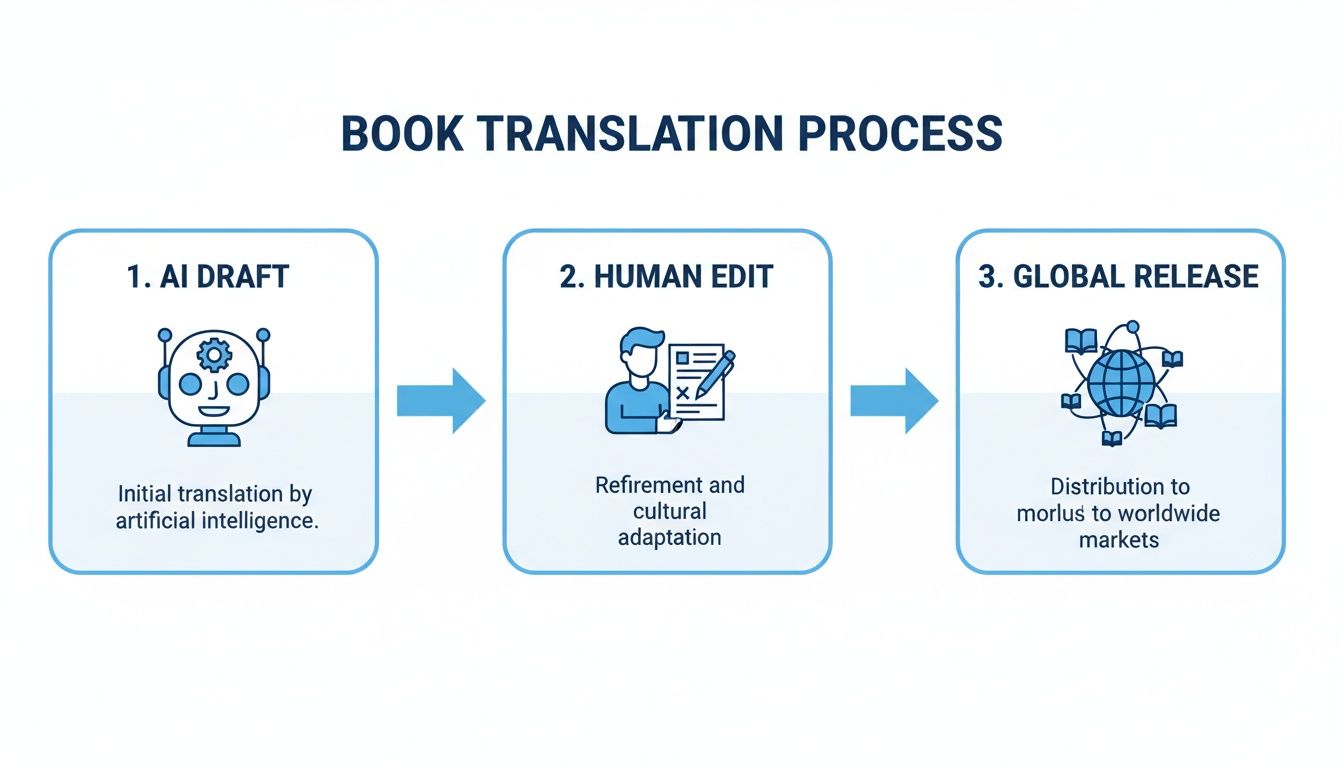
This visual really captures how the raw speed of AI and the nuanced skill of a human editor come together to create an efficient path to publication.
Stage 3: Human Post-Editing
This is where a good translation becomes a great one. The AI draft is your raw material; the human editor is the skilled artisan who shapes and polishes it. In the industry, we call this Machine Translation Post-Editing (MTPE), and it's the standard for producing professional-quality work.
A human editor, ideally a native speaker of the target language, will go through the AI's translation with a fine-toothed comb. They’re looking for the subtle things an algorithm might miss:
- Cultural nuances and idioms that just don't have a direct equivalent.
- Inconsistencies in a character's voice or dialogue that sounds clunky.
- Complex wordplay, puns, or humor that needs a creative, human touch to land properly.
This hybrid approach is the secret to balancing speed, cost, and quality. The AI does about 90% of the heavy lifting, freeing up the human expert to focus on the artistic and cultural details that truly make a story connect with a new audience.
Stage 4: Final Formatting and Distribution
Once the post-editing is done, you're holding a polished, publishable manuscript. The final step is getting it ready for the world. This means formatting the new, translated EPUB file so it meets the specific guidelines for global platforms like Amazon KDP, Apple Books, and Kobo.
You'll also need to update your book cover with the translated title and write localized book descriptions and marketing copy that speak directly to your new readers. With a professionally refined text in hand, you’re finally ready to hit "publish" and introduce your story to the world.
This entire workflow is part of a massive, growing industry. The global language services market hit USD 71.7 billion in 2024 and is expected to reach USD 75.7 billion in 2025 as AI becomes even more central to the process. You can dig into more of these stats in the 2025 Nimdzi 100 report.
Understanding Costs and Copyright in AI Translation
For any author thinking about using AI to translate their book, two big questions always come up: How much is this going to set me back, and who actually owns the translated version? It's crucial to get straight answers before you jump in. The good news is, the money and legal stuff are a lot less complicated than you might imagine.
One of the biggest wins for AI translation is its pricing. Forget the confusing quotes and steep per-word rates you get from traditional agencies. AI services usually offer clear, predictable costs. This lets you budget properly and make smart choices about taking your book global.
Demystifying AI Translation Pricing
Most AI translation platforms, like BookTranslator.ai, use a simple pay-as-you-go system based on your word count. For instance, you might pay a set fee for every 100,000 words you translate. This completely removes the guesswork and tells you the cost upfront.
This model is a game-changer for indie authors and small publishers who need to watch every penny. You can figure out the exact price to translate your entire book series into several languages before you even start. For a deeper dive into the numbers, check out our guide on AI translation costs provides a comprehensive overview.
The core benefit here is financial accessibility. A professional human translation for an 80,000-word novel can easily run you over $10,000. An AI service can deliver a high-quality first draft for a tiny fraction of that—often just a few hundred dollars.
This incredible cost-effectiveness means you can experiment with new international markets without a massive financial gamble. You could translate your book into Spanish, German, and French to see which one takes off, then decide where to invest more in marketing or a human post-editor.
Clarifying Copyright and Ownership
Copyright is another common worry, but the answer here is refreshingly simple. When you use an AI platform to translate your work, you, the author, retain full copyright ownership of the translated version.
Think of the AI as a sophisticated tool, just like your word processor or a grammar checker. It’s the instrument you’re using to create a new version of your work, but you are the one in the driver's seat. The service provider has no claim on your intellectual property. You're free to publish, sell, and profit from the translated book exactly as you would with the original.
This legal clarity gives you total peace of mind. The translated book is your asset, and you control its destiny. Of course, this fits into a much bigger conversation about technology and creativity. The discussions around the ethics of writing with AI touch on many of the same points we see in translation, offering a great perspective on how we work with these new tools. At the end of the day, the AI is there to serve your creative vision—not the other way around.
Who Should Use AI Book Translation?

You might think AI book translation is only for a specific type of author or publisher, but its reach is surprisingly wide. It's a tool that cracks open new doors for just about everyone involved in the world of books, from the person writing them to the person reading them.
Different people use AI translation to get around different obstacles. For some, it's about breaking down financial walls; for others, it's about getting information quickly. Let's dig into who's getting the most out of this technology right now.
Independent Authors and Self-Publishers
If you're an indie author, you know the biggest roadblocks to a global audience are cost and time. AI translation tackles both head-on. An author who has a successful series in English can suddenly test the waters in international markets without betting the farm.
Instead of sinking thousands into a single human translation, they can use AI to do things that were once unthinkable:
- Go global, all at once: Imagine launching your new book in Spanish, German, and French on the same day, for a fraction of what one traditional translation would cost.
- Test the market without the risk: You can see which countries are actually buying your work before you pour money into a marketing campaign or a full human-edited version.
- Keep control of your work: You guide the process, making sure the AI's output—your new baseline—still reflects your original vision.
This gives authors the power to build a worldwide brand on their own schedule and budget. It turns a massive financial gamble into a smart, manageable business move.
Academic Researchers and Students
Academia is fueled by information, but language barriers can bring research to a screeching halt. A scientist in the U.S. might need to understand a groundbreaking study from Germany, but waiting weeks for a professional translation just isn’t feasible when deadlines are looming.
AI translation provides a solution right now. Researchers can translate dense, technical papers in moments to grasp the key findings and see if the work is relevant to their own. This ability to get the gist of global research almost instantly helps speed up discoveries and encourages more international teamwork.
The real win for academics is pure speed. A researcher can get through a 500-page foreign study in a few hours, not a few months. That means they can cite it, build on it, and contribute to the global conversation faster than ever before.
Small Presses and Niche Publishers
Small publishing houses run on tight budgets, which has always made expanding into other countries a tough call. AI translation changes that equation. It lets them bring in a wider range of books without going broke. A small press that focuses on science fiction can now affordably acquire the rights to a hit Polish novel and introduce it to English readers.
This helps them carve out a unique space in the market, competing with the big players by offering a curated international collection that readers couldn't find anywhere else.
Avid Readers and Fans
And finally, this technology benefits the people who matter most: the readers. If you're a fan of a specific genre—say, Japanese light novels or Scandinavian noir—you no longer have to wait years for the next book in your favorite series to get an official translation.
With tools like BookTranslator.ai, a dedicated fan can translate an EPUB file for their own personal reading and dive into a story almost as soon as it hits shelves in its home country.
This isn't just a niche trend. The demand for instant access to content is fueling huge growth, with the AI language translation market projected to hit USD 2.94 billion by 2025. You can find more details on how AI is changing the translation industry at Day Translations.
Common Questions About AI Book Translation
Whenever a new tool comes along, a lot of questions pop up. It’s no different with AI book translation. Authors and publishers naturally want to know about quality, who owns the work, and where this technology really shines. Let’s get into some of the most common questions we hear.
Is AI Translation Good Enough for Publication?
The short answer? Not by itself. Think of the AI as an incredibly fast and talented junior translator. It produces a first draft that's often surprisingly accurate and readable, handling the bulk of the work in minutes.
But it’s still a draft. To get a truly publishable book, you need a human expert to step in. This workflow, known as Machine Translation Post-Editing (MTPE), is the industry standard. A professional editor will take the AI's output and polish it, catching subtle cultural nuances, smoothing out any awkward sentences, and making sure your unique authorial voice comes through loud and clear. This hybrid approach gives you a professional, market-ready book for a fraction of what traditional translation costs.
Will the AI Steal My Copyright?
Absolutely not. Let's be perfectly clear: when you use an AI tool to translate your book, you retain 100% of the copyright to that new version.
Think of the AI like a sophisticated piece of software, no different than a word processor or a grammar checker. You are the creator, and the AI is the instrument you're using. The final translated work is your intellectual property, period. You alone have the right to publish it and profit from it.
What Kind of Books Work Best for AI Translation?
AI is a fantastic tool, but it has its strengths. It performs best on books with clear, straightforward language and consistent terminology. This makes it an ideal fit for several categories:
- Genre Fiction: Thrillers, sci-fi, and romance novels usually have direct narratives that AI models can translate with impressive accuracy.
- Non-Fiction and How-To Guides: These books are often structured and rely on repeating key terms and concepts, which plays right into the AI's strengths.
- Academic and Technical Texts: When the goal is to share research or complex information clearly, AI provides a fast and reliable way to translate dense material.
On the other hand, books that lean heavily on lyrical prose, poetry, complex wordplay, or deep literary subtext are much trickier for an algorithm. For those truly artistic projects, a seasoned human translator is still your best bet to capture the soul of the work.
Can AI Handle a Character's Unique Voice?
Yes, and it's getting better all the time. Today's AI models have been trained on massive amounts of literature, so they can pick up on stylistic patterns. If one of your characters speaks in short, punchy sentences and another uses very formal, flowery language, the AI can often keep those styles consistent.
That said, dialogue is where a human post-editor really earns their keep. They can take the AI’s solid foundation and refine it, ensuring each character's voice feels completely natural and authentic in the new language. They’ll catch any slightly "off" phrasing the machine missed, making the dialogue truly pop off the page for your new audience.
Ready to see how BookTranslator.ai can bring your story to a global audience? Upload your EPUB and get a professional-quality AI translation in minutes. Start your translation project today!