
When you’re looking for the best translator software, the right choice really boils down to what you’re translating. For a quick phrase or an email, something like Google Translate works just fine. But if you’re an author or a reader dealing with an entire book, you're playing in a completely different league. That’s where specialized platforms, like our own BookTranslator.ai, are designed to shine.
Why Standard Translation Tools Fail with Long-Form Content
The demand for high-quality translation has gone way beyond simple sentences. Authors, researchers, and readers across the globe need accurate translations of whole books, dense academic papers, and detailed reports. The problem is, most standard translation tools just aren't built for that kind of heavy lifting.
These tools typically work by breaking down text into small, isolated chunks, and that's where things go wrong. They lose the overarching context. This piecemeal approach completely shatters the narrative flow, muddles a character's unique voice, and twists complex arguments that were carefully built over dozens of chapters. If you’ve ever tried to paste an entire novel into a free online translator, you know the disjointed, often nonsensical mess that comes out the other side. We dive deep into this specific problem in our article on the context window dilemma for AI translation.
The Modern Translation Landscape
To meet this growing need, the market for advanced translation tech is booming. The global AI translation market hit an impressive $2.34 billion in 2024, climbing from $1.88 billion in 2023. That’s a staggering 24.9% compound annual growth rate. This isn't just a trend; it's a fundamental shift. Multilingual communication is now a strategic goal, not just an afterthought. You can get more details on this explosive market growth on SkyQuestT.
This evolution means picking the right translator software requires a much sharper eye. It’s no longer about just word-for-word accuracy. The real test is how a tool handles the specific challenges of lengthy, structured content.
Key Takeaway: The best translator software for a book or manuscript must do more than just swap out words. It has to preserve the original document’s structure, intent, and unique style from the first page to the last.
Critical Criteria for Evaluating Translators
So, how do you find a tool that can actually go the distance? You have to look at the factors that directly affect the quality of a long-form translation. A solid evaluation framework is what separates the professional-grade software from the basic utilities.
Here are the non-negotiables to consider:
- Contextual Accuracy: Does the tool actually understand what's happening in the story? It needs to maintain consistent terminology, tone, and character voices across hundreds of pages.
- Format Preservation: Can it handle your original file format, like an EPUB or PDF, without wrecking the layout? Keeping headings, paragraphs, and styling intact is crucial.
- Language Coverage and Quality: It’s not enough for a tool to just "offer" a language. How good is the translation quality for your specific language pair, especially when dealing with literary nuance or technical jargon?
- Data Privacy and Security: What happens to your manuscript after you upload it? You need to know that your work is secure and won't be used to train some other company's AI model.
How We Judged the Best Translation Tools
When you’re translating a whole book or a dense research paper, a simple side-by-side comparison of features just doesn’t cut it. You need to know how these tools perform under pressure with complex, long-form documents. That’s why we developed a specific set of criteria to put them through their paces.
We went far beyond just checking for basic word-for-word accuracy. Our goal was to find the tools that truly respect the author's original intent and deliver a polished, ready-to-use document. Here’s a look at exactly what we measured and why it matters for you.
Accuracy and Language Support
First and foremost is translation accuracy. This is the bedrock of any good translation. But for long-form content, accuracy means so much more than just correct grammar. It's about capturing the author's unique voice, preserving subtle nuances, and correctly interpreting idiomatic expressions so they don't turn into cringeworthy literal translations. For a much deeper look at this, we've broken down how translation accuracy metrics are measured and why they matter.
Just as crucial is the real-world quality of a tool's language pair coverage. It's easy for a service to boast support for 100+ languages, but we found the quality can fall off a cliff for less common pairs. We focused on platforms that provide consistently excellent translations for the languages that authors, publishers, and academics actually use.
Key Insight: Real accuracy in a book-length project means the software gets the big picture. It has to keep character voices consistent and track key terminology from chapter one all the way to the final page.
Handling Your Document and Its Formatting
This is where many translation tools fall apart. A great translator is useless if it mangles your manuscript's file. We specifically zeroed in on two make-or-break capabilities:
- Long-Form Document Handling: Can the tool actually process an entire EPUB or PDF file at once? Many can't, crashing or chopping your text into disconnected, unusable pieces.
- Formatting and Layout Preservation: We checked if the final translation kept the original structure intact. This means preserving chapter headings, paragraph breaks, italics, and all the other formatting that makes a book readable.
If a tool spits out a 400-page document that you have to reformat by hand, it’s not a serious solution.
Value and Security
Finally, we looked at the practical side of things. We compared the different pricing models we came across—from ongoing subscriptions to one-time project fees—to figure out which offered the best value for different needs.
We also took a hard look at data privacy and security. Uploading your unpublished manuscript is an act of trust. You need to be certain your intellectual property is safe. We gave top marks to tools with transparent, ironclad policies ensuring your work isn't stored forever or used to train other AI models.
Comparing the Top AI Translation Tools
When you’re looking for the right translator software, a simple feature checklist won't cut it. You have to get into the nitty-gritty of real-world performance. A tool that perfectly translates a single paragraph might completely fall apart when you feed it a 400-page novel. I'm going to compare the big generalist tools like Google Translate and DeepL against more specialized platforms, zeroing in on how they actually handle long-form content.
The real test comes down to practical questions. How well does a tool keep the chapter structure of an EPUB file intact? Can it maintain a consistent authorial voice across a massive narrative? Does it translate complex, technical jargon without fumbling the meaning? These are the questions that truly matter.
The Generalist Giants: Google Translate and DeepL
Google Translate is, without a doubt, the most accessible tool out there. Its language coverage and speed are unmatched. For a quick, on-the-spot translation of a short bit of text, it's a fantastic option. The problem is, when you give it a long document, it tends to work sentence by sentence. This approach often strips away the broader context, leading to a choppy and inconsistent final product.
DeepL, on the other hand, has built a solid reputation for producing more natural-sounding translations, especially for common European languages. It’s often better than Google at picking up on subtle idioms and keeping the tone smooth. While its document feature is a step up, it can still wrestle with the complex formatting of files like EPUBs, often leaving you with a lot of manual cleanup to do.
The core difference really comes down to their design philosophy. Generalist tools are built for speed and accessibility across a huge range of simple tasks. Specialized tools are engineered from the ground up to solve one specific, complex problem: preserving the entire integrity of a book.
For a really deep dive into how different tools stack up in real-world scenarios, check out this breakdown of 18 AI translation tools tested by Reddit users.
The Rise of Specialized Platforms
To fill the gaps left by the generalists, specialized software like BookTranslator.ai has come onto the scene. These platforms are purpose-built for one demanding job—translating entire books. Their biggest advantage is an architecture designed from the start to handle large, structured files.
Instead of slicing a book into thousands of disconnected sentences, these systems process the whole document as a single, cohesive project. This lets the AI maintain contextual awareness from one chapter to the next, making sure character names, key terms, and the narrative voice stay consistent from start to finish.
This infographic breaks down the three pillars—Accuracy, Formatting, and Security—that really set a specialized tool apart.
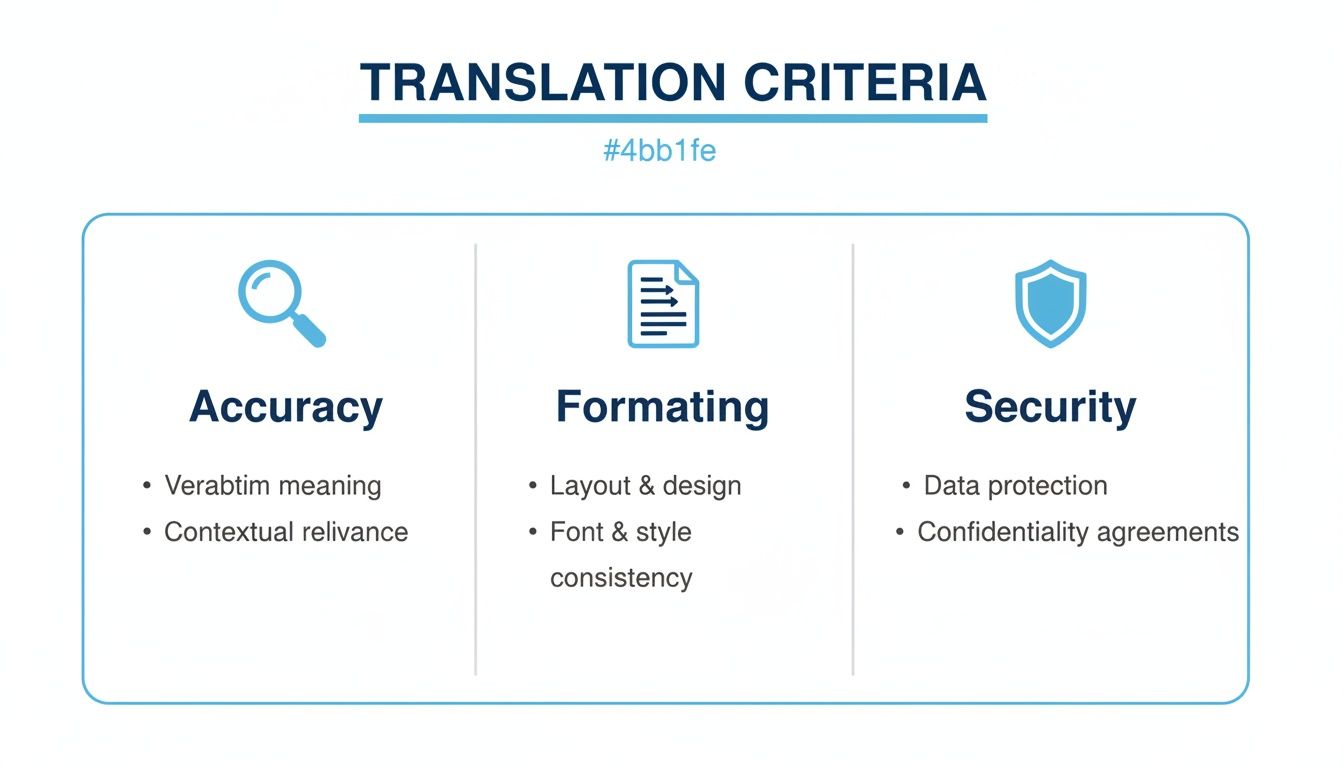
As you can see, for long-form content, preserving the layout and keeping your data secure are just as crucial as pure translation accuracy.
Feature Comparison of Top Translator Software for Books
To make the differences clearer, let's put these tools side-by-side. The table below compares the key features that matter most when you're translating a book, not just a sentence.
| Feature | BookTranslator.ai | Google Translate | DeepL | Other Competitor |
|---|---|---|---|---|
| EPUB/MOBI Support | Native (Upload & Translate) | No | Limited (via document) | Varies |
| Layout Preservation | High Fidelity (Maintains chapters, styles) | Poor | Moderate | Low to Moderate |
| Context Awareness | Full-Book (Consistent terminology) | Sentence-Level | Document-Level | Varies |
| Glossary Feature | Yes, for custom terms | Yes, limited use | Yes | Often missing |
| Pricing Model | Per-Book or Subscription | Free (with limits) / API | Free / Subscription | Subscription / API |
| Best Use Case | Full Novels, Non-Fiction | Quick Snippets, Web Pages | Business Documents, Articles | Varies by tool |
This comparison highlights that while generalist tools are powerful, they simply weren't built with the unique structure of a book in mind.
Formatting Preservation: The Make-or-Break Factor
For authors and publishers, formatting isn't just window dressing; it’s a vital part of the reading experience. One of the biggest failings of most translation tools is their inability to preserve the original layout of a manuscript.
- Chapter Breaks: Generalist tools frequently ignore or botch chapter headings, mashing chapters together and destroying the book’s fundamental structure.
- Styling: Crucial stylistic choices, like using italics for emphasis or blockquotes for excerpts, are often completely lost, which changes the author's intended tone.
- Paragraph Integrity: Poor handling can lead to merged or split paragraphs, creating a dreadful wall of text that’s a chore to read.
Specialized software tackles this problem head-on by first analyzing the source file's structure before any translation happens. It identifies headings, paragraph breaks, and styling elements, then intelligently reapplies them to the translated text. This makes sure the final output is a mirror image of the original, ready to go without you needing to spend hours on painstaking reformatting.
Beyond just accuracy, the real goal is a translation that reads naturally. The output shouldn't just convey information; it should feel as if it were originally written in the target language. If you're looking to polish AI-generated content even further, exploring the best AI to human text converter tools can offer some great techniques for achieving that human touch.
A Closer Look at BookTranslator.ai for Book Translation
While your average translation tool can handle a paragraph or two, they start to buckle under the weight of a full manuscript. This is where a dedicated platform like BookTranslator.ai really shines. It was built from the ground up by people who understand the unique headaches authors and publishers face when translating long-form work.
Instead of just chopping up a book into thousands of isolated sentences, BookTranslator.ai treats the entire manuscript as a single, cohesive project. That single shift in approach is the key to maintaining a consistent narrative voice, keeping character dialogue in sync, and making sure terminology stays uniform from cover to cover.
One-Click EPUB Translation
Let’s be honest: the biggest technical hurdle for most authors is the EPUB format. These files aren't just text; they're a complex package of content and formatting code that dictates how the book looks and feels. BookTranslator.ai turns this complicated mess into a simple, one-click process.
You just upload your EPUB file directly. There’s no need to painstakingly convert it to a plain text file, which inevitably strips out all your careful formatting. This native support is a massive advantage, as it sidesteps the frustrating and error-prone job of reformatting an entire book after translation. The system reads the EPUB, translates the words, and then puts it all back together exactly as it was.
Key Differentiator: The ability to work directly with EPUB files is a game-changer. It saves hours—sometimes days—of post-translation cleanup and delivers a professional, reader-ready file right out of the gate.
The entire interface is designed to be straightforward, guiding you through the process without any jargon. This screenshot shows just how simple it is: you can literally drag and drop your file to get started.
This focus on a clean user experience makes powerful AI translation accessible to everyone, not just the tech-savvy. The goal here is clearly to help you get the job done quickly and without any fuss.
Preserving Your Authorial Voice and Formatting
Every author’s biggest fear is that translation will flatten their style and erase their unique voice. BookTranslator.ai tackles this head-on by using advanced AI models trained on enormous libraries of literary works. This specialized training helps it grasp the subtle nuances of creative writing.
The AI isn't just doing a word-for-word swap. It analyzes sentence structure, tone, and idiomatic phrases to create a translation that feels true to the original text. For fiction authors, whose style is just as important as the plot, this is non-negotiable.
Just as critical is keeping the book’s structure intact. The platform’s formatting engine is smart enough to ensure that:
- Chapter Headings: Are identified and kept in their proper place.
- Paragraph Breaks: Remain exactly where you intended them to be.
- Stylistic Elements: Like italics, bolding, and blockquotes are all preserved.
This incredible attention to detail means the translated EPUB you get back mirrors the original's layout perfectly. You receive a file that’s ready for distribution, not a raw text dump that needs hours of manual labor.
Clear Pricing and Building Trust
Figuring out the cost of translation can be a nightmare. Many services have confusing subscription plans or per-word rates that are impossible to predict for a 100,000-word novel. BookTranslator.ai cuts through the noise with a transparent pay-per-book model. For authors and publishers on a budget, this clarity is a huge relief.
There are no monthly fees or sneaky recurring charges. You pay for a translation when you need one. This is especially useful for indie authors who might only publish a few books a year and don't want to be locked into an expensive subscription.
The platform offers different tiers, like Basic and Pro plans, so you can pick the AI model that best suits your project and budget. This gives you a choice between affordability and access to the absolute latest in AI technology. Testimonials from actual users often point to the tool's reliability with tricky language pairs and praise its knack for retaining nuance. And with a money-back guarantee, there's very little risk in trying it out. For anyone looking for the best translator software for books, this specialized tool nails the essentials: format, voice, and value.
How to Choose the Right Translator for Your Specific Project
Trying to find the single "best" translator is a fool's errand. The truth is, the right tool is always the one that fits your specific needs. A platform that's perfect for a researcher wrestling with dense academic papers will almost certainly disappoint an author trying to bring their novel to a new audience.
The key is to match your goals to the software’s core strengths. Let's cut through the marketing hype and look at what really matters for four different kinds of users: indie authors, academics, publishers, and curious readers.
For Independent Authors and Self-Publishers
As an indie author, you're juggling quality, cost, and your own time. You need a translation that does more than just swap words—it has to capture the voice and style you bled for. But you also can't afford to spend the next month manually reformatting a butchered manuscript.
Here’s what you should be looking for:
- Flawless Format Preservation: Your number one priority. The tool absolutely must handle your EPUB file without wrecking chapter breaks, paragraph styles, and italics. This is non-negotiable.
- Narrative-Aware Accuracy: A good translator understands context. It needs to keep character voices and key terms consistent from page 1 to page 300.
- Straightforward Pricing: A clear, pay-per-book model is usually much better for an author's budget than a monthly subscription, especially when your publishing schedule isn't set in stone.
A specialized tool like BookTranslator.ai was literally built for this. Its ability to process an EPUB and hand it back to you, perfectly formatted and ready to publish, saves an incredible amount of time and frustration. For authors, that efficiency is gold.
For Academic Researchers and Students
If you're a researcher or student, you live in a world of technical jargon, complex data, and PDF files. For you, it's all about precision. One mistranslated term in a scientific study or a historical document can derail your entire work. Accuracy isn't a feature; it's the entire point.
Your checklist should include:
- Mastery of Technical Language: The AI must be trained on academic and scientific literature to correctly handle specialized terminology.
- Robust PDF Handling: You need a tool that can chew through large, complex PDFs without mangling tables, charts, or citations.
- Ironclad Privacy: When you're working with unpublished research, you need absolute certainty that your confidential documents are kept secure and aren't being used to train some other company's AI.
This is where a service like DeepL often shines. Its translation models are widely respected for their accuracy with formal and technical content. Just be sure to double-check their file size limits if you're working with particularly massive documents.
Situational Insight: It's a classic trade-off. Authors need a translator that gets the creative nuance right, while researchers need one that nails the literal, terminological accuracy. The best tool for one is rarely the best for the other. The first step is knowing which kind of accuracy you can't live without.
For Publishers and Small Presses
Publishers operate at a different scale, managing entire catalogs of books. Your focus naturally shifts to workflow efficiency, consistency across multiple titles, and the ability to scale your operations without friction.
Here are the features that make a real difference for a publishing house:
- Scalability and API Access: For handling a high volume of books, the ability to automate the translation process with an API is a game-changer.
- Brand and Terminology Control: Custom glossaries are essential. They ensure that character names, unique terms, and series-specific language are translated consistently across every single book you publish.
- Team-Friendly Workflow: You'll want a platform that allows multiple users to collaborate, manage projects, and run a streamlined review process.
For Avid Readers and Hobbyists
Finally, what if you're just a curious reader who wants to explore books from other parts of the world? Your needs are much simpler. You want something affordable, easy to use, and quick. The goal is to get a readable translation for your own enjoyment, not to publish a masterpiece.
Here’s what you should care about:
- An Intuitive Interface: It should be as simple as dragging and dropping your e-book file. No complicated settings or steep learning curves.
- Budget-Friendly Pricing: A low, per-book cost makes it practical to translate lots of books without breaking the bank.
- Wide Language Support: The more languages offered, the more of the world's literature you can unlock.
For personal use, the winner is whichever service offers a simple workflow and a clear price tag. You just want to get in, get your translated book, and get back to reading.
Your Final Checklist for Choosing a Translation Tool
Alright, you've seen the options and you're ready to make a choice. But before you pull the trigger, let's run through a final checklist. Think of this as the last gut check to make sure the tool you're eyeing is actually the right fit for your project.
Asking these questions now will save you a world of hurt later. It’s the difference between a smooth translation and a project bogged down by formatting nightmares and unexpected costs.
Core Functionality and File Handling
First things first, can the software even handle your document? This is where most generic tools fall apart when faced with anything longer than a blog post.
- File Format Support: Does it really support your file type? I’m talking about native support for complex formats like EPUB, MOBI, or a PDF with lots of images and tables. If it can’t open your file cleanly, nothing else matters.
- Layout Preservation: Will your chapter breaks, italics, and blockquotes survive the trip? The best way to know for sure is to run a small sample. You need a tool that understands document structure, not just a string of words.
- Contextual Awareness: This is a big one. Does the AI read the whole book for context, or is it just translating sentence by sentence? Full-document analysis is what separates a coherent narrative from a disjointed mess of translated phrases.
The Litmus Test: Ask yourself this—was this tool built for a 500-word email or a 50,000-word manuscript? The user interface and its features will tell you everything you need to know.
The Practical Side of Things
Finally, let's talk brass tacks. The best tech in the world is useless if it doesn't fit your budget or protect your work.
- Pricing Model: Take a hard look at the costs. Does a per-word, per-book, or subscription model make more sense for you? Be wary of vague pricing that could spiral once you start uploading larger files.
- Data Privacy Policy: Where does your book go after you upload it? You need to be 100% certain your manuscript isn't being fed into a public AI model or stored on some server indefinitely. Your intellectual property is non-negotiable.
Your AI Book Translation Questions, Answered
Diving into AI for book translation can feel a bit daunting. When you're dealing with an entire manuscript, the stakes are high, and it's natural to have questions about what the technology can really do. Let's tackle some of the most common ones we hear from writers and publishers.
We'll get straight to the practical concerns that pop up when you're moving beyond a simple sentence and translating a full-length book. My goal is to help you feel confident in choosing the right tool for your work.
How Does AI Book Translation Accuracy Stack Up Against a Human?
This is the big one, isn't it? The answer really depends on what you mean by "accurate." When it comes to straightforward, factual text, the best AI models are incredibly precise. In fact, they can be more consistent than a person over a 300-page book, ensuring key terms are always translated the same way.
But where a human translator shines is in capturing the soul of the work—the subtle cultural jokes, the clever wordplay, and the delicate literary tone. A human can feel the author's intent. That's why the gold standard for a publishable book is often a hybrid approach: use a powerful AI for the heavy lifting and then have a human editor polish the final draft. It’s the perfect blend of machine speed and human artistry.
Think of it this way: AI gives you a technically perfect first draft. A human editor then transforms that draft into a piece of art that truly connects with a new audience.
Can AI Really Grasp Literary Nuances and Cultural Context?
Today's AI is surprisingly good at recognizing common literary devices. Since it's trained on massive libraries of books, it can often find a pretty good equivalent for a metaphor or simile.
The tricky part is navigating those deep-seated cultural idioms or references that just don't have a direct counterpart in another language. An AI might give you a literal translation that’s grammatically correct but completely misses the point, leaving the reader confused. A human translator knows when a phrase needs to be adapted or even replaced with a different one to evoke the same feeling. They act as that essential cultural bridge.
What’s the Smartest Way to Translate an EPUB File?
Honestly, the only way to do it without pulling your hair out is to use a tool that handles the EPUB format directly. If you try to use a generic translator, you’ll have to copy and paste the text, lose all your formatting, and then spend days trying to piece the book back together. It’s a nightmare.
A purpose-built tool, on the other hand, understands the structure of an EPUB file. It translates the text within the existing layout, preserving everything from chapter headings and italics to paragraph breaks. You get a fully formatted, ready-to-read book in one go. It’s the most efficient and reliable method by a long shot.
Ready to translate your book without losing its soul—or its formatting? BookTranslator.ai was built specifically for this challenge. Get a professional-quality translation of your entire EPUB in a single click. Start your translation at https://booktranslator.ai.