
The search for the best translation programs has changed a lot, especially when it comes to long-form content like e-books. The top contenders today, from general powerhouses like DeepL to specialized tools like BookTranslator.ai, are all focused on nuance, authorial voice, and formatting. It's no longer about just swapping words; it’s about delivering a reading experience that honors the original work.
Why Modern Book Translation Demands a New Approach

Translating a book is a world away from translating a simple sentence or an email. Early machine translation tools were notorious for their clunky, literal outputs. They stripped away an author's unique style and cultural subtleties, making them completely useless for any kind of literary work.
Today, authors, publishers, and even academics need smarter systems. They're looking for tools that grasp context over thousands of words, not just a few sentences. The real task isn't just converting words but reconstructing the entire narrative with its original intent and flow. That means preserving the delicate balance of dialogue, pacing, and tone that makes a story feel alive.
Common Hurdles in E-Book Translation
Translating digital books also brings a host of technical headaches that most generic programs just aren't built to handle. For anyone trying to publish an e-book, keeping the file’s structure intact is just as crucial as the accuracy of the text itself.
Some of the biggest challenges include:
- Preserving EPUB Formatting: You need to be sure that chapters, headings, subheadings, and paragraph breaks stay perfectly organized.
- Maintaining Stylistic Elements: It's vital to keep italics, bold text, and other specific formatting consistent with the source document.
- Handling Complex Layouts: Things like footnotes, endnotes, and embedded images need to be translated without messing up the reader's experience.
If a tool fails at any of these, the final product can end up confusing, unprofessional, and basically unreadable. It completely defeats the purpose of the translation. This guide dives into how well the top contenders solve these very specific problems.
For authors and publishers, the best translation program isn't just a utility—it's a partner in preserving artistic integrity across languages. The goal is to make the translation invisible, allowing the author's voice to resonate with a new audience.
This growing demand for better solutions is why the market is expanding so quickly. Driven by globalization and cross-border e-commerce, the language translation software market is expected to grow by USD 13.02 billion between 2025 and 2030. This boom is fueled by neural machine translation (NMT), which is fantastic at handling document-level context and perfectly suited for the complex job of book translation. You can learn more about the translation market's impressive growth in this industry analysis.
A Practical Comparison of Leading Translation Tools
When you’re translating an entire book, picking the right program is a much bigger decision than just choosing the most famous name. For authors, publishers, and even students, the devil is in the details. You need a tool that can handle the specific challenges of long-form content, which means looking past surface-level features and focusing on what really counts: translation accuracy, format integrity, layout preservation, and a workflow that doesn't drive you crazy.
To get a real sense of what’s out there, let's put the big names—Google Translate, DeepL, and Microsoft Translator—head-to-head with a specialized tool like BookTranslator.ai. Each one brings something different to the table, and their strengths and weaknesses really come to light when you're trying to translate something as complex as an e-book.
High-Level Feature Showdown
Before we get into the nitty-gritty, a quick feature comparison can give you a solid lay of the land. This table zeroes in on the capabilities that are make-or-break for anyone translating a book or a lengthy document.
Feature Comparison of Leading Translation Programs for E-Books
This table provides a side-by-side comparison of top translation tools based on features critical for authors, publishers, and students translating long-form content like e-books.
| Feature | Google Translate | DeepL | Microsoft Translator | BookTranslator.ai |
|---|---|---|---|---|
| Primary Use Case | Quick, general-purpose text snippets | High-quality, nuanced text and documents | Business and enterprise integrations | E-book and long-form document translation |
| EPUB Support | No direct upload; requires copy-paste | Limited document support; formatting issues | Limited document support; formatting issues | Native EPUB upload and preservation |
| Layout Preservation | Minimal; text-only focus | Inconsistent; struggles with complex layouts | Inconsistent; often alters structure | High; designed to mirror original file |
| Translation Nuance | Good; improving but can be literal | Excellent; strong with idioms and tone | Good; often geared toward business text | Very Good; optimized for literary context |
| Pricing Model | Free (with limits); API is paid | Freemium; subscriptions for heavy use | Freemium; part of Azure services | Pay-per-book; no subscription |
Right away, you can see a clear divide. The generalist tools are great for quick jobs, but they just aren't built for the specific needs of publishing. This is precisely where dedicated solutions come into their own.
Nuance and Idiomatic Accuracy
A book's soul is its author's voice, and that voice is built on idioms, cultural references, and subtle turns of phrase. This is where the AI model behind a translation program really shows its true colors.
DeepL has earned its reputation for being a leader here, especially with European languages. Its neural networks are trained on massive datasets that give it a much better grasp of context, resulting in translations that feel more human and less robotic. If you're an author translating a novel from German to English, for example, you'd likely find DeepL does a fantastic job with natural-sounding dialogue.
On the other hand, Google Translate, despite its incredible range of over 100 languages, can sometimes lean a bit too literal. It's an absolute workhorse for making information accessible, but it can miss the artistry in a piece of creative writing. Microsoft Translator lands somewhere in the middle, offering solid performance, but its engine is often tuned more for formal, business-style content.
A specialized service like BookTranslator.ai is engineered to tackle this exact problem. Its models are fine-tuned on literary content, aiming for that sweet spot between DeepL's idiomatic fluency and the broad language support needed to reach a global market. For authors, this focus makes it one of the best translation programs available.
The Critical Issue of Formatting and Layout
For any author or publisher, a translated book with broken formatting is practically worthless. This is probably the single biggest difference between the tools on the market. A book isn't just a wall of text; its structure—chapters, headings, footnotes, and even paragraph breaks—is fundamental to how it's read and understood.
This is where the general-purpose tools really stumble:
- Google Translate and Microsoft Translator are text-first. If you upload a document, you’re likely to get a plain text file back, with all that vital structure completely stripped away.
- DeepL is a bit better, handling simple Word files or PDFs decently, but it often gets tripped up by the complex, interconnected nature of an EPUB file. It's common to see lost italics, broken chapter markers, or jumbled page layouts.
This formatting nightmare is exactly what a purpose-built tool like BookTranslator.ai was created to prevent. It accepts EPUB files directly, so its entire process is built around parsing the book's structure, translating the words, and then putting the file back together with every heading, chapter break, and stylistic element exactly where it belongs. To get a better handle on a smooth workflow, it's worth knowing what to look for in a modern https://booktranslator.ai/blog/document-translation-app.
Workflow and Ease of Use for Authors
Let's be honest: an author shouldn't need a computer science degree just to translate their manuscript. The ideal process should be straightforward and efficient.
With tools like Google Translate or DeepL, translating a book can be a real slog. You might have to convert your EPUB to another format, copy and paste text one chapter at a time, and then spend hours or even days painstakingly reformatting the entire book. All that manual work is not only tedious but also opens the door to countless errors.
In sharp contrast, a service like BookTranslator.ai offers a simple, one-click solution. The author just uploads their final EPUB, picks a target language, and gets back a fully formatted, translated EPUB ready to go. This "upload and download" model is a massive time-saver and completely removes that painful reformatting step.
This drive for more powerful, user-friendly tools is happening across the board. The AI translation software market has been booming, growing from USD 2.2 billion in 2023 and is on track to hit USD 4.9 billion by 2033, expanding at a rate of 9.2%. This growth is fueled by deep learning breakthroughs that are making translations faster and more accurate than ever before.
And it’s not just about text anymore. Translation is branching out into all kinds of media. For a great look at what's available for audio content, check out this guide to the 12 best audio translation tools. It's a perfect example of how specialized tools are popping up to meet the needs of specific content types.
Understanding the Technology Behind Accurate Translations
To really pick the right translation tool, you have to look under the hood. The difference between a clunky, literal translation and one that actually sounds natural comes down to the AI model doing the heavy lifting. The industry has come a long way from the older, less effective methods.
Not too long ago, machine translation mostly relied on something called Statistical Machine Translation (SMT). This model worked by chewing through massive amounts of text and translating on a phrase-by-phrase basis. It was essentially playing a game of probabilities, guessing which word or phrase was the most likely match in the new language.
While it was a step up from basic word-for-word swapping, SMT had some serious drawbacks, especially for long-form content like a book. The results were often awkward and disjointed because the AI had no real grasp of the bigger picture—the context, the grammar, or the author's voice.
The Rise of Neural Machine Translation
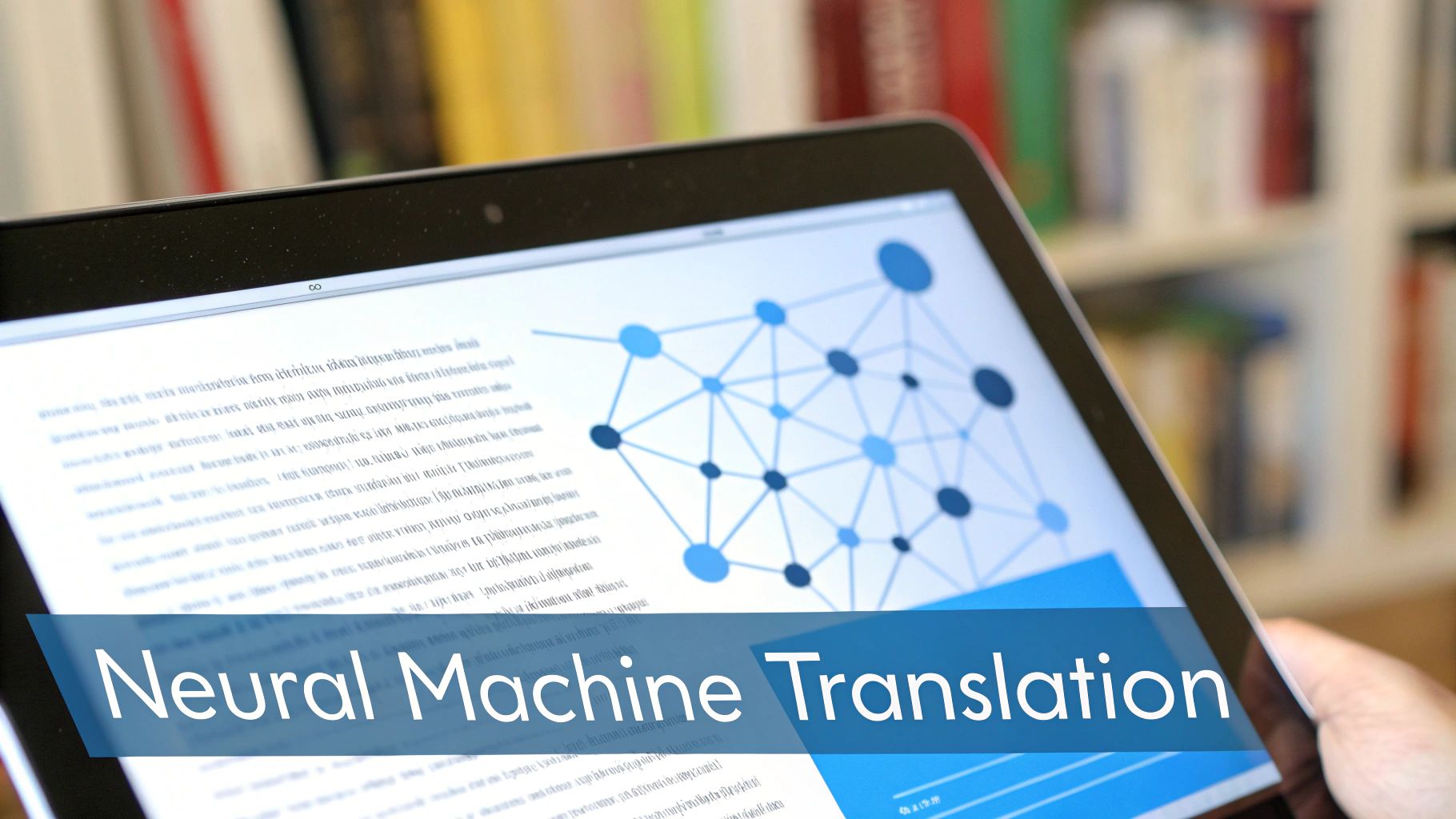
Today, the gold standard for quality translation is Neural Machine Translation (NMT). This technology was a huge leap forward, using artificial neural networks designed to mimic how the human brain learns and processes information.
Instead of just looking at isolated phrases, an NMT model analyzes the entire sentence, and sometimes the whole paragraph, to understand the full context before it even starts translating. This holistic view allows it to navigate complex sentence structures, handle idioms with surprising grace, and maintain a consistent tone throughout a text.
For authors and publishers, this is a game-changer. An NMT-powered tool is far more likely to preserve the unique voice and style that make a book worth reading. It can tell the difference between a character’s slang-filled dialogue and the narrator’s more formal prose—something older systems just couldn’t manage.
The real magic of NMT is its contextual awareness. By processing sentences as complete thoughts, it sidesteps the robotic phrasing that plagued early translation software. The end result is a translation that is far more fluid and readable.
How NMT Powers the Best Translation Programs
These days, almost every top-tier translation service uses NMT. This technology has become the engine of the entire AI translation market, which is growing at a staggering 24.9% compound annual rate. You can see its power in action with services like Google Translate, which has hit accuracy rates as high as 94% for Spanish and 90% for Tagalog in certain tests.
But not all NMT models are built the same. The quality of the final translation depends heavily on the data used to train the AI. A specialized service like BookTranslator.ai, for example, fine-tunes its models specifically on literary works. This training helps it develop a better feel for narrative flow, character voice, and the subtle nuances of creative writing.
This is a big reason why it’s a go-to choice for authors. You can dive deeper into how this works in our guide on how AI translates books into 99 languages.
Advanced AI Models and the Future
And the technology isn't standing still. The latest AI models are getting even smarter, capable of understanding deeper layers of meaning and cultural context. This is incredibly important when translating between languages with wildly different grammatical rules, like Japanese and English.
This progress is also spilling over into other types of media. For a glimpse at where things are headed, look at tools like an AI Audio Translator, which applies similar AI principles to spoken language. Once you understand the core technology, you can make a much more informed choice, picking a program based on what it can actually do, not just what the marketing says.
A Realistic Breakdown of Translation Costs and Value
Trying to figure out the cost of translation services can feel like comparing apples to oranges. Every service seems to have a different pricing model, which makes it tough to guess what the final bill for a big project, like an e-book, will actually be. You really have to look past the sticker price to see what you're getting for your money.
Generally, you'll run into a few common approaches. There are the "free" options like the basic version of Google Translate, which are fine for grabbing a quick translation of a sentence or two but fall apart with large volumes and don't handle file formats like EPUB. Then you have subscription plans, like those from DeepL Pro, geared toward people who need to translate a lot of text all the time. Finally, there are pay-per-use models, which are often the most straightforward.
Subscription vs Pay-Per-Use Models
If you're an author or a small publisher just looking to translate a single book, a monthly subscription is usually a waste of money. Think about it: you might pay for a full month but only need the service for a couple of days to get your manuscript processed. That model is great for corporate users with a constant flow of documents, not so much for one-off projects.
On the other hand, a pay-per-book or pay-per-word model ties the cost directly to what you actually use. It’s simple, transparent, and there are no surprise fees or commitments. For instance, a service like BookTranslator.ai gives you a clear price based on your book's word count before you even start. That kind of predictability is a lifesaver when you're trying to budget a publishing project.
The smartest financial choice isn't always the one with the lowest per-word rate. It's the one that fits the scale of your project. A pay-per-book model stops you from paying for subscription time you'll never use, making it a much better value for a single, large translation.
And don't forget the hidden cost of your own time. A "free" tool that forces you to spend hours manually fixing the formatting isn't really free, is it? The whole point of a specialized service is to save you from that headache, and that's a huge part of its overall value. You can dive deeper into this in our article on the real cost of AI book translation.
Cost Scenario Analysis for a Standard 80,000-Word Book
Let's make this real. Here’s a breakdown of what it might cost to translate a standard 80,000-word novel using a few different services. This table really highlights how the pricing model impacts the final cost for a typical author's project.
| Service | Pricing Model | Estimated Cost for 80,000 Words | Best For |
|---|---|---|---|
| Google Translate | Free (with manual work) | $0 (but requires hours of reformatting) | Casual users translating short text snippets. |
| DeepL Pro | Subscription (Advanced Plan) | ~$30 (one month, assuming the project is done quickly) | Professionals with ongoing, multi-document needs. |
| BookTranslator.ai | Pay-Per-Book (Basic Tier) | ~$5.99 (based on $5.99 per 100k words) | Authors and publishers translating single e-books. |
As you can see, the best deal really comes down to your situation. Sure, Google Translate is free, but the amount of manual labor required makes it a non-starter for a full book. DeepL Pro is a great investment if you have a constant stream of translation work, but for a single book, a dedicated pay-per-use service clearly comes out on top for both price and pure convenience. This kind of analysis helps you see which translation program actually delivers the best value for your project.
How to Choose the Right Program for Your Project
Picking the right translation software isn't about finding the one "best" tool—it's about finding the right tool for your specific job. The needs of a self-publishing author are worlds apart from those of an academic researcher. What's perfect for a quick, casual read will absolutely not work for a polished, commercially released e-book.
Instead of chasing a single solution, you have to match the program's strengths to your project's demands. Are you translating a technical paper loaded with jargon, or are you just trying to enjoy a bestseller from another country? Each scenario points to a different path.
This flowchart helps visualize the decision-making process. It shows how your project type—whether it's a one-off book, an ongoing publishing schedule, or just a quick lookup—steers you toward the most logical and cost-effective tool.
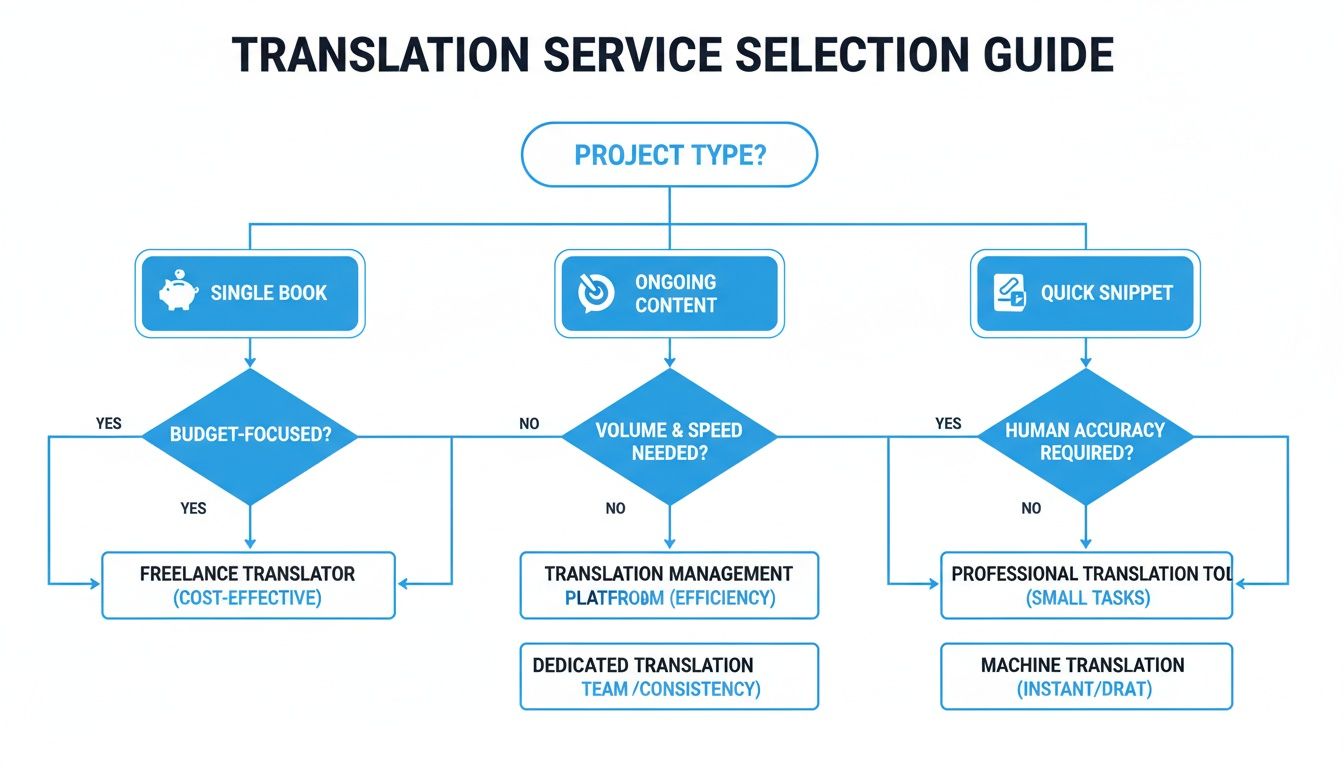
As the chart makes clear, one-time projects like a single e-book translation are best served by a pay-per-use model. This simple insight can save you from sinking money into a monthly subscription you don't really need.
The Self-Publishing Author
If you're an indie author, two things matter above all else: preserving your book's original layout and keeping costs down. You've spent countless hours getting your manuscript's formatting just right, from chapter breaks to italicized thoughts. The last thing you need is a tool that scrambles all that work.
Your top priority must be flawless EPUB format preservation. It's non-negotiable. Beyond that, a pay-per-book pricing model makes far more sense than a recurring subscription for a one-and-done project.
Recommendation: A specialized service like BookTranslator.ai was built from the ground up for this. It handles EPUB files natively, ensuring the translated version is a pixel-perfect mirror of your original. Its one-time fee aligns perfectly with an author's budget.
The Academic Researcher
An academic researcher operates in a completely different world. When you're translating dense scientific papers or historical texts, pinpoint accuracy with specialized terminology is everything. The author's "voice" is secondary to ensuring every single term is translated with precision.
You'll need a tool that can handle domain-specific language and maintain absolute consistency across hundreds of pages. The ability to create and apply a custom glossary is a game-changer here.
Recommendation: For this kind of work, DeepL is a powerhouse. It's widely praised for its nuanced translations, especially for European languages. The Pro version lets you build custom glossaries, which is critical for maintaining consistency with technical terms. While it might not be the best for complex EPUB formatting, its raw textual accuracy is hard to beat for document-heavy projects.
The Avid Reader or Student
Let's say you're a reader who just wants to explore foreign literature or a student who needs to understand a source text for a class. You're not publishing anything, so a few formatting quirks are no big deal as long as the content is readable and the meaning comes through clearly.
Your priorities are speed, ease of use, and affordability. The ideal tool is either free or extremely cheap, with a dead-simple workflow—just upload a file or paste some text.
Recommendation: A two-pronged approach works best here. For quick lookups, nothing beats the convenience of Google Translate. For a full book, the basic tier from a service like BookTranslator.ai offers a shockingly affordable way to get a fully readable, formatted e-book for a tiny one-time fee. It’s an incredible value for personal use.
The key takeaway is to define your primary outcome first. If the end goal is a professionally published e-book, prioritize format preservation. If it's a deep understanding of technical content, prioritize terminology management.
The Small Publisher or Business
A small press or a business with regular translation needs requires a more industrial-strength solution. You might be localizing a dozen books a year or a constant stream of marketing content. For you, efficiency, workflow management, and brand consistency are the name of the game.
You need a platform that balances quality with features that support a continuous, repeatable process. In this case, subscription models often become cost-effective, and the ability to integrate with other software is a major benefit.
Recommendation: This is where a Translation Management System (TMS) or a top-tier subscription is the right call. DeepL Pro offers a powerful API for custom integrations. For even larger operations, comprehensive platforms like Phrase or Smartling are designed to manage complex localization projects from start to finish, giving you the control and consistency required for professional publishing.
Your Top Questions About Book Translation Software, Answered
Deciding on the right tool to translate your book brings up a lot of questions. It's completely normal to worry about everything from the security of your manuscript to just how good an AI translation can actually be. Getting solid answers before you commit is key.
Let's walk through the most common concerns I hear from authors. We'll cover what really happens to your manuscript when you upload it, whether AI can handle creative prose, and what the editing process looks like once the machine has done its part. The goal is to clear up any confusion so you can move forward confidently.
How Secure Is My Manuscript with These Programs?
Handing over your unpublished work to an online service can feel like a leap of faith. Security is a huge deal, and it’s one of the biggest differences between free, public tools and professional-grade services.
If you paste your text into a free tool like the public Google Translate website, you're essentially agreeing that your data might be used to train their models. For an unpublished book, that’s a non-starter.
Professional services and paid APIs, on the other hand, operate under much stricter privacy rules.
- Paid Subscriptions (like DeepL Pro): These services almost always offer end-to-end encryption and have clear policies stating they won't use your text to train their AI. Your manuscript remains your property, period.
- Specialized Services (like BookTranslator.ai): Platforms built specifically for authors have security baked into their design. They’ll often have explicit terms explaining that your manuscript is processed securely and scrubbed from their servers after a short time.
The bottom line? Always read the terms of service. For any serious project, avoid free public tools and go with a service that explicitly guarantees the privacy and security of your intellectual property.
Can AI Really Capture the Nuance of Creative Writing?
This is the million-dollar question for any author. Let's be realistic: AI translation isn't a magic wand that produces a flawless, ready-to-publish literary masterpiece. But what it can do is get you remarkably close.
Modern Neural Machine Translation (NMT) has gotten incredibly good at grasping context, tone, and even some figurative language. For straightforward prose, the output can be shockingly good. The real test comes with the tricky stuff—subtle humor, culturally specific metaphors, or the unique cadence of a character's voice.
Think of AI translation as a highly skilled, lightning-fast assistant who produces a fantastic first draft. It does about 80-95% of the heavy lifting, freeing up a human editor to focus on polishing the artistry and nuance instead of starting from a blank page.
This approach doesn't just work; it saves an enormous amount of time and money. The quality also hinges on the AI model itself. A generic model might iron out a character's quirky dialogue into something flat, while a model trained on literary works will do a much better job of keeping that unique flavor intact.
What Does the Post-Translation Editing Process Look Like?
No matter how sophisticated the AI, a human touch is non-negotiable for a high-quality book translation. Once the software gives you back your translated manuscript, the next step is a thorough review and edit. In the industry, we call this Machine Translation Post-Editing (MTPE).
The process usually breaks down into a few key stages:
- The First Read-Through: Just read the translation to get a feel for the overall flow. You're looking for any jarring issues with the tone or obvious mistakes in meaning.
- Bilingual Review: This is where the real work happens. You (or a professional editor) compare the translation side-by-side with your original text. This is how you catch subtle inaccuracies, clunky phrasing, or moments where your authorial voice got a little lost.
- Cultural Adaptation: You need to make sure idioms, jokes, and cultural references actually land with the new audience. A direct translation often falls flat, so you might need to find a local equivalent that carries the same spirit.
- Final Polish: Lastly, a final proofread checks for any lingering spelling, grammar, or punctuation errors that slipped through the cracks.
The amount of editing you'll need to do can vary wildly. A translation from a top-tier program might just need a light touch-up, while one from a less capable tool could require a serious rewrite. Always factor time and budget for this editing phase into your project plan—it's what separates an amateur translation from a professional one.
Ready to translate your book with confidence? BookTranslator.ai offers a secure, simple, and affordable solution designed specifically for authors. Preserve your formatting and get a high-quality AI translation in minutes. Start your book translation today!