
Opera's built-in page translation is a game-changer. It's a powerful, integrated tool that instantly flips websites from a foreign language into one you understand. This means you can ditch those clunky third-party extensions and make browsing the global web a whole lot smoother.
Why Opera's Integrated Translator Is a Cut Above
Let's face it: hitting a language barrier online is frustrating. The old way involved copying and pasting text into a separate translation tab, which completely breaks your focus. Opera gets rid of that hassle by building the solution right into the browser. This isn't just a minor perk; it fundamentally changes how you explore international content.
Think about it. You could be browsing a Japanese e-commerce site for a rare collectible or catching up on a German news story. Instead of hitting a wall of unreadable text, Opera simply asks if you'd like to translate the page. One click, and it's done. There's no friction, no performance hit from extra add-ons, and no interruption. It's a core reason many people stick with Opera.
A Key Driver of Global Adoption
This feature isn't just convenient—it's a major factor in Opera's growth. The built-in translator has helped the browser carve out its 1.72% to 2.1% global market share. In fact, user surveys show that a staggering 40% of users point to this feature as a top reason for making the switch.
This is especially true in the BRICS nations, where cross-language browsing jumped by 25% after the pandemic. You can dive deeper into browser market dynamics over at Statcounter.
This kind of built-in capability truly opens up the web, making it accessible to everyone. If you're curious how this compares to other browsers, our guide on a web translator for Safari offers another perspective.
The real benefit is immediacy. Opera removes the mental step of "I need to translate this" and replaces it with a simple "yes" or "no" decision, making the entire internet more accessible.
To get a better sense of how instant translation technology is breaking down barriers, it's interesting to see how a physical auto translate device can do the same for digital products in new markets.
Getting Your Translation Settings Dialed In
Before you can start breaking down language barriers online, you'll need to make sure Opera's built-in translator is turned on and configured just right. The good news? Opera keeps this process simple, so you won't have to wade through a maze of complicated menus. The whole idea is to make translation feel automatic for languages you don't know, while leaving the ones you do completely alone.
First things first, let's head over to Opera's settings. The quickest way is to just hit Alt+P on your keyboard. You can also find it by clicking the main Opera menu icon, usually in the top-left corner. Once you're in the settings panel, just scroll down to the "Languages" section—this is where all the magic happens.
Fine-Tuning Your Language Preferences
In the Languages menu, you're looking for a toggle switch. It should say something like, "Offer to translate pages that are not in a language you read." Go ahead and flip that on. This is the master switch that activates the helpful little pop-up you'll see when you land on a foreign-language site.
Speaking of that pop-up, it's designed to be there when you need it and out of the way when you don't. It just appears right in the address bar.
As you can see, it's pretty subtle. A quick click is all it takes to translate the page without interrupting what you're doing.
Now, you'll want to tell Opera which language to translate into. This is your target language, and for most of us, it's simply our native tongue. Set that as your default.
Pro Tip: Here's a step people often miss. Take a second to customize the "Do not offer to translate" list. For instance, if you're fluent in both English and Spanish, add Spanish to this list. That way, Opera will never bother you with a translation prompt on Spanish websites. It's a small tweak that makes for a much smarter browsing experience.
By spending a few moments here, you can:
- Set your go-to language for all translations.
- Stop seeing pop-ups for languages you already speak.
- Make sure the feature is always ready to go when you stumble upon a new site.
Honestly, taking two minutes to get this set up will save you a ton of little annoyances down the road and make browsing the global web feel a lot more seamless.
How to Use the Opera Translate Page in Real Time
Once you've got the settings dialed in, actually using Opera's translator is a piece of cake. The browser gives you a few different ways to translate content as you browse, so you're never stuck trying to decipher a page. It's designed to be seamless.
Let's walk through a real-world scenario. Say you're hunting for a specific camera lens and land on a German photography forum. All the technical specs and user reviews are in German. Since you've already enabled the feature, a small pop-up will appear right in the address bar, asking if you want to translate the page. This is the fastest route—one click, and the entire page reloads in English (or whatever your default language is).
Accessing Translation On-Demand
What happens if you accidentally click "No" on that pop-up but then realize you do need the translation? No problem. Opera gives you two other quick ways to get it done.
- The Address Bar Icon: Look for the small translation icon that stays visible in your address bar. Clicking it reopens the translation prompt, letting you translate the page whenever you're ready.
- The Right-Click Menu: This is my personal go-to for more deliberate control. Just right-click anywhere on the page, and you'll see a "Translate" option in the context menu.
This flexibility means you're always just a click or two away from understanding the content in front of you. The initial setup is just as straightforward.
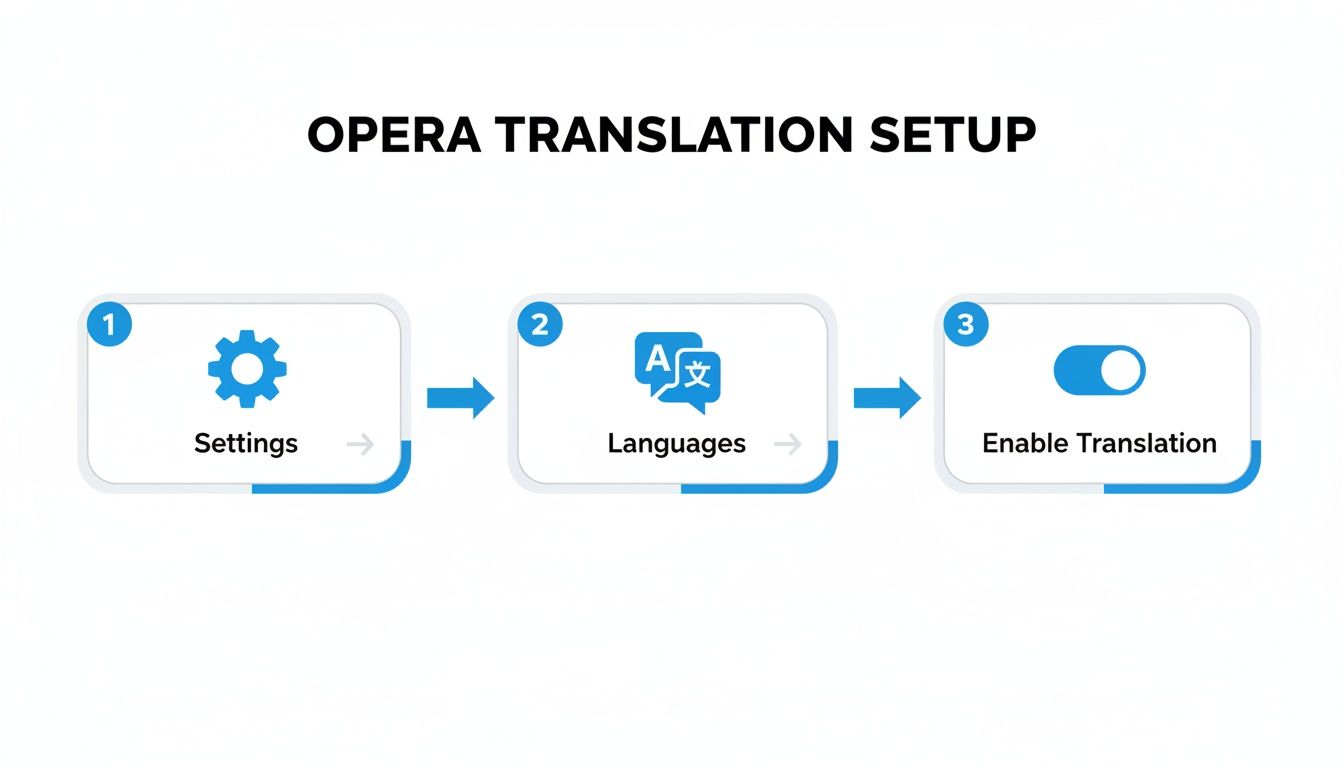
As you can see, getting it running is a simple, one-time task that unlocks these handy real-time features.
Opera Translation Methods at a Glance
Each method has its place depending on your browsing style. Here's a quick breakdown to help you decide which one works best for you.
| Method | How to Access | Best For |
|---|---|---|
| Automatic Pop-Up | Appears in the address bar on foreign pages | Quick, one-click translations for immediate understanding. |
| Address Bar Icon | Click the icon after dismissing the pop-up | Changing your mind and translating a page you initially ignored. |
| Right-Click Menu | Right-click anywhere on the page | Manually triggering a translation with more direct control. |
Ultimately, having these different options lets you tailor the experience to how you work.
The real beauty of Opera's system is how it adapts. It offers an automatic prompt when it thinks you need it but keeps manual controls close at hand so you're always in charge.
This user-first approach has been a hallmark of Opera since it launched back in 1995. It's one of the reasons the browser maintains a steady 1.85-3.02% usage share among mobile and tablet users. For its 300+ million users, features like this are essential for everything from research to online shopping—some studies have even shown that translating product pages can boost e-commerce conversions by as much as 22%.
Of course, Opera's tool is built for full-page translations. If you only need to translate a single sentence or a short paragraph, a general online translator tool might be a faster option. And for really heavy-duty tasks, like translating entire eBooks, you'll want a dedicated solution. We actually cover that in our guide on real-time EPUB translation with AI tools.
Troubleshooting Common Translation Problems
Even the most dependable browser features can hit a snag now and then. If you find the Opera translate function isn't working quite right, don't worry. The fix is usually pretty simple, and most problems boil down to just a few common culprits like a setting that got toggled off or a conflict in browser data.
The most common complaint I hear is that the translation bar just doesn't show up on a foreign-language site. Before you start digging into complex fixes, let's cover the basics. Go back into your settings and make sure the main translation feature is still enabled. It sounds obvious, but you'd be surprised how often a browser update can flip a switch without you realizing it.
When the Translation Fails or Looks Garbled
It's also incredibly frustrating when a translation starts but only gets halfway through, leaving you with a jumbled mess of two different languages. This usually points to a problem with your browser's cache or a squabble between your extensions.
A good first move is to clear your browser's cache. Old, stored data can sometimes interfere with how Opera processes and renders a page, causing the translator to stumble.
If that doesn't do the trick, here are a few other things to try:
- Look for Extension Conflicts: Try disabling your other extensions for a moment, especially things like ad-blockers or VPNs. Sometimes these tools can inadvertently block the script that makes the translation happen.
- Update Opera: Make sure you're running the latest version of the browser. What feels like a major bug to you might be something the developers already fixed in a recent patch.
- Double-Check Language Settings: Pop back into your language settings. Confirm your target language is correct and, more importantly, check the list of languages you've told Opera not to translate.
A common oversight is accidentally adding a language to the "never translate" list. If one specific site consistently refuses to translate, that list is the first place I'd look.
What if the translation works, but it's full of strange errors? That's likely an issue with the translation engine itself. While you can't fix their algorithms, it can be fascinating to learn how AI detects translation errors to understand what's happening behind the scenes.
The Grayed-Out Translation Option
Ever right-click on a page, see the "Translate" option, but find it grayed out and unclickable? This usually means Opera either can't figure out what language the page is written in or thinks it's a language you already understand.
A quick page refresh (Ctrl + R on Windows or Cmd + R on Mac) can often solve this. It forces the browser to take a second look at the content and might be all it needs to kickstart the translation feature.
Taking Your Translation Skills to the Next Level
Once you're comfortable with the basics, you can start using Opera's translator with a lot more finesse. Sometimes, a full-page translation is just overkill, and that's where a more targeted approach comes in handy.
Picture this: you're browsing a foreign news site, and just a single paragraph is giving you trouble. Instead of translating the whole page and potentially losing some of the original context, just highlight the text you need. A small "Translate" option will pop right up in the context menu. This gives you a quick, clean translation on the spot without ever reloading the page, letting you get the info you need and get back to reading.
Knowing When to Call in a Specialist
Opera's built-in translator is fantastic for day-to-day browsing, but it's smart to know its limitations. Machine translation is powerful, but it's not foolproof, and for certain tasks, you absolutely cannot afford any mistakes.
There are definitely times when you should reach for a dedicated translation service. I always recommend it for situations like these:
- Legal Documents: Think contracts or agreements. One slightly off word can change the entire legal meaning. It's not worth the risk.
- Professional Communication: When you're sending an important business email or report, getting the nuance and tone just right is crucial.
- Technical Manuals: For complex instructions, precision is everything. You don't want a mistranslation when safety or proper operation is on the line.
For these high-stakes scenarios, using a specialized platform known for accuracy, like DeepL, or even hiring a professional human translator is the only way to go. It's about picking the right tool for the job.
The goal isn't to rely on one tool for everything, but to build a toolkit. Use Opera for quick, convenient browsing, and turn to specialized services when absolute precision is required.
This practical, built-in feature has actually made Opera a popular choice in emerging markets. In Africa, where Opera holds a 7.67% market share, its efficient, AI-powered translation is a huge benefit, helping to reduce page load times on slower networks and keeping users engaged. You can dig into more stats on global browser usage at Backlinko.
Common Questions About Opera's Translator
Even with a tool as handy as Opera's built-in translator, a few questions always seem to come up. Let's walk through some of the most common ones I hear, so you can get back to browsing without a hitch.
So, Who's Doing the Translating?
A big question is always about what's happening behind the scenes. Opera's translation magic comes from Lingvanex, an AI-powered service.
What I really appreciate about this setup is how they handle your data. All the translation work happens on Opera's own servers in Europe. This means your text isn't getting passed around to third-party companies, which is a huge plus for anyone who cares about privacy.
Oops, How Do I Switch Back to the Original?
Translated a page by accident? Or maybe you just want to double-check the original phrasing. No problem at all.
After you opera translate page, you'll notice the little translator icon sticks around in your address bar. Just give that a click and hit "Show original." The page will snap right back to its original language. It's that simple.
Is It Safe for Sensitive Information?
This is a critical one. You're on your banking site or a checkout page, and you're wondering if it's safe to translate. Here's my take:
While Opera's connection is secure, I always recommend against using any automated translator on pages where you're entering sensitive data like passwords or credit card numbers. It's just a good habit to stick to the original language for those tasks to eliminate any risk.
Why Isn't the Translator Working on This Page?
Every now and then, you might find a page where the translation option doesn't pop up. This usually happens for one of two reasons: the website is built with complex code that the translator can't quite read, or the language on the page is too mixed up for it to identify. For the vast majority of sites, though, it works like a charm.
When you're dealing with something much bigger than a webpage, like translating an entire eBook, a browser tool won't cut it. For that kind of heavy lifting, a dedicated service like BookTranslator.ai is what you need. It's designed for accurate, long-form content translation, which you can check out at https://booktranslator.ai.