
Translating a book from Spanish to Arabic is about far more than swapping words; it's about connecting two profoundly rich literary and cultural worlds. This isn't just a technical task. It’s a delicate process that requires linguistic precision, cultural sensitivity, and a good bit of technical know-how. The real goal is to craft an Arabic version that feels just as natural and compelling as the original Spanish work.
Your Complete Roadmap for Spanish to Arabic Translation
Embarking on a Spanish to Arabic translation project opens your work up to millions of new readers. The demand for content in this language pair has exploded, which makes sense when you look at the numbers. Spanish is spoken by around 559 million people globally, while Arabic connects you to over 274 million speakers across the Middle East and North Africa (MENA).
This isn't just about raw numbers, though. Both language regions represent massive, digitally-savvy markets with significant purchasing power. Tapping into this intersection is a huge opportunity. You can find more insights into language statistics and how they shape global markets online.
This guide will walk you through the entire journey, making sure your story resonates deeply with its new audience.
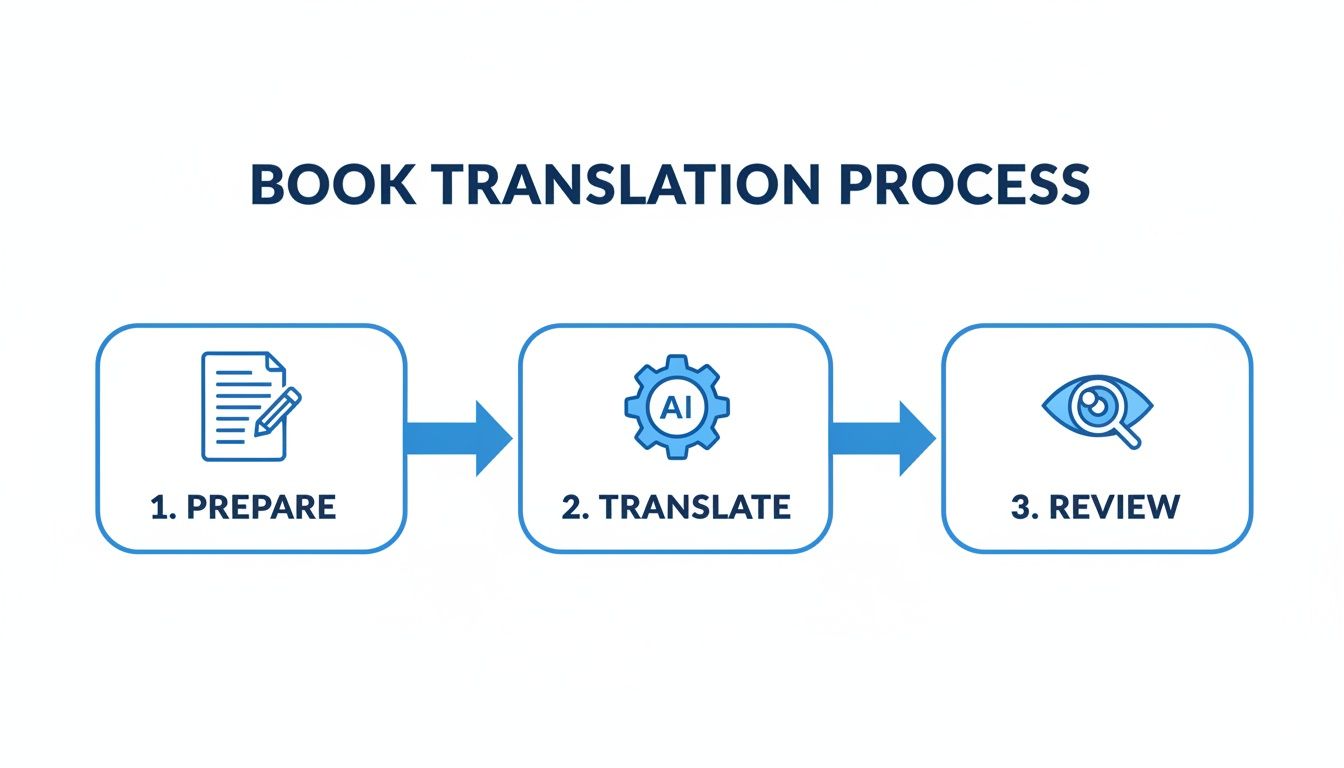
Here's a quick look at the major stages we'll be covering. Think of it as a high-level flight plan for your project.
Key Stages of Spanish to Arabic Book Translation
| Stage | Primary Goal | Key Consideration |
|---|---|---|
| Preparation | Create a clean, error-free source file. | Fixing formatting issues and ensuring the Spanish text is finalized. |
| Translation | Convert the Spanish text into fluent Arabic. | Choosing the right tools (AI or human) and handling cultural nuances. |
| Review & QA | Polish the translated text for publication. | Checking for accuracy, flow, and technical issues like RTL layout. |
Each stage builds directly on the last. If you rush the preparation, you'll get a messy translation, which makes the review phase a nightmare. A little extra care upfront saves a ton of headaches later.
Why Getting This Right Is So Important
A successful translation is much more than a technical exercise; it's a creative and commercial one. When done well, it unlocks incredible opportunities. But it demands careful attention to detail at every step.
A great translation doesn't just change the language; it preserves the soul of the story. It makes a reader in Cairo feel the same emotions as a reader in Madrid, bridging cultural gaps with shared human experience.
Throughout this guide, we'll dive deep into the practical steps and real-world challenges you'll face. We’re going to cover:
- Manuscript Prep: How to get your Spanish EPUB file ready for a smooth, clean conversion.
- Cultural Nuances: The tricky business of adapting idioms, humor, and social norms that don’t translate directly.
- Technical Hurdles: How to manage right-to-left (RTL) layouts and font compatibility without pulling your hair out.
- AI-Powered Tools: Using services like BookTranslator.ai to handle the heavy lifting efficiently and affordably.
- Post-Editing & QA: The absolutely critical role of human review in perfecting the final product.
By understanding these components, you can approach your translation spanish to arabic project with confidence, fully equipped to make your book a success in the Arab world.
Getting Your Spanish Manuscript Ready for a Flawless Translation

The quality of your final Arabic ebook is decided long before you translate the first word. A successful translation from Spanish to Arabic all comes down to the quality of the source material. Think of your original Spanish manuscript as the blueprint for a house—if the foundation is cracked, the final structure will be shaky at best.
This initial prep work is your chance to clear any potential hurdles for the translation process, whether you’re using an AI tool or a human expert. A little bit of cleanup now will save you countless hours of frustrating revisions down the road.
Nail Down Your Formatting for Consistency
AI translation engines, like the one powering BookTranslator.ai, are incredibly sophisticated, but they need clean, logical formatting to make sense of your book's structure. If your Spanish EPUB is a mess of inconsistent styles, you can bet the Arabic version will be a jumbled, poorly organized file.
Start by making sure your document uses proper, built-in styles for headings—H1 for chapter titles, H2 for the main sections, and so on. Avoid the temptation to just manually bold text and crank up the font size to create a heading. This structured data gives the translation software clear signposts, helping it keep your layout perfectly intact.
Here are a few essential formatting checks to run:
- Consistent Paragraph Breaks: Stick to a single paragraph return between paragraphs. Don't hit "Enter" multiple times to create extra white space.
- No Manual Line Breaks: Hunt down and remove any manual line breaks (Shift + Enter) hiding inside your paragraphs. These can chop sentences in half and completely throw off the translation logic.
- Proper Heading Styles: Apply a clear hierarchy of heading styles (Heading 1, Heading 2, etc.) throughout the entire manuscript.
- Clean Up Special Characters: Do a quick search for any bizarre characters or symbols that might have crept in during file conversions and get them fixed.
This isn’t just about making things look pretty; it's about feeding the system a clean, machine-readable file to ensure a smooth technical conversion.
Simplify and Clarify Your Spanish Text
Once your formatting is squared away, it’s time to look at the text itself. The goal here isn't to "dumb down" your writing, but to make it as clear and direct as possible. This is particularly vital when you’re bridging the gap between languages as different as Spanish and Arabic.
Long, winding sentences packed with multiple clauses can be a nightmare for any translation process to untangle correctly. It's often a good idea to break them down into shorter, more straightforward sentences.
For example, take a sentence like this:"El protagonista, quien a pesar de las advertencias de su familia había decidido emprender el viaje, sintió un profundo temor al ver que la tormenta se acercaba."
You could easily simplify it to:"El protagonista decidió emprender el viaje, a pesar de las advertencias de su familia. Sintió un profundo temor cuando vio que la tormenta se acercaba."
That small edit makes the chain of events much clearer and dramatically lowers the risk of grammatical slip-ups in the final Arabic version.
Taking the time to simplify complex sentences and clarify idioms is like sharpening your tools before starting a project. It makes the actual work of translation smoother, faster, and far more accurate.
Tackle Cultural and Idiomatic Nuances
This is where your prep work can really make a difference. Spanish is packed with colorful idioms and cultural references that simply have no direct equivalent in Arabic. If you translate them literally, you’ll confuse your readers at best—and sound completely nonsensical at worst.
Comb through your manuscript, identify these phrases, and decide on a strategy. You generally have two solid options:
- Rephrase with a Neutral Equivalent: Swap the idiom for a direct explanation of its meaning. For instance, instead of
"estar en la luna"(literally "to be on the moon"), you could write"estar distraído y pensando en otra cosa"(to be distracted and thinking of something else). - Find a Conceptual Equivalent: This is trickier and requires deep cultural knowledge, but you might find an Arabic idiom that carries a similar emotional weight, even if the words are totally different.
By proactively dealing with these cultural quirks, you give the translation process a clear path to an accurate, natural-sounding result. For a deeper dive, our checklist for translating books to a native language provides even more tips for prepping your manuscript. This groundwork ensures your story's soul remains powerful and intact for a whole new audience.
Navigating Critical Linguistic and Cultural Divides
Once your files are in order, you get to the real heart of the work: bridging the vast linguistic and cultural chasms that separate Spanish and Arabic. This is where the true art of translation from Spanish to Arabic lies. A direct, word-for-word conversion will almost always fail, leaving you with a book that feels awkward, clunky, or even unintentionally offensive.
The linguistic differences are obvious enough, from the script to the grammar. But the real challenge is adapting the cultural context so your story hits home emotionally. It’s no surprise that localized content often sees 30–50% higher engagement rates—it speaks to readers in a way that feels authentic and familiar. For a deeper dive into this, you can discover more insights about Spanish-to-Arabic professional translation and see just how crucial these connections are.
Success hinges on making smart localization choices that keep your original intent intact while respecting the norms of an Arabic-speaking audience.
The Nuances of Formality and Respect
One of the first hurdles you'll face is formality. Spanish handles this with a fairly clear line between tú (informal 'you') and usted (formal 'you'). Arabic is a different world entirely, with a much more complex and layered system of honorifics that can change dramatically based on region, social status, and the situation itself.
Imagine a casual, friendly chat between two young friends in a Madrid café who use tú with each other. You can't just pick a single Arabic equivalent and run with it. The right choice depends entirely on the specific dialect and the social dynamic you want to portray.
Here are just a few ways this could play out:
- Egyptian Arabic: The characters might use terms like ya basha or ya bey as playful signs of respect, even between friends.
- Gulf Arabic: Here, you'll often find more formal titles used even in casual conversations, reflecting a different cultural standard.
- Levantine Arabic: This region has its own unique set of informalities that would sound completely out of place anywhere else.
Get this wrong, and your characters’ dialogue will instantly feel stilted or, even worse, disrespectful. The key is to first define the relationship between the characters, then find the Arabic phrasing that perfectly captures that same social dynamic.
A translator's job is not to find the perfect word, but the perfect feeling. The goal is for an Arabic reader to understand the characters' relationships implicitly, just as a Spanish reader would.
Adapting Humor and Social References
Humor is notoriously tough to translate. What’s hilarious in Spanish can easily fall flat or be misunderstood in Arabic. Sarcasm, irony, and culturally specific jokes lean heavily on shared social knowledge that just doesn't cross borders.
Think about a Spanish character who makes a witty jab referencing a popular TV show from the 1990s. An Arabic reader would have zero context for this, and a literal translation would only create confusion. You have a few options:
- Cut the Reference: If the joke isn't vital to the plot, the simplest solution is often to just remove it.
- Find a Cultural Equivalent: Search for a similar, well-known cultural touchstone in the Arab world that achieves the same comedic effect. This requires deep cultural knowledge.
- Explain It (Sparingly): In some non-fiction, you might get away with a brief explanation, but be warned—this is a surefire way to kill the humor.
- Rewrite the Joke: Create a brand new joke based on a more universal idea (like situational irony) that still fits the character's personality.
The same thinking applies to social norms. A scene showing a casual dating custom that’s common in Spain might need careful handling to avoid alienating readers in more conservative parts of the Arab world. The goal isn't censorship; it's cultural adaptation to keep the core emotional story front and center.
A Practical Case Study in Adaptation
Let's walk through a simple example to see this in action. Imagine this line from a Spanish novel:
- Original Spanish: "¡Qué morro tienes! Te comiste la última tortilla sin preguntar," dijo Elena, dándole un codazo amistoso a Javier.
- Literal (and Awful) Translation: "What a snout you have! You ate the last tortilla without asking," said Elena, giving Javier a friendly elbow.
This translation is a mess. "Qué morro tienes" is an idiom that means "You've got some nerve," and "tortilla" could easily be misinterpreted. The "friendly elbow" might also come across differently.
A good, culturally adapted translation would zero in on the intent:
- Adapted Arabic (Conceptual): The translator would swap the Spanish idiom for a phrase that conveys playful accusation, like "يا لك من مفترٍ" (ya lak min muftarin - "Oh, what a glutton you are!"). They would also clarify "Spanish omelet" if the food is a key detail and describe the physical contact in a way that feels natural in an Arab context, maybe as a light tap on the shoulder.
This is the careful work of deconstruction and reconstruction that separates a mechanical conversion from a truly artful translation from Spanish to Arabic. It’s what ensures your narrative feels real, your characters are believable, and your story connects on a deeply human level.
Getting the Technical Details Right for Arabic Ebooks
When you're translating a book from Spanish to Arabic, it's easy to get lost in the linguistic and cultural details. But let me tell you, if you trip up on the technical side, all that beautiful prose won't matter. A broken layout can make your ebook literally unreadable.
The biggest challenge, hands down, is the switch from a left-to-right (LTR) language like Spanish to a right-to-left (RTL) one like Arabic. This is way more than just clicking "align right." It fundamentally changes the book's entire structure, from how pages turn to where images sit on the page.
If this RTL conversion is botched, you end up with a disaster. Punctuation lands on the wrong side of a sentence, and paragraphs flow backward. It’s a mess. Fortunately, this isn't a manual job anymore. Modern platforms like BookTranslator.ai are built to handle this, reworking the EPUB's code so the entire reading experience feels natural for an Arabic reader.
Don't Let Your Fonts Fail You
Your choice of font is suddenly a massive deal. A lot of the go-to fonts for Spanish simply don't have the characters or ligatures needed for Arabic script. Pick the wrong one, and your text will be littered with empty boxes (we call them "tofu") or just look plain wrong.
For an Arabic ebook, your font absolutely must support:
- All Arabic Characters: This means the initial, medial, final, and isolated forms of every letter.
- Diacritics (Tashkeel): These little marks are critical for pronunciation and meaning, especially in formal texts.
- Ligatures: In Arabic, certain letter combinations blend into a single glyph. A good font makes these connections look seamless.
I've had great results with open-source fonts like Amiri, Noto Naskh Arabic, and Scheherazade New. They were specifically designed for readability and have the complete character sets you need.
A clean, readable font is the foundation of the reader's experience. It’s not just a nice-to-have; it's essential. If the words are a pain to look at, the story is already lost.
We go into much more detail on this in our EPUB translation guide on preserving format and style. It’s worth a read if you want to keep your book's visual identity intact.
The Tricky Business of Numbers and Mixed Text
Another classic mistake is how numbers are handled. Arabic text flows from right to left, but numbers—whether they’re Western or Eastern Arabic numerals—are read from left to right. Your ebook needs to manage this "bi-directional" text properly. If it doesn't, phone numbers, dates, and any other figures will be scrambled.
It gets even more complex when you mix languages in one sentence, like dropping in a brand name.
For example:
"قررت استخدام Google للبحث عن المعلومات." (I decided to use Google to search for information.)
Here, the Arabic flows right-to-left, but the word "Google" has to stay left-to-right. A professional-grade ebook will display this perfectly. A poor conversion might flip the English word backward or break the sentence flow entirely.
The bottom line is this: the technical work in a translation from Spanish to Arabic is just as vital as the linguistic work. Getting the RTL layout, fonts, and mixed-direction text right is what separates a frustrating, amateur-looking ebook from a polished, professional one that Arabic readers will actually enjoy.
Bringing in the AI: A Smarter Way to Translate Your Spanish Book to Arabic
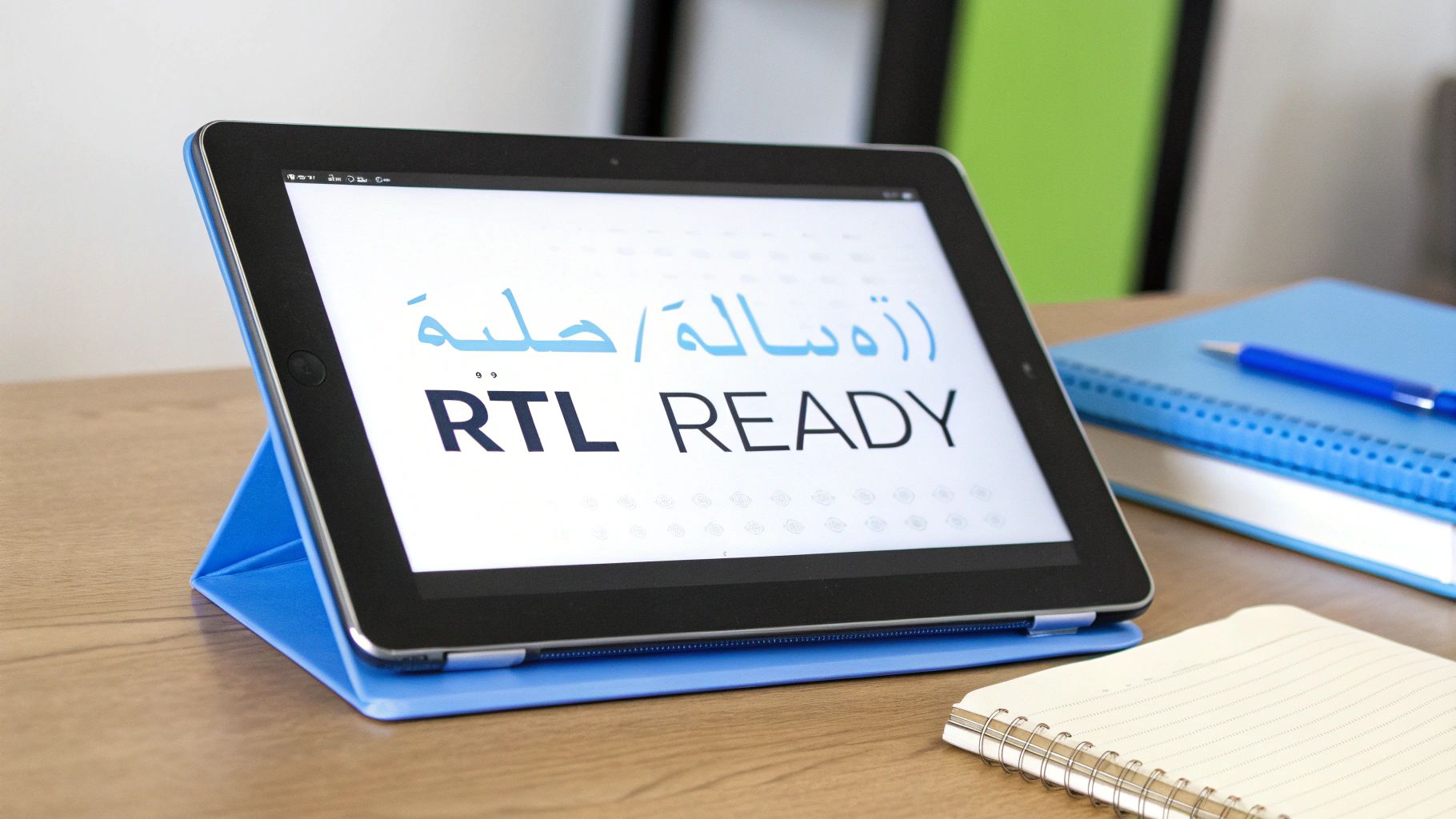
This is what a great result looks like. The Arabic text is perfectly formatted for right-to-left (RTL) display on a digital reader, looking clean and professional. A good AI service handles all this tricky technical stuff behind the scenes, so you can pour your energy into the story itself.
Once your manuscript is clean and you have a solid grasp of the cultural nuances, it's time to let artificial intelligence do the heavy lifting. Modern AI has completely changed the game, making the translation of Spanish to Arabic books faster and more affordable than ever. It tackles the most grueling parts of the process in a tiny fraction of the time it would take a person.
Services like BookTranslator.ai are built specifically for this. Forget the old days of manually copying and pasting chapters into a generic tool. Here, you just upload your prepared EPUB file. The system gets to work immediately, translating the text while keeping all your formatting intact—from chapter breaks to heading styles.
Picking the Right AI Model for Your Book
Not all AI models are built the same, and the best one for you really depends on your book's personality. Most specialized translation platforms will offer a couple of different tiers. Knowing the difference is crucial for getting the results you want without paying for power you don't need.
Here’s how I think about it:
- Basic AI Models: These are your go-to for straightforward, informational writing. If you've got a non-fiction guide, a technical manual, or a simple children’s book, a basic model is usually more than enough to produce a solid, accurate translation.
- Pro AI Models: For anything with literary flair—fiction, poetry, or complex prose with a distinct emotional core—you'll want to invest in an advanced model. These "Pro" engines are trained on massive, diverse libraries of literature, which makes them far better at understanding an author's unique voice, subtle tone, and those tricky turns of phrase.
A simple Spanish recipe book, for example, would translate beautifully with a Basic model. But if you're trying to capture the layered metaphors in a novel with the richness of Gabriel García Márquez, a Pro model is the only way to go. It’s trained to catch that feeling.
The choice between 'Basic' and 'Pro' isn't just about the price tag. It's a strategic decision based on your book's complexity. Your goal is to match the tool to the task to get the most authentic final product.
How Token-Based Pricing Works
Most specialized AI translation services, including BookTranslator.ai, run on a token-based pricing system. It’s a much more honest approach than a flat fee because you only pay for exactly what you use. A "token" is basically a piece of a word, usually about four characters long.
So, a 100,000-word book might break down into roughly 130,000 tokens. The platform scans your manuscript, calculates the total token count, and gives you a price based on that number. This pay-as-you-go model is incredibly efficient for authors and publishers, with no subscriptions or long-term contracts to worry about.
This model is a big reason why the machine translation market is exploding, projected to jump from USD 678 million in 2024 to USD 995 million by 2026. This growth is fueled by AI making powerful tools accessible to more creators.
The AI Translation Workflow in Practice
The whole process is designed to be dead simple. You upload your Spanish EPUB, select Arabic as your target language, and pick the AI model that fits your book. The platform will then generate an instant quote based on your token count.
Once you give the green light, the AI starts working its magic. The speed is genuinely impressive. From our own internal data, we've seen projects that would take months of human work get done in just a few hours. You can read more about https://booktranslator.ai/blog/how-ai-speeds-up-translation-timelines.
It’s also fascinating to see how this technology is branching out. Beyond direct translation, we’re seeing new AI innovations in language tutoring that are changing how people learn in the first place.
When the AI is finished, you’ll get a fully formatted Arabic EPUB back. This isn't the final product, of course, but it’s a huge head start. You now have an excellent first draft, ready for the essential post-editing phase where a human expert will add that final layer of polish.
Answering Your Spanish to Arabic Translation Questions
Moving a book from Spanish into Arabic for the first time can feel like stepping into a new world. You’re bound to have questions. I’ve put together some straight answers to the most common concerns I hear from authors and publishers to help you navigate the process with confidence.
Just How Good Is AI for a Complex Spanish to Arabic Translation?
Modern AI has gotten seriously impressive with Spanish to Arabic, especially for the nuts and bolts of grammar, vocabulary, and sentence structure. If you’re translating non-fiction, you might be shocked at how clean the raw output is.
But literary work? That's a whole different ballgame.
This is where the nuances live—the author's voice, the subtle wordplay, the cultural idioms that make a story breathe. AI, even at its best, often fumbles these finer points. The most effective path forward is a hybrid approach.
Let a high-quality AI service do the initial heavy lifting. It can power through 90-95% of the text with incredible speed. Then, you bring in a native Arabic-speaking editor to take it across the finish line. They'll be the one to nail the cultural resonance, smooth out any clunky phrasing, and make sure your unique style shines through. This way, you get the best of both worlds: the raw power of AI and the essential polish of a human expert.
After Using an AI, Do I Really Still Need a Human Editor?
Yes. Absolutely. For a professional-quality book, this step is non-negotiable.
Think of the AI as your incredibly fast first-draft translator. It builds a fantastic foundation, but it’s still just a foundation. Your human editor is your quality control expert and, just as importantly, your cultural guide. Their job is to catch the subtle things an algorithm will always miss.
A native Arabic speaker is crucial for:
- Spotting awkward phrasing that might be grammatically correct but just sounds off to a native ear.
- Adapting cultural references so they actually land with the target audience.
- Ensuring the authorial voice remains consistent and compelling in Arabic.
- Preserving the emotional impact, which often hangs on very specific, culturally-loaded word choices.
This final human touch is what transforms an acceptable translation into a polished, professional book that readers will truly connect with. It's the last, most critical step.
"An AI can translate your words, but only a human can translate your voice. The editor's job is to ensure the soul of your story survives the journey between languages."
What Are the Biggest Mistakes to Avoid in This Process?
Having guided countless authors through this, I've seen the same few missteps pop up time and again. Dodging them from the get-go will save you a world of headaches, time, and money.
Here are the three big ones:
- Rushing the Prep Work: Trying to translate a poorly formatted or unedited Spanish EPUB is a recipe for disaster. The AI's output is a direct reflection of its input; garbage in, garbage out.
- Skipping Cultural Adaptation: A word-for-word translation of Spanish jokes, social norms, or figures of speech can feel flat, confusing, or even off-putting to an Arabic reader. Localization is what makes a story feel real.
- Ignoring the Technical Details: This is huge. If you don't implement the right-to-left (RTL) layout correctly, your ebook will be an unreadable mess. Font choice is also critical, as many standard fonts simply can’t handle Arabic script properly.
Using a specialized service that automates these technical bits, especially the RTL conversion, is a massive advantage and helps you sidestep these common traps.
How Should I Handle Images or Illustrations with Spanish Text?
This is a key part of the process that AI can't touch. Any text embedded in your images—think maps, diagrams, or speech bubbles in an illustration—has to be handled manually.
You’ll need to fire up an image editor like Photoshop, GIMP, or Canva to replace the Spanish text with its Arabic equivalent. But this isn't just a copy-and-paste job.
You have to choose a font that’s clear, legible in Arabic, and fits your book’s overall design. I strongly recommend bringing in your human editor or a graphic designer for this. They'll make sure the translated text is placed correctly within the image and respects right-to-left conventions, so it looks natural and professional. Skimp on this, and your book will immediately look amateurish.
Ready to see how fast and easy your book translation can be? At BookTranslator.ai, we turn your Spanish EPUB into a professionally formatted Arabic ebook in minutes. Get an instant quote and start your translation journey today. Discover more at BookTranslator.ai.