
Translating a book from Spanish to Arabic is about so much more than just switching out words. It’s about building a bridge between two of the world's most vibrant literary traditions, connecting an author's unique voice with millions of potential new readers. It’s a process of carrying culture, nuance, and story from the Spanish-speaking world to the heart of the Arab world. And thanks to modern tools, that journey is easier than ever.
The Untapped Market for Spanish to Arabic Book Translation

For independent authors and publishers, the Spanish-to-Arabic market is a massive opportunity just waiting to be seized. Picture a Colombian author's magical realism finding a captivated audience in Cairo. Or a Spanish historian’s deep dive into Al-Andalus becoming a go-to resource for researchers in Dubai. This isn't just a daydream; it's a very real market ready for great stories.
The numbers alone are staggering. You have over 500 million Spanish speakers and around 315 million Arabic speakers globally. This isn't just a large audience; it's an economically powerful one. Spanish-speaking consumers, for example, are expected to command a combined purchasing power of over $2 trillion by 2025. To properly navigate this landscape and meet the demand for high-quality content, working with professional translation services can make all the difference.
Why This Language Pair Is a Goldmine
The bond between the Spanish and Arabic worlds goes far beyond statistics; it's etched into centuries of shared culture and history. This deep-rooted connection means that literary themes, historical fiction, and cultural narratives often strike a chord with readers in both languages. On top of that, the digital book market is booming in both regions, creating the perfect conditions for authors looking to go global.
A few key factors are driving this opportunity:
- High Smartphone Penetration: In Gulf countries, smartphone use is north of 70%. This has sparked a massive surge in digital reading, meaning your translated eBook can land in the hands of millions almost instantly.
- Growing Digital Economies: As economies expand in Latin America and the Middle East, a larger middle class has emerged with more disposable income to spend on books and entertainment.
- Cultural Crossover: The shared history, especially in places like Andalusia, creates a natural interest in historical fiction, academic works, and cultural literature that crosses between the two languages.
For an author, entering a new market is like discovering a hidden continent of readers. The Spanish-to-Arabic path is one of the most promising and underexplored territories in modern publishing.
This is where tools like BookTranslator.ai come in. They are built to handle the heavy lifting, making a once-daunting process feel straightforward and affordable. By taking care of the technical complexities, these platforms let creators focus on what they do best: connecting with readers.
If you want to dig deeper into this, check out our guide on https://booktranslator.ai/blog/how-ai-translates-books-for-emerging-markets. It breaks down how this technology is opening doors for authors who previously saw international publishing as out of reach, turning a global vision into a tangible reality.
Getting Your Spanish EPUB Ready for a Flawless Translation
A great Spanish-to-Arabic translation doesn't start with the first translated word. It starts with your original file. Just like a chef preps their ingredients—the mise en place—before even thinking about turning on the stove, you need to prepare your Spanish EPUB. This initial work is what prevents a mountain of headaches later on.
Think of it as laying a solid, clean foundation. When you tidy up your source file, you give the translation engine the best possible chance to work its magic, especially when it has to tackle the complexities of a right-to-left (RTL) script like Arabic. The goal here is a truly "translation-ready" file that knows how to hold its shape.
Tidy Up Your EPUB’s Internal Code
Behind the scenes, an EPUB is just a bundle of HTML and CSS files. If that code is a tangled mess of unnecessary tags and inline styling, it's going to trip up the translation software. I've seen it happen countless times—the result is a mess of formatting errors in the final Arabic version, from broken paragraphs to wildly inconsistent fonts.
Here’s where to focus your cleanup efforts:
- Simplify Formatting: Get rid of overly complicated styles. Stick to the basics: standard headings (H1, H2, H3), paragraphs, and blockquotes. This makes it a thousand times easier for the AI to correctly identify and format each piece of text.
- Centralize Your CSS: Make sure all your styling rules live in a single, clean CSS stylesheet instead of being scattered throughout the HTML files as inline styles. Consistency is everything for maintaining your book's intended look.
- Check Your Chapter Breaks: Double-check that every chapter begins with a properly tagged heading and is neatly contained in its own HTML file within the EPUB package. This is critical because it’s how tools like BookTranslator.ai know where one chapter ends and the next one begins.
If you’re new to the technical side of EPUBs, it's well worth your time to review a good beginner's guide to translating EPUB books. Many of the core principles apply directly here. A little time spent on this now pays off big time later.
Handle Fonts and Images the Right Way
Embedded fonts and images with captions can be real troublemakers. A Spanish font probably won't have the characters needed for Arabic script, which leads to ugly display errors. Image captions are another classic problem area; they need to be translated and positioned correctly within the RTL layout.
To sidestep these issues, your best bet is to use fonts known for broad language support or simply let the e-reader's default font do its job. For images, make sure the captions are plain text elements, not baked into the image itself. This lets the AI actually see and translate the text.
Proactive file preparation is the single most effective way to ensure the integrity of your book's layout is preserved during the Spanish to Arabic translation process. A clean source file equals a clean output.
Create a Translation Glossary Before You Start
Consistency is what separates a professional translation from an amateur one. Before you do anything else, build a glossary of your book's essential terms. This isn't just for technical manuals—it’s an absolute lifesaver for fiction, too.
Your glossary should be a simple list covering:
- Character Names: How should each name be transliterated into Arabic? Decide once and stick to it.
- Key Locations: Document every important place, whether real or fictional, to keep the spelling consistent.
- Unique Terminology: Jot down any made-up words, special concepts, or recurring phrases that are unique to your story's world.
This document becomes your go-to reference during the final quality check. You can quickly search the translated Arabic EPUB to make sure these key terms were handled just right. While you can't upload this glossary directly into most AI tools just yet, having it ready makes your post-translation review faster, more accurate, and guarantees a much more polished book for your new Arabic-speaking readers.
Getting the Arabic Script and Right-to-Left Layout Right
Translating from Spanish to Arabic is more than just swapping words. It’s a complete flip of the book’s entire structure, from how a sentence reads to where the page numbers sit. Honestly, this is the technical part that trips up most authors and publishers who are new to the Arabic market.
Think about it: the whole reading experience gets mirrored. In Spanish, your eyes naturally track from the top-left to the bottom-right of a page. In Arabic, that journey is from top-right to bottom-left. This shift doesn't just affect the text; it changes everything about your book's design.
The Heart of the RTL Conversion
When we talk about converting an EPUB to Arabic, we're not just reordering text. We're rebuilding the book's very foundation. A physical Arabic book has its spine on the right, and you turn the pages from left to right. A good digital version has to feel just as natural.
This means a few things have to happen:
- Page Flow: Page 1 needs to be on the right, with the rest of the book flowing to the left.
- Layout Elements: All your chapter titles, headers, and footers need to be right-aligned.
- Lists and Indents: Even things like bullet points and numbered lists have to follow suit, with the bullet or number appearing on the right side of the text.
You see similar issues pop up in other digital spaces, too. For instance, many businesses run into major problems with ecommerce website design challenges with Arabic content because they assume a simple language pack will handle the deep structural changes required. It rarely does.
The Trickiness of Bidirectional Text
One of the sneakiest challenges is what's called "bidirectional" text. This is what happens when you have a bit of left-to-right text—like an English brand name or a Spanish phrase—smack in the middle of a right-to-left Arabic sentence. If it's not handled correctly, the punctuation goes haywire and the word order gets jumbled, making the sentence unreadable.
Take a phrase like "The author used BookTranslator.ai for the translation." In Arabic, a poorly built system might throw the ".ai" to the front of the sentence or mess up the period's placement. A smart translation engine knows how to spot these LTR bits and keep them flowing correctly within the larger RTL sentence.
Your goal should be an Arabic eBook that feels like it was born in Arabic. The second a reader spots a leftover formatting quirk from the original language, the illusion is broken. It instantly signals a cheap, automated job.
This need for a truly native feel is driving a huge demand for quality translation from Spanish to Arabic. Arabic-speaking markets are booming, and readers have high expectations. The translation industry is taking note; forecasts for 2026 already pinpoint Arabic and Spanish as a crucial language pair, fueled by growth in travel, business, and digital media.
This screenshot from BookTranslator.ai shows a simple upload process. Behind this clean interface, the platform is automatically handling all the complex file conversion heavy lifting.
The idea is that the technology should manage these structural shifts for you, letting you stay focused on the content, not the code.
Choosing Your Fonts Wisely
Typography in Arabic isn't just about aesthetics; it's fundamental to readability. Spanish uses a fixed alphabet, but Arabic letters actually change their shape depending on where they are in a word (initial, middle, or final position). A font that wasn't designed with this in mind can make the text look disjointed or, worse, unreadable.
Here are a few things I always tell people to look for in an Arabic font:
- Clarity: Is it easy on the eyes? For a long book, you want something clean and legible, like Noto Sans Arabic or Amiri.
- Genre Fit: The font should match the book's tone. A classic historical novel might call for a more traditional, calligraphic style, while a modern tech thriller would work better with a clean, sans-serif font.
- Diacritic Support: Make sure the font can properly display all the diacritics (the little vowel markings). They are essential for correct pronunciation and meaning, especially in classical or religious texts.
Trying to manually reformat an entire book for RTL and proper typography is a nightmare. It means digging into the EPUB's CSS code to change text direction, realign everything, and mirror page layouts. It's tedious and incredibly easy to mess up. For a deeper dive into how EPUBs are built, our article on dynamic versus fixed-layout EPUBs is a great resource.
This is exactly why automated tools built for this specific purpose are so valuable. A platform like BookTranslator.ai is engineered to handle the entire process. It intelligently mirrors the layout, manages tricky bidirectional text, and ensures the final Arabic EPUB is structurally perfect. It turns what could be weeks of manual coding frustration into a process that takes just a few minutes.
Choosing the Right AI Translation Workflow for Your Book
Taking your book from Spanish to Arabic is more than just a simple file upload. The real first step is a strategic one: deciding which AI tool is the right fit for your specific project. This isn't just about saving a few dollars; it’s about matching the complexity of your manuscript to the power of the AI model doing the heavy lifting.
With a tool like BookTranslator.ai, the process itself is refreshingly simple. You upload your polished Spanish EPUB, pick Arabic as your target language, select a plan, and hit "translate." Behind that clean interface, a sophisticated formatting engine works to preserve your chapters, styling, and overall structure.
Matching Your Book to the Right Plan
The difference between a basic and a pro-level AI model can be night and day for the final quality of your Arabic eBook. Think of it as the difference between a standard wrench set and a mechanic’s specialized toolkit. Both can tighten a bolt, but one is precision-engineered for more delicate and complex jobs.
Let's look at two common scenarios I see all the time:
- Scenario A: The Contemporary Fiction Novel. Imagine a modern romance or a fast-paced thriller written in everyday Spanish. This is a perfect job for a Basic plan. The AI models are incredibly good at capturing narrative flow and natural-sounding dialogue, giving you a highly readable translation at a fantastic price point.
- Scenario B: The Academic Historical Text. Now, picture a dense scholarly work on the history of Al-Andalus, packed with specific terminology, intricate sentences, and subtle historical context. This kind of project absolutely calls for a Pro plan. The advanced models are trained on vastly larger datasets, so they're far better at handling academic jargon and maintaining the formal, precise tone your work requires.
One of the biggest technical hurdles is flipping the entire book's layout from left-to-right (LTR) Spanish to right-to-left (RTL) Arabic. This is all handled automatically under the hood, as this flowchart shows.
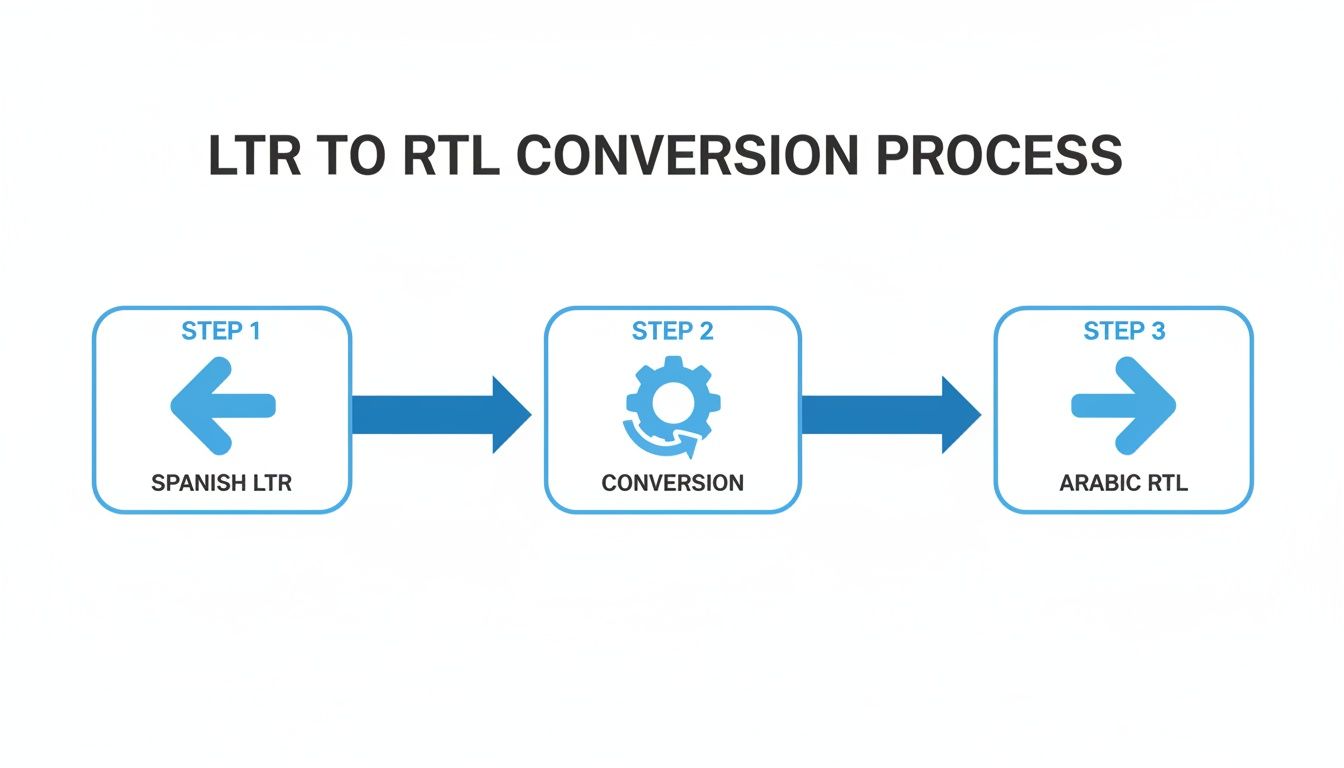
This process isn't just about text direction; the platform mirrors the entire book's structure to create a seamless reading experience for an Arabic audience, all without you having to touch a single line of code.
A Simple Workflow for Powerful Results
Kicking off your first translation shouldn't be intimidating. The workflow is built for authors and publishers, not developers, so you can stay focused on your content.
Here’s how straightforward it is:
- Upload Your Polished EPUB: Start with the clean, well-formatted Spanish EPUB you prepared. A good input file is the foundation for a great output.
- Select Your Languages: Set Spanish as the source and Arabic as the target.
- Choose Your Plan: Take a moment to assess your book. For most fiction, the Basic plan is a solid choice. If you're translating non-fiction, a technical manual, or something with literary depth, the Pro plan is well worth the investment.
- Initiate Translation: With one click, the AI gets to work. It reads the Spanish, translates it, and completely rebuilds the EPUB with a perfect RTL Arabic layout.
This automated process ensures everything from your table of contents to your chapter headings is preserved and correctly oriented. The goal is an Arabic eBook that feels like it was written in Arabic from day one.
Choosing the right plan on BookTranslator.ai really comes down to your book's content. Here’s a quick breakdown to help you decide.
BookTranslator.ai Plan Comparison for Spanish to Arabic Projects
| Feature | Basic Plan ($5.99/100k words) | Pro Plan ($9.99/100k words) |
|---|---|---|
| Best For | General fiction, romance, thrillers, and books with straightforward language. | Academic works, technical manuals, literary fiction, and books with specialized terminology. |
| Translation Nuance | Excellent for capturing narrative and dialogue flow in common scenarios. | Superior handling of complex sentence structures, idioms, and subject-specific jargon. |
| Tone Preservation | Reliably maintains the general tone of the original manuscript. | More adept at preserving subtle tonal shifts, formality, and the author's unique stylistic voice. |
| Cost-Effectiveness | The most affordable option for authors looking to reach a new market with standard-complexity books. | A premium investment for ensuring the highest accuracy and quality for more demanding content. |
| RTL Layout Handling | Flawless, fully-automated RTL conversion for all content. | Flawless, fully-automated RTL conversion for all content. |
Ultimately, both plans deliver a professionally formatted Arabic eBook. The Pro plan just gives you that extra layer of linguistic precision that can make all the difference for more complex material.
The best AI workflow is one you don't even have to think about. It should handle the immense technical challenge of language and layout so the author's original voice can shine through in a new language.
By thinking carefully about your book’s unique needs, you set your project up for success right from the start. It’s a small decision, but it has a huge impact on the final product you’ll proudly share with millions of new readers.
Your Post-Translation Checklist for a Polished Arabic eBook
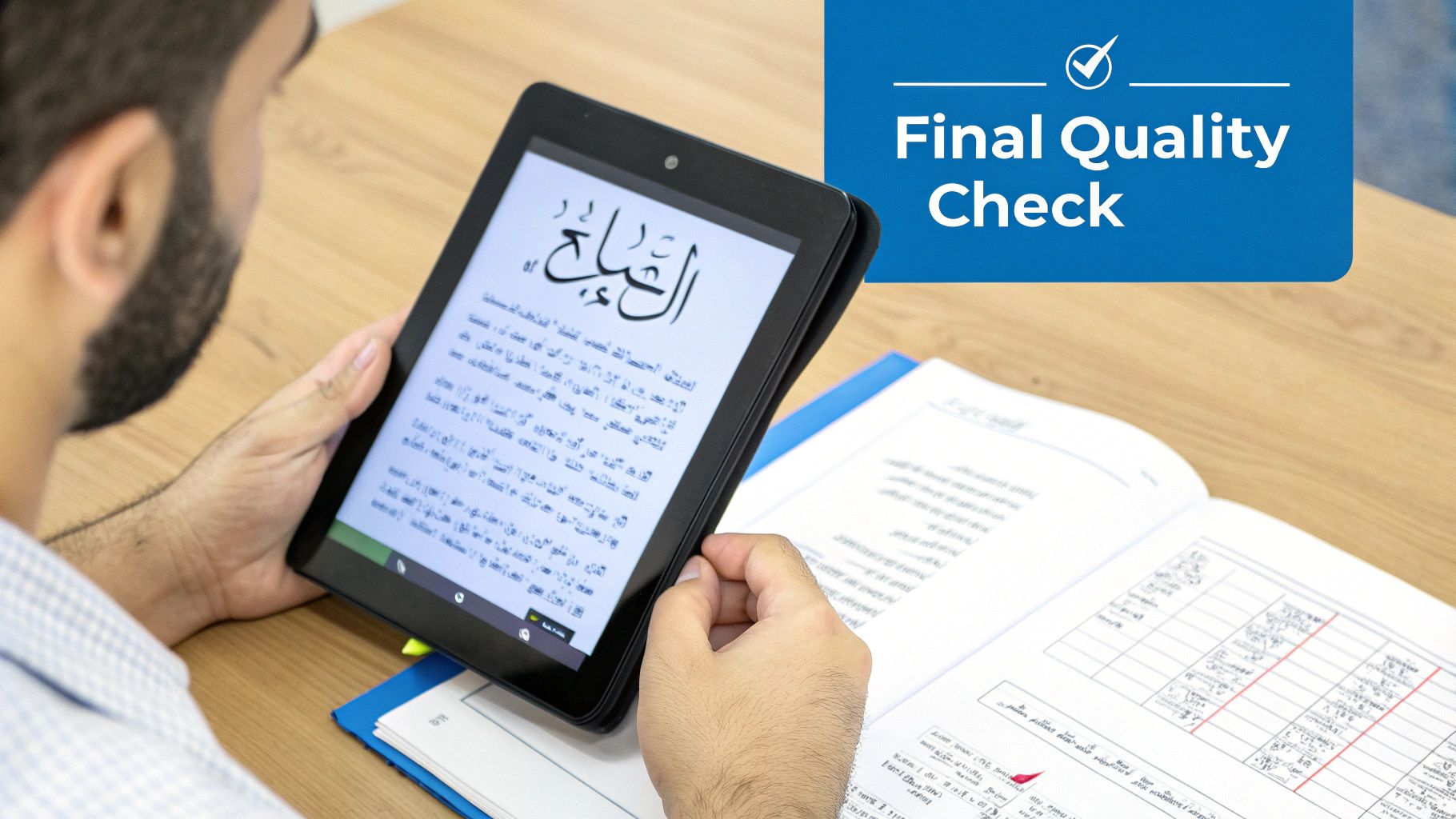
When that freshly translated Arabic EPUB lands in your inbox, it's easy to get excited and rush straight to publishing. But hold on. This is the moment that separates the pros from the amateurs. A final quality assurance pass is what turns a raw AI translation into a polished, professional book that Arabic-speaking readers will genuinely enjoy.
Even if you don't speak a word of Arabic, you can—and should—do the first round of checks yourself. This isn't about grammar; it's about making sure the book is structurally sound and visually correct. A few minutes spent here can save you from embarrassing, reputation-damaging mistakes down the road.
The First Pass: Your Structural and Visual Review
Before anyone reads a single sentence, you need to act as a building inspector for your eBook. Your goal is to spot any foundational cracks and make sure everything is where it's supposed to be. The easiest way to do this is to open the original Spanish EPUB and the new Arabic version side-by-side.
Here’s what to look for on your initial sweep:
- Structural Integrity: Does the Arabic table of contents match the original, chapter for chapter? Skim through the entire book. Are all chapters present and in the right order? This basic check prevents catastrophic errors like missing content.
- Visual Layout Consistency: Pay close attention to the right-to-left (RTL) layout. Are the chapter titles, headers, and page numbers all aligned to the right? Do bullet points and numbered lists flow correctly from right to left? This confirms the automated RTL conversion worked as expected.
- Key Element Spot-Check: You don't need to read Arabic to recognize names and titles. Check the cover, title page, and author bio. Is your name transliterated correctly? Is the book title right? These are high-visibility spots where a mistake looks especially unprofessional.
Think of this as your first line of defense. If you find any major structural problems, it’s a good sign that your original Spanish EPUB might have had some funky formatting. Fix the source file, then run the translation again.
Quality assurance isn't an optional add-on; it's an investment in your authorial brand. A small upfront effort prevents negative reader reviews and protects the professional reputation you've worked hard to build.
Bringing in a Native Speaker: The Human Touch
Once you've confirmed the book's structure is solid, it's time to bring in an expert. No matter how good the AI gets, a final review by a native Arabic-speaking proofreader is absolutely non-negotiable for a professional translation from Spanish to arabic. This is where the real magic happens.
An AI is great at translating words, but a human expert is essential for capturing the book's soul. Spanish is rich with idioms, cultural references, and turns of phrase that have no direct Arabic equivalent. A native speaker won't just translate them; they'll transcreate them, finding a way to evoke the same feeling and meaning for an Arab audience.
For instance, a casual Spanish saying about family might need to be rephrased to align with cultural norms in the Middle East. A human proofreader catches these subtle yet critical details, preventing awkward phrasing or even unintentional offense. This is the step that makes your book feel truly authentic, not just translated.
Finding and Hiring the Right Proofreader
Finding a skilled freelancer is easier than you might think. When you post a job on a freelance platform, just be crystal clear about what you need.
Your job description should specify that you’re looking for:
- A native Arabic speaker.
- Someone to proofread an AI-translated EPUB.
- A review focused on cultural nuances, idioms, and awkward phrasing.
- A final check for any lingering grammatical errors or typos.
Don’t forget to provide them with the glossary of key terms you created earlier. That document is a huge time-saver, helping them ensure character names, locations, and other unique terms are perfectly consistent from start to finish.
This final proofreading step is a small investment—usually a fraction of what a full human translation would cost—but the return is massive. It’s the final 10% of effort that delivers 100% of the professional polish. Partnering with a human expert guarantees your story will connect with its new audience, protecting your reputation and ensuring every reader has a great experience.
Got Questions About Spanish to Arabic Translation?
If you're thinking about translating your book from Spanish to Arabic, you've probably got a few questions buzzing around. It's not just a matter of swapping words; there are technical details and cultural bridges to cross. Let's tackle some of the most common things authors and publishers ask when they're getting ready to reach the Arab world.
My goal here is to give you clear, straightforward answers so you can move ahead feeling confident that your project is on the right track from day one.
How Long Does the AI Translation Actually Take?
The initial AI translation itself is incredibly fast. I've seen a platform like BookTranslator.ai turn around a standard 80,000-word novel—complete with all the right formatting—in just a few minutes. The technology is built for speed.
But the real work, where your time and attention will make all the difference, is in the preparation before and the quality checks after. Getting your Spanish EPUB just right beforehand and thoroughly reviewing the Arabic output is what separates an amateur job from a professional, polished book.
Will the Final Arabic eBook Work on Kindle and Other Stores?
Yes, absolutely. A good AI translation service will give you a standard EPUB file, which is the universal format for just about every major platform out there. This includes Amazon KDP, Kobo, and Apple Books, so you're covered.
The magic happens behind the scenes. The system is smart enough to handle all the tricky right-to-left (RTL) coding and layout adjustments deep within the file. This means your readers get a smooth, natural reading experience, whether they're on a Kindle, an iPad, or an Android phone.
One final tip from experience: always do a quick preview of the final EPUB on a couple of different devices or e-reader apps before you publish. It's a simple check that ensures everything looks perfect everywhere.
Can I Use a Glossary to Keep Things Consistent?
While you can't upload a glossary directly into the platform, making one is a non-negotiable step in a professional workflow. Think of it as your project's "bible"—the single source of truth you'll rely on during your quality assurance checks.
By putting together a list of key terms before you even start, you can easily scan the final Arabic EPUB to make sure everything lines up. I always recommend including:
- Character Names: How are they being transliterated? It needs to be the same every single time.
- Unique Place Names: Keep the spelling of all your story's locations consistent.
- Specialized Terminology: Make a list of any jargon or unique concepts central to your book's world.
This document is also a massive help when you pass the file to a human proofreader. It gives them a clear style guide to follow. For books with a lot of technical terms, I'd suggest looking at the Pro plan, as its more advanced models are better at handling that kind of specialized vocabulary.
What’s a Major Cultural Hurdle to Watch Out For in Fiction?
The biggest challenge, without a doubt, is capturing cultural nuance and idioms. Spanish is packed with colloquialisms tied to local culture, social norms, and family life that simply don't have a one-to-one equivalent in Arabic.
This is where the AI will get you 90% of the way, but human expertise is needed for that last 10%. A native Arabic-speaking reviewer won't just translate these phrases; they'll transcreate them. They’ll find a way to make the Arabic text spark the same feeling and meaning as the original Spanish. It’s this final human touch that makes a story truly connect with a new audience and avoids awkward, literal translations.
Ready to connect with a whole new audience? With BookTranslator.ai, you can get your EPUB translated from Spanish to Arabic in minutes, all while keeping your book's original layout and feel intact. Kick off your translation project and open up your story to the Arab world.
Visit https://booktranslator.ai to get started.