
When you're ready to translate your book from Chinese to Spanish, you’re standing at a fork in the road. One path is a modern, cost-effective hybrid of AI and human expertise. The other is the traditional, premium route of a full professional human translation.
The right choice isn't a one-size-fits-all answer. It really comes down to your book's genre, your budget, and how quickly you need to get it to market. For a lot of authors I work with, the hybrid approach strikes the perfect balance between quality, speed, and cost.
Choosing Your Translation Path: Hybrid AI vs. Human Expert
Before you even think about the first chapter, you need a strategy. This decision is much bigger than just comparing price tags; it’s about figuring out how to make your book resonate with a completely new audience. The demand for cross-cultural content is exploding. Just look at the numbers: the global translation industry was valued at $60.68 billion in 2022 and is expected to hit $96.21 billion by 2032. Chinese and Spanish are right at the top of that list, which spells a massive opportunity for authors.
So, let's break down the two main ways you can tackle this.
The Hybrid AI and Human Model
This method, often called Machine Translation Post-Editing (MTPE) in the industry, is a smart two-step process. First, AI generates a solid first draft of the translation. Then, a professional human editor steps in to refine it—fixing errors, smoothing out awkward phrasing, and, most importantly, making sure your unique authorial voice shines through.
This approach is a fantastic fit for:
- Genre Fiction: Think fast-paced thrillers, sprawling sci-fi, or heartfelt romance novels. Here, the plot and clear storytelling are king, and the MTPE process delivers that beautifully.
- Non-Fiction: If you've written a straightforward how-to guide or a technical manual, the speed of AI combined with an expert’s polish is incredibly efficient.
- Budget-Conscious Projects: Let's be honest, translation can be expensive. MTPE is significantly more affordable than a full human translation, putting global publishing within reach for indie authors and small presses.
This flowchart gives you a clear picture of how the hybrid workflow looks.
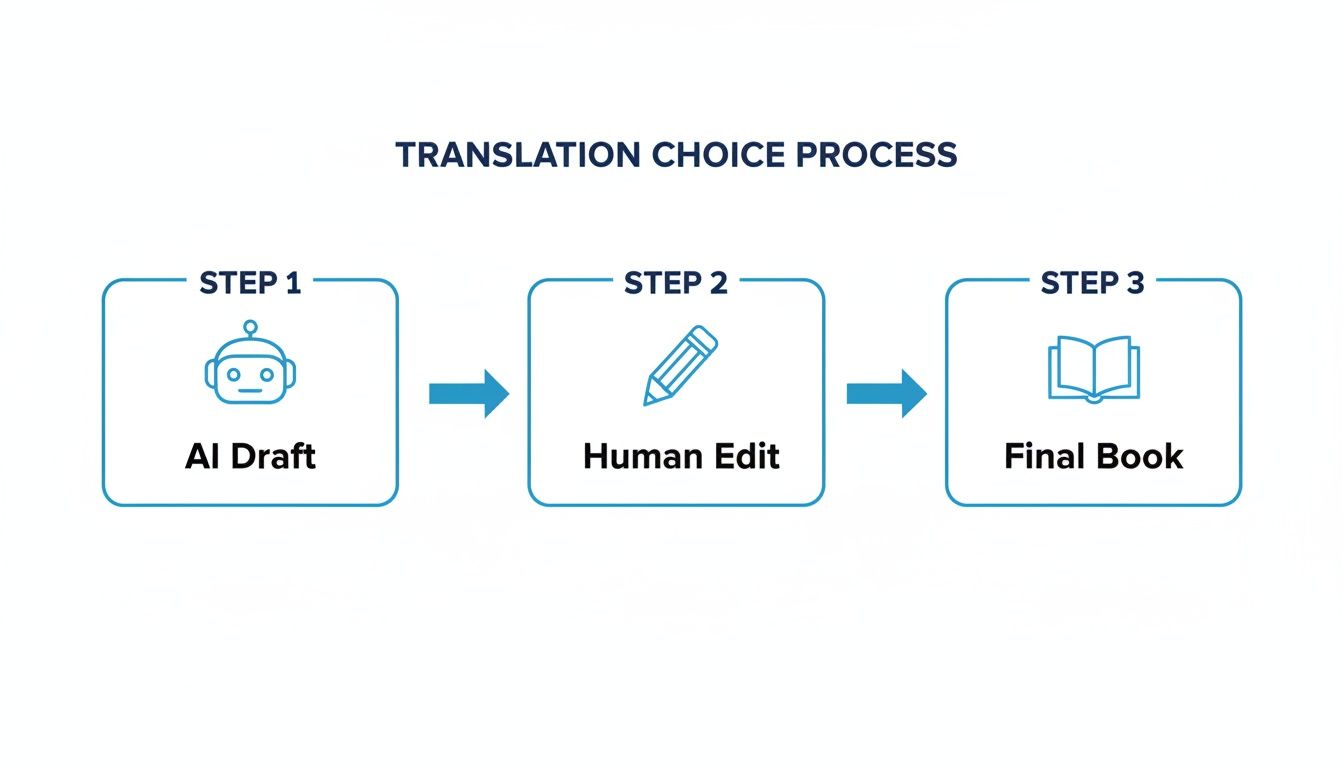
As you can see, the raw AI output is just the starting point. The real magic happens in that human editing stage, which transforms the draft into a polished, reader-ready book.
The Full Human Translation Expert
Some projects just demand a human touch from start to finish. For certain types of books, you simply can't replace the deep cultural and linguistic nuance a professional translator brings to the table. This is the path to take when every single word matters.
Consider going this route if your book is:
- Literary Fiction: Works with complex prose, subtle metaphors, or a highly unique style need a translator who is as much an artist as a linguist. They're not just translating words; they're recreating the experience.
- Poetry: Translating poetry is its own art form. It requires an expert who can preserve rhythm, rhyme, and emotional impact—something an AI just isn't built for.
- Culturally Sensitive Content: If your book dives into complex historical events or delicate cultural topics, you need a human expert to navigate those subtleties and avoid the kind of clumsy misinterpretations an AI can easily make.
Comparing Translation Methods for Books
Here's a quick comparison to help you choose the right path for your project.
| Factor | Machine + Human Post-Editing (MTPE) | Professional Human Translation |
|---|---|---|
| Best For | Genre fiction, non-fiction, tight budgets, and fast turnarounds. | Literary fiction, poetry, culturally sensitive content, and stylistic prose. |
| Cost | Significantly lower, typically 30-50% of human translation cost. | Higher premium price, reflecting deep expertise and time investment. |
| Speed | Much faster. AI generates the initial draft in hours or days. | Slower. A translator typically handles 2,000-3,000 words per day. |
| Quality | High quality, focused on accuracy, readability, and preserving voice. | Highest quality, focused on nuance, artistic style, and cultural adaptation. |
| Process | AI draft followed by comprehensive human editing and proofreading. | Human-led process from start to finish, often with multiple review rounds. |
Ultimately, both paths lead to a translated book, but the journey—and the final result—can be quite different. Your choice will shape how your story is received in the Spanish-speaking world.
The best path forward is all about balancing speed, cost, and the artistic demands of your manuscript. A hybrid approach makes global publishing accessible, while a full human translation protects literary integrity.
Thinking about how AI fits into creative work is a hot topic. Many of the arguments in the debate on AI content writing versus traditional methods also apply directly to translation.
For a more detailed look at these two methods, I highly recommend checking out our full guide on the pros and cons of AI versus human book translation.
Getting Your Manuscript Ready for a Flawless Translation
You'd be surprised how much of a great translation chinese to spanish happens before a single word is ever changed. Think of it as laying the groundwork for a house—a little extra effort upfront saves you from major headaches later. Your goal is to hand over a file that's clean, clear, and perfectly consistent.
Start by giving your original Chinese manuscript one last, thorough scrub. It’s easy to overlook tiny typos or slightly awkward phrases, but these are exactly the things that can trip up both AI tools and human translators. Small ambiguities can easily snowball into bigger errors, so hunt down any inconsistencies, grammar issues, or culturally-specific idioms that won't have a direct Spanish equivalent.
Create a Consistency Glossary
This is a pro tip that will save you a world of trouble: create a simple glossary. It doesn't have to be fancy; a basic spreadsheet is perfect. This little document becomes your translator's bible, ensuring key elements stay consistent from the first page to the last.
Here’s what to include:
- Key Terminology: Got any special terms, jargon, or made-up words specific to your story's world? List them here with a short explanation.
- Character Names: Lock down the official spelling for every single character. No more accidental variations.
- Place Names: Do the same for all locations, whether it's a real city or a fantasy kingdom.
This glossary acts as a single source of truth, making sure the core building blocks of your book remain solid, no matter who or what is doing the translation.
Simplify Your Document Formatting
Formatting is the silent killer of translation projects. If you've ever wrestled with a complex DOCX file or a finicky EPUB, you know what I mean. Intricate layouts with multiple columns, text boxes, and fancy fonts can completely fall apart when run through translation software, leaving you with a jumbled mess.
This image gives you a peek under the hood of an EPUB file, showing just how complex it can be.
All that underlying code can get scrambled if your source file isn't set up properly. The solution? Keep it simple. Stick to standard headings, basic paragraphs, and avoid over-the-top styling.
If you're starting with a less-than-ideal format, you might need some help. For example, mastering PDF parsing can be a lifesaver for converting tricky layouts into clean, structured data that a translation workflow can actually handle.
A clean manuscript, a simple format, and a solid glossary. That’s the trifecta. Get these three things right, and you’ll slash your error rate, cut costs, and speed up the entire project. It lets your translator focus on what really matters—capturing your voice, not fixing your typos.
Using AI for the Initial Draft Translation
Alright, your manuscript is clean and prepped. Now it's time for the hybrid method's secret weapon: letting a specialized AI do the initial, heavy-lifting pass. This is where your Chinese text gets its first transformation into a solid Spanish draft.
You'd be surprised at how well modern AI tools can chew through an entire book while keeping most of the original formatting intact.
The trick is picking the right tool for the job. Your everyday, copy-paste translator won't cut it for a full-length book. You need a platform built specifically for long-form content, one that understands EPUB or DOCX files. Services like BookTranslator.ai are designed to handle chapter breaks, headings, and all those little stylistic elements that give a book its structure. Without that, you risk getting a garbled mess.
Getting the Best First Draft From the Machine
A little bit of strategy goes a long way here. The single most effective technique I've found is to feed the AI your book in smaller, more digestible pieces. Don't just upload your entire 80,000-word novel in one go.
Instead, process it chapter by chapter. I know it sounds like more work, but it pays off.
- Better Accuracy: AI models do a much better job of maintaining context and consistency over shorter segments.
- Easier to Spot Problems: Reviewing and fixing errors in a single chapter is far less daunting than tackling the whole book at once.
- Fewer Glitches: Smaller files almost always process faster and run into fewer technical hiccups.
This one step drastically improves the quality of the raw output. It gives your human editor a much cleaner, stronger foundation to work from, saving them a ton of time on the back end.
Remember, the goal of this AI phase isn't to get a perfect final product. It's about generating a high-quality, workable draft. Think of the AI as an incredibly fast but very literal assistant. It does the grunt work, freeing up your human expert to focus on what they do best: polishing the nuance, capturing your voice, and adapting the text for a new culture.
Knowing What to Expect From AI
AI translation is a game-changer, but it’s not magic. The machine translation market is on track to hit $7.57 billion by 2032, but even the most advanced tools can stumble over deep cultural nuances. For example, AI often botches Chinese idioms when translating to Spanish, giving you a literal—and often nonsensical—phrase.
So, be prepared to see some stiff dialogue or awkward phrasing. The key is to recognize these are just rough spots for your human editor to smooth out. Our guide on how AI speeds up translation timelines dives deeper into how to manage this workflow effectively.
Finding the Right Editor to Perfect Your Spanish Version

The AI draft you get back is just the raw clay. The real artistry in any translation chinese to spanish begins when a skilled human editor gets their hands on it. This post-editing and quality assurance (QA) phase is where your book truly finds its soul, transforming a literal, word-for-word text into a story that grips Spanish-speaking readers.
Think of your editor as a cultural guide. Their job isn’t just about fixing commas; it’s about recapturing the rhythm, voice, and emotional heart of your original manuscript. This is the crucial step that prevents your prose from sounding clunky, robotic, or just plain "foreign" to your new audience.
What to Look For in a Bilingual Editor
Hiring the right person is probably the single most important decision you'll make in this hybrid process. A great editor doesn't just know two languages; they live and breathe two cultures. As you start vetting candidates, here are the three non-negotiables to look for.
- Native Spanish Speaker: This is a deal-breaker. A native speaker has an intuitive feel for the language's cadence, slang, and cultural context that a non-native, no matter how fluent, can't fully replicate. They'll know instantly if a line of dialogue rings true or falls flat.
- Expertise in Your Genre: The editor you need for a hard sci-fi novel is very different from the one you'd hire for a historical romance. Find someone with a portfolio of editing books in your specific niche. They'll already know the tropes, conventions, and reader expectations.
- Deep Understanding of Chinese Culture: While they don’t need to be a native Chinese speaker, they absolutely need a solid appreciation for the cultural nuances baked into your text. This is what stops AI misinterpretations of customs, traditions, or social cues from slipping through.
The ideal editor is a native Spanish speaker who reads your genre for fun and has a genuine curiosity about the cultural context of your story. This combination ensures both linguistic precision and artistic integrity.
A Practical Quality Assurance Checklist
Once you've hired your editor, the real QA work begins. Having a structured checklist helps keep everyone on the same page and ensures no small detail gets missed. Here’s a simplified version of the checklist I use for my own projects.
- Consistency Check: Are all character and place names spelled the same way from start to finish? Is the key terminology you defined in your glossary used correctly and consistently?
- Dialogue and Tone: Does the dialogue sound natural? Do your characters speak in a way that reflects their personality, age, and social standing within a Spanish-speaking context? Critically, is your unique authorial voice still there?
- Cultural Adaptation (Localization): Have idioms and cultural references been adapted properly? A phrase that’s perfectly clear in Chinese can be completely meaningless in Spanish. For example, a joke about the Gaokao exam might need to be swapped for a more relatable concept.
- Formatting and Readability: Are the chapter breaks, paragraphing, and punctuation all correct? Does the book read smoothly, or are there awkward sentences that need to be rephrased for a better flow?
By working through these points together, you and your editor can polish that raw AI draft until it shines. It's this crucial stage that elevates your book from being merely translated to truly localized. If you need some help gauging an editor's capabilities, you can find great tools in guides that offer a language proficiency checker for writers.
How to Budget for Your Translation Project

Let's talk numbers. Getting a handle on the costs of your translation from Chinese to Spanish is absolutely essential before you start. Without a realistic budget, you risk either overspending or, worse, cutting corners that tank the quality of your final book.
When you start reaching out for quotes, you’ll notice that translators and editors use a few different pricing models. What you see often depends on who you're working with and their preferred method.
Here are the most common ways they'll quote you:
- Per Source Character: This is the standard for projects starting from Chinese. You’re charged a small amount for every single character in the original manuscript.
- Per Target Word: More of a Western standard, where the bill is based on the final word count in Spanish. This can be less predictable since Spanish is often wordier than Chinese.
- Flat Project Fee: My personal favorite for larger projects. You agree on a single, all-in price for the entire book, which gives everyone clarity from day one.
Comparing the Hybrid and Traditional Paths
The single biggest decision impacting your budget is whether you go the hybrid route (AI-assist plus human editor) or spring for a full professional translation from scratch. The price difference isn't small—it directly reflects the hours of intensive, creative labor involved.
A full, traditional human translation is a premium, craft-driven service. For a typical 60,000-word novel, you should be prepared to invest somewhere between $4,000 and $9,000. You're paying for a skilled linguist's ability to capture every bit of nuance, cultural context, and authorial voice.
The hybrid workflow, on the other hand, makes things much more accessible. That same novel might only cost between $1,500 and $3,500. Here, you’re not paying for a full translation but for an expert editor's time to whip the AI's raw output into a polished, publishable manuscript. It's a faster, more focused task.
To put these numbers into perspective, here's a sample breakdown comparing the two approaches.
Estimated Cost and Time for a 60,000-Word Novel
| Metric | Hybrid (AI + Human Edit) | Full Professional Translation |
|---|---|---|
| Estimated Cost | $1,500 - $3,500 | $4,000 - $9,000 |
| Estimated Timeline | 2 - 4 weeks | 4 - 8 weeks |
| Best For | Authors on a budget, faster market entry, genre fiction | Literary fiction, complex non-fiction, brand-sensitive projects |
As you can see, the savings in both time and money with the hybrid model are significant, but it's crucial to weigh that against the specific needs of your book.
Your budget needs to account for more than just the word count. A book with dense, technical language will cost more than a straightforward romance novel. The experience of your chosen editor and how quickly you need the work done also play a big part in the final price.
Thinking About Timelines
Money and time go hand in hand. A full human translation of a 60,000-word book is a marathon, not a sprint, often taking 4-8 weeks. A dedicated professional can realistically translate and self-edit about 2,000 words a day.
This is where the hybrid workflow really shines. The initial AI pass takes just a few hours. A skilled post-editor can then polish the entire manuscript in as little as 2-4 weeks. If you have a tight launch schedule for the Spanish market, that speed can be a game-changer.
Getting Your Book into the Hands of Spanish Readers
Alright, you've got a fantastic Spanish translation. Now for the exciting part: actually launching your book. This isn't just a matter of uploading a file; it's about making your book feel like it was born in Spanish, not just translated into it.
First up, let's talk formatting. The little things make a huge difference here. For instance, Spanish typography handles dialogue differently than Chinese. Instead of standard quotation marks, Spanish readers are accustomed to seeing long dashes (—), known as rayas. It’s a subtle shift, but getting it right instantly signals to readers that this is a professional publication.
Make Your Book Look the Part
Think of your book's cover and description as its first handshake with a new reader. A cover that captivated a Chinese audience might fall flat in Spain or Mexico. It's often worth the investment to get a new cover designed specifically with the tastes and genre conventions of the Spanish market in mind.
This "re-branding" goes beyond the cover. You'll need to adapt all your marketing assets:
- Your Book Blurb: This isn't a direct translation. It's a rewrite. You need to craft a description that hooks a Spanish-speaking reader, hitting cultural notes and genre expectations they'll recognize.
- The Author Bio: Tweak your bio. What parts of your story or credentials will resonate most with readers in Spain or Latin America? Highlight those.
- Keywords and Categories: Dig into what Spanish readers are actually searching for on platforms like Amazon KDP. Finding the right Spanish keywords is crucial for discoverability.
Your cover, description, and bio are your book's first impression. Localizing them isn't just a translation task; it's a marketing necessity that tells Spanish-speaking readers, "This book is for you."
Finally, think strategically about distribution. When you publish through a platform like Amazon KDP, you can target specific storefronts like Amazon.es (Spain) and Amazon.com.mx (Mexico). Don’t just release it everywhere; focus your launch efforts. This could mean running targeted ads in specific countries or reaching out to popular Spanish-language book bloggers. With a localized package and a smart launch plan, you're setting your book up for real success in this massive, passionate new market.
Common Questions About Book Translation
Even with a solid workflow, a few tricky questions always pop up when you're getting ready to translate a book. I've been asked these countless times by authors planning their first translation from Chinese to Spanish, so let’s get you some quick, practical answers.
Which Spanish Dialect Should I Target?
This is a big one. With over 560 million Spanish speakers out there, you’re right to wonder which market to aim for. The main choice usually boils down to Peninsular Spanish (for Spain) or a broader Latin American Spanish.
For most fiction and non-fiction, the industry standard is what’s called "Neutral Spanish." Think of it as a carefully polished dialect designed to be understood by the widest possible audience, stripping away slang and idioms that would only make sense in one specific country.
Unless your story is deeply rooted in a particular region, like a historical novel set in Madrid, sticking with Neutral Spanish is almost always the smartest move for reaching the most readers.
How Do I Handle Culturally Specific References?
What happens when a punchline relies on a piece of Chinese pop culture, or an entire scene revolves around a festival that has no equivalent in the Spanish-speaking world? This is where a skilled human editor truly earns their keep. Their job isn't just to translate, but to transcreate.
A good editor will find a functional equivalent. For instance, they might:
- Swap a culturally specific Chinese holiday for a more universally understood type of celebration.
- Replace a tricky idiom with a Spanish one that captures the same spirit and emotional weight.
- Weave in a quick, natural-sounding explanation if the reference is too important to the plot to be replaced.
The goal is to recreate the experience for the reader, not just the literal text.
Don’t get bogged down in finding a word-for-word match for every cultural nuance. Trust your editor to localize—to adapt the core idea so it resonates emotionally with Spanish-speaking readers. It’s about creating a parallel experience.
Can I Protect My Copyright During Translation?
Yes, and you absolutely should. Your original copyright already protects the core story, characters, and world you created. The Spanish version is legally considered a "derivative work," and you, the author, hold the exclusive right to authorize it.
The key is to use a clear "work-for-hire" agreement when you bring a translator or editor onto the project. This contract ensures there's no confusion: it legally establishes that you retain 100% of the copyright and all commercial rights to the finished translation.
Ready to bring your book to a new audience? With BookTranslator.ai, you can get a fast, high-quality first draft of your manuscript in Spanish while preserving your original formatting and voice. Start your project with a single click.