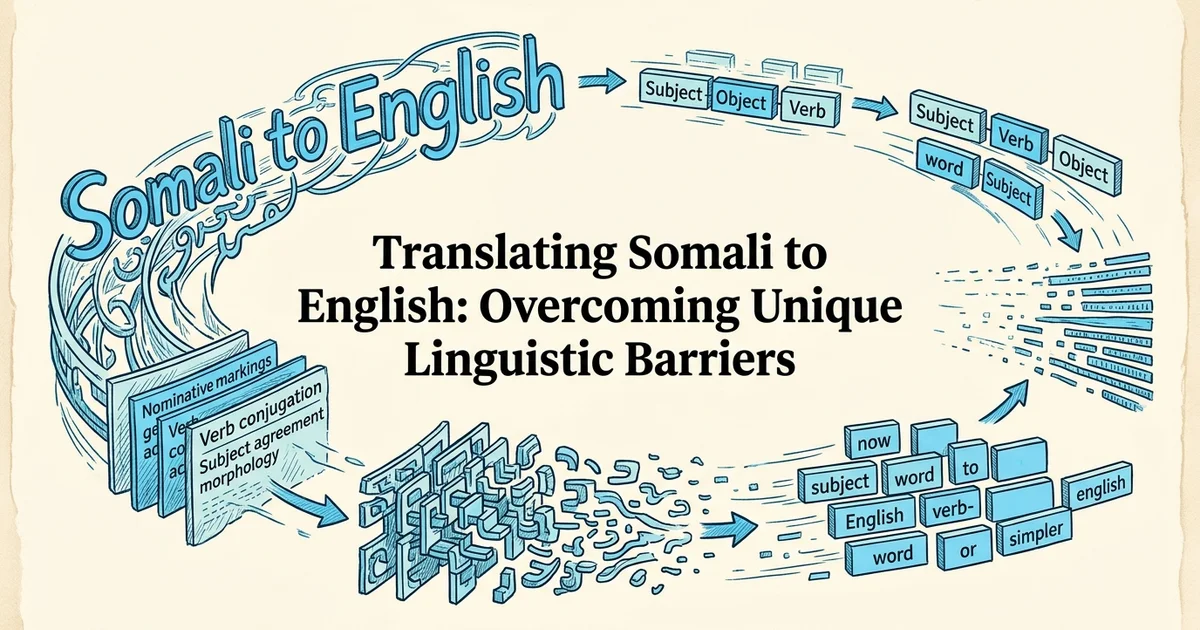
Introduction: understanding the Somali translation challenge
Anyone who has tried to translate Somali to English using a standard tool knows the frustration: garbled output, missing nuance, and a nagging sense that something important got lost. That experience is not a coincidence. It reflects a genuine structural problem in how translation technology has developed, and it has real consequences for readers, researchers, publishers, and communities alike.
Why Somali is harder to translate than most languages
Somali is spoken by an estimated 20 million people across the Horn of Africa and a global diaspora, yet it remains what linguists classify as a low-resource language. This means that the large volumes of digitized, parallel-text data that modern AI systems depend on for training are simply scarce for Somali. According to a case study on conversational AI for low-resource languages, Somali presents specific phonological and morphological features that compound this data scarcity, making it especially difficult for general-purpose models to handle accurately.
The real cost of getting it wrong
The stakes go beyond awkward phrasing. According to research published in Accuracy of Artificial Intelligence vs Professionally Translated Discharge Instructions, AI translations showed clinically impactful errors in 92% of Somali medical content, compared to just 13% for professional human translation. That gap illustrates why choosing the right tool for the right context matters enormously.
What this guide will help you do
This article maps out practical solutions across a spectrum of needs and budgets. From quick online tools for casual queries, to professional human translators for sensitive documents, to AI-powered services like BookTranslator.ai for translating full EPUB books into Somali or English with context-aware consistency, you will find an approach matched to your situation. Quality expectations and appropriate use cases are addressed at every step. 📖
Quick fix: immediate solutions for Somali-to-English translation
When you need a Somali translation right now, three options can get you moving within minutes. Each comes with real trade-offs, so matching the tool to your actual need matters more than simply grabbing the fastest one available.
Option 1: machine translation for casual queries
Google Translate and similar free tools handle short, everyday Somali phrases reasonably well. They work best for understanding the gist of a social media post, a brief message, or a simple label. Accuracy drops sharply with longer text, idiomatic expressions, or anything requiring cultural nuance. Treat the output as a rough orientation, not a reliable final version.
Option 2: community and crowdsourced help
Platforms like Reddit's language communities or dedicated Facebook groups for Somali speakers can produce surprisingly accurate results for short passages. A native speaker's eye catches what algorithms miss. Response times vary, and this approach is unsuitable for confidential material.
Option 3: AI-powered translation for structured documents
For translating a full Somali or English EPUB book, context-aware AI tools are the fastest credible option. Research suggests that fine-tuned AI models have pushed Somali translation quality significantly higher in recent years, with one case study recording BLEU score improvements from 28.6% to 47.2% after targeted fine-tuning. BookTranslator.ai applies context-aware AI to preserve formatting, maintain consistent terminology, and deliver a readable result without manual reformatting.
For deeper guidance on choosing between these approaches based on document type and quality requirements, the next section examines exactly why Somali presents such distinct challenges.
Why Somali translation is challenging: understanding the root causes
Understanding what makes Somali difficult to translate into English helps you set realistic expectations and choose the right tools. The challenges run deeper than vocabulary differences. They stem from structural linguistic gaps, a shortage of training data, and a technology ecosystem that is only now catching up to the language's complexity.
The low-resource language problem
Somali is classified as a low-resource language, meaning it lacks the large volumes of annotated text that power high-quality machine translation for languages like Spanish or French. According to Modern Languages Open (2024), Somali has historically been poorly supported by major AI systems, though it has recently moved into formal support across several generative-AI platforms. That shift matters, but it does not erase the underlying data gap. Models trained on limited Somali text still struggle with nuance, idiomatic expressions, and domain-specific vocabulary.
Structural differences between Somali and English
Beyond data scarcity, the two languages are built very differently. Somali is a Subject-Object-Verb language, while English follows Subject-Verb-Object order. Somali also uses a grammatical gender system, a complex case-marking structure, and a tonal distinction between high and low vowels that carries meaning. These features have no direct English equivalents, which means a translator cannot simply swap words. Entire sentence structures must be rebuilt, and subtle meaning can be lost in that reconstruction.
The gap between general AI and specialized translation
General-purpose AI tools were not designed with Somali in mind. Research suggests that targeted fine-tuning makes a measurable difference: according to Scribd (2024), fine-tuning reduced speech-to-text word error rates from 31% to 18% for Somali, a significant improvement that generic models cannot replicate out of the box. 🔬
This gap matters most for longer, structured content like books or academic texts, where consistency and accuracy compound across thousands of words. The next section explores which AI translation tools have made the most progress in closing it.
Solution 1: AI translation tools for quick and affordable translation
For straightforward Somali-to-English translation needs, AI tools offer the fastest and most affordable starting point. They work best for short, informal, or low-stakes content where a rough but readable translation is sufficient. Understanding what each platform does well, and where it falls short, helps you choose the right tool for the job.

How the major platforms compare
The three most widely used AI translation tools each take a different approach to Somali:
- Google Translate supports Somali directly and is the most accessible option. It handles short phrases and common vocabulary reasonably well, but struggles with complex sentence structures and idiomatic expressions. Use it for quick lookups, travel phrases, or understanding the gist of a short message.
- DeepL does not currently offer Somali as a supported language, making it a non-starter for this language pair despite its strong reputation for European languages.
- ChatGPT (GPT-4 and later) can translate Somali with more contextual awareness than Google Translate, especially when you provide explicit instructions about tone and register. It performs better on longer passages but can still hallucinate vocabulary or mishandle dialectal variation.
For each tool, the basic workflow is similar: paste your Somali text, specify the target language as English, and review the output critically before using it.
Accuracy limitations you need to know
AI performance on Somali lags significantly behind high-resource languages like Spanish or French. According to Enhancing Conversational AI for Low-Resource Languages: A Case Study on Somali (2024), fine-tuning on Somali-specific data improved human quality ratings from 3.1 to 4.3 out of 5, but generic off-the-shelf models have not yet reached that bar. The implication is clear: standard AI tools are working from a thinner foundation than most users realize.
The stakes rise sharply in sensitive contexts. According to research published in PMC, AI translations of medical discharge instructions had a 92% clinically impactful error rate, a sobering reminder that AI-only translation is not appropriate for health, legal, or safety-critical content.
When AI-only translation is acceptable
AI tools are a reasonable choice when:
- The content is informal or conversational (social media posts, personal messages)
- Speed matters more than precision and the reader can tolerate minor errors
- You are pre-processing a large volume of text before human review
- The subject matter is general and low-stakes
For longer structured content, such as books, the consistency problem compounds quickly. A tool like BookTranslator.ai addresses this specifically by applying context-aware AI across an entire EPUB file, preserving chapter structure, formatting, and terminology throughout, rather than translating passage by passage in isolation. For authors or readers working with full-length Somali texts, that consistency layer makes a meaningful practical difference.
Solution 2: hybrid translation approach for higher quality
The hybrid model sits between pure AI and pure human translation: an AI tool generates a complete first draft quickly and affordably, then a qualified Somali-speaking editor reviews and refines it. The result is significantly better accuracy than AI alone, at a fraction of the cost of full human translation from scratch.
The quality gap between these approaches is not trivial. According to a study published in PMC examining AI versus professionally reviewed translations, AI alone produced an error rate of 92% compared to just 13% for professionally translated content. That difference has real consequences for readers, publishers, and authors whose credibility depends on accuracy.
Building the AI-assisted first draft
Start by running your Somali source text through a capable AI translation tool to produce a complete working draft. This step handles the structural heavy lifting: sentence order, vocabulary mapping, and basic formatting. For book-length content, tools like BookTranslator.ai are particularly useful here because they process entire EPUB files with context-aware translation, keeping character names, chapter headings, and recurring terminology consistent from page one to the final chapter.
Terminology consistency and style preservation
Before handing the draft to a human reviewer, create a terminology glossary. List proper nouns, culturally specific terms, place names, and any domain-specific vocabulary that appears repeatedly. This document becomes the editor's reference point, ensuring that the same Somali term is rendered the same way in English throughout. Style notes, such as whether the original text is formal, colloquial, or poetic, should accompany the glossary so the editor can adjust tone without rewriting entire passages.
Chapter-level review process for long-form content
For books or extended documents, a chapter-by-chapter review structure works better than a single end-to-end pass. Assign each chapter as a discrete unit, with the editor checking for:
- Meaning accuracy: does the English convey what the Somali source actually says?
- Cultural nuance: are idioms and proverbs adapted rather than translated literally?
- Consistency: do terms and names match the glossary throughout?
- Flow: does the English read naturally, not like a machine output?
This staged approach catches compounding errors early rather than discovering structural problems at the end.
Working with Somali-speaking editors
Finding a qualified Somali-speaking editor is the most critical step. Prioritize editors who are native or heritage speakers with subject-matter familiarity relevant to your content. Freelance platforms, diaspora community networks, and academic departments with linguistics programs are practical starting points. Brief the editor thoroughly: share the glossary, the style notes, and context about the intended audience.
Cost-benefit reality
The hybrid approach typically costs more than AI alone but substantially less than commissioning a full human translation from scratch. The AI draft reduces the editor's working hours significantly, since reviewing and correcting is faster than translating. For a self-publisher or academic researcher working with limited budgets, this balance makes professional-grade quality genuinely achievable without the expense of a traditional translation agency.
Solution 3: professional human translation for critical content
Some content simply cannot afford errors. When the stakes involve a patient's health, a legal outcome, or an academic credential, professional human translation is not a luxury but a requirement. For Somali to English work specifically, the consequences of mistranslation can be severe and immediate.
Discover how BookTranslator.ai - Basic Plan approaches somali language to english BookTranslator.ai - Basic Plan.
When professional translation is non-negotiable
The clearest cases are medical, legal, and academic documents. According to Accuracy of Artificial Intelligence vs Professionally Translated Discharge Instructions, professionally translated medical discharge instructions still showed a 13% error rate, which underscores how demanding this language pair is even for trained specialists. Legal contracts, immigration paperwork, court transcripts, and certified academic credentials all fall into this category. For book publishers and authors, sworn translations of rights agreements or author credentials may also require certified human work.
How to find qualified Somali-English translators
Sourcing a qualified translator takes more than a quick online search. Reliable channels include:
- Professional associations such as the American Translators Association (ATA), which maintains a searchable directory
- University language departments with Somali studies or linguistics programs
- Community organizations serving Somali diaspora populations, which often maintain vetted referral networks
- Specialist agencies that focus on low-resource or African languages
Vetting questions to ask before hiring
Before committing to a translator, ask these directly:
- Do you hold a formal qualification in Somali linguistics or translation studies?
- Can you provide samples of previous work in this specific domain (medical, legal, literary)?
- What is your back-translation or quality review process?
- Are you a native Somali speaker, and which dialect is your primary one?
- Can you provide references from past clients in a comparable field?
Pricing and turnaround expectations
Professional Somali-English translation typically runs between $0.12 and $0.25 per source word, depending on specialization and urgency. Turnaround for a 2,000-word document is usually two to five business days. Rush fees can double the rate.
For longer-form content such as full books, a professional human translator is rarely practical on budget or timeline. This is where a tool like BookTranslator.ai becomes relevant: its context-aware AI preserves consistent terminology and voice across an entire EPUB, offering a structured alternative for literary and educational content where certified legal accuracy is not the primary requirement. The pay-per-book model means authors and researchers can translate a complete manuscript without committing to agency retainer fees.
Preventing translation problems: best practices for future projects
Good translation outcomes rarely happen by accident. The teams and independent publishers who consistently produce accurate, readable Somali-to-English content build deliberate systems before a single word is translated. A few structured habits, established early, prevent the most common quality failures from compounding across projects.
Prepare source material with clarity in mind
Before translation begins, review your Somali text for ambiguous phrasing, cultural references, or context-dependent expressions that may not map directly to English. Clean source material reduces translator errors and improves output quality regardless of whether you use AI or human translators.
Define your quality threshold upfront
Decide what accuracy level your project requires. Quick comprehension tasks tolerate rough translations; medical or legal documents do not. This decision determines whether AI alone suffices or whether you need human review.
Create a reference glossary for key terms
Somali-specific terminology—cultural concepts, place names, or domain-specific vocabulary—should be documented in a glossary before translation work begins. Share this with AI tools or human translators to ensure consistency across the entire project.
Build in review time for critical content
Never publish high-stakes translations without a qualified Somali speaker reviewing the output. Even professional translators benefit from a second set of eyes, and AI translations require this step without exception.
Test your chosen tool on a small sample first
Before committing an entire project to one translation method, run a small section through your selected tool. Compare the output against your quality standards and adjust your approach before investing time and resources in the full project.

Build and maintain a terminology glossary
Consistency is one of the hardest problems to solve in Somali translation, particularly for long-form content where the same technical term, character name, or concept may appear hundreds of times. A living glossary, updated after every project, gives translators and AI tools a shared reference point. For book translation specifically, tools like BookTranslator.ai apply context-aware AI across an entire EPUB, which helps maintain consistent terminology from chapter one through to the end without manual cross-referencing.
Establish a style guide for your content type
A terminology glossary tells translators what to call things. A style guide tells them how to say them. Academic content, children's books, and legal summaries each carry different register expectations. Documenting those expectations upfront, including tone, sentence length preferences, and how to handle Somali-specific cultural references, reduces revision cycles significantly.
Plan for structured review cycles
Quality assurance is increasingly recognised as a central challenge in Somali translation work. Build at least one review pass by a native Somali speaker into your project timeline from the start, rather than treating it as an optional final step.
Document decisions for future consistency
Record every significant translation choice, especially for culturally loaded terms or phrases with no direct English equivalent. This decision log becomes your most valuable asset when returning to a subject area months later, ensuring a consistent voice across an entire body of work.
When to seek professional help: escalation guidelines
Even the most diligent preparation has limits. Some Somali to English translation projects carry stakes too high for AI tools alone, and recognizing those thresholds early can save you from costly, sometimes irreversible, mistakes.
Medical and legal content
Patient safety and legal liability demand a higher standard than any current AI system can reliably meet. According to Accuracy of Artificial Intelligence vs Professionally Translated Discharge Instructions, AI translations were consistently inferior to professional translations for medical content. In legal contexts, a mistranslated clause can invalidate a contract or misrepresent testimony. Always engage a certified professional for:
- Clinical documents, discharge instructions, and informed consent forms
- Contracts, immigration paperwork, and court filings
- Academic credentials and certified transcripts
Literary and published works
Published books require more than linguistic accuracy. They demand cultural fluency, stylistic sensitivity, and consistency across tens of thousands of words. For authors working with EPUB files who need a reliable starting point before professional review, BookTranslator.ai preserves formatting and maintains consistent terminology throughout, making the professional editor's job significantly cleaner.
Red flags that signal escalation
- Repeated complaints from native Somali-speaking reviewers about unnatural phrasing
- Content involving vulnerable populations, health outcomes, or financial decisions
- Any project where errors carry legal, reputational, or safety consequences
Conclusion: choosing the right translation approach for your needs
Translating Somali to English successfully means matching your method to your content's stakes. General-purpose AI tools work for quick comprehension tasks. Specialized platforms handle book-length projects with formatting intact. Human professionals remain essential when accuracy is non-negotiable.
The core takeaway is straightforward: the higher the stakes, the more human oversight you need. As research on conversational AI for low-resource languages confirms, general-purpose AI performs substantially worse for Somali than for high-resource languages, making tool selection genuinely consequential.
For authors and publishers working with book-length Somali content, BookTranslator.ai offers a practical starting point: context-aware AI that preserves your EPUB structure, maintains consistent terminology, and costs as little as $6.99 per 100,000 words with a 7-day money-back guarantee.
Your next steps:
- Identify your content type and risk level
- Choose your primary method accordingly
- Build in native-speaker review for anything audience-facing
Frequently asked questions
How do I translate Somali to English?
For short text, free tools like Google Translate or Microsoft Translator offer quick results. For documents, dedicated AI platforms handle larger files. For high-stakes content, pair any AI tool with a native Somali speaker for review.
What is the best Somali-to-English translator?
No single tool dominates for every use case. Google Translate works for casual phrases, while specialized AI platforms perform better on longer, structured content. For book-length EPUB files, BookTranslator.ai preserves formatting and maintains consistent terminology throughout.
Can Google Translate translate Somali accurately?
It handles common phrases reasonably well but struggles with idiomatic expressions, tonal nuance, and complex grammar. Treat its output as a draft, not a final translation.
How accurate is Somali-to-English translation?
Accuracy varies significantly by tool and content type. According to JAMA Network Open (2025), clinically impactful errors appeared in 92% of AI-translated Somali medical instructions, underscoring the importance of human review for sensitive material.
How do I translate a Somali PDF or book into English?
Convert your file to EPUB format, then use a context-aware translation service. BookTranslator.ai supports 99+ languages and preserves your original layout throughout the process.
Is Somali difficult to translate into English?
Yes. Somali is a low-resource language, meaning AI models have less training data to draw from compared to widely spoken languages, which increases the risk of errors.
Can AI translate Somali audio into English text?
Emerging speech-to-text models do support Somali. According to researchers studying conversational AI for low-resource languages (2025), fine-tuned models reduced word error rates from 31% to 18%, showing real progress but also remaining limitations.
How do I say a Somali word or sentence in English?
For individual words and phrases, an online Somali-English dictionary or Google Translate works well. For full sentences, cross-check with a second tool or a native speaker to confirm the meaning is preserved.