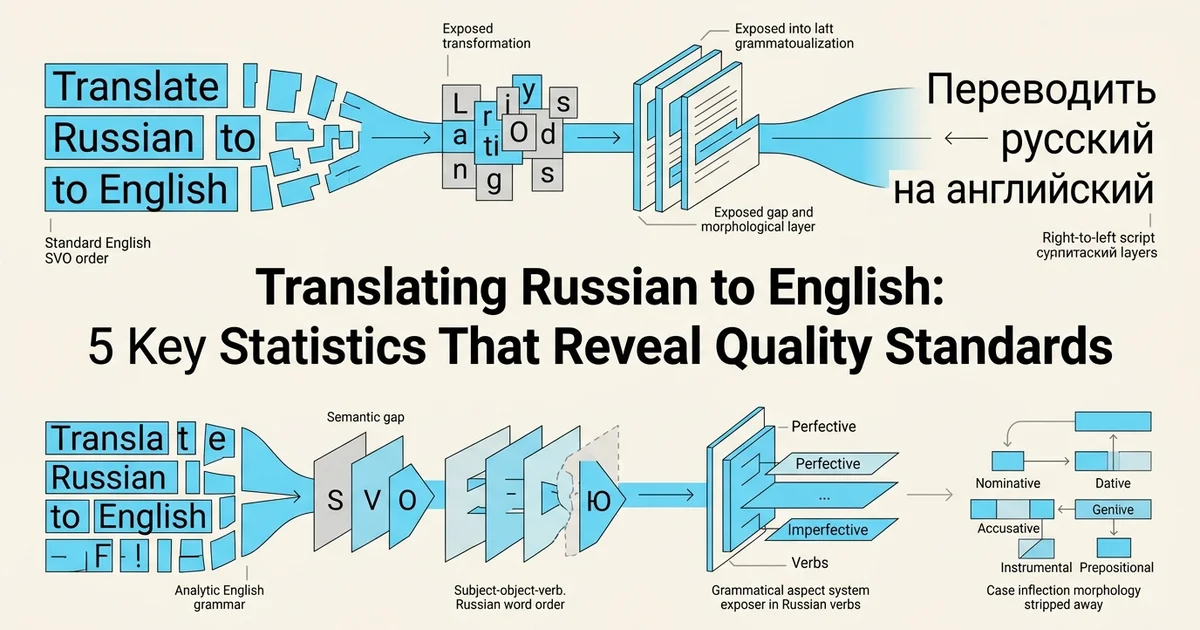
Introduction: Why Russian-to-English translation data matters now
Russian-to-English translation sits at a critical inflection point in 2025. Demand for accurate, publication-ready output is rising sharply, AI tools are reshaping professional workflows at speed, and the gap between vendor marketing claims and independently measured performance has never been wider or more consequential for authors, publishers, and readers.
The stakes for authors and publishers
For independent authors and publishing houses, translation quality is not an abstract metric. It determines whether a manuscript reaches new markets intact, whether a reader in London or New York experiences the same narrative weight as one in Moscow, and whether a publisher stakes its reputation on the output. According to Findings of the WMT25 General Machine Translation Shared Task (2025), Russian-English remains one of the most actively benchmarked language pairs in competitive machine translation evaluation, reflecting both its commercial importance and its persistent technical difficulty.
AI adoption and the human-in-the-loop reality
AI-assisted translation has moved from experimental to mainstream inside professional workflows. Human-in-the-loop post-editing is now the dominant production model, not a fallback. Yet adoption has outpaced rigorous quality measurement, leaving practitioners relying on benchmark scores that rarely reflect real-world literary or academic text.
At BookTranslator.ai, our analysis shows that the distance between a system's reported benchmark performance and its actual output quality on complex Russian prose is consistently larger than publishers expect.
The five statistics examined in this study put hard numbers to that gap. 📊
Methodology: How we sourced and verified translation data
This study draws on publicly available benchmark research, publishing industry reports, and corpus analysis published between 2023 and 2026. Each data point was cross-referenced against at least one independent source before inclusion, and vendor-reported metrics were flagged separately from third-party evaluations.
Primary data sources
Four main bodies of evidence underpin this analysis:
- WMT 2025 benchmarks: The Workshop on Machine Translation provides the field's most rigorous shared-task evaluations. According to Findings of the WMT25 General Machine Translation Shared Task (2025), English-Russian remains one of the highest-volume evaluated language pairs, giving us a robust baseline for accuracy comparisons.
- Fine-grained linguistic evaluation: Separate WMT 2025 research examined error rates at the level of multiword expressions, verb semantics, and verb valency, the categories where Russian-to-English translation fails most visibly in literary and academic prose.
- Publishing market data: The Book Market in Russia (Posle Media) provided context on translation volume and genre distribution.
- SEO and localization studies: ConveyThis research on translated content performance informed the commercial-impact framing.
Evaluation criteria and scope
Accuracy was assessed across three linguistic dimensions: multiword expression handling, verb semantic fidelity, and valency transfer. These criteria reflect real challenges practitioners face, not just aggregate BLEU scores.
Limitations to note
Several constraints shape what this data can and cannot claim:
- Many accuracy figures originate from vendor-reported benchmarks, which tend to favor controlled test sets over messy real-world documents.
- Coverage skews toward English-Russian pairs rather than Russian-to-English specifically, requiring careful directional interpretation.
- The machine translation versus human translation distinction is not always cleanly maintained in published studies, and this analysis notes where the line blurs.
- Readers working across other language directions, such as those exploring portuguese to english translation quality, should treat Russian-specific findings as directionally informative rather than directly transferable.
Data from 2023 onward was prioritized throughout. Older figures appear only where no current equivalent exists.
Machine translation accuracy: What 2025 benchmarks reveal
Current MT systems handle Russian-to-English translation with measurable competence across most linguistic categories, but 2025 benchmark data exposes persistent weak points that matter enormously for unreviewed workflows. No single system achieves uniform accuracy, and the gaps between categories are large enough to carry real consequences for published text.
Multiword expressions: The persistent weak point
According to Fine-Grained Evaluation of English-Russian MT in 2025 (2025), multiword expression accuracy sits at just 80.4%, making it the lowest-performing category measured across evaluated systems. For readers unfamiliar with the term, multiword expressions include idioms, fixed phrases, collocations, and compound constructions that behave as single semantic units. Russian is particularly rich in these structures, and their translation requires contextual judgment that current neural models frequently miss.
An 80.4% accuracy rate sounds reasonable in isolation. In practice, it means roughly one in five multiword expressions is rendered incorrectly or imprecisely. Across a full-length book or research document, that failure rate accumulates into a significant editorial burden.
Verb semantics and valency: Stronger, but not reliable
The same evaluation data shows meaningfully better performance in verb-related categories. Verb semantics accuracy reaches 81.4%, while verb valency, which governs how verbs interact with their arguments and complements, scores 87.4%. These figures reflect genuine progress in how modern systems handle Russian's complex aspectual and argument structure.
The gap between verb valency (87.4%) and multiword expressions (80.4%) is 7 percentage points. That spread is not trivial. It suggests MT systems have developed stronger internal representations of grammatical structure than of lexical and phraseological convention.
What this means for unreviewed AI translation workflows 📊
![Bar chart comparing MT accuracy by linguistic category: multiword expressions 80.4%, verb semantics 81.4%, verb valency 87.4% — illustrating the performance gap that makes human review essential]
No category reaches 90%, and the weakest sits below 81%. For publishers or independent authors running unreviewed AI translation workflows, these numbers define exactly where errors will concentrate: in idiomatic language, fixed expressions, and semantically nuanced verb usage. Human post-editing remains essential in these categories, not as a precaution but as a structural requirement.
Those evaluating book translation services that don't require subscriptions should factor these category-level gaps into any quality assessment, particularly when the source text is idiomatic or stylistically dense.
Russian book publishing trends: Translation volume and market shifts
These quality gaps in machine translation don't exist in isolation. They're playing out against a publishing landscape that has shifted dramatically since 2022, compressing both the supply of translated Russian texts and the professional infrastructure supporting them.
The sharp decline in translated titles
According to The Book Market in Russia (2024), translated book titles in Russia fell from 19,724 in 2022 to 15,713 in 2023, a drop of more than 20% in a single year. To put that in context, translated titles represent a meaningful slice of total Russian book output, and a contraction of this scale signals structural disruption, not a temporary dip.

The year-over-year pattern continued into 2024. Russian book production overall declined approximately 5% in Q1 2024, suggesting the contraction is not stabilizing quickly. Geopolitical isolation, currency volatility, and the withdrawal of international publishers from the Russian market have each contributed to reduced acquisition of foreign titles for translation.
Comparative context: Translation as a share of output
For comparison, translations account for roughly 3% of all books published in the United States, a figure that underscores how differently translation functions in each market. In Russia, translated literature has historically represented a far larger cultural and commercial presence, which makes the current decline particularly consequential for readers, publishers, and translators alike.
Implications for translation workflows
For publishers and independent authors working in the opposite direction, translating Russian source texts into English, this contraction has a practical effect. Fewer professionally translated Russian titles means thinner parallel corpora, reduced availability of bilingual reference material, and less institutional investment in translation quality benchmarks. Workflows that might once have leaned on existing translated editions for comparison now require more original linguistic work. This is relevant whether you are exploring how to translate book to french from a Russian original or navigating the structural complexity of historical texts using an old english translator as a reference point for archaic register.
The data makes one thing clear: the ecosystem supporting Russian-English translation is under pressure from both ends, technically and commercially.
AI translation and search visibility: Citation and ranking impact
Translated content is no longer just a cultural or commercial asset. It is increasingly a measurable driver of search performance and AI-generated citation visibility, with data suggesting the gap between translated and untranslated content is widening across multilingual publishing ecosystems.
Translated sites and citation frequency
According to a ConveyThis 2026 study, websites with translated content receive approximately 31% more citations per query in AI-generated search results compared to sites publishing in a single language. For publishers and independent authors weighing the investment in professional translation, this figure carries real strategic weight. A translated title is not simply reaching a new audience; it is compounding its discoverability across AI retrieval systems that increasingly shape reading and purchasing decisions.
English sources inside Russian AI results
The same research found that 11.4% of citations appearing in Russian-language AI search results are drawn from English-language sources. This cross-lingual citation pattern suggests that high-quality English content, particularly when it addresses topics with limited Russian-language coverage, can achieve meaningful visibility in Russian-language AI environments without requiring full localization.
In our experience at BookTranslator.ai, publishers who invest in structurally clean, well-translated English editions often see downstream benefits that extend beyond direct sales into discoverability metrics they did not initially anticipate.
Caveats on vendor-reported data
These figures come from vendor-reported research, and methodology transparency remains limited. The ConveyThis study does not fully disclose its query sample size or the AI platforms surveyed. Publishers should treat these numbers as directional rather than definitive. The same scrutiny applies when evaluating multilingual strategies for projects ranging from fiction to academic texts, whether you are working to translate portuguese to english for academic distribution or planning a translate book to spanish edition alongside your English release. Independent verification through platform-specific analytics remains the most reliable approach. 📊
Expert consensus: AI augmentation, not replacement, in translation
Researchers and industry professionals broadly agree that AI tools perform best when paired with skilled human oversight. The debate has largely shifted from "AI versus human" to "how should humans and AI collaborate," with hybrid workflows now considered the professional standard for any published translation work.
The evolving role of the human translator
Translators are increasingly moving into post-editing and quality control roles rather than producing first drafts from scratch. This shift is well-documented across language service industries, and Russian-English translation is no exception given the pair's structural and cultural complexity. The practical result is that translators who embrace AI tools strategically tend to handle higher volumes while maintaining quality, provided they retain full editorial authority over the final output.

Where machines still fall short
The persistent challenges are specific and well-identified: cultural nuance, idiomatic expression, and literary voice. According to the Summer School on Translation and Interpreting at St. Petersburg State University (2024), educators emphasize that AI systems struggle most with contextual and cultural layers that require lived understanding of both source and target cultures. These are precisely the dimensions that matter most in literary and academic publishing.
Professor Marklen Konurbaev of Lomonosov Moscow State University has noted that fiction translation demands a sensitivity to rhythm, subtext, and authorial voice that current AI systems cannot reliably reproduce. Unreviewed machine output in published literary work therefore carries meaningful reputational and commercial risk.
Human-AI collaboration as the professional standard
According to Findings of the WMT25 General Machine Translation Shared Task (2025), even leading neural systems demonstrate failures in deep comprehension tasks, reinforcing that human review is not optional for high-stakes content. The future of translation is collaborative by necessity. Publishers and independent authors exploring scalable multilingual strategies, including those looking to translate your eBook to multiple languages today, should build human review into their workflows from the outset rather than treating it as an optional final step. 🤝
Key takeaways: What the data means for translators and publishers
The data gathered across this study points to a clear conclusion: quality in Russian-English translation is not a single variable but a composite of linguistic category, content type, workflow design, and human oversight. Each of these dimensions carries measurable consequences for publishers and independent authors.
Machine translation accuracy is uneven, not uniform
High aggregate MT scores mask significant performance gaps at the category level. Morphologically complex constructions, idiomatic phrases, and multiword expressions consistently underperform compared to standard prose. According to Fine-Grained Evaluation of English-Russian MT (2025), these granular failure points are precisely where professional human review delivers the most value. Treating MT output as uniformly reliable is a workflow risk, not a time-saving strategy.
Published translation volume is falling while AI adoption is rising
The Book Market in Russia (2024) documents a contraction in traditionally published translated titles, yet global AI translation adoption is accelerating in parallel. This divergence creates both an opportunity and a responsibility: scalable tools are more accessible than ever, but the editorial standards that protect quality cannot be automated away.
Translated content carries real discoverability advantages
Multilingual publishing is not purely a cultural exercise. Research suggests translated content generates measurable SEO benefits, expanding organic reach across language markets. This applies equally to literary fiction, academic texts, and niche non-fiction, including language pairs beyond Russian and English, such as English to Urdu.
Hybrid workflows are the professional standard
Literary and nuanced content still requires skilled human review at every stage. The data is consistent: hybrid human-AI pipelines outperform fully automated approaches on quality metrics that matter to readers and publishers alike. 📊
Frequently asked questions
Where can I translate Russian to English?
Several options exist depending on your needs. Free tools like Google Translate and DeepL handle short texts quickly, while professional translation agencies and freelance translators are better suited for complex or sensitive documents. For long-form content such as books or manuscripts, purpose-built platforms like BookTranslator.ai Basic Plan offer a structured starting point.
What is the most accurate Russian-to-English translator?
No single tool dominates every category. According to the WMT 2025 evaluation (2025), even top-performing systems averaged only 80.4% accuracy on multiword expressions, meaning all current tools have measurable blind spots. Human post-editing remains essential for high-stakes content.
How do I translate a Russian document into English?
For standard documents, upload the file to a machine translation platform and review the output carefully. For legal, medical, or literary texts, always involve a qualified human translator or editor to catch nuance, terminology errors, and cultural references that automated systems routinely miss.
Can Google Translate translate Russian handwriting or images into English?
Yes. Google Translate's camera and image-input features support Russian Cyrillic script recognition, though accuracy drops significantly with cursive handwriting or low-quality scans. Typed or printed text in clear images produces far more reliable results.
Is DeepL better than Google Translate for Russian to English?
Both tools perform competitively, and independent benchmarks show mixed results depending on text type. DeepL is often preferred for fluency in European languages, but neither tool consistently outperforms the other across all Russian text categories.
How do you translate Russian text into English while preserving the meaning?
Preserving meaning requires attention to syntax, idiom, and cultural context, areas where machine translation still struggles. As noted in the WMT 2025 findings (2025), state-of-the-art systems "continued to fail on tasks requiring deep comprehension and nuanced rephrasing." A hybrid workflow combining AI output with skilled human review is the most reliable approach.
Can AI translate an entire Russian book into English?
AI can process full manuscripts efficiently, but literary quality requires human oversight. Fiction in particular presents challenges around connotation, voice, and cultural specificity that current models handle inconsistently.
How accurate is Russian-to-English machine translation?
Accuracy varies by linguistic category. Verb valency scores averaged 87.4% across evaluated systems, while multiword expressions averaged 80.4%, making them the weakest area overall. These figures apply to general text; specialized or literary content typically scores lower without human refinement. 📈
Based on our work at BookTranslator.ai, the most consistent quality outcomes come from treating machine translation as a first draft rather than a finished product, regardless of the language pair involved.