Introduction: why translating German to English matters
Translating German to English sounds straightforward until you actually try it. German sentences stretch across entire paragraphs, verbs arrive at the end of clauses, and compound nouns pack layers of meaning into a single word that English simply has no equivalent for. The result? Translations that are technically accurate but feel wooden, confusing, or completely stripped of the original author's voice.
The stakes are higher than ever. According to Publishers Weekly (2024), German publishers sold 6,669 book rights abroad in a single year, each one representing a manuscript that needs a high-quality English translation to reach its audience. The global literary translation market is valued at $1.7 billion in 2025, and demand is only accelerating.
At BookTranslator.ai, our analysis shows that the most common failure points cluster around three areas: structural distortion, terminology inconsistency, and loss of authorial tone. These are solvable problems, but only if you choose the right approach.
This guide covers everything you need. You will find quick fixes for urgent translation needs, honest comparisons of the best tools available, practical workflow strategies, and quality assurance methods that actually work. Whether you are an independent author, a publisher, or a researcher, there is a solution here that fits your situation. 📖
Quick fix: the fastest way to translate German to English right now
If you need a German sentence, paragraph, or short passage translated into English within the next two minutes, you already have access to a perfectly adequate tool. Google Translate handles short, casual content reliably enough for most immediate needs, and it costs nothing to use.
Copy your German text
Select and copy the German passage, sentence, or document excerpt you need translated. For best results with free tools, keep initial attempts under 500 words.
Paste into Google Translate or DeepL
Open Google Translate or DeepL in your browser, select German as the source language and English as the target language, then paste your text into the input field.
Review the output for obvious errors
Read through the translated text quickly, checking for awkward phrasing, missing words, or nonsensical constructions that indicate mistranslation of German compound nouns or verb structures.
Copy the English translation
Once satisfied with the quick review, copy the translated text and paste it into your document, email, or application where you need it.
How to get an instant translation with Google Translate
- Go to translate.google.com
- Set the left panel to German (or click "Detect language")
- Set the right panel to English
- Paste or type your text and the translation appears instantly
- For documents, click the Documents tab and upload a PDF or Word file directly
That is genuinely all it takes for quick lookups. 🔍
When a quick fix is good enough
Free tools work well in specific, low-stakes situations:
- Short phrases and sentences: menu items, product labels, social media posts
- Casual correspondence: informal emails where tone precision matters less
- Discovery reading: skimming a German article to decide if it warrants deeper attention
- First-draft orientation: getting a rough sense of a document's structure before commissioning a professional translation
AI translation tools are increasingly used exactly this way, as first-draft or discovery tools, particularly in publishing workflows where editors need to evaluate foreign-language manuscripts quickly.
Where quick fixes fall short
Free tools collapse under pressure when the content is long, complex, or professionally consequential. A German novel, an academic paper, or a legal contract will expose every limitation: inconsistent terminology, flattened sentence rhythm, and structural distortion that compounds across thousands of words.
For books specifically, the formatting problem alone disqualifies most free tools. Uploading an EPUB to Google Translate returns a broken file, not a readable book.
This is where purpose-built tools matter. BookTranslator.ai was built specifically to handle EPUB files at scale, preserving every chapter, footnote, and style element while using context-aware AI to keep character names and terminology consistent from page one to the last. If you are translating anything longer than a few pages, it is worth starting there rather than wrestling with a general-purpose tool that was never designed for the job.
For readers curious about translating in the opposite direction, the guide on how to translate book to German covers that workflow in detail.
Why German-to-English translation is challenging
German and English share Germanic roots, but that shared ancestry is deceptive. The two languages diverge sharply in structure, grammar, and cultural logic, which means a word-for-word conversion almost always produces something that is technically readable but fundamentally wrong.
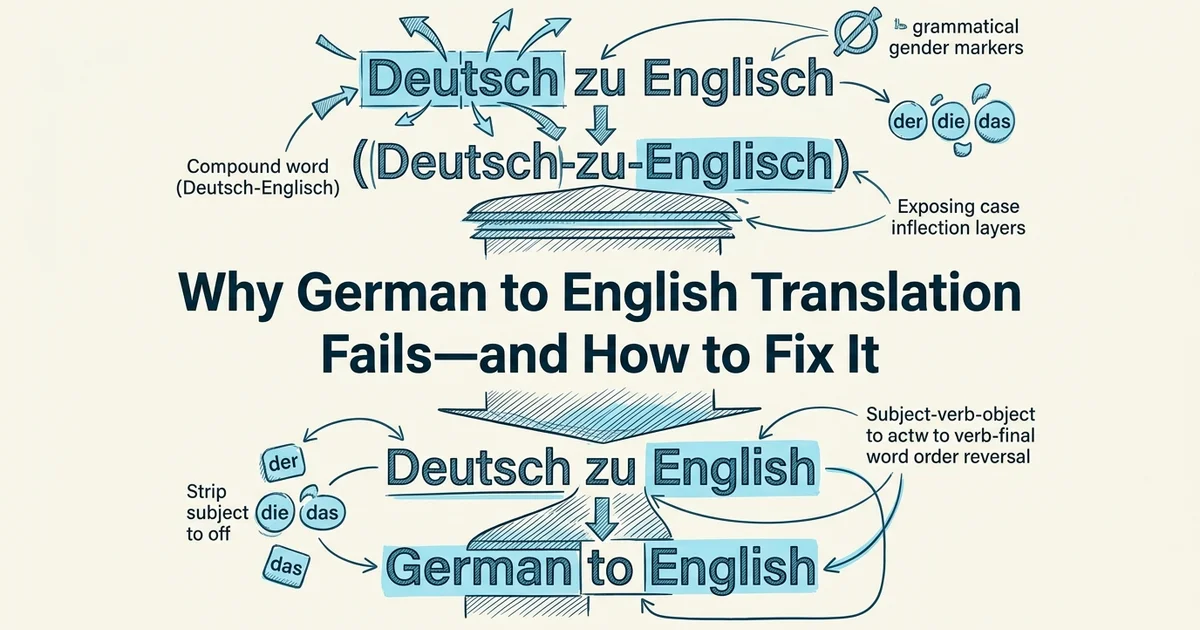
The grammar gap: compounds, cases, and word order
German builds meaning differently from English at the sentence level. Three structural features cause the most trouble:
- Compound words: German stacks nouns into single words that English must unpack into phrases. Verschlimmbessern (making something worse while trying to improve it) has no English equivalent at all.
- Case system: German marks nouns as nominative, accusative, dative, or genitive. English relies on word order instead, so direct mapping breaks down quickly.
- Verb placement: In subordinate clauses, German pushes the verb to the end. Automated tools that translate clause-by-clause often scramble the logical flow.
- Gendered nouns: Every German noun carries a grammatical gender that shapes surrounding articles and adjectives. English is largely gender-neutral, so these signals disappear in translation.
Cultural nuance and the limits of literal translation
Language carries culture, and German is no exception. Idioms, proverbs, and humor are built on shared references that simply do not transfer word-for-word. A phrase like Ich verstehe nur Bahnhof (literally "I only understand train station," meaning "I don't understand anything") would read as nonsense without cultural interpretation.
This is where automated tools hit a hard ceiling. They can recognize patterns, but they cannot reliably infer intent, register, or the emotional weight a phrase carries in its original context.
Technical accuracy versus literary quality
There is a meaningful difference between a translation that is correct and one that is good. Technical documents demand precision above all else. Literary texts demand something harder: preserving voice, rhythm, and tone while making the result feel natural to an English reader.
According to Publishers Weekly, publishers increasingly use machine translation as a first-draft tool, but human review remains essential for literary quality and cultural nuance. PEN America research reinforces this, finding that more than one-third of translators reported losing work to generative AI, even as the industry acknowledges that AI alone cannot carry the full weight of literary translation.
The three-tier translation spectrum
Not all translation is created equal. Understanding where your project falls on this spectrum shapes every decision that follows:
- Machine translation: Fully automated, fast, and affordable. Suitable for getting the gist of a document, but unreliable for nuance.
- Machine-assisted human translation: A human editor refines an AI-generated draft. This is the current industry standard for most commercial publishing workflows.
- Fully human translation: A professional translator works from scratch. Highest quality, highest cost, and the only realistic option for literary work where voice is everything.
For book-length projects, consistency across thousands of words adds another layer of complexity. Tools like BookTranslator.ai address this by using context-aware AI that tracks character names, terminology, and tone across an entire manuscript rather than treating each paragraph as an isolated unit. That said, knowing which tier your project needs is the first decision to make before choosing any tool or service. Readers who want to compare pay-as-you-go options before committing will find the breakdown in book translation services that don't require subscriptions useful at this stage.
Solution 1: AI-powered translation tools for speed and accessibility
AI translation tools have transformed how readers, researchers, and publishers approach German-to-English translation. For most everyday tasks, from translating a web article to converting a full EPUB manuscript, modern AI platforms deliver usable results in seconds at a fraction of the cost of traditional services.
Comparing the leading platforms
Not all AI translation tools are built for the same job. Here is how the major options stack up:
- Google Translate remains the most accessible option. Paste text, upload a document, or point it at a URL and it returns an English version almost instantly. It handles German reasonably well for general content, though it can flatten nuance and occasionally misreads compound nouns.
- DeepL is widely regarded as the strongest general-purpose tool for German-to-English translation. Its neural models handle subordinate clause structures and formal register better than most competitors, making it a solid choice for business documents, academic papers, and journalism.
- Microsoft Translator integrates directly into Office 365 and Azure workflows, which makes it practical for teams already working inside the Microsoft ecosystem. Batch document processing is a particular strength.
- Specialized book translation tools like BookTranslator.ai are built for a problem the general-purpose tools do not fully solve: translating long-form EPUB content while keeping every chapter, image, footnote, and style element exactly where it belongs.
Step-by-step: translating German documents and PDFs
For short documents and web content, the workflow is straightforward:
- Copy text into DeepL or Google Translate, or use the document upload feature for PDFs up to a few MB.
- Review the output for compound noun errors and overly literal phrasing, both common German-to-English failure points.
- Run a terminology check if the document uses domain-specific language (legal, medical, technical).
For EPUB books and longer manuscripts, general tools start to break down. Uploading a full book to Google Translate typically strips formatting and loses structural elements. This is where purpose-built services matter. BookTranslator.ai accepts EPUB files directly, applies context-aware AI that tracks character names and terminology across the entire manuscript, and returns a translated file with the original layout preserved. Pricing starts at $6.99 per 100,000 words with no subscription required. If you are also considering other language pairs, the same workflow applies when you translate book to french.
When AI translation is enough and when it is not
AI is sufficient for:
- Informational content: news articles, product descriptions, research abstracts
- Personal use: understanding a German email, reading a foreign-language edition
- First drafts: giving a human translator a strong starting point
Human review becomes necessary when:
- Legal or medical precision is required: a mistranslated clause carries real liability
- Literary voice matters: poetry, literary fiction, and creative nonfiction lose texture without a skilled human editor
- Publishing for a commercial audience: according to Publishers Weekly (2024), major publishers including Taylor & Francis are integrating AI translation across 30+ languages, but human editorial review remains part of the workflow for titles entering commercial distribution
The practical rule: use AI to handle speed and volume, then apply human judgment where accuracy or artistry is non-negotiable. 🎯
Solution 2: professional human translation for literary and high-stakes content
Professional human translation is the right choice when the cost of getting it wrong is high. Published books, legal contracts, medical records, academic papers, and marketing campaigns all carry consequences that no AI tool can fully absorb. In these contexts, a qualified translator brings not just language skills but domain expertise, cultural intuition, and accountability.
When professional translation is non-negotiable
The volume of professional German-to-English translation work is substantial. According to Books in Translation (2026), 8,756 German titles were translated in 2024, with translations representing 15% of all new German first editions and 25.2% within fiction alone. That scale reflects real market demand, particularly in publishing, where readers expect prose that reads as if it were written in English from the start, not assembled word by word from another language.
Beyond literature, the stakes are equally clear in:
- Legal documents: Contracts, court filings, and patents require precise terminology. A mistranslated clause can invalidate an agreement or expose a party to liability.
- Medical and clinical content: Patient records, trial protocols, and pharmaceutical documentation demand accuracy that protects lives.
- Academic papers: Peer-reviewed research must preserve the author's argument, methodology, and nuance without distortion.
- Marketing and brand materials: Tone, humor, and cultural resonance matter as much as literal meaning. A slogan that works in German can fall flat or offend in English.

What the professional translation process actually involves
Professional translators do far more than convert words. A quality workflow typically includes:
- Terminology research to build a glossary of domain-specific terms before translation begins
- Style guide alignment to match the client's preferred register, voice, and formatting conventions
- Cultural adaptation to replace idioms, references, and humor with English equivalents that carry the same weight
- Quality assurance through editing and proofreading by a second linguist, often followed by a final proofread
This process takes time. Expect professional literary or technical translation to move at roughly 1,500 to 2,500 words per day for a single translator, with agency projects adding review cycles on top. Costs typically range from $0.10 to $0.25 per word depending on specialization and urgency.
Finding qualified German-to-English translators
For most projects, there are three practical routes:
- Translation agencies offer project management, quality guarantees, and access to specialized translators. They suit high-volume or deadline-sensitive work.
- Freelance platforms such as ProZ and the American Translators Association directory let you search by language pair and subject area, read reviews, and verify credentials.
- Direct networks through publishing houses, academic institutions, or professional associations often surface translators with proven track records in specific genres or fields.
Always ask for a sample translation before committing, and confirm whether the translator holds relevant certifications, particularly for legal or medical content.
A note for independent publishers and self-publishers
If you are translating a book for commercial release, professional human translation is the gold standard for the final product. That said, not every stage of the process requires it. Many independent authors and small publishers use AI tools to produce a working draft quickly, then bring in a human editor to refine voice and catch cultural missteps. This hybrid approach can reduce professional translation costs significantly while preserving quality where it matters most. If you are exploring how AI can support that first-draft stage, particularly for EPUB formats, it is worth understanding what tools like BookTranslator.ai offer before deciding how much of the workflow to hand to a human. For projects in other language directions, the same logic applies: see how this plays out in practice with workflows designed to translate book to spanish.
The bottom line is that professional translation is an investment, not an expense, when the content carries real stakes. 📖
Solution 3: hybrid workflows combining AI and human review
The smartest approach for most publishers and independent authors sits between the two extremes covered so far. Hybrid workflows use AI to generate a fast, affordable first draft, then bring in a human editor to catch errors, smooth the prose, and verify cultural accuracy. The result is quality that rivals full human translation at a fraction of the cost.
Discover how BookTranslator.ai - Basic Plan approaches translate german to english BookTranslator.ai - Basic Plan.
According to Publishers Weekly (2024), publishers increasingly use machine translation as a discovery, triage, or first-draft tool, but require human review for literary quality and consistency. This is no longer an experimental workaround. It is becoming standard practice in commercial publishing.
The five-stage hybrid workflow
A well-structured hybrid process typically follows this sequence:
- AI first-draft generation. Run the source text through a context-aware translation engine. Tools like BookTranslator.ai handle full EPUB files in one pass, preserving chapter structure, footnotes, and formatting so the human editor receives a clean, readable document rather than a pile of extracted text.
- Terminology database setup. Before the editor begins, compile a glossary of key terms: character names, place names, technical vocabulary, and recurring phrases. This reference document keeps the editor consistent and dramatically reduces revision time on long manuscripts.
- Human editor review. A bilingual editor reads the AI draft against the original, flagging mistranslations, unnatural phrasing, and cultural missteps. This stage focuses on meaning and flow rather than typing from scratch, which cuts editing hours significantly.
- Consistency checking. A second pass, sometimes assisted by a find-and-replace tool or a dedicated proofreading application, confirms that terminology, character names, and tone remain uniform from chapter one to the end.
- Final polish. A light copyedit addresses grammar, punctuation, and readability before the file goes to layout or upload.
Cost-benefit reality
In our experience at BookTranslator.ai, authors who combine AI-generated drafts with targeted human editing typically reduce their overall translation spend by 40 to 60 percent compared to commissioning a full human translation, while still delivering a manuscript that reads naturally in English. The savings are most pronounced for non-fiction, genre fiction, and academic texts where stylistic nuance matters less than accuracy and clarity.
Managing version control and feedback loops
Version control is where hybrid projects often break down. A few practical habits prevent chaos:
- Name files clearly. Use a consistent convention such as title_v1_AI, title_v2_edited, title_v3_final so no one overwrites a good draft.
- Track changes throughout. Ask the human editor to work in a tracked-changes mode, whether in a word processor or a dedicated CAT tool, so you can review every decision and build a correction log.
- Create a feedback loop. Feed recurring errors back into your terminology database and share them with the AI tool's settings where possible. Over successive projects, this iterative improvement compounds, and each new translation starts from a stronger baseline.
For authors working with EPUB files specifically, this workflow integrates cleanly with BookTranslator.ai's pay-per-book model. You translate german to english at scale without a subscription commitment, then allocate your editing budget selectively based on the content's stakes. A detailed walkthrough of the full process is available in our guide on how to translate your eBook to multiple languages today. 📋
Solution 4: specialized tools for different content types
Not every German-to-English translation project looks the same. A scanned academic thesis, a formatted EPUB novel, and a multi-page legal PDF each demand a different approach. Matching the right tool to the right format is often the difference between a clean, usable translation and a corrupted mess.
Handling PDFs and scanned documents
PDFs are among the most common formats people need to translate German to English, and also among the most problematic. Standard translation tools strip out formatting, collapse columns, and lose footnotes entirely.
For digital PDFs, look for tools that parse the document structure before translating, preserving headers, tables, and page layout. For scanned PDFs, you need an OCR (optical character recognition) step first. OCR converts the image of text into actual characters that translation software can process. Skipping this step means your translation tool is working with a picture, not words.
Key considerations for PDF workflows:
- Use OCR tools like Adobe Acrobat or ABBYY FineReader before feeding scanned files into any translator
- Check OCR output carefully for German-specific characters like umlauts (ä, ö, ü) and the eszett (ß), which are frequent error points
- Verify that footnotes and endnotes are captured as text, not treated as image elements
Translating EPUBs and structured book files
Book translation is a significant undertaking. Research suggests it represents 46% of the $1.7 billion global literary translation market, which signals just how much structured content moves between languages.
EPUB files carry embedded formatting, chapter hierarchies, images with alt text, and sometimes embedded fonts. Generic translation tools flatten all of this. BookTranslator.ai is built specifically for this problem: it preserves the original EPUB structure, including chapters, footnotes, and image placement, while applying context-aware AI translation that keeps character names and terminology consistent across the entire book. For authors publishing across language markets, including less common pairings like english to urdu, this structural fidelity matters enormously.
Batch processing and large projects
When you are working with multiple files, such as a series of German research papers or a multi-volume book set, manual file-by-file translation becomes unsustainable. Prioritize tools that offer:
- Batch upload support for processing multiple files in a single workflow
- Terminology consistency across documents, so character names and technical terms do not drift between files
- Pay-per-use pricing rather than subscriptions, which keeps costs proportional to actual project volume
BookTranslator.ai's pay-per-book model fits naturally here. You scale up or down based on project size without locking into a monthly commitment, which makes it practical for both one-off translations and ongoing publishing pipelines. 📚
How to ensure translation quality and consistency
Quality assurance is not a single step at the end of a translation project. It is a framework built into every stage of the process, from the first draft through final delivery. For German to English translation specifically, where sentence structure, register, and cultural context shift dramatically, a structured approach to quality is what separates a readable result from a frustrating one.

Set clear benchmarks before you start
Define what "good" looks like before a single word is translated. That means specifying four things:
- Accuracy: does the English faithfully represent the German source meaning?
- Terminology consistency: are key terms, character names, and technical phrases rendered the same way throughout?
- Tone preservation: does the English match the register of the original, whether formal, colloquial, or literary?
- Cultural appropriateness: are idioms and references adapted rather than translated literally?
Without these benchmarks in writing, reviewers have no shared standard to work from.
Build a terminology database and style guide
For any project longer than a few pages, a terminology database pays for itself quickly. List every key term, name, and recurring phrase in German alongside its approved English equivalent. A style guide then captures tone decisions, punctuation preferences, and formatting rules. This is especially important when multiple reviewers touch the same document.
BookTranslator.ai's context-aware AI addresses this directly. Its engine tracks names, terms, and voice across an entire EPUB, so consistency does not erode chapter by chapter as it often does with pasted-text tools. For publishers managing several titles, that kind of built-in consistency reduces the manual correction burden significantly.
Use a multi-stage review process
Even strong AI output benefits from human eyes. A practical review sequence looks like this:
- Machine translation pass: generate the initial English draft
- Human editing: a bilingual editor checks meaning, idiom handling, and tone
- Proofreading: a separate reader checks grammar, flow, and formatting
- Final quality assurance: compare the English against the German source for any missed passages or terminology drift
Literary quality, cultural nuance, voice, and consistency remain core reasons for human review even as AI tools improve. This is especially true for German texts with complex subordinate clauses or culturally specific references that an automated pass may flatten.
Verify accuracy with back-translation
Back-translation is a simple but effective check: take a passage of your finished English text and translate it back into German, then compare it to the original. Significant divergence signals a mistranslation or meaning loss that needs correction. This technique works particularly well for idioms, where a literal rendering might pass a surface read but fail a meaning check. The same principle applies when working across other language pairs, such as portuguese to english, where false cognates create similar traps.
When to seek professional help or specialized services
Not every German to English translation project carries the same stakes. A casual reader working through a German novel for personal enjoyment faces very different consequences from a publisher preparing a legal contract or a researcher submitting to a peer-reviewed journal. Matching the level of professional support to the actual risk involved is the smartest way to protect both quality and budget.
Scenarios where professional translation is non-negotiable
Some content simply cannot afford errors. Legal contracts, medical documents, and academic publications all carry consequences that extend well beyond awkward phrasing. A mistranslated clause in a licensing agreement can void the document entirely. A dosage error in a translated medical guide can cause real harm. For these categories, credentialed human translators with domain expertise are the baseline requirement, not an upgrade.
Published books occupy a similar tier. According to Publishers Weekly (2024), German publishers sold 6,669 book rights abroad in 2024, reflecting the genuine commercial appetite for German titles in English-speaking markets. A translation that misrepresents the author's voice risks damaging both the book's reception and the publisher's reputation.
A practical decision framework
Before choosing your approach, assess four factors:
- Content importance: Will errors cause legal, financial, or reputational harm?
- Audience expectations: Are readers paying for a polished, professional product?
- Budget and timeline: Can the project absorb the cost and turnaround of full professional translation?
- Volume: Is the document short enough for human translation to be practical?
Escalating from AI tools to professional workflows
For book-length projects where professional translation costs are prohibitive, a hybrid workflow often delivers the best balance. Tools like BookTranslator.ai handle the heavy lifting of translating full EPUB files while preserving original formatting, chapter structure, and consistent terminology throughout. That output then becomes a strong foundation for a human editor to refine rather than a translator starting from scratch, reducing professional fees significantly without sacrificing quality.
When evaluating any translation service provider, look for verifiable credentials in the relevant domain, a portfolio of comparable projects, and clear quality guarantees. A 7-day money-back guarantee, as BookTranslator.ai offers, is a concrete signal that a provider stands behind its output.
Preventing translation problems in future projects
The best way to fix translation problems is to avoid them entirely. Publishers who use structured approaches to manage translation quality and consistency invest in prevention rather than correction, saving significant time and budget across every project they undertake.
Define requirements before you begin
Establish your target audience, tone, cultural context, and quality standards in writing before any translation work starts. A brief that specifies whether the text should read as formal or conversational, British or American English, and which technical terms must remain untranslated eliminates the most common sources of error from the outset.
Build reusable resources
Create a terminology database and style guide that travels with your project. These documents capture approved translations for character names, recurring phrases, and domain-specific vocabulary, ensuring consistency whether you are translating one book or a series. Tools like BookTranslator.ai apply context-aware AI across the full document, so terminology and voice stay coherent from chapter one to the final page.
Plan translation into your timeline and budget
Translation is rarely an afterthought in professional publishing, and it should not be in independent projects either. Allocate dedicated time and funds from the project's earliest planning stage. Rushed timelines produce rushed results, whether you are working with a human translator, an AI tool, or exploring something as niche as an old english translator for historical texts.
Frequently asked questions
How do I translate German to English?
The simplest approach is to paste text into a tool like DeepL or Google Translate for short passages. For longer documents or books, dedicated AI platforms handle formatting and consistency far better than general-purpose tools.
What is the best German-to-English translator?
For everyday text, DeepL consistently outperforms Google Translate on nuance and fluency. For full books in EPUB format, BookTranslator.ai preserves layout, formatting, and consistent terminology across the entire manuscript.
Can Google Translate translate an entire German book into English?
It can process text, but it strips formatting, loses context between chapters, and produces inconsistent terminology. A purpose-built book translation tool is a far more reliable choice for full-length manuscripts.
How accurate is German-to-English translation?
Modern AI tools achieve strong accuracy on standard prose but struggle with idioms, compound nouns, and domain-specific terminology. Human review remains valuable for publication-ready work.
What is the best AI translator for German to English?
DeepL leads for general text. For book-length projects requiring structural integrity and voice consistency, BookTranslator.ai's context-aware AI is purpose-built for that scale.
How do you translate a German PDF into English?
Convert the PDF to EPUB or a text-editable format first, then use a tool that preserves document structure. This prevents the formatting loss that plagues direct PDF translation attempts.
How much does it cost to translate German to English?
Professional human translators typically charge per word, making book-length projects expensive. BookTranslator.ai starts at $6.99 per 100,000 words with pay-per-book pricing and a 7-day money-back guarantee.
Is DeepL better than Google Translate for German to English?
For most users, yes. DeepL handles German's complex sentence structures and compound words more naturally. For book-scale projects, neither tool alone addresses formatting preservation or cross-chapter consistency.
Based on our work at BookTranslator.ai, the most successful translations combine context-aware AI with a clear editorial review step, keeping quality high from the first sentence to the last.