
Translating a book from Spanish to Arabic is more than just swapping words; it’s about connecting two of the world's most vibrant cultures and unlocking huge, often overlooked, markets for your work. This isn't just a technical task—it's a strategic decision to bridge rich literary traditions and introduce your stories to millions of new readers. Getting it right means understanding the massive commercial upside and the subtle cultural details that make a translation truly resonate.
Why Translate Spanish Books into Arabic Now

So, why this specific language pair, and why now? It comes down to a perfect storm of commercial and cultural drivers. You're essentially building a bridge between the massive Spanish-speaking world and the youthful, fast-growing markets across the Middle East and North Africa (MENA).
For an author, this opens up a direct line to an audience eager for new content. For a publisher, it's a major growth opportunity that lies far beyond the often-saturated Western markets.
The Scale of the Opportunity
Let’s look at the numbers, because they really paint a picture. Spanish is spoken by roughly 559 million people, while Arabic speakers number around 274 million. That incredible reach is a huge reason the global translation industry was valued at USD 60.68 billion in 2022 and continues to skyrocket.
The real growth is happening in language pairs that link major economic zones—like Latin America and Spain with the MENA region. And the demand isn’t just for corporate memos; it’s for literature, educational materials, and compelling non-fiction.
Tapping into the Arabic-speaking market means accessing a demographic where readership is growing, particularly among a younger, digitally native population eager for fresh perspectives and stories from around the globe.
It's About More Than Just Words
While the business case is compelling, the real magic happens in the cultural exchange. Spanish literature, with its incredible history of magical realism, powerful storytelling, and deep poetry, has a unique ability to connect with Arabic readers. There are even shared historical threads between Spain and the Arab world that create a natural curiosity and familiarity.
But to unlock that potential, the translation has to be done right. It’s not a simple copy-paste job. You’ll run into a few key hurdles:
- Script Direction: Spanish is a Left-to-Right (LTR) language. Arabic is Right-to-Left (RTL). This is a technical challenge that, if handled poorly, can completely wreck your book's layout and readability.
- Cultural Adaptation: Think about idioms, social norms, and historical references. A direct translation might not make sense or, worse, could be unintentionally disrespectful. These elements need to be thoughtfully adapted, not just translated.
- Maintaining Authorial Voice: The original author's unique style—their tone, humor, and rhythm—is what makes the book special. Preserving that in a new language demands a mix of deep linguistic skill and real artistic sensitivity.
Getting these details right is what separates a great translation from a clumsy one. To get started, you might look into tools that simplify document translation and help manage these complexities from the get-go. It's also worth understanding https://booktranslator.ai/blog/how-ai-translates-books-for-emerging-markets to see what modern solutions can do. This guide will walk you through the practical steps to handle these challenges and turn this complex process into a winning strategy.
Choosing Your Translation Path: Human, AI, Or A Hybrid?
Deciding how to translate your Spanish book into Arabic is the first, and most critical, decision you'll make. This choice sets the stage for everything that follows—your budget, your timeline, and ultimately, the quality of the finished product. This isn't just about a simple pros and cons list; it's about finding the right fit for your specific book.
A dense, poetic novel filled with cultural metaphors requires a completely different touch than, say, a straightforward technical manual. Getting this right from the start is the key to a successful project.
When To Go With A Human Translator
Let's be clear: for some books, there's just no substitute for a skilled, professional human translator. This is the path you take when the very soul of your work lies in its nuance, voice, and cultural depth.
Think about a work of literary fiction by a celebrated Spanish author. Their unique rhythm, their choice of words, their use of idioms—that’s not just window dressing, it's the heart of the book. A machine can translate the words, but a human translator lives inside the language. They feel the emotion behind a phrase and find its true counterpart in Arabic. This is where the art of translation really shines.
- Literary Fiction: Novels, poetry, and stories that live and die by their style and subtext.
- Culturally-Rich Non-Fiction: Books on history, art, or social commentary where a deep, contextual understanding is non-negotiable.
- Brand-Defining Content: Any book where the author's unique voice is a central part of its appeal and marketability.
Sure, this route is the most expensive and takes the longest. But for the right project, that investment is worth every penny to ensure your book's essence makes the journey from Spanish to Arabic intact.
The Power Of AI-Powered Translation
On the other hand, we have pure AI translation. Modern AI models have become astonishingly good, capable of churning through massive amounts of text with incredible speed. This makes them a fantastic choice when speed and budget are your main concerns.
Imagine you've written a series of technical guides or academic papers. The language is direct, precise, and mostly free of cultural flair. Your goal is simply to get information across clearly and quickly. An AI tool can tear through an entire manuscript in minutes, preserving the formatting for a tiny fraction of what a human translator would cost.
Of course, going pure-AI means you need to be careful. If you're considering AI or a hybrid approach, learning how to humanize AI text is essential for making sure the final text doesn't sound robotic or culturally tone-deaf.
The Hybrid Model: Getting The Best Of Both Worlds
This is where things get interesting. For a growing number of authors and publishers, the hybrid model hits the sweet spot. The process is simple: use AI for the initial heavy lifting to generate a complete first draft. Then, bring in a professional human editor to review the entire manuscript—refining the language, fixing any cultural missteps, and polishing the text to a high shine.
This "AI-first, human-finish" workflow is remarkably efficient. It slashes the time and cost of a full human translation while still delivering a professional, high-quality book. For a deeper look, check out our breakdown of AI vs. human book translation pros and cons.
This blend of machine speed and human expertise is quickly becoming the new industry standard. It's making professional-grade translation accessible to a much wider audience of creators.
Translation Method Comparison: Spanish to Arabic
To make your decision easier, let's break down the three paths. Each has its place, and the best choice really depends on your book's content, your budget, and how quickly you need to get to market.
| Method | Best For | Typical Quality | Estimated Cost | Turnaround Time |
|---|---|---|---|---|
| Human Only | Literary fiction, poetry, culturally sensitive non-fiction | Highest, captures nuance & style | $$$$ (High) | Weeks to Months |
| AI + Human Editor | Most fiction & non-fiction, commercial books | High, professional & natural | $$ (Moderate) | Days to Weeks |
| AI Only | Technical manuals, internal docs, information-heavy content | Good, but lacks nuance | $ (Low) | Minutes to Hours |
Ultimately, the right choice depends entirely on your project's DNA. By honestly assessing your book's genre, your budget, and your own quality standards, you can confidently pick the path that will best connect your story with a whole new world of Arabic-speaking readers.
How to Prepare Your Spanish ePub for Translation
Before you can even think about translating a Spanish book into Arabic, you need to start with a rock-solid source file. A clean, well-organized Spanish ePub isn't just a nice-to-have; it's the foundation for the entire project. Getting this right saves you from endless, costly revisions down the line.
Think of it as setting the stage. This initial prep work goes far beyond a simple spell-check. You're diving into the manuscript's guts to fix inconsistencies that can trip up even the smartest AI tools or the most seasoned human translator. Things as simple as using different heading styles for your chapters or having hidden formatting characters can create a domino effect of layout problems in the final Arabic version.
This decision tree can help you see how your book's genre might point you toward a fully human translation or a more efficient hybrid approach.
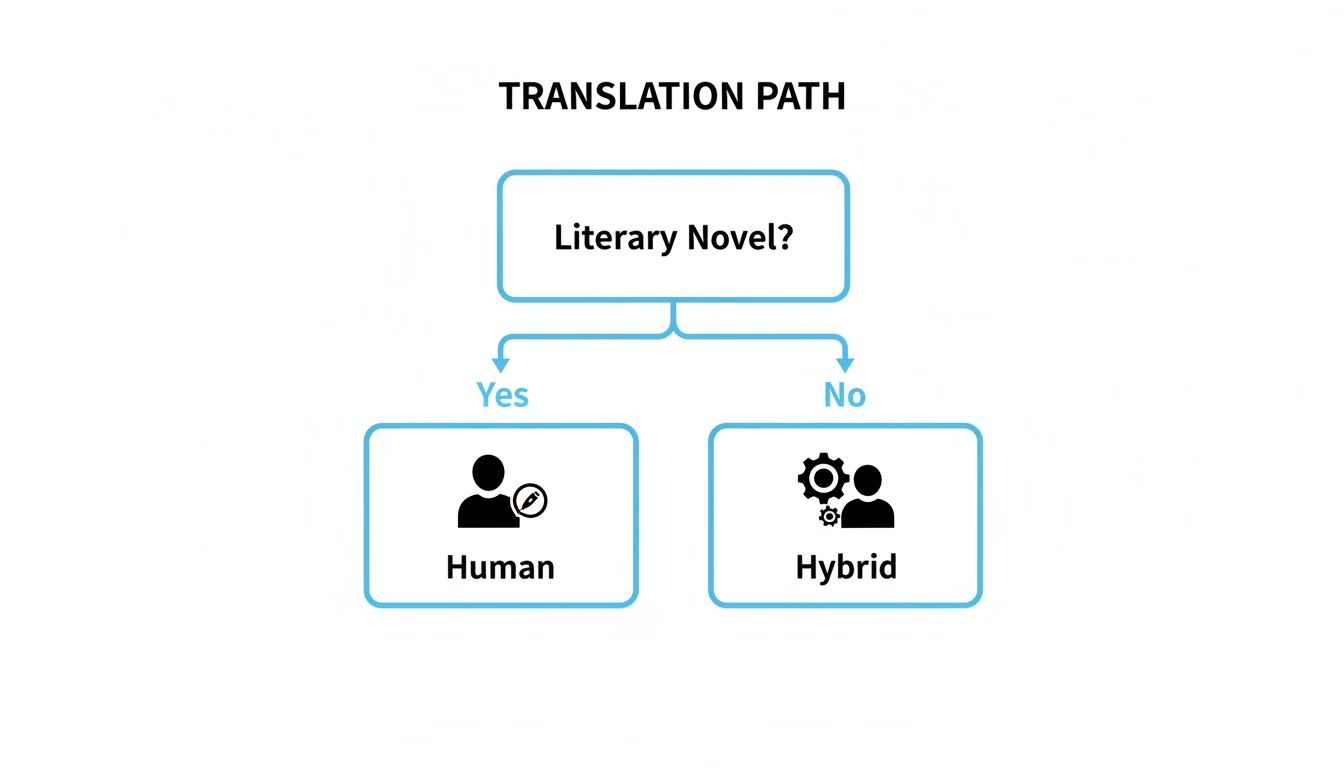
As you can see, a complex literary novel often benefits from the nuance of a dedicated human translator. For many other genres, however, a hybrid model delivers fantastic results much more efficiently.
Clean Up Your Manuscript
First things first: a thorough manuscript cleanup. This is about tackling the hidden architecture of your document to create a simple, consistent file that leaves no room for error.
- Standardize Formatting: Comb through your document and make sure all chapter titles use the same style (like Heading 1). Do the same for your subheadings (Heading 2, Heading 3, etc.). Inconsistent styling is one of the biggest culprits behind formatting chaos during translation.
- Remove Hidden Characters: Most word processors have a "Show/Hide Formatting Marks" feature. Turn it on. You'll probably be surprised to find extra page breaks, double spaces, and random tabs lurking in your text. These invisible gremlins can wreak havoc on the final layout.
- Simplify Complex Layouts: If your book has fancy tables, multi-column text boxes, or text wrapped around images, you might want to simplify them. While they look great in Spanish, these elements are notoriously tricky to adapt to a Right-to-Left script like Arabic. A cleaner, simpler layout has a much better chance of translating smoothly.
If you want to get into the technical weeds on this, our detailed ePub translation guide on preserving format and style covers these points with more specific examples.
Create a Glossary of Key Terms
Consistency is what separates a professional translation from an amateur one. A glossary is your secret weapon for ensuring that key terms, character names, and important phrases are translated the exact same way every single time.
Just create a simple two-column document. In one column, list the Spanish term. In the other, provide the specific Arabic translation you want, or even just a note explaining how it should be handled.
Your glossary becomes the single source of truth for the translator. It eliminates guesswork and ensures that "El Bosque Susurrante" is always translated as "الغابة الهامسة" and not accidentally as "الغابة الصامتة" in a later chapter.
This is absolutely essential for:
- Character and Place Names: Decide upfront if names should be transliterated (written phonetically in Arabic script) or if they have a direct translation.
- Recurring Phrases or Slogans: Any tagline or repeated line that’s central to your book's identity.
- Technical or Niche Terminology: Any specialized jargon related to your book's subject matter.
Develop a Clear Style Guide
Finally, a style guide is where you communicate your vision. It goes beyond the words themselves and gets into the tone, voice, and cultural feel of the translated book. This document tells your translator not just what to translate, but how to translate it.
Your style guide should answer a few core questions:
- Formality Level: Do you want the tone to be formal and academic, or casual and conversational?
- Target Audience: Are you writing for young adults in Riyadh or academics in Cairo? The answer dramatically affects vocabulary and cultural references.
- Cultural Adaptation: How should Spanish idioms or cultural references be handled? Are you okay with adapting them to the closest Arabic equivalent, or would you rather keep them literal and add a short explanatory note?
Giving your translator this guidance upfront provides the context they need to make smart, informed choices that honor your original work. It’s the best way to ensure the final Arabic version truly captures the soul of your book.
Navigating Right-to-Left Layout and Formatting
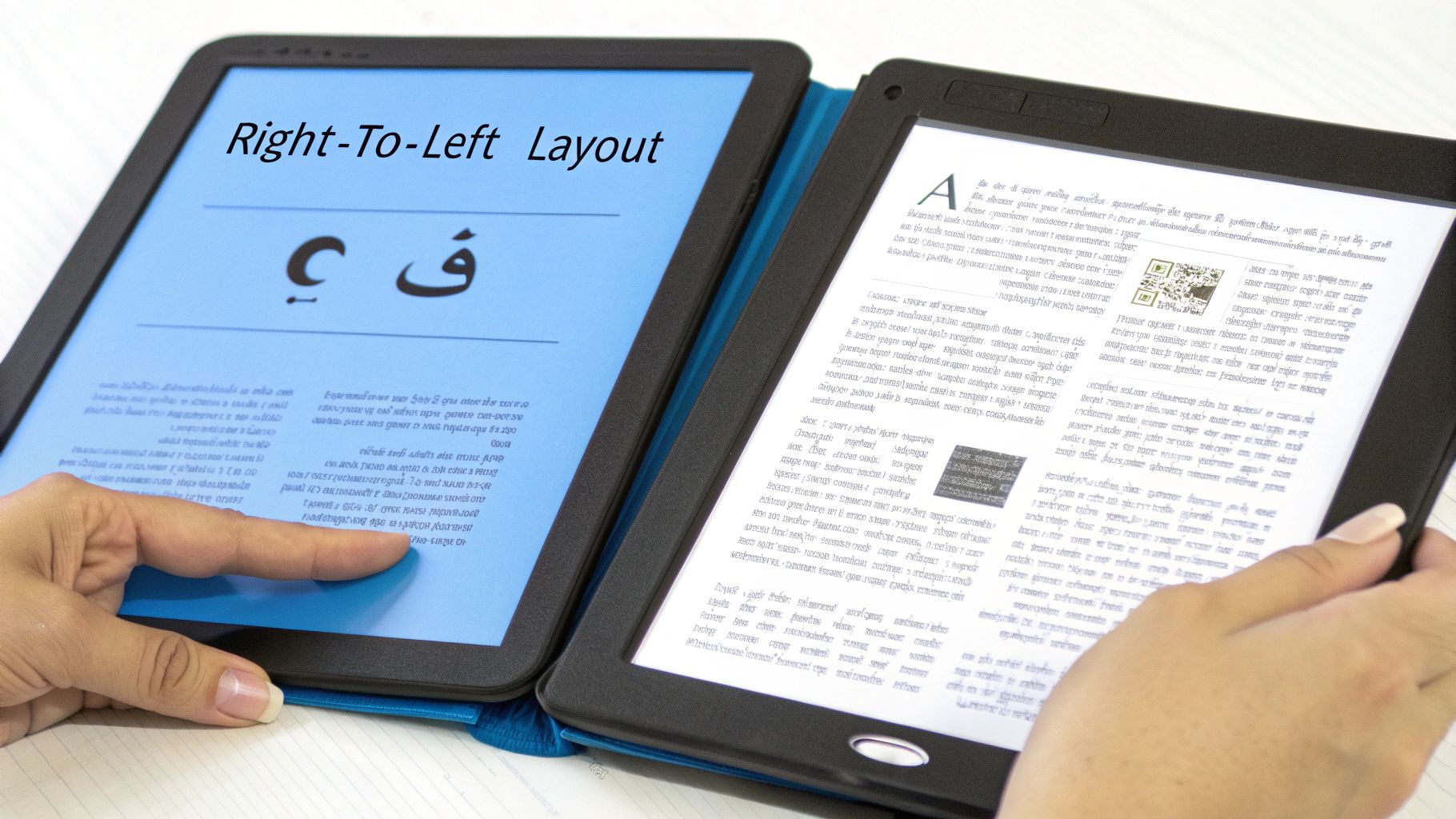
When you decide to translate from Spanish to Arabic, you're doing more than just swapping words. You're fundamentally flipping how the entire book is presented. Spanish reads from left to right (LTR), while Arabic is a right-to-left (RTL) script. This is, without a doubt, the biggest technical hurdle you'll face.
Messing this up makes a book unreadable. It's not just about which way the text flows; a proper RTL conversion impacts everything from page order and image placement to how numbers and punctuation are displayed. To an Arabic reader, a botched layout is an instant sign of a low-quality, unprofessional translation, completely undermining all your hard work.
Understanding the Right-to-Left Shift
So, what does going "right-to-left" actually mean for your ePub? In simple terms, it's a complete mirror image of the Spanish original.
In an Arabic book, page one is on the right. Readers swipe from left to right to move forward through the story. The spine of a physical book would be on the right-hand side. This shift has to be coded directly into the ePub’s underlying CSS and HTML.
This visual comparison shows just how different LTR and RTL layouts are.
Notice how everything from bullet points to paragraph alignment is reversed. It's a fundamental change in how the reader’s eye scans the page. Many authors assume their translation tool will just handle this, but that’s a risky bet. While a specialized service like BookTranslator.ai is built for this, most generic converters will break the layout, leaving you with a jumbled mess.
Common Layout Pitfalls to Avoid
Moving from Spanish LTR to Arabic RTL introduces some common problems. Knowing what to look for ahead of time will save you headaches during the quality check.
Keep an eye out for these frequent issues:
- Reversed Punctuation: In Arabic, the question mark faces the other way (؟) and the comma is inverted (،). If your final ePub still has standard Spanish punctuation, it's an immediate red flag.
- "Orphaned" Numbers: While Arabic script flows from right to left, numbers are still read left to right. This is called bidirectional text. If the code isn't handled correctly, numbers can get separated from the text they relate to, creating confusing sentences.
- Misaligned Images and Tables: Any images, charts, or tables that were aligned to the left in your Spanish version need to be mirrored and aligned to the right in the Arabic ePub. If not, they disrupt the natural visual flow for the reader.
The goal is to make the layout feel completely native to an Arabic reader. Anything that pulls their eye in the wrong direction—from a misplaced bullet point to a left-aligned chapter title—disrupts the reading experience.
Handling Bidirectional Text
One of the trickiest parts of this process is managing bidirectional text, or "BiDi." This is what happens when you have LTR text (like an English brand name, a URL, or a date) embedded within an RTL Arabic sentence.
Let's say your Spanish novel mentions "Coca-Cola." When translated, the sentence becomes Arabic (RTL), but "Coca-Cola" remains in its original script (LTR).
The ePub’s code needs to recognize and correctly display these mixed-direction segments. If it fails, you might see parts of the English words get scrambled or the sentence breaking in awkward places.
Best Practices for a Flawless RTL Layout
To make sure your book looks perfect, you need a workflow that prioritizes layout integrity from the start. This isn't something you can just fix at the end.
- Use RTL-Aware Software: This is the most critical step. Use a translation platform designed specifically for book-length projects that can handle RTL languages. Generic document translators will often strip or corrupt your ePub’s formatting.
- Declare the Language and Direction: In the ePub’s code, the root HTML element needs the right attributes:
<html lang="ar" dir="rtl">. This simple line of code tells every e-reader how to render the entire book correctly. - Insist on a Thorough Visual QA: Once the translation is done, a native Arabic speaker must review the final ePub on multiple devices—a Kindle, a Kobo, and a phone app. A layout that looks fine on one screen can break on another. This visual check is non-negotiable.
- Create a Separate RTL CSS File: For books with more complex styling, it’s a good idea to create a stylesheet just for the Arabic version. This lets you adjust alignments, margins, and other elements without touching the original Spanish CSS, keeping your source files clean.
The shift from LTR to RTL is a technical challenge, but it's completely manageable. By choosing the right tools and committing to a detailed quality assurance process, you can ensure your effort to translate from Spanish to Arabic results in a beautiful, professionally formatted book that your new audience will love.
Fine-Tuning Your Translation: The Crucial Editing and Cultural Review Stage
Getting your fully translated Arabic manuscript back feels like a major victory, but hold the celebration for just a moment. What you have is an excellent first draft, not the final product. Whether you used an AI service or a human translator, the next step—refinement—is where a good translation is transformed into a great one. This is the quality assurance (QA) process that makes or breaks your book's connection with Arabic-speaking readers.
This part of the journey goes far beyond just catching typos. It’s a deep, critical look at the text to ensure nothing important was lost—or unintentionally added—when you translate from Spanish to Arabic.
Proofreading vs. Bilingual Editing: They Aren't the Same Thing
Let’s clear up a common misconception. Many authors assume a standard proofread is all they need, but that's only half the battle. A complete QA workflow requires two distinct layers of review.
Standard Proofreading: Think of this as the final polish. A native Arabic proofreader meticulously hunts down grammatical errors, spelling mistakes, punctuation problems, and typos. Their job is to make sure the Arabic text itself is flawless. They aren't looking at your original Spanish manuscript at all.
Bilingual Editing: This is where the heavy lifting happens. A bilingual editor sits down with your Arabic translation and the original Spanish text side-by-side. They are laser-focused on accuracy, nuance, and tone. Did that witty remark from your protagonist land with the same punch? Was the author's subtle sarcasm preserved? This is how you catch any drift from the original's intent.
Skipping the bilingual edit is one of the most frequent—and costly—mistakes I see. You can have a grammatically perfect sentence in Arabic that completely misrepresents what you wrote in Spanish. Only a bilingual expert will catch that.
The Heart of the Matter: Cultural Adaptation
Now for the real magic. Cultural adaptation, or what we in the industry call localization, is about making sure your book doesn't just make linguistic sense but also hits the right notes culturally. A direct, word-for-word translation almost always falls flat because so much of a culture is baked right into its language.
Picture a character in a Spanish novel saying, "No hay mal que por bien no venga." A literal Arabic translation might be technically correct, but it would sound stilted and foreign. A sharp localizer would instead reach for a culturally equivalent Arabic proverb, something like "كل تأخيرة فيها خيرة" (Every delay has a good outcome). It captures the exact same optimistic spirit but feels completely natural to a local reader.
Localization is what makes your story feel like it belongs in its new cultural home. It’s about finding the emotional and contextual twin, not just a dictionary definition. This is what keeps your book from feeling like an awkward, clunky import.
A Practical Post-Translation QA Checklist
To get the most out of your review process, you need a structured approach. Even if you don't speak a word of Arabic, having a clear checklist helps you give your editor precise, actionable feedback.
Here's a simple framework I use to guide the final review.
Post-Translation QA Checklist
| Check Area | What to Look For | Common Pitfall to Avoid |
|---|---|---|
| Idioms & Slang | Do the Arabic equivalents capture the feeling of the Spanish original? Are they a good fit for the target audience's age and region? | Translating idioms literally. This often creates nonsensical or unintentionally funny phrases that completely break the reader's immersion. |
| Cultural Norms | Are there references to social norms, food, or traditions that might confuse or even offend an Arabic-speaking audience? | Assuming a cultural reference that's obvious in Spain or Latin America will land the same way in the Middle East or North Africa. |
| Character Names | Have the names been transliterated consistently every single time they appear? | Using slightly different spellings for the same character's name in different chapters. This is a sure-fire way to confuse your readers. |
| Tone & Formality | Does the level of formality in the Arabic dialogue mirror the original Spanish? Does a casual chat still sound casual? | Applying one single, overly formal tone to the entire book. This strips your characters of their individual voices and makes them all sound the same. |
Vague feedback is the enemy of a great translation. Instead of saying, "This chapter feels a bit off," get specific. Point to a passage and ask your editor, "Does this dialogue sound like something a teenager in modern-day Cairo would actually say?" This allows them to zero in on the problem and fix it.
This final, meticulous review is what ensures your hard work to translate from Spanish to Arabic pays off, resulting in a book that truly honors your original vision while warmly embracing its new audience.
Common Questions About Spanish to Arabic Book Translation
Deciding to translate your Spanish book into Arabic is a big step, and it's natural to have a lot of questions. After all, you're not just swapping words; you're bridging two rich cultures. We've helped countless authors and publishers make this leap, so we've put together answers to the questions that come up time and time again.
What's the Real Cost of Translation?
This is usually the first thing people ask, and the honest answer is: the cost is entirely up to you and the approach you take. The financial investment can range from the price of a coffee to that of a used car.
- Bare-Bones AI: For under $10 per 100,000 words, you can get a raw AI translation. This is your go-to if the goal is simply to make the text machine-readable and you're on a shoestring budget.
- The Hybrid Sweet Spot (AI + Human Editor): This is the most popular route for a reason. It gives you a professional-grade manuscript at a fraction of the cost of a traditional translator. You're paying for the AI's speed and the human editor's critical eye.
- Purely Human Translation: This is the premium, white-glove service. Professional literary translators charge by the word, and for a full-length novel, the cost can easily run into the thousands. It's a significant investment.
Your budget will be the biggest driver of your decision. The trick is to find the sweet spot between what you can afford and the level of quality your readers expect.
How Long is This Going to Take?
Like the cost, the timeline hinges completely on the method you choose. What used to take months can now, in some cases, be done in minutes.
An AI platform can process an entire manuscript almost instantly. Seriously, you can have a full draft ready in less time than it takes to brew a pot of tea.
On the other hand, a human translator works at a human pace. A pro might get through a couple of thousand words a day. For a standard 80,000-word novel, you could be looking at several weeks, or even a couple of months, from start to finish.
The hybrid model, once again, offers a great compromise. The AI does the heavy lifting in minutes, and the timeline is then determined by the human editor's schedule. This usually means your book is ready in a matter of days or a week or two, not months.
Can't I Just Use a Free Online Tool?
Look, free online translators are amazing for figuring out a menu in a foreign country or a quick email. But for a novel? Absolutely not. They just aren't built for the nuance and technical demands of publishing a book.
Here’s where they fall apart:
- Inconsistent Terminology: A key character's name or a recurring theme might be translated one way in Chapter 2 and completely differently in Chapter 10.
- Stripped Formatting: Your carefully crafted ePub file will be reduced to a wall of unformatted text. All your italics, chapter breaks, and paragraph styles will vanish.
- Zero Nuance: Your authorial voice, the subtle jokes, the sarcasm, the cultural touchstones—all of it gets lost. The result is flat and lifeless.
Using a free tool for a commercial book is like trying to build a house with a plastic hammer. You'll end up with a poor-quality product that frustrates readers and can do real damage to your author brand. A dedicated book translation service is designed specifically to handle these challenges.
Do I Need to Find a Bilingual Spanish-Arabic Translator?
Yes and no. It really depends on your workflow.
If you’re going the traditional, human-only route, then you absolutely need a professional translator who is an expert in both languages.
But if you choose the hybrid model, your focus shifts. You don't need a translator in the traditional sense. What you need is a native Arabic-speaking editor.
This person's job isn't to re-translate from Spanish. Their role is to take the high-quality AI draft and polish it to perfection. They'll smooth out awkward phrasing, ensure the cultural context is right, and make sure the final text flows beautifully for an Arabic reader. It's a much more efficient—and often more affordable—way to get the expert linguistic touch that turns a good translation into a great one. When you translate from Spanish to Arabic, this final human review is what makes all the difference.
Ready to bring your Spanish book to a new audience of millions? With BookTranslator.ai, you can get a professional-quality translation that preserves your book's original layout and voice. Start your translation today and connect with Arabic readers around the world.