- Access to English source text you want to translate
- Basic familiarity with translation tools or willingness to learn
- Understanding of your target audience's Myanmar language proficiency level
Introduction: when to use this translation checklist
Translating English content into Myanmar (Burmese) is one of the more technically demanding language pairs you can work with. At BookTranslator.ai, our analysis shows that projects fail most often not during translation itself, but in the preparation and verification stages that surround it. This checklist exists to close that gap.
Who this checklist is for
This guide is built for authors, publishers, researchers, and language learners who need reliable English-to-Myanmar output, whether for a full book, an academic paper, or educational materials. It applies equally whether you are working with a human translator, an AI tool, or a hybrid workflow.
Why Myanmar translation demands extra care
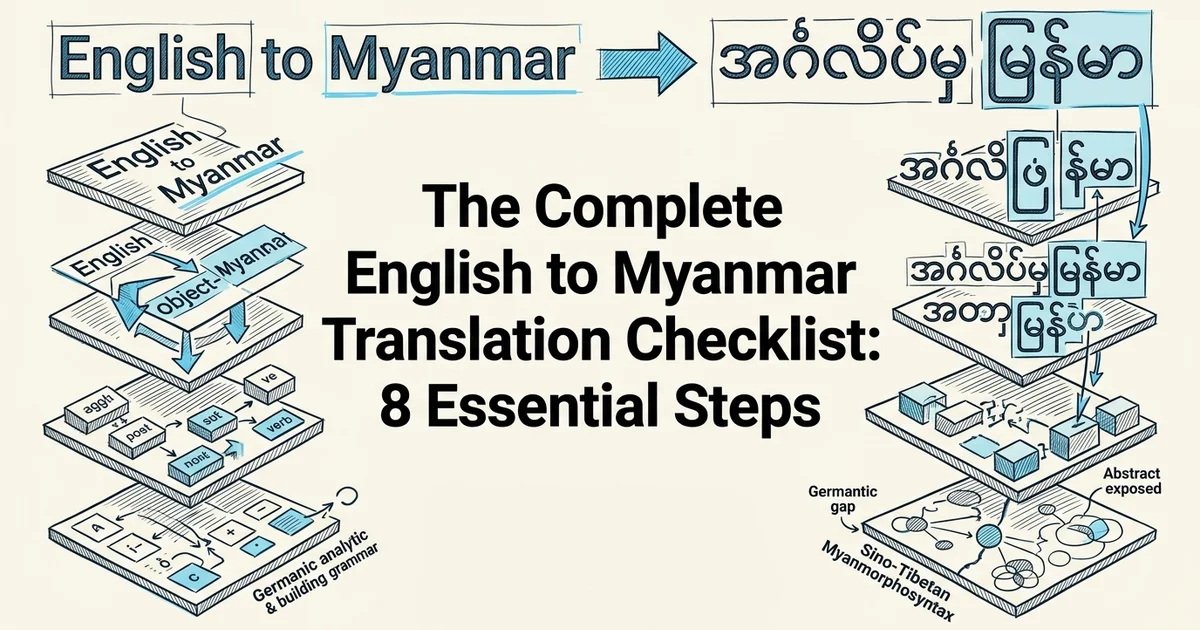
Burmese morphology and word order differ fundamentally from English. According to the Burmese NLP Benchmark for Evaluating Large Language Models (2025), current large language models still struggle with Burmese linguistic structure, making human review a practical necessity rather than an optional step.
Choosing your translation method
Your timeline and budget determine your approach:
- Machine translation only: Fast and affordable for internal drafts or simple reference material
- Human translation only: Best for literary, legal, or culturally sensitive content
- Hybrid (AI plus human review): The recommended path for published books and academic work, combining speed with accuracy
Tools like BookTranslator.ai handle the AI layer with context-aware processing, preserving your document's structure while keeping terminology consistent throughout.
Phase 1: prepare your English content for translation
Before any translation begins, your English source material needs to be in the best possible shape. A clean, well-organized document reduces errors, speeds up the process, and produces a far more accurate Myanmar translation. Invest time here and every subsequent step becomes easier.
- Review source text for clarity and consistency in terminology
- Remove or resolve any ambiguous pronouns and unclear references
- Check for proper formatting: headings, lists, and paragraph breaks
- Verify all special characters, numbers, and dates are correctly formatted
- Identify and mark any proper nouns, brand names, or untranslatable terms
- Ensure consistent spelling and capitalization throughout the document
- Remove unnecessary whitespace, extra line breaks, and formatting artifacts
- Create a glossary of technical terms and their intended meanings
- Test that your file format (EPUB, PDF, DOCX) is compatible with your chosen tool
- Back up your original English content before proceeding
Assess your source material
Start by reading through your full document with fresh eyes. Ask yourself:
- Are there sentences that are unusually long or structurally complex?
- Does the text rely on passive voice that could be interpreted multiple ways?
- Are there abbreviations, acronyms, or technical terms that lack explanation?
This matters because Myanmar (Burmese) has a fundamentally different grammatical structure from English. According to Myanmar Word Sense Disambiguation in Machine Translation (2025), word-sense ambiguity is one of the leading causes of translation errors in Burmese machine translation, meaning unclear English phrasing compounds the problem significantly.
Organize your text into manageable sections
Divide your document into logical chapters or segments before uploading. Clear section breaks help context-aware AI tools, like BookTranslator.ai, maintain consistent terminology and voice across a long manuscript rather than treating it as one undifferentiated block of text.
Build a terminology glossary
Create a simple reference document listing:
- Proper nouns: character names, place names, brand names
- Technical or domain-specific terms: legal, medical, or academic vocabulary
- Culturally specific concepts: idioms, proverbs, or references that may not translate directly
If you have already worked through a similar process for other language pairs, such as when you translate book to german, you will recognize this step as essential groundwork regardless of the target language.
Review for clarity and cultural references
Rewrite any idioms or culture-specific expressions in plain English first. Phrases like "hit it out of the park" or "ballpark figure" carry no meaning in a Myanmar cultural context. Document these alongside your glossary so your translation tool or human reviewer has the context needed to find an appropriate equivalent.
📝 What you should see: A clean, segmented document, a working glossary, and a short notes file flagging idioms and cultural references. This preparation set takes roughly 30 to 60 minutes for a standard book chapter but saves significant revision time later.
Phase 2: choose your translation method and tools
With your content prepared, the next decision shapes everything that follows: which tool or combination of tools will actually do the translating? The right answer depends on your project size, quality expectations, and budget. Spend time here before committing to a full workflow.
- Assess your project scope: short text, document, or full book
- Evaluate quality requirements: basic, professional, or publication-ready
- Consider budget constraints and available resources
- For short text: test Google Translate's English-to-Myanmar conversion
- For longer documents and EPUBs: evaluate BookTranslator.ai's capabilities
- Review tool documentation for Myanmar language-specific features
- Check if the tool supports your source file format
- Verify the tool's handling of special characters and Burmese script
- Test with a small sample of your content first
- Document your chosen tool and settings for future reference
Evaluate free and entry-level machine translation
Free tools give you a fast, low-cost starting point. Google Translate supports Myanmar among its 70+ languages and works well for short passages, quick reference checks, or understanding the rough shape of a text. For anything longer than a paragraph, however, quality inconsistencies become noticeable, particularly with Myanmar's complex script and sentence structure.
According to a 2024 machine translation study (2024), English-to-Myanmar translation achieved a BLEU score of 44.78 and a METEOR score of 74.23, reflecting meaningful progress but also real limitations in automated output. Free tools are a useful benchmark, not a final solution.
Consider AI-powered tools for longer projects
For full books, academic manuscripts, or publishing-ready content, context-aware AI translation produces noticeably better results. BookTranslator.ai is built specifically for this scale: it translates EPUB files into 99+ languages, preserves your original formatting and chapter structure, and maintains consistent terminology throughout the entire document. If you are looking for book translation services that don't require subscriptions, its pay-per-book model is worth examining before you start.
Test before you commit
Run a representative sample through any tool you are considering: a paragraph with technical terms, one with dialogue, and one with cultural references from your idiom notes. Compare outputs side by side.
Document your final choice:
- Record the tool name and version or plan
- Note any custom settings, glossary uploads, or style preferences applied
- Save this alongside your project glossary so every phase uses identical parameters
✅ What you should see: A confirmed tool selection, a brief test-output comparison saved to your project folder, and a one-line settings record. You are now ready to begin the full translation pass.
Phase 3: execute the translation with quality checks
With your tool confirmed and your settings documented, you are ready to begin the actual translation pass. This phase is where preparation pays off. Working through your content systematically, checking output as you go, prevents small errors from compounding into large structural problems by the time you reach the final chapter.
See how BookTranslator.ai - Basic Plan handles translate english to myanmar BookTranslator.ai - Basic Plan.
- Upload or input your prepared English content into your chosen tool
- Configure translation settings for Myanmar (Burmese) language pair
- Enable any available quality assurance or consistency checking features
- Run the initial translation pass on your entire document
- Spot-check the first 10% of translated content for obvious errors
- Verify that proper nouns and glossary terms translated correctly
- Check that formatting (headings, lists, line breaks) remained intact
- Look for untranslated segments or placeholder text
- Confirm that special characters and numbers appear correctly
- Save the draft translation with a clear version label
Divide your content into manageable batches
Start by splitting your source text into logical units, one chapter or section at a time. Batching keeps each translation pass focused and makes it far easier to spot inconsistencies before they spread. For book-length projects, In our experience at BookTranslator.ai, processing content chapter by chapter also allows the context-aware AI to maintain consistent character names, terminology, and tone across the entire manuscript without losing thread.

Review output for Burmese morphology and word order
Input each batch into your chosen tool and review the output immediately. Do not queue all batches and review later. Myanmar (Burmese) is an agglutinative, verb-final language, which means word order and morphological markers differ significantly from English. According to research published in the IJRPR, word-sense disambiguation remains a persistent challenge in Myanmar machine translation, making human review of each output batch essential rather than optional.
Flag any sentence where the subject-object-verb structure appears inverted or where particle markers seem missing. These are the errors most likely to confuse native Myanmar readers.
Check terminology consistency across sections
Cross-reference every translated batch against your project glossary. Confirm that proper nouns, technical terms, and recurring phrases match your pre-approved translations exactly. Tools like BookTranslator.ai handle this automatically through context-aware AI, keeping names and key terms stable across all chapters without manual cross-checking after every paragraph.
Adapt cultural references for Myanmar audiences
Identify idioms, metaphors, and cultural references flagged during your earlier preparation phase. Verify that the translation has substituted or adapted these appropriately rather than translating them word-for-word. A literal rendering of an English idiom will often read as nonsensical in Burmese. If you are working on content similar in scope to projects covered in our guide on how to translate book to french, the same cultural adaptation principle applies regardless of target language.
✅ What you should see: A complete translated draft divided by chapter, a flagged list of morphology or word-order issues for revision, and confirmed terminology consistency against your glossary. Every cultural reference should have a documented adaptation decision before you move to proofreading.
Phase 4: conduct comprehensive proofreading and refinement
With your draft complete, proofreading transforms a technically accurate translation into a genuinely readable Myanmar text. This phase catches the errors that automated tools miss: unnatural rhythm, cultural missteps, and encoding glitches that only become visible when you read the full document as a unified piece.
- Read through the entire Myanmar translation for natural flow and readability
- Identify awkward phrasing or unnatural word choices
- Check for consistency in terminology throughout the document
- Verify that cultural references and idioms are appropriately adapted
- Correct any grammatical errors or syntax issues in Burmese
- Ensure punctuation and spacing follow Myanmar language conventions
- Compare key sections back to the English original for accuracy
- Test text-to-speech if your project includes audio output
- Have a native Burmese speaker review critical sections if possible
- Document all corrections made during this phase
Read the translation aloud for natural flow
Read the entire Myanmar translation aloud from start to finish. Spoken review exposes awkward phrasing, overly long sentences, and unnatural word order that silent reading often skips past. Mark every passage where you stumble or pause unexpectedly. These friction points almost always signal a structural issue inherited from the English source.
Compare back to the original English
Place the English source and Myanmar translation side by side and read them in parallel. Check that meaning, tone, and intent remain consistent across every paragraph. Pay particular attention to complex sentences and technical terminology, where machine translation errors cluster most frequently. According to Burmese NLP Benchmark for Evaluating Large Language Models (2025), even high-performing models show measurable gaps on nuanced language tasks, so manual comparison at this stage is non-negotiable.
Bring in a native Myanmar speaker
Have a fluent native speaker review the full text for cultural appropriateness and natural fluency. This human-in-the-loop step catches register mismatches, overly formal phrasing, and culturally tone-deaf adaptations that no automated metric detects. If you are working on a full book project, BookTranslator.ai's context-aware AI reduces the volume of corrections a native reviewer needs to make, but it does not replace their judgment entirely.
Verify Myanmar script formatting and encoding
Open your final document and inspect the Myanmar script character by character in key sections. Confirm that Unicode encoding is consistent, that no placeholder characters appear, and that line breaks fall at natural word boundaries. According to research on Myanmar machine translation (2024), corpus quality and encoding consistency directly affect downstream readability, making this check essential before delivery.
✅ What you should see: A clean, fully annotated draft with all awkward passages resolved, a completed native-speaker review log, zero encoding errors in the Myanmar script, and a final terminology check confirming consistency with your original glossary.
Phase 5: finalize and deliver your translated content
With proofreading complete, your final task is to package and protect your work. Export correctly, test across devices, and document your process so future translations to Myanmar build on this one rather than starting from scratch.
- Export the final translation in your target format (EPUB, PDF, DOCX)
- Verify the exported file opens correctly and displays properly
- Test the file on multiple devices (desktop, tablet, mobile) if applicable
- Confirm all formatting, images, and embedded content are intact
- Create a final backup of the completed translation
- Generate a summary document of changes and corrections made
- Prepare metadata and file naming conventions for archival
- Test any hyperlinks, cross-references, or internal navigation
- Validate that the file meets any client or publication requirements
- Store documentation of your process for future Myanmar translation projects
Export in the right format for your use case
Choose your output format based on where the content will live. EPUB files destined for digital reading platforms should be exported with Myanmar Unicode encoding intact. If you used BookTranslator.ai for a book-length project, your translated EPUB is already structured identically to the original, with chapters, footnotes, and images preserved. For web or print use, export to PDF or DOCX and verify that Padauk or a compatible Myanmar font is embedded.

Test Myanmar script display across platforms and devices
Open your exported file on at least two different devices or applications. Myanmar script rendering varies significantly between operating systems, and a file that displays correctly in one environment may show broken characters in another. Check mobile readers, desktop apps, and any web-based viewer your audience is likely to use.
Back up both source and translated files
Store your original English document and the final Myanmar translation in at least two locations, such as cloud storage and a local drive. If you are working on longer publishing projects, see How to Translate Your eBook to Multiple Languages Today for a practical archiving workflow that scales across multiple language versions.
Document your methodology and build a style guide
Record which tools you used, which glossary terms you standardized, and any cultural adaptation decisions you made. Even a simple text file noting your Myanmar terminology choices will save significant time on your next project. If your work involves recurring content, expand this into a lightweight style guide covering tone, honorifics, and preferred transliterations. This documentation becomes especially valuable when coordinating with native-speaker reviewers across future translations.
✅ What you should see: A correctly formatted, fully rendered Myanmar-language file that displays without encoding errors on multiple devices, backed-up copies of both source and translated documents, and a written record of your translation decisions ready to inform your next project.
Frequently asked questions
How do I translate English to Myanmar language?
Start by choosing a tool suited to your content type. For short text, Google Translate handles basic English-to-Myanmar conversion quickly. For longer documents, EPUBs, or books, BookTranslator.ai uses context-aware AI to maintain formatting, terminology, and voice across the entire file.
What is the best English to Myanmar translator?
The best tool depends on your content. Google Translate works for quick phrases, while BookTranslator.ai is purpose-built for books and structured documents, preserving chapter layouts, footnotes, and consistent terminology throughout.
Can Google Translate translate English into Burmese?
Yes. Google Translate supports Burmese and, according to Google (2025), Gemini-based improvements have advanced translation quality, multimodal translation, and text-to-speech capabilities for supported languages including Burmese.
Is Burmese the same as Myanmar language?
Yes. "Burmese" and "Myanmar" refer to the same language. "Myanmar" is the more formal modern designation, while "Burmese" remains widely used in linguistic and academic contexts. Both terms appear interchangeably across translation tools.
How accurate is English-to-Myanmar translation?
Accuracy varies by tool and content complexity. Research suggests neural models are improving steadily for low-resource language pairs like English and Myanmar.
How do I translate a PDF or book from English to Myanmar?
Convert your PDF to EPUB format first, then upload it to BookTranslator.ai. The platform translates the full file while preserving its original structure, delivering a correctly rendered Myanmar-language EPUB ready for reading or publishing.
Can I translate English to Myanmar by voice?
Google Translate supports voice input for Burmese on mobile devices. Speak your English phrase, select Burmese as the target language, and the app returns both text and audio output.
How do I type Myanmar Burmese in Google Translate?
Install a Burmese keyboard (such as Zawgyi or Unicode/NLP Myanmar3) on your device, switch your input method to Burmese, then type directly into the Google Translate text field.
Based on our work at BookTranslator.ai, the most common failure point for translate english to myanmar projects is not the translation itself but the encoding step: always verify your output file renders correctly in Unicode before delivery.