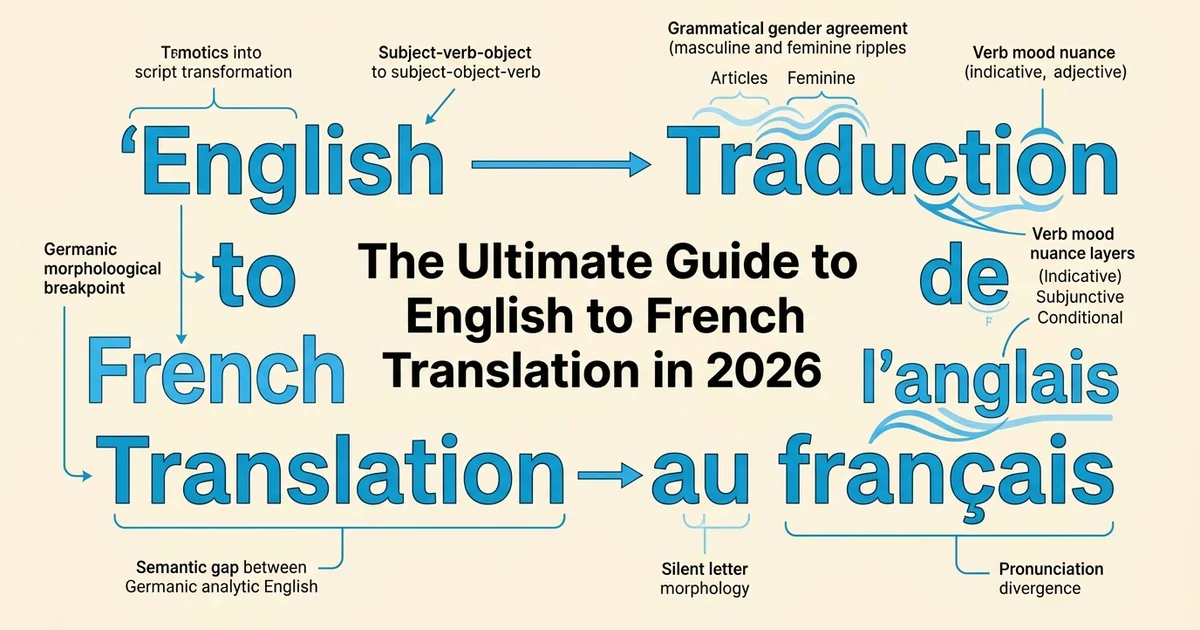
Introduction: Why English-to-French translation matters in today's publishing landscape
French is spoken by more than 320 million people across five continents, making it one of the most strategically valuable languages for any author, publisher, or educator looking to expand their reach. The demand to translate English to French has never been more urgent, or more technologically interesting, than it is right now.
The growing demand for French translations in global publishing
Publishing markets in France, Belgium, Canada, Switzerland, and across Francophone Africa are hungry for English-language content. For independent authors, reaching these readers has historically meant either expensive professional translation contracts or settling for clunky, formatting-destroying workarounds. Neither option scaled well. Today, that calculus is shifting fast.
Major players are paying attention. According to Publishing Perspectives (2025), Audible planned AI-assisted translation from English into French, Spanish, Italian, and German, with optional human review by professional linguists. When a company of that scale bets on AI-powered French translation, it signals a broader industry turning point.
How AI and technology are transforming translation workflows
The pace of research alone tells the story. According to A Systematic Review of ChatGPT in Translation Studies (2026), translation-study publications in the reviewed dataset increased from 46 in 2024 to 83 in 2025, reflecting an explosion of academic and professional interest in AI-driven translation methods.
At BookTranslator.ai, our analysis shows that context-aware AI models now handle the particular challenges of English-to-French translation, including gendered nouns, formal register shifts, and idiomatic phrasing, far more reliably than earlier rule-based systems ever could.
Who needs English-to-French translation and why
The answer is broader than most people expect:
- Independent authors wanting to publish in Francophone markets without a traditional publisher
- Publishing houses scaling multilingual catalogs efficiently
- Academic researchers distributing findings to French-speaking institutions
- Language learners and readers seeking titles unavailable in their native language
What this guide covers and how to use it
This guide walks you through everything: the mechanics of how translation actually works, the tools and methods available in 2026, quality benchmarks, cost comparisons, and practical workflows. Whether you are translating a novel, a textbook, or a business document, each section builds on the last. Feel free to read straight through or jump to the section most relevant to your immediate need. 🗺️
What is English-to-French translation and how does it work
English-to-French translation is the process of converting written or spoken content from English into French while preserving the original meaning, tone, and intent. It spans everything from a single sentence to a 400-page novel, and the methods used to achieve it have changed dramatically over the past decade.
Literal vs. contextual translation
At its most basic, translation can be approached in two ways: word-for-word (literal) or meaning-for-meaning (contextual). Literal translation maps each English word directly to its French equivalent. The result is often grammatically awkward and culturally tone-deaf. Consider the English idiom "it's raining cats and dogs." A literal translation produces nonsense in French; a contextual one reaches for "il pleut des cordes" (it's raining ropes), which carries the same expressive weight.
Professional translators have always worked contextually, reading paragraphs as units of meaning rather than strings of words. This is why register, cultural reference, and narrative voice matter as much as vocabulary accuracy. A legal document demands precision; a literary novel demands rhythm and personality.
How neural machine translation changed everything
Rule-based machine translation systems, which dominated the field through the early 2000s, relied on hand-coded grammatical rules and bilingual dictionaries. They were rigid, brittle, and notoriously poor at handling idiomatic language.
Neural machine translation (NMT) replaced this architecture with deep learning models trained on billions of sentence pairs. Instead of following rules, NMT systems learn statistical patterns across entire documents, allowing them to handle context, ambiguity, and style far more naturally. According to ACL Anthology (2025), large language model-based approaches now outperform earlier neural systems on a range of translation benchmarks, with measurable gains in fluency and adequacy scores.
The practical difference is significant. Where a rule-based system might render a French subjunctive incorrectly every time, a well-trained neural model learns when the subjunctive is expected and applies it appropriately across an entire text.
The role of human review
Even the best neural systems make errors that automated metrics miss: a character name rendered inconsistently across chapters, a cultural reference that lands wrong for a French-speaking audience, or a subtle shift in narrative voice. This is why professional translation workflows pair machine output with human post-editing.
According to Frontiers in Education (2026), human review remains essential for catching nuanced errors that AI systems consistently overlook, particularly in literary and specialized texts.
Tools like BookTranslator.ai address part of this challenge through context-aware AI that maintains consistent terminology, character names, and tone across an entire book-length document, reducing the volume of corrections a human reviewer needs to make.
Translation quality metrics
The field uses several benchmarks to evaluate translation output:
- BLEU score: measures how closely machine output matches human reference translations
- TER (Translation Edit Rate): counts the edits a human must make to correct machine output
- MQM (Multidimensional Quality Metrics): a more granular framework that scores accuracy, fluency, and style separately
No single metric captures everything. A high BLEU score on a technical manual tells you little about whether a translated novel reads naturally in French. Understanding these benchmarks helps you ask better questions when evaluating any translation service, whether you are working on a business report or looking to translate a book to German or French for a new market. 📊
Types of English-to-French translation: Finding the right approach for your needs
Not all translation projects are created equal. The approach that works beautifully for a legal contract will fall flat on a literary novel, and the tools suited to a software interface will struggle with a research paper. Choosing the right method starts with understanding what category your project falls into.
Literary translation for fiction and creative works
Literary translation is widely considered the most demanding form. A translator working on a novel must preserve not just meaning but rhythm, voice, cultural resonance, and emotional texture. This is where the debate around AI gets most heated. According to The Markup (2025), publishers and translators are actively wrestling with whether AI models can handle the nuanced demands of literary prose, with opinions split sharply across the industry.
For independent authors and small publishers looking to bring fiction to French-speaking audiences, the practical reality is that a hybrid approach often works best: AI translation to produce a strong first draft, followed by human editorial review for voice and cultural adaptation.
Technical and academic translation requirements
Technical documents, scientific papers, and academic texts demand precision above all else. Terminology must be consistent, definitions exact, and structure preserved. A mistranslated unit of measurement or a misrendered citation can undermine an entire paper's credibility. French academic conventions also differ from English ones, including citation formats and formal register expectations, so translators need subject-matter familiarity alongside linguistic skill.
Business and commercial document translation
Business translation covers a wide spectrum: contracts, marketing copy, financial reports, and internal communications. Each has its own register and risk profile. A marketing tagline needs creative adaptation to resonate with French consumers, while a contract demands word-for-word fidelity. Many organizations now use AI for routine documents and reserve human translators for high-stakes or brand-sensitive materials.
Website and software localization
Localization goes beyond translation. It adapts content for cultural context, date formats, currency, and user interface conventions. French users in France, Belgium, and Quebec have distinct expectations, and a single translated string can carry different connotations across those markets. Software localization also involves character limits, placeholder variables, and technical constraints that require specialized workflows.
Audiobook and multimedia translation
Digital audio is growing fast, and French-language audiobook demand is rising alongside it. Multimedia translation adds layers of complexity: translated scripts must match timing cues, suit voice performance, and account for the fact that French text typically runs longer than its English equivalent. This has real implications for subtitle timing and audio pacing.
Full-book versus excerpt translation
One practical decision many authors face is whether to translate an entire book or just a sample for pitching to French publishers or testing market interest. For full EPUB translations, tools like BookTranslator.ai handle complete books while preserving chapter structure, images, and formatting intact, which is a significant advantage over copy-paste workflows that flatten a document's layout. For authors exploring options without committing to a subscription, pay-per-book models offer a lower-risk entry point. 📚
How English-to-French translation technology works: From neural networks to large language models
Understanding what happens under the hood when you translate English to French helps you choose the right tool and set realistic expectations. Modern translation technology has evolved through several distinct generations, each with meaningful differences in quality, speed, and contextual awareness.
From rule-based systems to neural networks
Early machine translation relied on rule-based systems: hand-coded grammatical rules, bilingual dictionaries, and syntactic parsers. For English-to-French, this meant the software would identify a verb tense, look it up in a rule table, and apply the French equivalent. The results were often technically correct but stilted, missing the natural flow that native readers expect.
Neural machine translation (NMT) changed the game. Instead of following explicit rules, NMT systems learn statistical patterns from millions of bilingual text pairs. The architecture, built around encoder-decoder networks and attention mechanisms, allows the model to consider entire sentences rather than word-by-word substitutions. This is why modern NMT handles French gendered nouns, verb conjugation, and sentence inversion far more naturally than its predecessors.
How large language models raise the bar
Large language models (LLMs) take this further by training on vast corpora that span literature, journalism, scientific writing, and everyday conversation. Rather than optimizing purely for translation, they develop a broad understanding of how language works in context. This gives them a meaningful edge when handling idiomatic expressions, cultural references, and register shifts, all of which are particularly important in English-to-French literary translation.
According to A Systematic Review of ChatGPT in Translation Studies (2022–2025) (2026), research output on AI translation has grown rapidly, with publication counts rising from 46 to 83 studies in a single year, reflecting just how quickly the field is evolving. The same review examined over 140 studies and found that LLMs perform competitively across a range of translation tasks, though they still show limitations in highly specialized or culturally dense texts.
The context problem and why it matters for French
French is a language where context is everything. A single English word like "you" maps to "tu" or "vous" depending on formality. Adjectives must agree in gender and number with their nouns. Sentence rhythm differs significantly from English. Rule-based systems handle these mechanically; NMT handles them statistically; LLMs handle them contextually, drawing on surrounding paragraphs and even document-level signals to make better decisions.
This is where tools built specifically for long-form content have a practical advantage. BookTranslator.ai, for instance, uses context-aware AI that processes an entire EPUB book as a cohesive document, keeping character names, terminology, and narrative voice consistent from chapter one to the final page. That kind of document-level coherence is difficult to achieve when pasting text into a general-purpose chatbot in chunks.
Quality gaps that still exist
No technology is perfect. According to Machine Translation in the AI Era (2025), comparative research shows that while LLMs outperform earlier NMT systems on many benchmarks, gaps remain in handling literary nuance, humor, and culturally embedded meaning. For anyone looking to translate a book to French, understanding these limitations helps set appropriate expectations and informs decisions about when human review adds genuine value.
The technology is advancing fast. What matters most is matching the right system to your specific content type and quality threshold. 🔬
Benefits of automated English-to-French translation for modern publishers and authors
Automated translation delivers measurable advantages across the entire publishing workflow, from first draft to final distribution. For publishers and authors ready to reach French-speaking audiences, the gains in speed, cost, and scalability are transforming what was once a slow, expensive process into something genuinely accessible.
Speed and efficiency gains
Traditional literary translation projects can take months. Automated systems compress that timeline dramatically, processing a full-length novel in minutes rather than weeks. This speed advantage matters most when timing is tied to a series launch, a marketing campaign, or a seasonal sales window. Getting a French edition ready in parallel with an English release is now a realistic goal, not a luxury reserved for major publishers.
Cost reduction for independent authors and small publishers
Human translation rates for literary content typically run between $0.10 and $0.25 per word, making a 90,000-word novel a significant financial commitment. Automated tools reduce that upfront cost substantially, opening the French market to self-published authors and small presses that previously could not justify the expense. Tools like BookTranslator.ai price translation at a pay-per-book model starting at $6.99 per 100,000 words, with no subscription required, which makes experimentation low-risk for independent authors testing new markets.
Scalability across multiple editions
One of the clearest structural advantages of automation is scalability. A publisher managing a backlist of 50 titles can process multiple books simultaneously rather than queuing them through a single translator. The same logic applies to authors writing in series: each new installment can be translated into French, Spanish, or other languages without proportional increases in time or cost. If you are already thinking about expanding beyond French, the same workflow applies when you want to translate a book to Spanish or other target markets.
Integration with audiobook and multimedia projects 🎧
The timing here is particularly relevant. Digital audio sales are growing at 6.8% year-over-year, with digital audio now representing 17.2% of fiction sales. A French text translation serves as the foundation for a French audiobook, a localized marketing campaign, or subtitled video content. Automated translation makes it practical to pursue all of these formats without waiting for a lengthy human translation cycle to complete first.
Rapid market entry for French-speaking audiences
The French-speaking world spans dozens of countries across Europe, Africa, and North America, representing a combined readership that rivals any single English-language market. Automated translation removes the bottleneck that once forced publishers to prioritize which titles were worth localizing. According to The Markup (2025), AI translation tools are already reshaping how publishers think about international rights and distribution timelines. For authors who previously had no path into that market, the barrier has dropped considerably.
Challenges and limitations: Understanding what automated translation cannot do
Automated translation has made remarkable strides, but it is not a universal solution. For anyone looking to translate English to French at a professional level, understanding where these tools fall short is just as important as knowing what they can do well. The limitations are real, and ignoring them can result in costly errors.

Accuracy in specialized and technical domains
General-purpose AI translation performs reasonably well on everyday prose, but accuracy drops noticeably in specialized fields. Legal contracts, medical texts, and scientific literature all rely on precise terminology where a single mistranslation can change meaning entirely. French legal vocabulary, for instance, reflects a distinct civil law tradition that does not map cleanly onto English common law concepts. Tools without domain-specific training often produce plausible-sounding but technically incorrect output that requires expert review before any professional use.
Cultural nuance and idiomatic expression
French is rich with idioms, regional expressions, and culturally embedded references that resist literal translation. A phrase that lands naturally in English can read as awkward or even offensive when rendered word-for-word in French. Humor, irony, and colloquial speech are particularly vulnerable. According to A Systematic Review of ChatGPT in Translation Studies (2026), AI models continue to struggle with pragmatic and cultural dimensions of language, areas where human translators draw on lived experience that no model can fully replicate.
Preserving author voice and literary style
This is perhaps the sharpest limitation for publishers and authors. Voice is not just word choice. It is rhythm, sentence structure, the deliberate use of repetition, and the texture of a writer's sensibility. AI tools can produce fluent French, but fluency is not the same as fidelity to a particular artistic vision. Literary translation demands interpretive decisions that go beyond pattern matching. For authors concerned about maintaining consistency across a long manuscript, tools like BookTranslator.ai address part of this problem through context-aware processing that keeps character names, recurring terms, and narrative tone stable throughout an entire book. But even that capability has limits when the source text relies on subtle stylistic effects. For a deeper look at managing these trade-offs across formats, the guide on how to translate your eBook to multiple languages today covers practical strategies worth reviewing.
Proper nouns, brand names, and cultural references
Automated systems frequently mishandle proper nouns, either translating names that should remain unchanged or leaving culturally specific references unexplained. A character name with symbolic meaning, a brand with regional connotations, or a place name with historical weight all require judgment calls that current AI handles inconsistently.
The human cost: professional translators and market impact
The efficiency gains of AI translation come with a serious professional dimension that the publishing world is still reckoning with. A Society of Authors survey found that 36% of translators had already lost work due to AI, 43% reported reduced income, and 77% expected further negative income impact in the future. The Markup (2025) has documented the growing tension between publishers eager to cut localization costs and translators who argue that literary quality cannot survive without skilled human involvement. These are not abstract concerns. They reflect a genuine restructuring of a profession, and anyone using automated tools responsibly should factor that context into their decisions.
How to get started: Step-by-step workflow for translating English to French
Understanding the limitations of automated translation is only half the equation. The other half is knowing how to move from a finished English manuscript to a polished French translation without losing quality, formatting, or momentum. This workflow walks you through every stage of that process.
See how BookTranslator.ai - Basic Plan handles translate english to french BookTranslator.ai - Basic Plan.
Preparing your English manuscript
Before any translation begins, your source text needs to be clean. Ambiguous phrasing, inconsistent terminology, and unresolved typos all compound during translation, producing errors that are harder to fix in French than they would have been in English.
Work through this preparation checklist before you hand off your manuscript:
- Resolve all editorial issues. Translation is not a second round of editing. Fix grammar, punctuation, and structural problems first.
- Standardize terminology. If your book uses multiple spellings of a character name or technical term, pick one and apply it consistently throughout.
- Flag culturally specific content. Idioms, humor, measurements, and cultural references that may not translate directly deserve a note so your translator or tool can handle them intentionally.
- Choose your target French variant. French for France (fr-FR), Canadian French (fr-CA), and Swiss French carry real differences in vocabulary and register. Decide early.
Choosing your translation approach
The right approach depends on your content type, budget, and quality threshold. Three models are available, and each suits different projects.
- Fully automated translation works well for internal documents, research summaries, or early-stage drafts where speed matters more than polish.
- Hybrid translation combines AI output with human post-editing. This is the dominant professional model for published books and commercial content, balancing cost with quality.
- Human-only translation remains the gold standard for literary fiction, legal documents, and any text where voice and nuance are non-negotiable.
According to Machine Translation in the AI Era (2025), neural machine translation currently outperforms large language models for French-English pairs overall, though the gap is narrowing. That finding matters when you are selecting a tool: not all AI translation engines are equivalent.
Formatting and file preparation
File format shapes how smoothly translation proceeds. Plain text files are easiest to process but lose all structural information. EPUB files preserve chapters, headings, footnotes, and images, which matters enormously for book-length projects.
In our experience at BookTranslator.ai, one of the most common pain points authors encounter is receiving a translated file where the original layout has been flattened entirely. The BookTranslator.ai platform was built specifically to address this: it processes EPUB files while preserving the original structure, including chapter breaks, images, and styles, so the French output mirrors the English source exactly.
Quality assurance and proofreading
No translation, human or automated, should go to publication without a review pass. Build at least two stages into your process:
- Consistency check: Verify that names, titles, and recurring terms appear identically throughout.
- Native-speaker review: A fluent French reader, ideally one familiar with your genre, should read for naturalness and register.
Timeline and project management
A realistic timeline prevents rushed decisions. For a 70,000-word novel, allow one to two weeks for manuscript preparation, two to four weeks for translation (human or hybrid), and one to two weeks for review. Automated-only workflows compress the middle stage significantly, but the review phase should never shrink to compensate.
Best practices for high-quality English-to-French translation projects
Even the best workflow can produce mediocre results without deliberate quality practices built in from the start. The difference between a translation that reads like a native French publication and one that feels awkward often comes down to a handful of consistent habits applied throughout the project.
Selecting the right approach for your content type
Not all content translates the same way. Literary fiction demands a translator who understands voice and rhythm. Technical manuals require precision and domain-specific vocabulary. Academic texts need formal register and citation integrity. Before you translate English to French, map your content type to the appropriate method: human-led for creative and legal material, AI-assisted hybrid for long-form publishing projects, and automated-only for internal drafts or reference material.
Building a quality control workflow
Quality control is not a single step at the end. It is a layered process:
- Pre-translation: Clean the source text, resolve ambiguities, and flag culturally sensitive passages.
- Mid-translation: Review chapters or sections in batches rather than waiting for the full manuscript.
- Post-translation: Run a full read-through for consistency, then a targeted check for formatting and terminology.
This staged approach catches errors early, when they are cheapest to fix.
Maintaining terminology consistency
French readers notice when a character's name shifts spelling or a technical term appears in three different forms. Build a glossary before translation begins. Include proper nouns, brand names, recurring technical terms, and any English words you intend to keep untranslated. For book-length projects, tools that apply context-aware AI translation, like BookTranslator.ai, maintain consistent names, terms, and voice across an entire manuscript automatically, which is particularly valuable for series or multi-volume works.
Preserving formatting and layout
French text typically runs 15 to 20 percent longer than equivalent English text. This expansion affects page breaks, caption alignment, headers, and footnotes. Always translate into a format that preserves the original document structure. EPUB workflows that maintain chapter hierarchy, image placement, and style tags avoid the painful reformatting that plagues flat-file translations.
Testing with native French speakers
Before publishing or distributing, share a representative sample with native French readers from your target market. French spoken in Paris, Montreal, and Dakar carries real differences in idiom and register. A reader familiar with your genre will catch unnatural phrasing that even skilled translators occasionally miss. This step is especially important if your audience spans multiple French-speaking regions.
Documentation and version control
Keep a translation log that records the source file version, translator or tool used, glossary version applied, and review dates. If you later update the English source, a clear version history tells you exactly which passages need retranslation. This discipline also matters when working across language pairs: a project that later expands from French into, say, Portuguese to English benefits enormously from well-documented source files.
Tools and platforms for English-to-French translation: A comprehensive comparison
With your workflow documented and your glossary in place, the next decision is choosing the right tool for the job. The landscape in 2026 spans free consumer apps, specialized neural engines, and full-scale professional platforms. Each serves a different need, and picking the wrong one can cost you time, money, and quality.
Google Translate: Useful starting point, not a finishing line
Google Translate handles quick lookups and casual comprehension well. Its neural engine has improved dramatically, and the free tier covers most everyday needs. For publishing purposes, however, it falls short on register consistency, idiomatic French, and formatting preservation. It has no memory of your glossary, no version control, and no way to enforce consistent character names across a 90,000-word novel.
Use it to sanity-check a phrase or understand a source document at a glance. Do not use it as your primary engine for anything intended for readers.
DeepL and specialized neural services
DeepL is widely regarded as the strongest general-purpose neural translation engine for European language pairs, and English-to-French is one of its best-performing combinations. Its tone is more natural than Google Translate, and the paid tiers offer glossary support and document uploads. DeepL Pro handles Word and PowerPoint files reasonably well, though complex EPUB structures are outside its core design.
Other specialized services worth knowing include ModernMT (which learns from your corrections in real time) and Systran, which has deep roots in technical and legal translation.
BookTranslator.ai for full-book EPUB translation
For authors and publishers translating complete books, the challenge is not just linguistic accuracy but structural fidelity. BookTranslator.ai addresses this directly: its context-aware AI processes the entire EPUB as a single document, keeping character names, terminology, and narrative voice consistent from chapter one to the final page. Crucially, the output preserves the original EPUB structure, including chapters, images, footnotes, and styles, so the French edition looks identical in layout to the English source.
The pay-per-book model (starting at $6.99 per 100,000 words) suits independent authors who translate titles one at a time without committing to a monthly subscription. A 7-day money-back guarantee covers cases where the output is incomplete or corrupted.
Professional translation management platforms
Platforms like Phrase, Lokalise, and SDL Trados Studio are built for teams managing large, ongoing localization pipelines. They offer translation memory, multi-user workflows, quality assurance checks, and integrations with content management systems. These tools make sense for publishing houses running simultaneous multilingual releases, but the learning curve and licensing costs are significant for solo authors.
PDF translation tools and audiobook localization
PDF translation remains awkward across most tools because the format was never designed for editing. Adobe Acrobat's AI features and Smallpdf's translation add-on handle simple layouts, but complex academic PDFs with tables and footnotes often require manual cleanup. For audiobook localization, services like Findaway Voices and ACX connect translated scripts with French-speaking narrators, completing the full localization loop.
Feature and pricing comparison at a glance
![Comparison table showing Google Translate, DeepL Pro, BookTranslator.ai, and Phrase across dimensions including EPUB support, glossary control, formatting preservation, pricing model, and best use case. BookTranslator.ai leads on EPUB fidelity; DeepL leads on general document translation; Phrase leads on team workflow management.]
The right tool depends on your output format, your volume, and your audience. A language learner translating a single novel has very different needs from a publisher coordinating a six-language simultaneous release. Matching the tool to the task is the most practical decision you can make before a single word is translated.
The future of English-to-French translation: Emerging trends and technologies
The translation industry is moving faster than at any point in its history. AI models are growing more capable by the quarter, publisher workflows are being redesigned around hybrid human-machine pipelines, and academic researchers are racing to document what is working and what is not. For anyone who needs to translate English to French, understanding where the field is heading is as practical as knowing which tool to use today.

AI-assisted translation with human review
The dominant model emerging across major publishers and platforms is not fully automated translation, nor is it traditional human translation. It is a hybrid: AI produces a first draft, and a skilled human editor refines it for tone, cultural nuance, and literary voice. According to The Markup (2025), Audible has announced plans to use AI-assisted translation with human review, a signal that even the largest content platforms see this workflow as the practical path forward. The approach reduces cost and turnaround time while preserving the quality threshold that readers expect from published work.
Integration with audiobook production
One of the more surprising developments is the convergence of text translation and audio production. Platforms are beginning to build pipelines where a translated EPUB feeds directly into text-to-speech synthesis, compressing what was once a multi-month process into days. This matters enormously for French-language markets, where audiobook consumption has grown steadily. Tools like BookTranslator.ai are positioned within this shift: because the platform preserves original EPUB structure, including chapters, footnotes, and formatting, the translated file is immediately ready for downstream audio or print production without manual cleanup.
Specialized large language models for literary translation
General-purpose AI models have improved dramatically, but the frontier is now specialized models trained specifically on literary corpora. These systems are designed to handle the stylistic range that literary French demands, from formal register in historical fiction to colloquial rhythm in contemporary dialogue. According to A Systematic Review of ChatGPT in Translation Studies (2026), research publications on AI translation grew from 46 to 83 studies between 2022 and 2025, reflecting how rapidly academic attention is concentrating on this problem. The practical output of that research is already filtering into commercial tools.
Automated quality assurance and real-time localization
Quality assurance is shifting from manual spot-checking to automated systems that flag terminology inconsistency, register shifts, and untranslated segments across an entire manuscript. Simultaneously, real-time translation is becoming viable for live content: subtitles, live events, and serialized publishing. For self-publishers working across formats, this means that a single English source file can increasingly power French print, digital, and audio editions in parallel. Languages with deep historical complexity, including French and its many regional variants, are also benefiting from tools that can handle nuanced localization rather than simple word-for-word conversion. That same precision applies when working with historical texts, where resources like an old english translator illustrate how specialized linguistic knowledge shapes translation quality.
The 900-plus automated literary translations already completed across 60-plus language combinations suggest this is not a distant future. It is a present reality that publishers, authors, and readers are navigating right now.
Case studies: Real-world English-to-French translation success stories
The shift from theory to practice is where translation technology proves its real value. Across publishing, academia, and audiobook production, English-to-French translation workflows are delivering measurable results for organizations of every size. These stories illustrate what is possible when the right tools meet the right strategy.
Independent author scaling to the French market
A self-published romance author with a backlist of twelve titles faced a familiar problem: French readers were requesting her books, but hiring a professional translator for each title was financially out of reach. Using an AI-powered EPUB translation service, she processed her entire catalog in under a week. Tools like BookTranslator.ai preserve original chapter structure, images, and formatting throughout the translation process, which meant her finished French EPUBs were ready for direct upload to retailers without reformatting. Within three months, French-language sales accounted for roughly 20% of her monthly revenue.
Traditional publisher integrating AI into editorial workflow
A mid-sized independent publisher specializing in literary fiction began piloting AI-assisted translation for titles with strong French market potential. Rather than replacing their in-house translators, they used AI to produce a first draft, which editors then refined for voice and cultural nuance. The result was a workflow that cut first-draft turnaround from several months to days, freeing translators to focus on the creative decisions that matter most. According to The Markup (2025), Nuanxed had produced more than 900 automated literary translations across more than 60 language combinations, signaling that this hybrid model is gaining serious traction across the industry.
Audiobook localization combining translation and narration
Audible's announced initiative to offer AI-assisted translation from English into French, Spanish, Italian, and German, with optional human review by professional linguists, represents one of the most significant institutional commitments to this approach. For publishers, it opens a practical path to French-language audiobook editions without the cost of commissioning full human translation and studio narration separately.
Academic content reaching French-speaking researchers
A university press translating peer-reviewed monographs into French used AI translation to produce working drafts for bilingual subject-matter experts to review. This approach made French editions economically viable for titles that would otherwise remain English-only, broadening access for researchers across francophone Africa, Quebec, and Europe.
Small publisher expanding catalog affordably
For small publishers, per-book pricing models remove the subscription overhead that makes large platforms impractical. A boutique children's book publisher used pay-per-book AI translation to test French editions of three titles before committing to wider localization, a low-risk approach that mirrors how savvy publishers also explore adjacent markets. If you are curious how similar strategies apply to other language pairs, the guide on how to translate Portuguese to English covers comparable workflow principles.
Glossary: Key terms in English-to-French translation
Whether you are commissioning a professional translator, evaluating AI tools, or reviewing a finished manuscript, the field comes with its own vocabulary. Understanding these terms helps you ask better questions, set clearer briefs, and assess quality more confidently.
Neural machine translation (NMT)
NMT is a deep-learning approach that translates entire sentences as unified units rather than word by word. It captures context, idiomatic phrasing, and grammatical flow far more naturally than older statistical methods. According to Boyd and Mitkov via ACL Anthology (2025), NMT performed best overall in a French-English comparison, outranking both large language models and rule-based systems.
Large language models (LLM)
LLMs are AI systems trained on vast text corpora that can generate, summarise, and translate language. In translation workflows, they excel at stylistic adaptation and handling ambiguous phrasing, though they can introduce subtle inaccuracies that require human review.
Localization versus translation
Translation converts words from one language to another. Localization goes further, adapting cultural references, date formats, currency, humor, and tone so the content feels native to the target audience. A French translation of a British novel, for example, may require localization of idioms, not just vocabulary.
Quality assurance (QA)
QA in translation refers to systematic checks, both automated and human, that verify accuracy, consistency, formatting integrity, and adherence to style guides before a text is delivered or published.
Translation memory
A translation memory is a database that stores previously approved sentence pairs. When similar source text appears again, the system suggests the stored translation, saving time and enforcing consistency across long projects or series.
Terminology database
Also called a termbase or glossary, this is a curated list of approved translations for key terms, character names, brand names, or technical vocabulary. Tools like BookTranslator.ai apply context-aware AI to maintain this kind of consistency automatically across an entire EPUB, so a character's name or a recurring concept never drifts mid-book.
Markup and formatting preservation
This refers to retaining structural elements such as chapter headings, italics, footnotes, and image placement during translation. Losing markup is a common failure point with basic tools, and it typically requires costly manual reconstruction afterward.
Source and target language
The source language is the original text, in this guide always English. The target language is the language being translated into, here French. These terms appear throughout style guides, contracts, and tool interfaces, so recognising them immediately keeps communication with collaborators clear.
Related Articles
Frequently asked questions
How do I translate English to French?
The method depends on your content type and quality needs. For short texts, free tools like Google Translate or DeepL work well. For books or long documents, dedicated platforms such as BookTranslator.ai use context-aware AI to translate english to french while preserving formatting, chapter structure, and consistent terminology throughout.
What is the best English-to-French translator?
No single tool wins every scenario. According to Boyd and Mitkov (2025), neural machine translation performed best overall in a French-English comparison, with large language models ranking second. For literary or book-length content, purpose-built platforms that maintain voice and layout consistency tend to outperform general-purpose tools.
Can Google Translate translate an entire English book into French?
Google Translate can handle document uploads, but it struggles with long-form content. Formatting often breaks, terminology drifts across chapters, and nuance is frequently lost. BookTranslator.ai's EPUB translation preserves the original layout, images, and footnotes, making it a more reliable option for full-length books.
How accurate is English-to-French translation?
Accuracy varies by tool, domain, and text complexity. Modern neural systems perform strongly on standard prose but still struggle with idioms, cultural references, and literary style. Human post-editing remains valuable for high-stakes content.
How do I translate a PDF from English to French?
Convert your PDF to an editable format first, then use a translation tool that supports document uploads. Pay close attention to whether the tool preserves tables, headers, and image placement, as basic tools frequently flatten structure during conversion.
What is the difference between French and Canadian French translation?
Standard French targets audiences in France and much of Europe, while Canadian French (primarily Québécois) uses distinct vocabulary, spelling conventions, and idiomatic expressions. Specifying your target region to any translator, human or AI, is essential for natural-sounding results.
How much does it cost to translate English to French?
Professional human translators typically charge per word, with rates varying by specialisation. AI-powered services are considerably more affordable. BookTranslator.ai, for example, starts at $6.99 per 100,000 words with pay-per-book pricing and no subscription required.
Is DeepL better than Google Translate for English to French?
DeepL generally produces more fluent, natural-sounding French than Google Translate for shorter texts, particularly in formal or literary registers. However, for book-length projects, neither tool alone handles formatting preservation or cross-chapter consistency reliably.
Based on our work at BookTranslator.ai, the questions readers ask most often come down to two concerns: quality and structure. Getting both right requires choosing a tool built specifically for the content type you are working with.