
When you need to translate a document from Italian, you're at a crossroads. Do you opt for the lightning-fast, budget-friendly route of AI-powered machine translation, or do you invest in the nuanced, context-aware expertise of a professional human translator? The right answer really hinges on what your document is for, who's going to read it, and how complex it is.
Choosing Your Italian Translation Method
Figuring out how to translate your Italian document is the most important decision you'll make. It’s not just about swapping words; it’s about picking a path that gets you to your specific goal. You’re essentially weighing speed and cost against precision and cultural nuance.
The language services market has exploded, valued at over USD 60 billion in the early 2020s. With Europe making up about half of that, the need for Italian to English translation is stronger than ever, fueled by global business and the sheer volume of online content. This growth means you have more options than ever, from human experts to sophisticated AI tools. You can get a better sense of the industry's scale in this market overview.
So, which path is right for you? Let's break it down.
Machine vs Professional Translation: Which To Choose
Here’s a quick comparison to help you decide the best translation method for your Italian document based on key factors.
| Factor | Machine Translation (AI Tools) | Professional Human Translation |
|---|---|---|
| Best For | Informal, internal, or personal documents. | Business, legal, marketing, and technical content. |
| Speed | Nearly instantaneous. | Hours to days, depending on length and complexity. |
| Cost | Free to very low-cost. | Varies by word count, subject, and language pair. |
| Accuracy | Good for gist, but often misses nuance and context. | High accuracy with cultural and subject-matter expertise. |
| Tone & Voice | Can be generic and robotic. | Preserves brand voice, tone, and persuasive language. |
Ultimately, the choice comes down to your priorities. If you just need to understand the basics quickly and cheaply, AI is a great tool. But if accuracy and professionalism are critical, nothing beats a human expert.
When to Use AI and Machine Translation
AI tools are fantastic when you need a translation now and perfection isn't the goal. They're your best bet for getting the general meaning of a document in a pinch.
Consider AI for things like:
- Internal Communications: Quickly making sense of an email or memo from an Italian-speaking colleague.
- Personal Use: Translating a family recipe, a friendly letter, or customer reviews on an Italian website.
- Initial Research: Skimming through a large batch of articles to see which ones are worth a closer look.
Just remember, machine translation can easily trip over idioms, cultural references, and the subtle context that gives language its meaning. For a more detailed look at what AI can and can't do, check out our guide on AI translation quality, speed, and scale.
When to Invest in Professional Human Translation
For any document where mistakes could be costly or embarrassing, a professional human translator is the only way to go. Their skill isn't just about language; it’s about deep cultural understanding and specialized knowledge.
This is the non-negotiable choice for:
- Legal Documents: Think contracts, court records, or official certificates. One wrong word here can have massive legal fallout.
- Marketing Materials: Your website, brochures, and ads need to connect with an Italian audience. A human translator ensures your brand's voice and message land perfectly.
- Technical Manuals: For user guides or safety instructions, absolute clarity is essential to ensure things work correctly and safely.
Here's the bottom line: If the document is going in front of customers, being sent to an official agency, or has any legal or financial weight, investing in a professional translator isn't a luxury—it's a necessity. It’s the only way to be sure you’re getting the quality and precision you need.
A Practical Workflow for Any Document Format
When you need to translate a document from Italian, the file type itself really dictates your first moves. A simple text file is one thing, but most of the time you're dealing with documents that have specific formatting, images, and layouts that can fall apart during translation. Building a reliable workflow based on the format is the secret to keeping the original look and feel intact—and saving yourself hours of headaches fixing it later.
This flow chart gives you a bird's-eye view of the general process for translating an Italian document, from the initial once-over to the final quality checks.
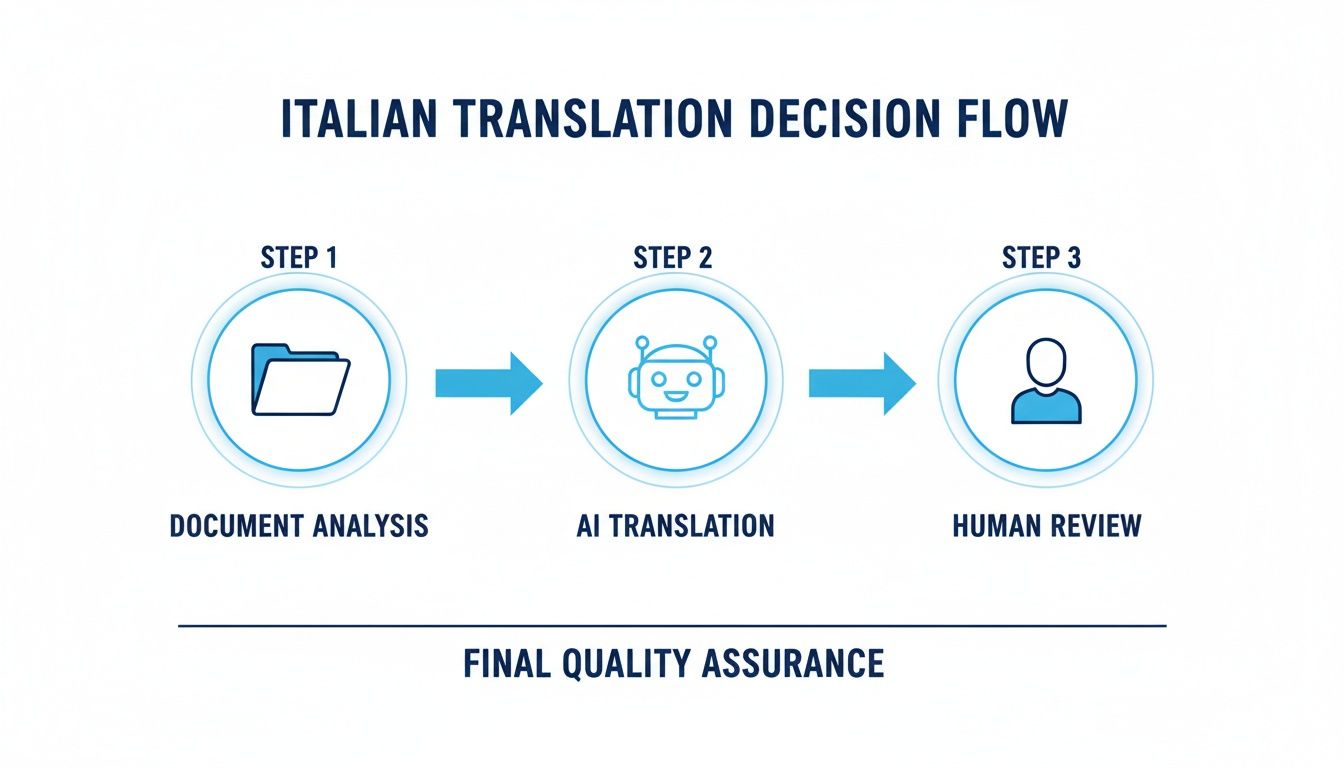
As you can see, the smart money is on a hybrid approach. AI gives you that initial burst of speed, but the human review is what really brings the accuracy and nuance home.
Handling Standard Word Documents
Let's start with the easy one: Microsoft Word files (.docx). These are generally the friendliest format for translation. Almost every tool out there, from AI platforms to the professional CAT (Computer-Assisted Translation) software used by human translators, plays nicely with them. They do a great job of keeping your formatting—think bold text, headings, and bullet points—right where it should be.
But there are a couple of "gotchas" to watch out for:
- Tracked Changes and Comments: If your Word doc is full of review feedback, you need to decide if that needs translating too. Some tools will just strip all that metadata out, so the safest bet is usually to accept all changes and clear the comments before you begin.
- Embedded Objects: This is a big one. Charts from Excel, graphs, and SmartArt can be a real pain. The text inside these objects often isn't "visible" to translation software. A solid workaround is to pull that text out, translate it on its own, and then manually pop it back into the chart or graph in the finished document.
The Challenge of Translating PDFs
Ah, PDFs. They are notoriously tricky because they're built to be a final, un-editable product. When you try to translate a document from Italian that’s a PDF, you're faced with a few options, and none are perfect.
Trying to translate a PDF directly usually results in a scrambled mess. A much better path is to first convert the PDF into an editable format, like a .docx file. There are plenty of online converters and tools like Adobe Acrobat Pro that can do this, but the quality of the conversion really depends on how complex the original PDF is. If you want to get into the weeds on why editable formats are so much better for this work, check out our comparison of EPUB vs PDF for AI translation.
My Pro Tip: Always, always try to get your hands on the original source file—whether it's the Word doc, the InDesign file, or whatever it was made in. This one step will save you more time and frustration than anything else.
Working with Scanned or Image-Based Files
So, what happens if your Italian document is just a scan, a photo, or a PDF that's basically just a picture of text? In these cases, translation software is blind; it just sees pixels, not actual characters. This is where Optical Character Recognition (OCR) technology comes to the rescue.
OCR software scans the image and intelligently converts the visual text into real, editable text that a computer can read. Many modern translation tools actually have OCR built right in. Once the text is extracted, you can treat it just like a regular Word document.
Be warned, though: the quality of the OCR is only as good as the quality of the scan. A blurry, low-resolution image will lead to a ton of errors, meaning you'll have to do a thorough proofread before you even start translating.
When You Need a Specialist: Translating Books and Ebooks with AI
Translating a book or an ebook from Italian isn't like running a business memo through a standard tool. When you're dealing with a novel, a dense research paper, or any kind of long-form content, those generic translators just don't cut it. They often butcher the very things that make a book work: chapter breaks, dialogue flow, and the author's unique voice. This is exactly why specialized AI translation platforms have become so essential.
These tools are built from the ground up to understand what a book is. They don't just see a wall of text; they recognize the structure. This means your chapters won't bleed into one another, your footnotes will stay put, and the ebook's layout remains intact—a common disaster zone for general-purpose translation software.
The Italian language is a huge market, with around 85 million speakers across the globe. For authors and publishers, that's a massive potential audience. And it's a two-way street. Italy has over 46 million digitally active people, but English proficiency isn't as high as in other parts of Europe. This makes a high-quality, natural-sounding translation a critical tool for anyone wanting to reach that market. For a deeper dive, some great insights on the Italian market as a growth strategy are available on latinobridge.com.
Keeping the Author's Voice Alive
Let's be honest, the soul of a book is its narrative voice. A clunky, literal translation can turn a beautiful, poetic Italian novel into something that sounds like it was written by a robot. This is where a tool like BookTranslator.ai really shines. It's trained on massive libraries of literature, which helps it pick up on the subtle nuances of tone, style, and authorial intent.
The whole process is designed to be straightforward: you upload your EPUB, pick your languages, and the AI gets to work, focusing on preserving not just the words, but the feel of the original.
This is so important because literary translation is about recreating an experience for the reader. The AI needs to be smart enough to handle idioms, cultural references, and the unspoken emotion packed into a line of dialogue. It’s about context, not just conversion.
Using Glossaries to Maintain Consistency
One of the most practical features of these specialized platforms is the glossary function. Think about translating an entire Italian fantasy series. How do you make sure that character names, made-up places, and unique magical terms stay the same across hundreds of pages? It's a logistical nightmare to do manually.
A glossary basically serves as a rulebook for the AI. You get to define exactly how key terms should be translated, and the platform enforces those rules consistently across the entire manuscript. This is how you avoid amateurish mistakes and deliver a polished, professional final product.
Here are a few ways a glossary becomes your best friend:
- Character and Place Names: Lock in the English spelling of names so you don't get weird variations. For instance, you can decide if "Giovanni" should remain "Giovanni" or become "John" and stick with it.
- Key Concepts: For non-fiction, this is a lifesaver. You can ensure a term like "sviluppo sostenibile" is always translated as "sustainable development," with no exceptions.
- Stylistic Choices: You can even use the glossary to guide the tone. If a certain Italian phrase should always have a formal or informal feel in English, you can set that rule.
By taking advantage of these purpose-built tools, authors and publishers can finally translate their Italian books for a global audience with confidence, knowing the heart of their story will still be there on the other side.
How to Proofread and Edit Your Translation
You’ve got your translated text back from Italian. That's a huge milestone, but don't hit "publish" just yet. The next step is all about quality control, and it’s what separates a document that's just okay from one that’s truly professional and polished. Think of it as refining the raw output to make sure it not only makes sense but actually connects with its intended audience.
Before diving in, it’s really helpful to understand the key distinction between editing and proofreading. They aren't the same thing. Proofreading is that final, meticulous check for any lingering typos, punctuation errors, or grammatical slips. Editing, on the other hand, takes a wider view, focusing on improving the flow, style, tone, and cultural resonance of the text.
Practical Review Techniques
Believe it or not, you can do a pretty solid first-pass quality check even if you don’t speak a word of Italian. One of the most effective tricks of the trade is reverse translation (sometimes called back-translation).
Here’s how it works: take the English translation and feed it back into Italian using a different translation tool. It’s not a perfect science, of course, but it’s fantastic for flagging major discrepancies. If the re-translated Italian looks nothing like your original source document, that’s a big red flag that something important got lost or twisted in the first translation. AI systems are getting quite good at this kind of cross-checking, and you can learn more about how AI detects translation errors in our guide.
Another practical step is a simple format check. Just run through the document and look for:
- Consistency: Are you seeing the same key terms translated consistently throughout?
- Numbers and Dates: Have numerical formats been localized? For example, dates in Italy are often written DD/MM/YYYY.
- Proper Nouns: Double-check that names of people, brands, and places haven’t been accidentally translated or misspelled.
A classic rookie error is assuming a direct, word-for-word translation will work. Italian is far more flexible with its sentence structure than English, and idioms are a minefield. The common Italian phrase "in bocca al lupo" literally means "in the wolf's mouth," but it's their way of saying "good luck." A simple machine translation would miss that entirely.
The Role of a Native Speaker Review
If your document is going to be client-facing or public in any way, getting a native Italian speaker to review it is absolutely non-negotiable. This is your ultimate safety net. It's the only way to catch all the subtle cultural nuances and linguistic quirks that both AI and non-native speakers will almost certainly miss.
A native reviewer does so much more than spot grammar mistakes. They'll make sure the tone is spot-on—for instance, knowing when to use the formal Lei versus the informal tu. They will catch cultural blunders and swap out clunky, literal translations for idioms that sound completely natural to an Italian ear. That final human touch is what makes your document not just communicate, but communicate with credibility.
Finding and Hiring Professional Translation Services
When a machine translation just won't cut it for your most important documents, it’s time to call in a professional. This is a non-negotiable step for anything official, client-facing, or legally binding. Whether you go with a freelance translator or a larger agency, getting a top-notch translation starts well before a single word is changed.
The first thing you need to do is get your details in order for an accurate quote. Don't just fire off the file and hope for the best—context is king. A true professional will need to know the document's total word count, the specific subject matter (is it legal, medical, or marketing?), and your deadline. These three things are the biggest factors in the cost and timeline of your project.
Understanding Pricing and Vetting Professionals
Once you start getting quotes, you’ll likely see two main pricing models: per-word and hourly. The per-word rate is the industry standard for most documents and gives you the clearest picture of your costs right from the start. Hourly rates are usually saved for more creative or nuanced tasks like copy editing or transcreation, where the job is more about adapting a message than a direct translation.
Before you sign on the dotted line, you absolutely must vet the translator or agency. A great translator will have a clear specialization. Think about it: you wouldn't hire a legal expert to translate a flashy marketing campaign, and you wouldn't ask a marketing guru to handle a complex medical device manual.
Look for these signs of a real pro:
- Subject-Matter Expertise: Does their portfolio or website show actual experience in your field?
- Client Reviews and Testimonials: What are past clients saying? Look for comments on reliability, communication, and, of course, the quality of the work.
- Native Speaker of the Target Language: The best translations almost always come from someone translating into their native tongue. An Italian native is perfect for translating from English, but for translating into Italian, you want a native Italian speaker.
The Importance of Certified Translations
For official documents—things like birth certificates, academic transcripts, or legal contracts that need to be submitted to a government agency—you’ll almost certainly need a certified translation. This isn't just a high-quality translation; it's a formal process that adds a layer of legal weight.
A certified translation comes with a signed statement, often called a Certificate of Accuracy, from the translator or agency. This document formally declares that the translation is a complete and accurate reflection of the original document, to the best of their professional ability.
This certification is what gives institutions the confidence they need to accept your translated document as official. Demand for certified translations is especially high in regulated fields like healthcare and law, where a single mistake can have serious consequences.
Interestingly, even with the rise of AI, these fields still rely heavily on human experts. Many translators now use a hybrid model, using machine translation to create a first draft before a human expert steps in for the critical post-editing, proofreading, and certification. To get a better sense of how the industry is evolving, you can explore detailed translation statistics on Redokun. This blended approach combines efficiency with the unshakeable accuracy required for official use.
Answering Your Top Questions About Italian Document Translation
When you're faced with a document in Italian that needs to be in English, a lot of questions pop up. It’s completely normal. Getting these sorted out from the start can save you a world of headaches, whether you're translating a legal contract, a family history, or your company's latest manual.
Let's walk through the questions I hear most often from clients.
What's This Going to Cost Me?
This is usually the first thing people ask, and the honest answer is: it depends. The price for translating a document from Italian can swing wildly based on the route you take.
If you just need the gist of an email from a colleague, a free AI tool might do the trick. But for anything more serious, you'll be looking at professional human translation. This is usually priced per word, with rates typically falling between $0.10 and $0.30. The final cost is shaped by a few key factors, like how technical the language is, how quickly you need it, and the translator's specific area of expertise.
Can I Just Use an App for My Official Paperwork?
This is a big one, especially for things like immigration forms, academic transcripts, or legal contracts. The answer here is a hard no. For any document that needs to be submitted to an official body, a certified translation is non-negotiable.
These organizations need absolute certainty that the translation is a faithful, accurate, and complete version of the original. An AI-generated text just doesn't come with that guarantee.
So, what makes a translation "certified"? It's a formal statement signed by the translator or translation agency. This document, often called a "Certificate of Accuracy," confirms that the translation is a true and correct representation of the Italian original. It's the professional seal of approval that institutions require.
You might also run into other terms like "notarization" or "Apostille," especially if the document is for international use. These are distinct legal processes. If you're unsure, it’s worth a moment to understand the difference between an Apostille and a Notary Public.
How Long Will I Have to Wait?
Naturally, you want to know when you'll get your translated document back. The timeline really hinges on which path you choose.
- AI Translation: You'll have your text in seconds. It’s pretty much instant.
- Professional Translation: A seasoned human translator can realistically work through about 2,000 to 2,500 words in a standard workday. The total time for your project will depend on its length and the translator's availability.
My advice? Always confirm the deadline with your translator before the project kicks off. Trying to rush the job often leads to higher costs and, more importantly, a greater chance of errors. You hired an expert for their precision, so give them the time to deliver it.
If you’re an author or publisher with an entire book to translate from Italian, you're playing a different ballgame. Standard document tools just can't handle the nuances of a full-length EPUB.
BookTranslator.ai was built for this exact challenge. It's designed to manage long-form content, preserving the voice, chapter structure, and formatting of your original work. You can get a professional-grade translation of your book in minutes. Check it out at https://booktranslator.ai.