
Before a single word of your book is translated into English, the real work begins. The secret to a great translation isn't just about the words; it’s about thorough preparation of your original manuscript and creating a clear guide for all the unique elements that make your story yours. Getting this foundation right makes the whole process smoother and ensures the final product feels just as authentic as the original.
Your Pre-Translation Checklist
Taking your story to a global audience is a massive step. A successful launch, however, really hinges on the prep work you do upfront. If you rush into translation without a solid plan, you're asking for inconsistencies, formatting nightmares, and a final version that feels like a shadow of the original.
Think of it like building a house. You wouldn't start putting up walls without a solid foundation. This pre-translation phase is your foundation.
This isn’t just about handing over a file. It’s about setting your project up for success from the very beginning. It doesn't matter if you're using a sophisticated AI tool or working with a human translator—the quality of what you put in directly impacts the quality of what you get out. A clean, well-prepared manuscript is the most important asset you have.
Get Your Manuscript Into a Standard Format
First things first, you need to get your book into a universal format that's easy to work with. You might have written it in a niche program, but the translation workflow needs a stable, accessible file type.
- DOCX Files: This is the gold standard, hands down. It's universally compatible, easy for human translators to use with change-tracking tools, and simple for AI platforms to process.
- EPUB Files: If your book is already an ebook, a clean EPUB file is a great starting point. Many modern translation services can work with EPUBs directly, which helps preserve your original layout and structure.
- Plain Text (TXT): This is a last resort. A TXT file strips out all formatting—italics, bolding, chapter breaks—which means you'll have to re-apply everything later. Only use this if you have no other option.
Whatever format you land on, make absolutely sure it’s the final, fully edited version. Translating a work-in-progress is a recipe for headaches and extra costs, as every single change means going back to re-translate and review.
A clean source file isn't just a "nice-to-have"—it's non-negotiable. Typos, messy formatting, and stray comments in your original manuscript will multiply into confusion and errors in the English version. That means more time and more money spent fixing avoidable mistakes.
Create a Glossary and Style Guide
Every book has its own unique world. You've got specific terms, character names with hidden meanings, and a narrative voice that's all your own. To protect these crucial elements, you need to create a simple guide for your translator, whether it's a person or an AI.
This doesn't need to be some massive, formal document. A simple glossary can work wonders.
Here's what it should include:
- Key Character Names: List them all out to keep the spelling consistent. If a name has a specific cultural meaning, add a quick note about it.
- Unique Places or Concepts: Got fictional cities, magical systems, or made-up slang? List them here with a short definition.
- Recurring Phrases or Idioms: Note any catchphrases or idioms that are key to a character's personality or the story's theme. You can even suggest the tone you'd like to capture in English.
A simple guide like this prevents a character named "Javier" from suddenly becoming "Xavier" halfway through the book. For a much deeper look at what to prepare, this checklist for translating books is a fantastic resource. A little bit of prep work here goes a long way in making sure your authorial voice shines through, loud and clear.
Choosing Your Translation Method
Once your manuscript is polished and ready, you’ve hit a major fork in the road. How you choose to translate your book into English will have a massive impact on your budget, your timeline, and the final quality of the work. This isn't just about finding the cheapest or fastest route; it’s about matching the translation method to your book’s unique personality and your ultimate goals.
You've got three main paths to consider. Let's break them down with some real-world scenarios to help you figure out where your project fits.
The Rise of AI-Powered Translation
Let's be honest: purely AI-driven translation has completely changed the game, especially for indie authors and anyone watching their budget. Modern AI tools can chew through an entire novel in a matter of minutes, spitting out a full first draft for a tiny fraction of what a human translator would charge.
Imagine you've written a fast-paced science fiction series and want to get it in front of an English-speaking audience while the genre is hot. In this scenario, an AI-first approach makes a ton of sense. It does the heavy lifting, handling the literal word-for-word translation so you can pour your time and money into a solid final edit.
This isn't just a fringe idea anymore. The technology is getting better at a staggering pace. Recent studies show that over 70% of independent language professionals in Europe now use machine translation in their workflow. Even on the corporate side, 39% of marketers incorporate machine translation into their localization strategies, which shows a growing trust in its output.
Key Takeaway: For genre fiction like thrillers, romance, or sci-fi—where plot and pacing are king—AI offers an unbeatable mix of speed and affordability. It’s the perfect tool for authors who need to move fast and keep costs down.
The Craft of Professional Human Translation
On the other side of the coin, you have professional human translation. Think of this as the artisanal, handcrafted approach. It’s reserved for books where every single word, every comma, carries significant weight.
Picture a lyrical work of literary fiction, a deeply personal memoir, or a book of poetry. These projects are all about subtle wordplay, cultural nuances, and a distinct authorial voice—things an algorithm can easily fumble. A human translator does more than just swap words; they act as a cultural interpreter, carefully re-crafting metaphors and preserving the rhythm of your prose so it sings in English.
This route is definitely an investment. Timelines are much longer, often stretching over several months, and the costs are significantly higher, usually billed per word. But for a publisher chasing literary awards or an author whose legacy is built on their unique style, that investment is non-negotiable.
This chart illustrates the basic workflow. Notice that no matter which path you take, it all starts with a clean manuscript and a well-prepared glossary.
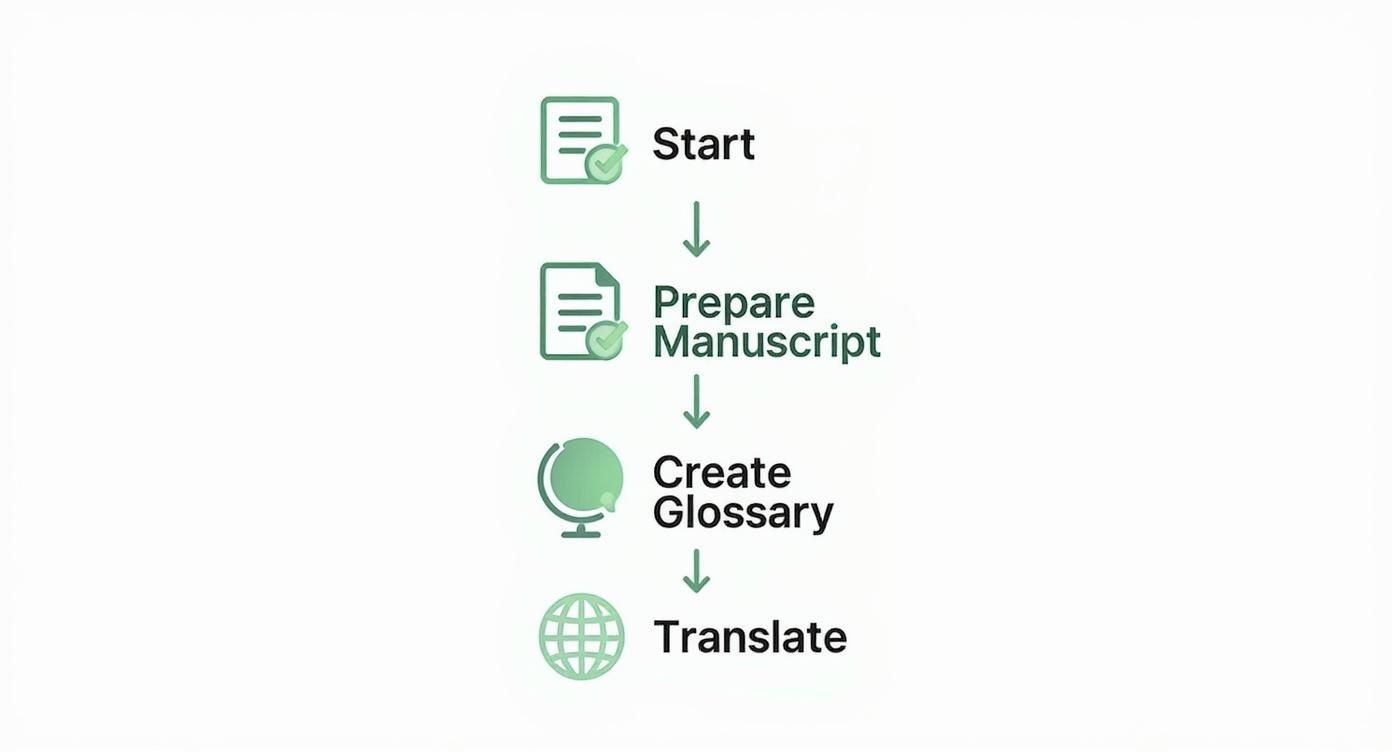
This simple visual makes a crucial point: solid preparation is the foundation for a quality translation, regardless of the tools you use.
The Best of Both Worlds: A Hybrid Approach
For many authors and publishers, the sweet spot is found somewhere in the middle. The hybrid model, which pairs AI translation with professional human post-editing (PEMT), gives you a fantastic balance of speed, cost, and quality.
Here’s the breakdown of how it typically works:
- First, an AI platform generates the initial translation of the entire book.
- Then, a professional human editor, who is a native English speaker, goes through that AI draft with a fine-toothed comb.
- Their job is to fix any awkward phrasing, correct errors, smooth out the flow, and inject the cultural nuance and voice the AI missed.
This approach is much faster and more affordable than a full human translation, but the final product is worlds away from a raw, unedited AI output. It's an excellent choice for non-fiction, technical guides, or commercial fiction where you need both accuracy and a natural, readable style. Many of the same principles apply when you translate digital products for international markets using tools like Google Docs, so it's a useful skill to understand.
Comparison of Book Translation Methods
To help you visualize the trade-offs, here’s a table comparing the three main approaches side-by-side.
| Factor | AI Translation | Human Translation | AI + Human Post-Editing (Hybrid) |
|---|---|---|---|
| Cost | Very Low (often a flat fee or per-word rate of <$0.01) | High (typically $0.12 - $0.25+ per word) | Moderate (a blend of AI cost + editing fees) |
| Speed | Extremely Fast (minutes to hours) | Slow (weeks to several months) | Fast (days to a few weeks) |
| Quality | Variable; good for gist, but lacks nuance and flow | Very High; captures voice, culture, and literary style | High; combines AI efficiency with human refinement |
| Best For | Genre fiction, rapid market entry, tight budgets, first drafts | Literary fiction, poetry, memoirs, high-prestige projects | Commercial fiction, non-fiction, balanced projects |
This table should give you a clear snapshot of where each method shines. For a much more granular analysis, our guide on AI vs. human book translation really gets into the weeds on the pros and cons of each.
Ultimately, this decision comes down to what you value most. Are you optimizing for speed, cost, or artistic perfection? By understanding the strengths of each path, you can make a smart choice that brings your story to its new English-speaking audience in the best way possible.
Preserving Your Authorial Voice and Formatting
A great translation does more than just swap words; it captures the soul of your story. When you translate a book into English, you're handing over its very essence—your humor, your carefully built tension, the unique rhythm of your prose. Nailing this is what separates a book that feels truly yours from one that just falls flat.
This is a two-front battle. On one side, you have to protect your authorial voice so that witty dialogue doesn’t turn robotic. On the other, you have to manage the technical stuff to make sure your book's layout doesn't become a complete train wreck.
Guiding the Nuance of Your Voice
Your authorial voice is your book's DNA. It’s the sarcastic jab from your main character, the poetic descriptions of a fantasy kingdom, or the sharp, minimalist sentences in a thriller. A straight, literal translation often strips all that magic away.
The best way to prevent this is by providing clear guidance, whether you're working with a human translator or refining prompts for an AI tool. I've found that creating a simple "voice and tone" guide works wonders.
Here’s what to put in it:
- Character Briefs: For each main character, write a quick paragraph describing their personality, how they talk, and any signature phrases they use. Does a character speak formally, or are they constantly using slang?
- Contextual Notes: Flag any passages with double meanings, puns, or cultural jokes that won’t make sense in English. You have to explain the original intent so your translator can find a clever equivalent.
- Overall Tone: Is the book's mood satirical, somber, academic, or playful? Give a few examples directly from your text to show exactly what you mean.
Think about it: if a character’s humor is all dry understatement, a literal AI translation might read their lines as serious, completely missing the point and changing their personality. Your notes are the map that guides the translation to capture the feeling, not just the words.
A translator’s duty isn’t just a "faithful" transcription of words. It is to produce a work of literature that reads with the same ease, nimbleness, and vitality as the original. A clunky, overly literal translation diminishes the source material, even if every word is technically correct.
Protecting Your Book's Structure and Layout
Beyond the words, a book's structure is critical to the reader's experience. Chapter breaks control pacing, footnotes add crucial context, and embedded images bring the story to life. When you translate a book to English, especially from formats like EPUB, preserving that layout is a technical challenge that can sneak up on you.
One bad file conversion can leave you with a mess. Chapter headings might bleed into the main text, italics could vanish, and footnotes might become a jumbled mess at the end of a paragraph. The result is an unprofessional-looking book that will take you hours to fix by hand.
To dodge this bullet, focus on a few key technical preparations:
- Start with a Clean File: Before you do anything else, make sure your source file (DOCX or EPUB) is perfectly formatted. Get rid of stray comments, fix any inconsistent heading styles, and ensure your images are anchored correctly.
- Check Format Compatibility: If you're using a translation tool, double-check that it fully supports your file type and all its formatting. The better platforms are built to recognize and maintain the structural tags inside EPUB files.
- Spot-Check Key Elements: As soon as you have an initial translation, immediately check the important stuff. Are chapter breaks where they should be? Are bulleted lists still formatted correctly? Have any special characters survived the trip?
For anyone working with ebooks, getting this technical side right is a non-negotiable. Our EPUB translation guide on preserving format and style goes much deeper into handling these complex files. A little time spent here will save you from a massive formatting headache later, ensuring your book looks just as good in English as it did in its original language.
Budgeting and Quality Control for Your Translation
https://www.youtube.com/embed/1lBmzfdwDHs
Alright, let's talk about the two things that can make or break your translated book: the budget and the quality. Getting the words right is one thing, but if you don't manage the money side of things or have a solid plan for quality checks, you're setting yourself up for a headache.
Thinking about costs upfront helps you set realistic expectations. And a smart quality control process? That’s what takes a decent translation and turns it into something truly great—a book that readers will love.
Decoding Translation Costs
So, how much is this all going to cost? When you start shopping around for services to translate your book into English, you’ll run into a few different ways people charge. There’s no single "right" price, just the one that makes sense for your project and your wallet.
H3: Understanding the Pricing Models
AI-driven tools like BookTranslator.ai have really changed the game. They usually price based on word count or tokens, which is super straightforward. You might see a rate like $5.99 per 100,000 words, making it simple to figure out your total cost right from the start. No hidden fees, no surprises. This is a fantastic route for authors who want a fast, affordable first draft to build on.
Now, if you go the traditional route with a professional human translator, the numbers look quite different. They typically charge by the word, with rates starting around $0.12 and going up to $0.25 per word or even more. The price depends on their experience, the language they're translating from, and how complex your book is. For a typical 80,000-word novel, you can see how that adds up quickly.
There's also a great middle-ground option: the hybrid model. You use an AI tool for the heavy lifting—the initial translation—and then bring in a human editor for the post-editing polish. You get the low cost of the AI translation upfront, and then pay an editor a much more reasonable hourly or per-word rate to perfect it. It’s a smart way to balance quality and cost.
Building a Bulletproof Quality Assurance Process
Here’s the thing: a first draft is never the final product. It doesn’t matter if it came from a sophisticated AI or a seasoned human translator. The real magic happens during the quality assurance (QA) stage. This is where you sand down the rough edges and polish the text until it sings for a native English-speaking audience.
A good QA process has a few layers. Skipping any of them is a gamble you really don't want to take.
- Bring in Beta Readers: This is your secret weapon. Find native English speakers who are actually part of your target audience. A book aimed at a British audience will need a different flavor than one for American readers. Your beta readers will spot awkward phrasing or cultural references that just don't land right—things a translator might easily overlook.
- Hire a Fresh Pair of Eyes: This is non-negotiable. The person who did the initial translation or post-editing is simply too close to the text to see every little mistake. You absolutely need a separate proofreader to catch the typos, grammar slip-ups, and punctuation errors that sneak through.
- Read It All Out Loud: This is my final pro-tip. Before you hit publish, read the entire manuscript aloud. You will immediately hear the clunky sentences, the unnatural dialogue, and the places where the rhythm is off. This final check is all about making sure the story flows and your original voice is still there.
The goal isn’t just to create an accurate translation. It's to create a piece of literature that feels just as alive and effortless as the original. A stiff, literal translation can kill your story, even if every single word is technically correct.
This multi-step review process is what transforms a good translation into a professional, market-ready book. When you’re budgeting, make sure you set aside time and money for these quality checks. It's just as important as the translation itself. By investing in a solid QA strategy, you’re respecting your own work and giving your new English-speaking audience the incredible reading experience they deserve.
Untangling Copyright for Your Translated Book
It’s easy to get caught up in the excitement of translation and rush toward publishing, but hitting pause to handle the legal side is one of the most important things you'll do. The world of copyright for translated books isn't as scary as it sounds, and getting it right from the start protects your hard work and prevents major headaches later on.
When you translate a book, you’re creating something the law calls a derivative work. This is a key term to understand. It means your new English version is a separate, copyrightable piece of art that’s built on your original, copyrighted story.
This creates two distinct sets of rights:
- You (The Original Author): You still own the copyright to the core story, its characters, and the plot. Nobody can translate your work without your green light.
- The Translator: The translator holds the copyright to their specific translation—the unique combination of English words they used to bring your story to life.
Why a Translator Agreement is Non-Negotiable
Because two different copyrights are at play, a rock-solid written agreement is essential if you're working with a human translator or post-editor. This contract is your roadmap, defining everyone's rights and responsibilities so there are no surprises. A handshake deal just won't cut it.
Your agreement needs to spell out a few critical points:
- Payment: How will they be paid? Is it a flat fee for the project, a per-word rate, or hourly? When are payments due?
- Royalties: Will the translator get a cut of the book’s sales? If so, be specific about the percentage and the payment schedule.
- Credit: How will the translator be acknowledged? The industry standard is to credit them on the cover and title page.
- Ownership: This is the big one. The agreement must clearly state who owns the final translated text. Most often, authors pay a fee that makes the translation a "work-for-hire," giving the author full rights to publish and market it.
A well-crafted agreement is your best insurance policy against future disputes. It establishes clear ownership from day one, giving you the freedom to publish, distribute, and promote the English version of your book however you see fit.
The Murky Waters of AI and Copyright
AI translation tools throw a fascinating wrench into the legal works. As of now, the law is playing catch-up. In most places, copyright protection is reserved for works created by a human.
That means a raw, unedited translation spit out by an AI probably can't be copyrighted on its own. But the story changes dramatically once a human gets involved. If you use AI for a first pass and then you or a professional editor dive in to substantially rewrite, refine, and reshape the text, that heavily edited version is a different story.
The deciding factor is human creativity. The more you or an editor polishes and perfects the final manuscript, the stronger your copyright claim becomes. If you're using this hybrid approach, it’s a smart move to document your editing process. This area of law is moving fast, so keeping an eye on new developments will be key to protecting your work down the road.
Publishing and Marketing Your Book in English
You’ve done it. The translation is polished, edited, and ready to go. Now comes the exciting part—getting your story into the hands of a massive new English-speaking audience. But simply uploading the file isn't enough. To make a real impact, you need a smart approach to publishing and marketing.
This final leg of the journey is all about positioning. You'll need to handle the technical side of formatting for big retailers, but just as importantly, you have to re-think your marketing materials to truly click with readers in a new culture.
Formatting for Major Retailers
Before anyone can fall in love with your story, your book needs to play by the rules of the major platforms. Retailers like Amazon KDP, Apple Books, and Barnes & Noble Press all have their own technical guidelines to ensure every book looks great on their devices.
Think of a perfectly formatted EPUB file as your universal key. It’s the standard because it's reflowable, meaning it adjusts to fit any screen, from a tiny phone to a large e-reader.
Here’s what to look out for:
- Clean Chapter Breaks: Make sure every new chapter starts fresh on its own page, with no awkward spacing.
- A Clickable Table of Contents: This is non-negotiable. Readers expect it for easy navigation, and most stores require it.
- Properly Embedded Fonts and Images: If you've used any special fonts or have images in your book, they need to be embedded correctly so they show up for everyone, on every device.
While plenty of tools can convert a DOCX file to an EPUB, don't skip the final check. Always preview your file on as many different devices and apps as you can. A sloppy format looks unprofessional and is a surefire way to get a one-star review before anyone even reads the first page.
Localizing Your Book Cover and Blurb
Here's a hard truth: a cover that flew off the shelves in your home country might be a complete dud in the US or UK. Localization is more than just translating words; it's about adapting your marketing to fit the cultural and design expectations of a new audience.
To give your book a fighting chance, understanding essential book cover design tips for the English-language market is crucial. Genre conventions can be wildly different. A typical fantasy cover in Japan, for instance, often has a very different art style compared to its American counterpart.
Your book cover is your single most important marketing tool. You have about three seconds to get a potential reader to click. Do your homework—spend time browsing the bestsellers in your genre on Amazon to see what visual styles are working right now.
The same goes for your book blurb. This isn't just a summary; it's your sales pitch. It needs to be sharp, compelling, and written in a way that resonates with English-speaking readers. Any idioms or cultural shorthand from the original language will need to be completely reworked to land effectively.
Keywords and Categories for Discoverability
How will readers find your book among the millions of others out there? This is where strategic keywords and categories become your secret weapon. When you upload your book, you'll be asked to choose categories (like genres) and provide a list of keywords.
Put yourself in a reader's shoes. What would they type into the search bar to find a book just like yours?
- Go Niche: Instead of just "fantasy," try something more specific like "epic fantasy with dragons" or "urban fantasy with a strong female lead."
- Lean into Tropes: Readers are actively searching for their favorite tropes. Use terms like "enemies to lovers," "found family," or "chosen one."
- Spy on the Competition: Look at the bestselling books in your niche. What categories are they in? What kind of keywords do you think they're using?
English dominates the global publishing scene. According to UNESCO data, about 60% of all translated books published worldwide are originally from English. Tapping into this market means you have to make your book visible. You can dive deeper into these global translation patterns on translationpatterns.substack.com.
By taking the time to choose the right keywords and categories, you're essentially giving retailers a roadmap to hand-deliver your book to the right readers. It's the final, critical step in turning your translation project into a successful global launch.