
When you need a Spanish document translator, the first big question you'll face is whether to go with an advanced AI tool or a seasoned human expert. The right answer really comes down to what you're translating, who it's for, and how complex it is. A quick, informal email just doesn't have the same requirements as a legally binding contract.
Choosing Your Spanish Document Translator: Human vs. AI
The choice isn't always black and white. It's a trade-off between things like speed, cost, cultural nuance, and official certification. AI translators, like BookTranslator.ai, are lightning-fast and incredibly affordable. This makes them a fantastic option for translating huge volumes of text, like an entire e-book or a series of internal reports, where the main goal is just clear comprehension. You can get a whole novel translated in minutes for a flat fee.
On the other hand, human translators offer something AI still can't replicate. They get the subtle cultural context, understand the difference between Castilian and Latin American Spanish, and can nail the specific tone needed for sensitive material.
If you're dealing with anything that has legal consequences—think contracts, immigration paperwork, or court documents—a certified human translator is the only way to go. Their work is backed by a guarantee of accuracy that official bodies demand.
When AI Translation Makes Sense
AI shines when you need to get things done quickly and efficiently. It’s the perfect tool for:
- Long-form Content: Think entire e-books or hefty research papers where keeping the original layout and structure intact is a must.
- First Drafts: You can get a solid first pass done in minutes, which can then be polished by a native speaker.
- Internal Communications: Perfect for business memos, training guides, and internal wikis that your Spanish-speaking team needs to understand right away.
When You Absolutely Need a Human Translator
Some projects just need that human expertise. You'll want to hire a professional for:
- Certified Documents: Anything legal, medical, or academic that needs a signed certificate of accuracy.
- Creative Works: Marketing slogans, literary fiction, and poetry are filled with wordplay and cultural idioms that AI often misses.
- High-Stakes Content: Business contracts or user agreements where a single mistake could lead to serious financial or legal trouble.
This table helps you quickly decide which translation method is best suited for your specific document type and needs.
Quick Comparison: AI vs. Human Translation
| Factor | AI Translator (e.g., BookTranslator.ai) | Human Translator |
|---|---|---|
| Speed | Extremely fast; translates thousands of words per minute. | Slower; a professional typically translates 2,000-3,000 words per day. |
| Cost | Very low, often a fixed fee or a few cents per word. | Higher, priced per word or per hour, starting around $0.10/word. |
| Nuance & Context | Good at literal translation but can miss cultural subtleties and idioms. | Excellent at capturing tone, style, and cultural relevance. |
| Consistency | Perfectly consistent with terminology across the entire document. | Can have minor inconsistencies, though professionals use tools to minimize this. |
| Certification | Cannot provide legally certified translations. | Can provide certified translations for official use (legal, immigration, etc.). |
| Best For | E-books, internal reports, first drafts, and large-volume content. | Legal documents, marketing copy, literary works, and high-stakes business contracts. |
Ultimately, weighing the pros and cons of machine vs. human translation is about matching the tool to the job.
The global demand for language services, including document translation, has ballooned into an estimated $71.7 billion market in 2024. This boom just goes to show how critical professional Spanish translators remain, especially in legal, medical, and technical fields. You can dig into these market trends over at Nimdzi.com.
Sometimes, the smartest move is a hybrid approach. You can use an AI tool for the initial heavy lifting and then have a human expert come in for the final polish. This process, known as post-editing, gives you the best of both worlds: speed from the machine and nuanced accuracy from a person.
For a deeper dive into how this plays out for different audiences, take a look at our guide on AI vs. traditional translation for local audiences.
Preparing Your Documents for a Flawless Translation
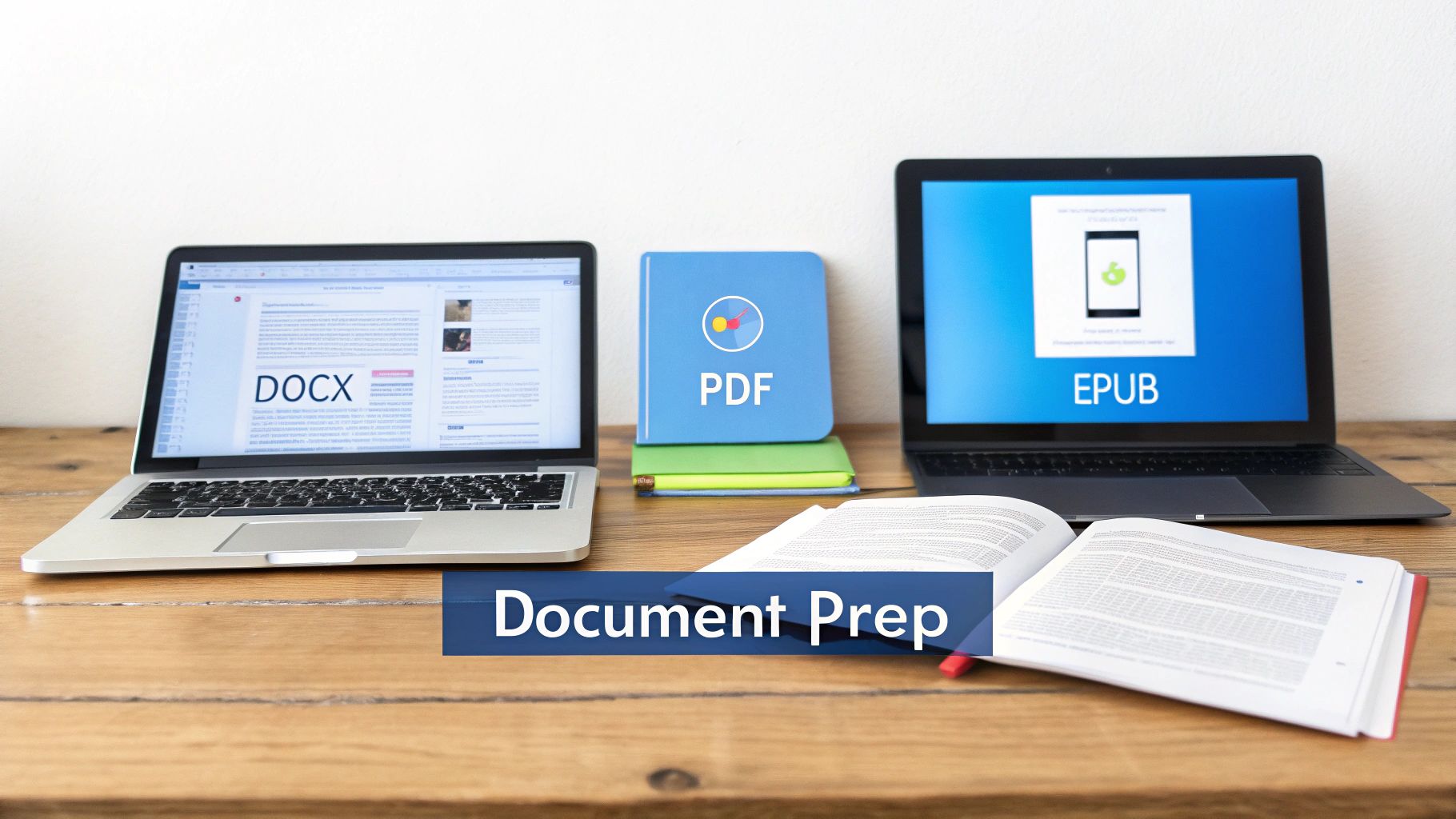
The secret to a great translation isn't just about picking the right spanish document translator. Honestly, a lot of the magic happens before the translation even begins.
Taking the time to prep your documents is one of those things that seems small but can save you from a world of headaches—frustrating errors, surprise delays, and even extra costs. Think of it like a chef doing their mise en place. Prepping the ingredients makes the entire cooking process smoother and the final dish that much better.
Your source document is the blueprint. Any little quirk, unresolved comment, or formatting mess will almost certainly be carried over, and often, it gets magnified in the translated version. A quick cleanup ensures that whether you're using a human or an AI, they have a crystal-clear, final version to work from.
Finalizing Standard Documents Like DOCX and PDF
For your everyday files like Microsoft Word (DOCX) or PDFs, the prep work is pretty straightforward but absolutely non-negotiable. The aim here is to create a "locked-in" version of your text.
Before you upload or send anything off, run through this simple checklist:
- Accept or Reject All Tracked Changes: This is a big one. Leftover tracked changes in a DOCX file can completely confuse translation software, sometimes causing it to skip entire sections or translate deleted text. Finalize every single edit.
- Delete All Comments: Just like tracked changes, comments and annotations can be accidentally picked up by automated systems as part of the main text. This can lead to some very strange and out-of-place sentences in your final translation.
- Make Sure Your PDF Text is Selectable: If you’re starting with a PDF, do a quick check. Can you click and highlight the text? If you can't, it's likely an image-based PDF, which most tools can't read. The text has to be "live" for a translator to work with it.
A clean, finalized source file is the single most effective way to prevent costly and time-consuming revision rounds. Trust me on this—many translation services will charge extra for having to re-process a file submitted with unresolved edits.
Preparing Ebooks and Complex EPUB Files
Now, when you get into translating an entire ebook, especially in a format like EPUB, you have to be a bit more meticulous. This is especially true when working with a specialized AI service like BookTranslator.ai. These files aren't just a wall of text; they're intricate packages of content and structural data that tell an e-reader how to display everything from chapters to images.
The whole game here is preserving that structure. Modern AI translators are built to recognize and maintain your original layout, but a well-prepared file gives the AI the best possible chance to produce a professional, polished result.
Key EPUB Prep Steps:
- Check Your Chapter Breaks: Make sure your book is properly divided into chapters within the EPUB file itself. This structure is what helps the AI maintain the narrative flow and ensures the final translated ebook is easy for readers to navigate.
- Manage Your Images: Does your ebook have images with text baked into them, like diagrams or infographics? That text won't be translated automatically. You'll need a plan: either replace them with text-free versions ahead of time or have them translated separately and swapped in later.
- Review the Metadata: Every EPUB has metadata—the book’s title, author, publisher info, etc. Double-check that all of this is correct before you start, as it will be carried over directly into the new translated version.
Getting your files right from the start is about more than just accurate words; it’s about creating a final document that looks and feels professional. For a deeper dive, you can explore our guide on the top tools for translation-friendly formatting.
Understanding Translation Costs and Turnaround Times
Let's get right to it and talk about the two things that drive every project: money and time. When you’re looking for a Spanish document translator, figuring out the costs and how long it'll take can feel like guesswork. But once you understand the different pricing models out there, you can budget properly and set realistic deadlines.
You’ll find the translation world is mostly split into two camps. Traditional human translators almost always charge by the word. It's the industry standard. On the other hand, AI translation services, like BookTranslator.ai, lean towards fixed-fee packages or subscriptions, which makes budgeting for a big project, like a whole book, much simpler.
This is a really important distinction. A per-word rate can balloon based on how complex your document is, whereas a fixed cost tells you the exact price from the get-go. No surprises.
What Drives Translation Costs Up
A handful of factors can seriously inflate the final bill, whether you’re using a human translator or an AI platform. It’s almost never just about the word count.
Here are the usual suspects that push prices higher:
- Certified Translations: If you need a translation for something official, like an immigration document or court filing, it has to be certified. That extra layer of formal verification always costs more.
- Technical Content: There's a world of difference between translating a casual blog post and a dense medical study. Specialized content requires a subject matter expert, and that expertise comes at a premium.
- Rush Fees: Need it done yesterday? You’ll pay for it. Tight turnarounds often come with hefty rush fees that can tack on an extra 25% to 100% to the base price.
For human translation, you’ll see these factors reflected in the rates. A general document might run you between USD 0.10 and USD 0.20 per word. But for highly technical or certified work, you could be looking at USD 0.25–0.35+ per word. You can get more details on what goes into Spanish translation costs on speakwrite.com. This is exactly where AI’s flat-rate pricing becomes a huge advantage for any project that doesn’t require official certification.
My advice? Before signing off on any translation project, demand a detailed quote. Make sure it breaks down every single line item. You want to ask about any potential charges for file prep, formatting, or review cycles to avoid nasty surprises on the final invoice.
AI Cost Models and Turnaround Times
AI platforms completely change the game by focusing on speed and volume. Instead of billing by the word, they often use a straightforward flat rate per project or offer subscriptions if you have ongoing translation needs. For a more detailed breakdown, we wrote a whole guide on what to expect from AI translation costs.
But where AI really shines is its incredible speed.
A professional human translator might need a full week, maybe more, to get through a 100,000-word book. An AI tool can process that same project—layout, formatting, and all—in just a few minutes. That massive time-saving is a game-changer for anyone who needs to publish, share, or launch their work fast.
Putting It All Together: A Modern Translation Workflow
So, how does all this theory actually play out in a real project? Let's walk through a typical workflow, say, for translating a full-length ebook using a service like BookTranslator.ai. This isn't just a matter of dumping text into a black box; it's a smart process built to respect and preserve all the work you put into your original document.
It all starts with a simple file upload. Once you've polished your manuscript—finalizing edits, stripping out comments, and getting your DOCX, PDF, or EPUB file just right—you pop it into the platform. That one action sets the whole automated process in motion.
What happens next is where the magic lies. The system doesn't just see a wall of text. It intelligently scans the entire document, identifying every heading, chapter break, paragraph, and even the small stylistic choices like bold or italic text. This deep structural analysis is what separates modern tools from the old, clumsy copy-paste methods that would obliterate your formatting.
From Upload to First Draft in Minutes
With the document's structure mapped out, the AI gets to work on the actual translation. It processes your text chunk by chunk, translating the content while simultaneously cross-referencing its structural map. This is how a chapter heading in English seamlessly becomes a correctly placed chapter heading in Spanish.
The speed is frankly astounding. A book that might take a human translator weeks of painstaking work can be fully translated and reassembled in just a few minutes.
When it’s done, you get a link to download your file in the exact same format you uploaded. This isn't a plain text file—it's your complete document, ready to go, mirroring the original layout. Your ebook still has its chapters, your business report still has its tables, and your technical manual still has its neatly formatted lists.
The biggest leap forward in today's translation workflow is format preservation. You’re not just getting back a bunch of translated words; you’re getting a translated product that looks and feels just as professional as the original, saving you from days of tedious reformatting.
Review and Refinement: The Human Touch
Now that you have the AI-generated draft, the process shifts to quality control. The machine has done the heavy lifting, but the human eye is indispensable. I always start with a quick spot-check to make sure the formatting held up as expected.
Are the chapter breaks where they should be? Do the tables look right? Is the overall structure solid?
Once that's confirmed, it's time for the linguistic review. AI translation is incredibly good, but this is where a native Spanish speaker reads through the text to iron out any awkward phrasing or cultural nuances that the machine might have missed. This combination of AI speed and human oversight is the hallmark of an effective modern Spanish document translator process. You get the best of both worlds: machine efficiency and the crucial final polish that only a person can provide.
This flowchart illustrates the key elements that typically determine the cost of a translation project.
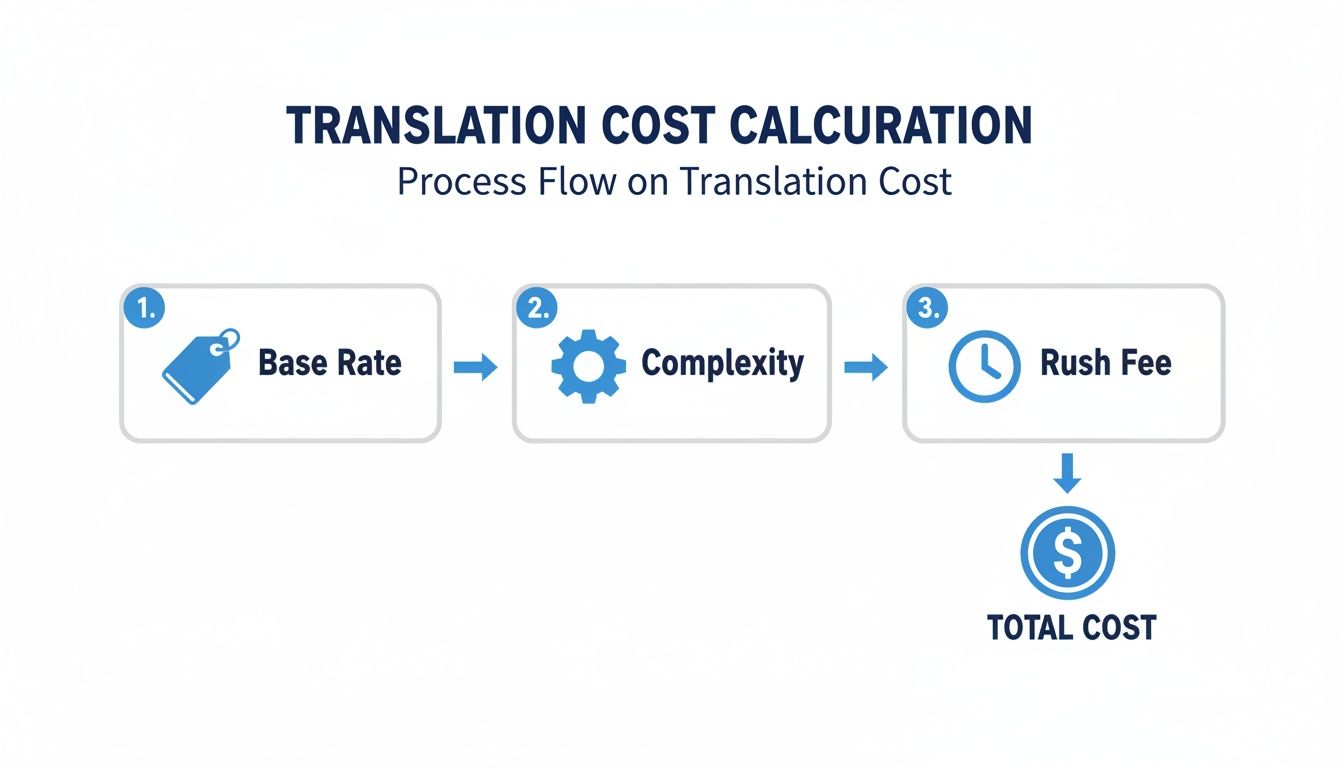
As you can see, the final price is usually a function of the base rate per word, modified by factors like document complexity and whether you need the job done in a hurry.
Mastering Quality Control and Post-Translation Editing
Whether you've used an AI tool or a professional translator, the first version you get back is just that—a first draft. The real magic, where a good translation becomes truly great, happens during the quality control stage. This is what separates a document that's simply understood from one that genuinely connects with a Spanish-speaking audience.
Think of post-translation editing as more than just a spell-check. It's a comprehensive review that dives deep into everything from grammatical precision to cultural resonance. For any document that carries your brand's name, your research, or your creative voice, this step is absolutely essential.
Spanish is a huge language, not just in the number of native speakers but also in its business importance, making it a top priority for localization. As you can see from these online language trends, the demand is only growing. The need for a thorough quality check is even more obvious when you consider the subtle but critical differences between dialects, like the Spanish used in Mexico versus Spain.
The Role of a Native Speaker Review
Getting a native Spanish speaker to review your translated document is the gold standard for a reason. They have an intuitive grasp of the language that even the smartest software can't replicate, catching awkward phrasing or idioms that don't quite hit the mark.
Here’s a good way to look at it: an AI might give you a structurally perfect building, but it’s the native speaker who furnishes it and makes it feel like a home. They’ll adjust the tone, check for appropriate cultural references, and make sure the text flows naturally.
A simple proofread will catch typos. A deep native speaker review ensures cultural connection and emotional impact. One gives you correctness; the other gives you resonance.
Your Quality Control Checklist
When it's time to review the translation, either by yourself or with a professional editor, it helps to have a system. A focused approach keeps you from getting bogged down and helps you give clear, constructive feedback.
Here's a practical checklist I use to guide my own reviews:
- Accuracy: First and foremost, does the Spanish text perfectly capture the meaning of the original? Double-check all critical data, names, and any technical jargon.
- Consistency: Is the terminology used consistently? For example, if you settle on "cliente" for "customer," stick with it. Don't switch back and forth between that and "usuario."
- Cultural Nuance: Are there any phrases, jokes, or examples that might fall flat or be misinterpreted by your specific Spanish-speaking audience? What’s funny in English might be confusing or even offensive in another culture.
- Tone and Style: Does the translation's voice match the original's intent? Whether it's formal, casual, academic, or marketing-focused, the style needs to be a perfect mirror.
By giving the review process the attention it deserves, you guarantee your final document is polished, professional, and ready to make an impact. This final pass is what makes any Spanish document translator, human or AI, a truly valuable tool in your arsenal.
Answering Your Spanish Document Translation Questions
Diving into document translation, especially with something as important as a legal contract or your next novel, naturally brings up a lot of questions. Getting the right answers is key to making sure your final translated document is accurate, secure, and right for your audience. Let's walk through some of the most common questions I hear about using a Spanish document translator.
Think of this as your quick-start guide to moving forward with confidence.
What Exactly Is a Certified Spanish Translation?
A certified translation isn't just a regular translation. It comes with a signed statement from the translator or their agency, what's often called a Certificate of Accuracy. This is their formal declaration, under oath, that the translation is a complete and precise reflection of the original document.
You'll run into this requirement for almost any official use. Think about submitting documents for immigration, to courts, universities, or other government bodies. We're talking about things like birth certificates, marriage licenses, academic records, and legal contracts. That certificate is the official seal of approval the receiving institution needs to trust the document.
Can AI Translators Really Handle Different Spanish Dialects?
This is a great question. Modern AI has gotten surprisingly good at navigating the differences between Spanish dialects, like the Castilian Spanish spoken in Spain versus the diverse forms you'll find across Latin America. For most everyday text, an AI can give you a translation that's perfectly understandable and gets the job done.
But—and this is a big but—if your content relies heavily on cultural nuance, you need a human touch. For something like a marketing slogan, a work of fiction, or ad copy, I always recommend having a native speaker from your target region review the AI's work. They'll catch the subtle cues and idioms that an algorithm might miss, ensuring your message connects properly and you don't end up with an awkward or culturally deaf translation.
The best approach I've seen for many projects is a hybrid one. Use AI for the heavy lifting to get a fast, consistent first draft. Then, bring in a native speaker to add that final layer of polish and cultural expertise. It's the sweet spot between efficiency and quality.
How Do I Know My Data Is Safe With Online Tools?
Security is non-negotiable, and any online translation tool worth its salt knows this. Reputable platforms use strong encryption to protect your files the moment you upload them and while they're being processed. They also have clear privacy policies that should explicitly state your documents won't be sold or shared with anyone else.
My advice? Always take a minute to read the terms and privacy policy before you upload a single file. For exceptionally sensitive documents—think unreleased manuscripts, proprietary business plans, or confidential legal files—the gold standard is still a professional human translator willing to sign a non-disclosure agreement (NDA). That gives you a legally binding layer of security and some much-needed peace of mind.
Ready to see how well your e-book can be translated while keeping its original formatting intact? BookTranslator.ai offers a secure, fast, and high-quality solution built for authors and publishers. Translate your book now at BookTranslator.ai.