
Before you even think about translation software or workflows, let's talk about the single most important part of this whole process: the legal side. Securing the proper rights is what separates a legitimate, professional publishing project from a fan translation that could disappear overnight. If you don't have permission, everything else you build is on shaky ground.
Securing Translation Rights for Your Light Novel
It's easy to get swept up in the excitement of bringing a favorite story to a new audience. But the real work starts with navigating the world of copyright law, not with the first chapter. Every single light novel is a protected piece of intellectual property. This means the original author and publisher hold all the cards when it comes to who can copy, sell, or create new versions of their work—and yes, a translation is considered a new version.

Skipping this step isn't just a bad idea; it's against the law. Fan translations, or "scanlations," often operate in a legal gray area, but they are technically copyright infringement. While they come from a place of passion, they can be hit with takedown notices or legal threats at any moment, which makes them a dead end for anyone serious about this.
Researching Copyright and Finding the Rights Holder
So, where do you begin? Your first mission is to figure out who actually owns the translation rights. Nine times out of ten, this will be the original Japanese publisher, not the author.
The best place to start is the book’s copyright page, which is usually one of the first few pages. It will list the publisher's name, likely in Japanese.
- Pinpoint the Publisher: Look for names like Kadokawa (株式会社KADOKAWA), Shueisha (株式会社集英社), or Kodansha (株式会社講談社).
- Check Their Corporate Site: Nearly all major publishers have a website, and you're looking for a section on international rights, foreign rights, or licensing.
- Craft Your Inquiry: You’ll need to send a professional email to their rights department. Be specific about the title you're interested in and the territory you want to acquire rights for (e.g., North America, English-language worldwide).
Getting a grip on the basics of understanding intellectual property protection is a huge help here. It gives you the language and context you need to navigate these conversations.
Understanding Licensing Agreements
If the publisher is open to your proposal, the next step is a licensing agreement. This is the official contract that lays out the entire relationship. It can be a complex and expensive process, which often explains the friction between the high cost of official licenses and the impatience of fans who just want to read the next volume.
This is a dilemma we've looked at closely—the classic showdown between six-figure rights deals and community-driven efforts. We explore this topic in depth here: https://booktranslator.ai/blog/ai-translation-vs-10k-rights-why-readers-are-taking-matters-into-their-own-hands
A licensing agreement is your rulebook. It will clearly define royalty splits, the specific countries where you're allowed to sell the book, how long the license lasts, and much more. This document is the foundation of your entire project.
Getting this right is more important than ever. The global market for light novels is exploding, valued at around $1.2 billion and projected to hit $3.5 billion by 2033. That’s a compound annual growth rate of 12.7%—a clear sign of a booming industry. Securing the rights properly is your ticket to being a part of that growth, legally and professionally.
Getting Your Source Files Ready for Translation
A great translation doesn't just happen. It all starts with a clean, well-prepared source file. Think of it like a chef prepping ingredients—if you start with bad produce, the final dish will suffer. The same principle applies here. If your digital files are a mess, the translation will inherit those problems, leaving you with a huge cleanup job later.
For light novel translation, EPUB is king. It’s structured, flexible, and designed for text that flows and reflows, which AI tools can process far more accurately than rigid formats like PDF. If you're curious about the technical details, we break it down in our guide comparing EPUB vs PDF for AI translation. Honestly, giving your AI a pristine EPUB is the single best move you can make for a smooth project.
Tidying Up the Text
Before you even think about uploading, you need to do a bit of digital housekeeping. Source files, especially if they’ve been converted from another format, are often packed with hidden junk that can completely derail a translation.
The goal is to strip out everything that isn't part of the actual story. This usually means hunting down and eliminating:
- Extra Line Breaks: Get rid of those unnecessary blank lines between paragraphs. They can confuse the AI, making it think a single sentence is two separate thoughts.
- Weird Formatting Artifacts: Keep an eye out for strange characters, leftover bits of HTML from a sloppy conversion, or funky spacing. These are the gremlins that cause the most headaches.
- Unwanted Metadata: Sometimes, files come with publisher's notes, conversion logs, or other text that has nothing to do with the book itself. Just delete it.
Spending 20 minutes cleaning your source file now can literally save you hours of painful post-editing later. A clean input leads to a clean output. It lets the AI do what it does best: focus on the language.
A simple text editor's "find and replace" function is your best friend for this task. This small upfront effort pays off big time by preventing mangled sentences and formatting nightmares in your final translated version.
Handling Text Inside Images
Here's a classic light novel problem: what do you do with text that's part of an illustration? I'm talking about sound effects, text on signs, or little thought bubbles. AI can't "see" this text, so you have to give it a helping hand.
You've got a couple of good options. The simplest approach is to just transcribe the text from each image and pop it into the EPUB file right below the illustration. This keeps the context crystal clear for both the AI translator and, eventually, the human reader.
So, if an image has a character shouting "行くぞ!" (Ikuzo!), you’d just add a caption or a new line of text beneath it that says "行くぞ!" The AI will then grab that text and translate it along with everything else.
Creating a Consistency Glossary
Finally, and this is a big one, create a glossary. This is an absolute game-changer for keeping things consistent, especially if you're working on a series. Light novels are full of unique character names, specific locations, and made-up terms for magic or special abilities. You need them to be the same from chapter one to chapter twenty.
Your glossary doesn't have to be some complex database. A simple two-column list is all you need:
| Source Term | Target Term (English) |
|---|---|
| リムル・テンペスト | Rimuru Tempest |
| 転生 | Tensei (or Reincarnation) |
| 魔国連邦 | Jura Tempest Federation |
Think of this as a set of rules for the AI (and a cheat sheet for you during the editing phase). Many professional tools, including BookTranslator.ai, let you upload a glossary directly. The system then automatically applies your specific terms, which prevents "Rimuru" from suddenly becoming "Rimel" halfway through the book. This simple step is your number one defense against jarring inconsistencies.
Building Your AI-Powered Translation Workflow
With a clean source file in hand, it's time to put the tech to work. Modern AI tools built specifically for books have completely upended the old way of doing things. What used to be a mountain of a task is now far more manageable, letting you create a workflow that gets you 80-90% of the way to a finished translation in a sliver of the time.
This is exactly what platforms like BookTranslator.ai were designed for. Instead of feeding it text sentence by sentence, you upload the entire EPUB. The AI processes the whole book at once, preserving everything from chapter breaks and scene separators to italicized thoughts and bolded sound effects. The goal isn't just a raw text dump; it's a first draft that's structurally identical to the original Japanese novel.
Kicking Off Your Translation Project
Once you upload your EPUB, you'll have a few critical choices to make. This isn't just a "click-and-go" operation; you need to give the AI the right marching orders to get the tone and quality you're after.
Your most important decision? Choosing the right AI engine. They all have their own personalities and strengths.
- DeepL, for example, is fantastic for its natural-sounding prose and linguistic precision. It's a go-to for a lot of straightforward narrative text.
- More advanced models like GPT-4o really shine when it comes to context and nuance. This is a game-changer for light novels, which are often full of witty banter, complex lore, and subtle character moments that a less sophisticated model might miss.
If you're curious about how different engines stack up, it's worth checking out some user tests comparing AI translation tools for book-length projects. A little research here can help you match the right AI to your novel's unique voice.
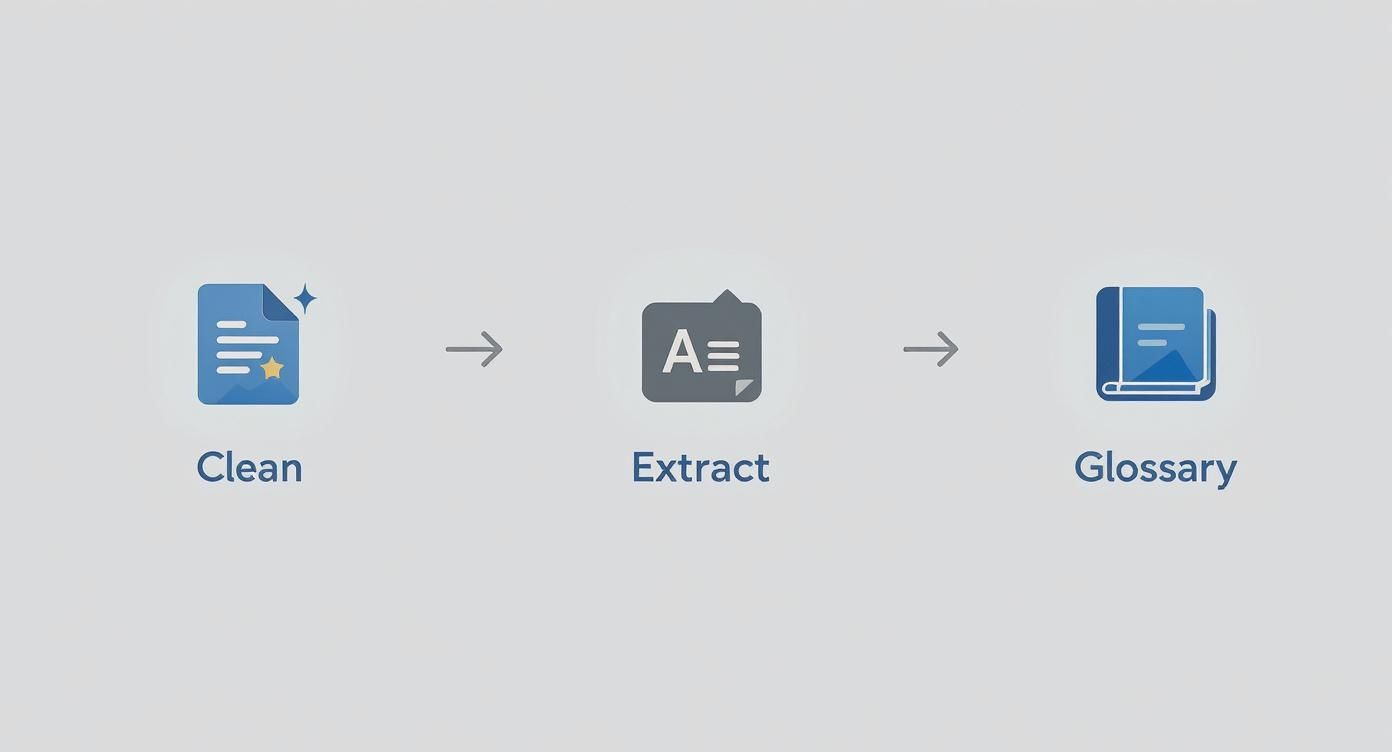
This workflow shows how those essential prep steps—cleaning the document, extracting the text, and building a glossary—feed directly into the AI translation process for a much better outcome.
Putting Your Glossary to Work
Remember that glossary you spent time creating? Now's when it becomes your project's MVP. Before you hit "translate," you'll upload that glossary file. The AI will then treat it as a list of hard-and-fast rules.
Every single time a term from your list appears—whether it's "Rimuru Tempest," a special ability, or "Jura Tempest Federation"—the AI will use the exact English equivalent you provided. This simple step single-handedly solves one of the most frustrating problems in machine translation: inconsistency. It's how you guarantee names and key terms stay the same from page one to the final chapter.
A glossary is the difference between an AI translating a signature attack three different ways and getting it right every time. You’re enforcing consistency from the start, which is the bedrock of a professional-feeling translation.
Keeping the Original Formatting and Style
The real beauty of a book-centric AI workflow is its ability to respect the original layout. A good tool won't just spit out a wall of text; it intelligently mirrors the source file's formatting.
This means that:
<h2>and<h3>tags for chapter titles are kept in place.- Italicized text used for a character’s internal monologue stays italicized.
- Paragraph breaks are preserved exactly as they were.
This intelligent formatting is a massive time-saver. You get to skip hours of tedious manual reformatting and jump straight into the good stuff: the human-led post-editing that will truly make the translation shine.
Bringing Your Translation to Life with a Human Touch
The AI has done the heavy lifting, giving you a remarkably complete first draft. Now the real artistry begins. This is where your human expertise transforms a technically accurate translation into a story that grips the reader. It’s about so much more than just fixing grammar—it's about injecting nuance, personality, and cultural soul into the text.
This stage is absolutely essential for capturing the author's unique voice. While the AI is fantastic at conveying the literal meaning, it can sometimes smooth over the stylistic quirks that make a story memorable. A skilled human editor knows how to spot the author's pacing, humor, and tone, and carefully weave that personality back into the English version.
Making Dialogue Sound Natural
One of the first things you'll probably notice in a raw AI draft is that the dialogue can feel a bit stiff. It might be grammatically perfect, but it doesn't sound like something a real person would actually say. Your job is to loosen it up without losing the original intent.
This often means letting go of a strict word-for-word approach. Imagine a character who speaks in short, sharp sentences in Japanese. A direct translation might feel clunky and robotic. You'll want to use contractions, rephrase sentences, and adjust the rhythm to capture that same abrupt, energetic personality in English.
- Read it aloud. This is the best test. Does the dialogue flow, or do you find yourself stumbling over awkward phrases?
- Embrace contractions. Simple changes like turning "I will not" into "I won't" instantly make a line feel more conversational.
- Mind the formality. The way close friends talk is completely different from how a knight addresses their king. Make sure the language reflects those relationships.
The goal isn't just to translate the words; it's to translate the relationship between the characters. A well-edited conversation reveals their personalities and the dynamics between them, which is the heart of any good story.
This commitment to quality is what has allowed the English light novel market to flourish. Reader expectations are high, a trend that took off in the mid-2010s alongside the surge in anime and manga popularity. In 2016 alone, publishers released over 80 light novel volumes in English, a number that was blown away the very next year. You can get more insights on the English light novel boom to understand the market's rapid growth.
Handling Cultural Nuances
Light novels are steeped in Japanese culture, and this is where an editor's real-world knowledge becomes invaluable. You're going to run into concepts, honorifics, and jokes that just don't have a clean, one-to-one equivalent in English.
Honorifics are the classic example. Suffixes like -san, -kun, or -sama pack a ton of information about relationships, respect, and social standing. Just leaving them in the English text can confuse readers, but stripping them out completely can erase that vital context.
You have a few solid strategies for tackling this:
- Show, Don't Tell: Use the dialogue or narration to demonstrate the relationship. Instead of "Tanaka-san," you might use "Mr. Tanaka" in a formal setting, or just "Tanaka" if the context makes it clear they're peers.
- Keep Them Strategically: In some stories, especially historical dramas or settings where the Japanese context is crucial, you might decide to keep certain honorifics. Just make sure it's a deliberate choice, and apply it consistently.
- Find an Equivalent: Sometimes, a different cultural marker can do the same job. A military rank like "Captain" or a term of endearment like "kiddo" can often capture the spirit of the original honorific.
Cultural jokes and puns are another big hurdle. A clever play on words in Japanese can fall completely flat in English. This is where you need to get creative. You can try to find a similar English pun that fits the scene, or you might need to rewrite the joke entirely to get the same comedic reaction from the reader.
To help guide this crucial step, here's a checklist of what to look for when you're refining the text.
Post-Editing Focus Areas for Light Novel Translation
| Editing Task | Why It's Important | Example |
|---|---|---|
| Dialogue Flow & Naturalness | Prevents "translation-ese" and makes characters sound like real people. | Changing "I am not able to go" to "I can't go." |
| Character Voice Consistency | Ensures each character has a distinct personality that remains stable throughout the book. | Does the gruff knight suddenly start speaking in complex, poetic sentences? Fix it. |
| Cultural Context (Honorifics, etc.) | Translates the social dynamics and relationships, not just the words. | Deciding whether "Onii-chan" becomes "big brother," a first name, or a term of endearment. |
| Idioms & Puns | Avoids nonsensical literal translations by finding a cultural equivalent for the punchline. | Replacing a Japanese pun about rice balls with an English "food pun" that fits the tone. |
| Glossary Term Adherence | Maintains consistency for key names, places, and magical terms, which is critical for world-building. | Ensuring a spell is always called "Fireball" and not "Flame Orb" or "Inferno Sphere." |
| Tone & Pacing | Matches the mood of the original, whether it's a tense action scene or a lighthearted comedic moment. | Using shorter, punchier sentences during a fight scene to increase the pace. |
Perfecting these areas is what separates a readable translation from an unforgettable one. It's the craft that truly honors the original work.
Final Quality Assurance Checks
After you've polished the prose, it's time for one last, thorough quality assurance (QA) pass. This isn't just another proofread; it's a final, holistic review to catch anything that might have slipped through the cracks.
Your final QA checklist should look something like this:
- Glossary Consistency: Run a final search for every term in your glossary. Make sure they were applied correctly and consistently everywhere.
- Character Voice: Pick a major character and read only their dialogue for a few chapters. Does their voice feel consistent and true to their personality?
- Illustration Placement: Flip through the book and confirm all the illustrations are where they should be. Check that any transcribed text you added is formatted correctly.
- Formatting Integrity: Give the entire EPUB a final skim. Look for any broken headings, weirdly formatted italics, or other visual glitches that may have appeared during editing.
This meticulous final review is what elevates your project to a professional-grade translation. It’s the last step in ensuring the final book is not just accurate, but a genuine pleasure to read.
Publishing Your Translated Light Novel
After all those late nights and countless hours of translation, QA, and refinement, your light novel is finally ready for its debut. This is the home stretch—turning your polished manuscript into a professional, ready-to-sell ebook and getting it in front of a hungry global audience.
The market for light novels is exploding. It recently hit a value of $1.74 billion and is on track to smash $3.18 billion by 2033. A huge chunk of that growth is being driven by English translations for readers in North America and Europe. There’s a massive, built-in audience just waiting for your book.

Exporting and Validating Your EPUB
First things first, you need to generate that final EPUB file. If you've done your post-editing inside a platform like BookTranslator.ai, this is often a simple one-click export. The tool bundles up all your formatting, images, and text into a neat package. If you’ve been working in another editor, just be sure to save or export it as a standard EPUB.
But don't just export and upload. You have to validate the file. An EPUB that looks perfect on your computer can easily fall apart on a Kindle, Kobo, or Nook.
Think of validation as a final technical proofread. It's an automated check that scans the EPUB’s code to make sure it meets industry standards. This simple step guarantees a smooth, professional reading experience for everyone, no matter what device they're using.
Using a free tool like the EPUBCheck validator is an absolute must. You can find easy-to-use web versions or download the software to run on your own machine. It will scan your file and spit out a report flagging any issues—from broken HTML tags to missing metadata—letting you fix them before a reader discovers them.
Crafting Compelling Metadata
Your metadata is what sells your book on the store page. It's the title, author name, and most critically, the book description. This isn't just a summary; it's your sales pitch. Don’t rush it.
A killer description will:
- Hook the reader right from the first sentence with an intriguing question or a wild premise.
- Introduce the protagonist and their core problem or goal.
- Hint at the stakes—what's on the line?—without spoiling the story.
- Match the novel’s tone. Is it an action-packed isekai, a hilarious rom-com, or a dark fantasy? The description should reflect that.
Spend some real time on this. Those few paragraphs can be the difference between a browse and a buy.
Navigating Self-Publishing Platforms
With a validated EPUB file and a polished description, it’s time to head to a publishing platform. For most indie translators, Amazon Kindle Direct Publishing (KDP) is the go-to. A crucial final step is to actually get your book into readers' hands, and for a deep dive on this, you can find excellent walkthroughs on how to publish your light novel on Amazon.
The process is pretty straightforward, but you’ll want to get the details right:
- Upload Your Manuscript: This is where you'll upload that squeaky-clean, validated EPUB.
- Design a Cover: A great cover is non-negotiable. You might need to license the original Japanese artwork or commission a new design that screams "light novel" to potential readers.
- Set Your Price and Royalties: Do your homework. Look at what similar translated light novels are priced at to find that sweet spot that’s both competitive and profitable.
- Choose Distribution Territories: This goes back to your rights agreement. You’ll select only the countries where you have the legal license to sell the book.
Get these pieces right, and you'll smoothly bridge that final gap between a finished file and a published book, ready for an eager audience to discover and devour.
Common Questions About Light Novel Translation
As you get into the world of light novel translation, you'll find that some questions come up again and again. It's a field where passion for storytelling meets the hard realities of technology and law, and navigating that intersection can be tricky.
Let's break down some of the most common concerns I see from both aspiring translators and dedicated fans. Getting these right is key, whether you're just working on a personal project or aiming for a professional release.
Can You Translate a Light Novel Without Knowing the Language?
This is probably the most-asked question, and honestly, the answer is a qualified yes. Modern tools like BookTranslator.ai can produce a surprisingly accurate first draft, which opens the door for people who aren't fluent in the source language.
But—and this is a big "but"—it's not a one-and-done solution. While the AI does the heavy lifting, the human touch is absolutely essential. The AI gives you the raw text, but it's a human editor who has to finesse the cultural nuances, nail each character's voice, and make the dialogue sound like something a real person would say.
Think of it this way: the AI is the architect drawing the blueprint, but you're the master craftsman who brings it to life.
An AI translation is your starting point, not the finish line. It gets you 90% of the way there, but that final 10% of human refinement is what separates a readable text from a truly great story that honors the author's vision.
How Much Does AI Translation Cost?
Here’s some good news. Using an AI service to translate a light novel is dramatically cheaper than commissioning a traditional translator for a private project. We're talking about a fraction of the cost, usually priced based on the book's length rather than an expensive per-word rate.
Typically, you'll see pricing based on word or character count. For a standard 250-page light novel (which is usually around 50,000 to 70,000 words), you could expect to pay anywhere from $20 to over $100. The price difference really comes down to the quality of the AI engine you choose.
- Standard Engines: These are great on a budget and deliver solid results for more straightforward prose.
- Advanced Engines: Options like GPT-4o cost more, but they're brilliant at handling complex narratives, subtle humor, and the distinct voice of each character.
Always check the pricing page of whatever tool you're considering. A good platform will give you a clear, upfront cost per book with no surprises, so you know exactly what you’re paying before you hit "translate."
Is AI Good Enough to Replace a Human Translator?
Not yet, and maybe not ever. AI is an incredibly powerful assistant, not a replacement. The gold standard in the industry today is a workflow called Machine Translation Post-Editing (MTPE), where a human expert takes the AI’s draft and perfects it.
AI is fantastic at:
- Speed: It can translate an entire novel in just a few minutes.
- Consistency: It flawlessly applies your custom glossary terms every single time.
- Formatting: It preserves the original layout, italics, and structure perfectly.
But humans are still irreplaceable for:
- Cultural Nuance: Figuring out how to adapt jokes, honorifics, and cultural references that don't have a direct equivalent.
- Character Voice: Making sure the stoic hero doesn't sound like the bubbly sidekick.
- Creative Judgment: Finding clever solutions for puns, idioms, and wordplay.
This hybrid approach really is the best of both worlds. You get the raw speed and power of the machine, guided by the creative intuition and cultural wisdom of a human.
What About the Legality of Fan Translations?
This is the most critical point of all. Translating and distributing a light novel without getting permission from the copyright holder is copyright infringement. Period.
While fan translations (or "fantl's") are almost always born from a genuine love for the series, they exist in a legal gray area. At any moment, the publisher can issue a takedown notice or pursue more serious legal action.
If you want to legally translate and publish a light novel, there's only one way to do it: you have to acquire the official translation rights from the original Japanese publisher. This involves a formal licensing agreement. It's a complex process, but it's the only path that ensures your work is legitimate and won't be taken down. Using AI for your own private reading is one thing, but posting it online for others is a whole different ballgame.
Ready to see how an AI-powered workflow can kickstart your own high-quality translation? With BookTranslator.ai, you can get a draft of an entire EPUB file in minutes, with all the original formatting and styling perfectly intact. This lets you skip the grunt work and jump straight to the creative art of editing.
Give it a try and start your translation at https://booktranslator.ai today.