
Korean Books for Your Parents: Beyond Google Translate's Failures
Google Translate often struggles with Korean books, missing key nuances like honorifics, idioms, and context-dependent meanings. This makes the reading experience confusing and disjointed, especially for your parents who might not be familiar with Korean culture. Formatting issues in translated files can further disrupt readability on devices like tablets or e-readers.
Here’s the solution: Use tools like BookTranslator.ai, which specialize in translating Korean to English while preserving the original structure and tone. It ensures consistent terminology, smooth formatting, and context-aware translations tailored for American readers. For just $5.99 per 100,000 words, you can create polished, easy-to-read versions of Korean books for your parents to enjoy.
Key takeaways:
- Avoid Google Translate for Korean books - it lacks accuracy and cultural understanding.
- BookTranslator.ai offers a simple 3-step process to create high-quality translations.
- Choose EPUB format for e-readers or PDF for tablets for the best reading experience.
- Review and tweak translations for clarity, especially cultural terms like "oppa" or "ajumma."
Help your parents dive into Korean literature without the frustration of poorly translated text.
What Makes a Good Korean Book Translation for Parents
A high-quality translation does more than just convert words; it captures the essence and context of the original text while presenting it in clear, natural American English. The best translations strike a balance - staying true to the source material while ensuring the content reads smoothly and is easy to understand [2][6][8].
Preserving Context While Keeping Text Clear
A good translation maintains the subtlety and rhythm of the original Korean text without sounding clunky or overly literal. This involves carefully selecting English phrases that feel natural to American readers while still retaining the original meaning. For instance, when dealing with Korean honorifics or culturally specific terms, the translator should include brief explanations rather than forcing awkward English equivalents. This approach preserves the cultural richness without alienating the reader [2][5][6].
Thanks to advancements in AI, modern tools can now handle complex Korean grammar and cultural nuances, producing text that feels smooth and conversational [4][5][7]. Beyond the words themselves, attention to formatting ensures your parents can enjoy a seamless and comfortable reading experience.
Proper Formatting for E-Readers and Tablets
The reading experience can be significantly enhanced by consistent and thoughtful formatting. A good translation will preserve the original structure, including chapter divisions, paragraph spacing, and any visuals like images or bolded text that add to the story's appeal [6]. Proper formatting ensures the book looks polished and is easy to navigate, especially on e-readers or tablets [3][6].
Exporting the book to ePub format is particularly helpful, as it maintains the layout while allowing readers to adjust fonts and sizes for their comfort [3][6]. Additionally, consistent use of terminology - especially for character names and recurring concepts - helps avoid confusion and keeps the story flowing smoothly [1][3].
U.S. Standards and Conventions
To make the translation feel familiar and accessible, it’s important to follow conventions that American readers expect. This includes using the MM/DD/YYYY date format (e.g., 12/11/2025), adding commas to separate thousands in numbers (1,000 instead of 1.000), and converting metric measurements into imperial units. For example, if the original text mentions "10 kilometers", the translation might say "10 kilometers (about 6 miles)" to help readers visualize the distance. These adjustments ensure the story feels natural and relatable for parents who may not be familiar with international formats. By aligning with these standards, the translation becomes more intuitive and enjoyable for its audience.
How BookTranslator.ai Translates Korean Books

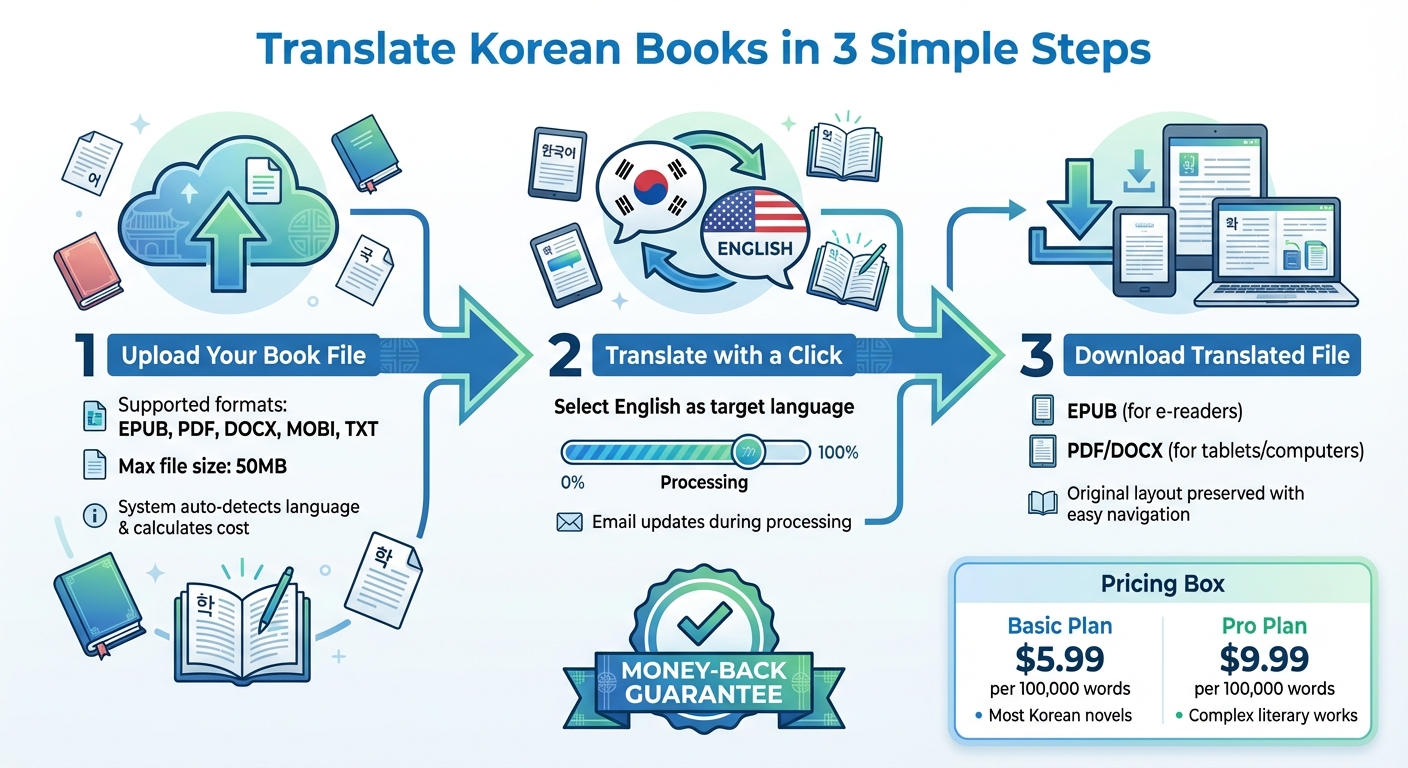
How to Translate Korean Books in 3 Simple Steps with BookTranslator.ai
BookTranslator.ai is designed with ease in mind, offering an AI-powered solution tailored for translating Korean books. The platform addresses the unique challenges of Korean literature, such as keeping character names consistent, honoring cultural nuances like honorifics, and ensuring the story flows naturally across thousands of words.
Upload, Translate, and Download in 3 Simple Steps
Here’s how it works:
- Upload your book file: Drag and drop your Korean book in formats like EPUB, PDF, DOCX, MOBI, or TXT, with a maximum file size of 50MB. The system automatically identifies the source language and calculates the translation cost based on the word count before moving forward.
- Translate with a click: Choose English as the target language and start the translation process. The platform keeps the original structure intact, and you'll receive email updates as the translation progresses. Processing time depends on the book's length.
- Download the translated file: Once ready, you can download the translation in your preferred format - EPUB for e-readers, or PDF/DOCX for tablets and computers. The translated version retains the original layout, making it easy to navigate chapters and adjust font sizes.
This straightforward process ensures translations are accurate and accessible, particularly for older readers.
Features for a Reader-Friendly Experience
BookTranslator.ai focuses on creating translations that are easy to read and navigate. It uses clear, legible fonts with proper line spacing and paragraph breaks, ensuring a comfortable reading experience on tablets and e-readers. The original table of contents and chapter structure are preserved, allowing readers to move seamlessly between sections using their device's navigation tools.
The AI also approaches cultural context with care. Instead of forcing literal translations, it provides brief clarifications for Korean honorifics and culturally specific terms. Additionally, the platform automatically adapts U.S. conventions for measurements, currency, and formatting.
Translations follow American English standards, including spelling (e.g., "color" instead of "colour"), double quotation marks, and the MM/DD/YYYY date format. These adjustments ensure the text feels familiar and natural for American readers.
Pricing: Two Flexible Options
BookTranslator.ai offers a simple pay-per-book model, avoiding subscription fees. You can choose between two plans:
- Basic Plan: $5.99 per 100,000 words. This option delivers high-quality AI translations with preserved formatting, making it suitable for most Korean novels and nonfiction works.
- Pro Plan: $9.99 per 100,000 words. This plan uses the latest AI model for even greater accuracy, ideal for books with complex literary styles or heavy cultural references.
| Plan | Price | Best For |
|---|---|---|
| Basic | $5.99 / 100,000 words | Most Korean novels and nonfiction books |
| Pro | $9.99 / 100,000 words | Complex literary works needing higher precision |
The final cost is calculated based on the actual word count, with a minimum price of $5.99. Plus, the platform offers a money-back guarantee if you’re not satisfied with the translation quality. This transparent pricing ensures you get an affordable and reliable translation solution tailored to your needs.
sbb-itb-0c0385d
Tips for Translating Korean Books for Your Parents
Using BookTranslator.ai: Step-by-Step Guide
Start by getting a clean digital copy of the Korean book. The best file formats for BookTranslator.ai are EPUB, PDF, DOCX, or MOBI. If the book has DRM protection, make sure to remove it legally so the platform can process the file. Rename the file with a clear English title, like "Mom_Korean_Novel.epub", to avoid confusion later when sharing it with your parents. This preparation ensures a smoother translation process.
Once you've uploaded the file to BookTranslator.ai and selected Korean to English, wait for an email notification that your translation is ready. Download the translated file in EPUB format for e-readers or PDF/DOCX for tablets. Before handing it over, preview the file to check the chapter structure and text flow. If your parents use a Kindle, send the EPUB file to their Kindle email or sync it using the desktop app. For those with iPads or Android tablets, open the file in Apple Books or Google Play Books - both apps preserve the layout and allow customization of font size and screen brightness. To make reading easier for older parents, consider adjusting the settings beforehand to larger fonts (14–16 pt) and higher contrast.
Checking and Improving Translations
After downloading the translated file, take a moment to review it for accuracy and readability. You don’t need to read the entire book, but a quick check can go a long way. Focus on the opening chapters, where character relationships and tone are established, and skim through dialogue-heavy sections, as these often include Korean honorifics and family dynamics that might need fine-tuning. Fix any stiff or overly literal sentences to improve flow.
Look out for Korean cultural references, such as food names, holidays, or school terms, that might confuse readers unfamiliar with them. If something seems unclear, you can either simplify the term or add a brief explanation in parentheses. Not fluent in Korean? No problem. Use another tool or ask a bilingual friend to clarify tricky idioms or relationship terms that don’t translate smoothly. These small adjustments make a big difference in ensuring the book is enjoyable and easy to understand.
When to Keep Korean Terms vs. Translating Them
Certain Korean words carry meanings that English can’t fully express. Words like "oppa", "unni", "sunbae", or "ajumma" are often best left as-is, especially when they highlight specific social relationships or hierarchies. For example, "oppa" isn’t just "older brother" - it can also refer to an older male friend in a specific context. When keeping these terms, include a short explanation the first time they appear, such as "oppa (older brother figure)", or add a glossary at the beginning of the book.
On the other hand, translate terms to English when the nuance isn’t critical and leaving them in Korean might disrupt the flow. For instance, "eomma" can simply become "Mom", "appa" can become "Dad", and "seonsaengnim" can translate to "teacher" in straightforward contexts. This balanced approach keeps the cultural essence of the story intact while making it easier for your parents to enjoy the book.
Making Korean Books Accessible for Your Parents
Introducing your parents to Korean literature doesn’t have to involve wrestling with clunky translations or spending hours fixing formatting issues. BookTranslator.ai turns this into a smooth, three-step process: upload your Korean book file (EPUB, PDF, DOCX, or MOBI), choose Korean to English as the language pair, and download a neatly formatted translation. The final file keeps all the original chapter breaks, headings, and paragraph structures intact. It’s ready to be enjoyed on devices like Kindle, Nook, Kobo, or any tablet app, where your parents can easily adjust font size, line spacing, and brightness - just like they would with any English-language book.
The platform ensures the translation retains the book’s original tone and meaning, using clear and natural language that’s perfect for readers who might not be familiar with Korean culture. Plus, it’s budget-friendly, with pricing based on word count, so you can translate full-length novels without worrying about subscription fees.
Once you’ve completed your first translation, you can help your parents build a curated digital library of Korean works. Start small - try novellas or essay collections to see what they enjoy. Then, as they get hooked, you can move on to longer novels, using the same simple process. Over time, BookTranslator.ai becomes a behind-the-scenes tool that handles the technical side, leaving your parents free to explore their growing library with just a tap.
With its ability to maintain formatting, deliver context-aware translations, and work seamlessly across devices, this tool transforms scattered Korean titles into a well-organized digital library that fits perfectly with U.S. reading habits. After a quick review to tweak any cultural references that might be confusing, you’ll have a ready-to-read file that makes Korean literature an effortless part of your parents’ reading experience.
FAQs
How does BookTranslator.ai ensure Korean cultural nuances are preserved?
BookTranslator.ai is built to retain the essence and subtle details of Korean texts during translation. It ensures that the tone, style, and intent of the original content are carefully preserved, resulting in translations that feel natural and aligned with the cultural context.
By paying close attention to elements like idioms, honorifics, and references specific to Korean culture, BookTranslator.ai provides translations that are not only precise but also respectful of the traditions and values woven into Korean literature.
What file format works best for translating Korean books with BookTranslator.ai?
The EPUB format works best when translating Korean books using BookTranslator.ai. It maintains the book's structure, layout, and content throughout the translation process, ensuring smooth and precise results.
If your book is in a different format, it’s a good idea to convert it to EPUB before uploading. This will help you get the most accurate and efficient translation.
How can I make sure the translated book is easy for my parents to read on their devices?
To make sure your parents can easily read the translated book, consider using AI-powered tools like BookTranslator.ai. These tools help preserve the book’s original formatting, offer built-in glossaries for better understanding, and work seamlessly across different devices.
Pay attention to features such as clear, easy-to-read fonts, adjustable text sizes, and user-friendly navigation. These options ensure your parents can enjoy the translated book comfortably on whichever device they prefer.