
If you want to say 'book' in Russian, the word you're looking for is книга (kniga).
That's your starting point. It’s pronounced roughly like KNEE-ga, with the emphasis on the first syllable. This one little word is your key to unlocking one of the world's great literary cultures.
Your Quick Answer: The Russian Word for Book

Learning книга (kniga) is more than just memorizing a new piece of vocabulary. It connects you to a society that deeply values reading. You can see this in the sheer number of books that get translated into Russian.
In 2023 alone, Russia published a massive 8,778 book titles that were originally written in English. That makes it the top country for importing translated literature. This stat really shows the strong appetite Russian readers have for English-language authors, a connection made possible by professional translation services. For those interested, you can find more data about these translation trends.
The Essentials at a Glance
Before we get into the nitty-gritty of pronunciation and grammar, let's cover the basics. Getting these details right from the start will make a huge difference in how you use the word.
Here’s a simple table to keep the core information handy.
Quick Guide to 'Book' in Russian
| Cyrillic | Transliteration | Simple Pronunciation | Grammatical Gender |
|---|---|---|---|
| книга | kniga | KNEE-ga | Feminine |
Understanding these points is fundamental. The spelling, the sound, and especially the gender will all come into play when you start building sentences.
Why does gender matter so much? In Russian, because книга is a feminine noun, any adjectives describing it will need to have a feminine ending. For example, you would say interesnaya kniga (an interesting book), not interesniy kniga.
Key Takeaway: Nailing the spelling (книга), the transliteration (kniga), and the grammatical gender (feminine) is your first practical step. It’s the foundation for speaking and writing correctly right from the get-go.
Alright, you know the word for book is книга, but let's get you sounding less like a textbook and more like a local. Getting the pronunciation right is one of those small things that makes a huge difference in how you're understood.
The single most important thing to remember is the stress. Russian is all about emphasis, and for книга, that stress falls hard on the first syllable: KNEE-ga. If you say kni-GA, you'll immediately sound like a foreigner. It’s a dead giveaway.
Nailing the Individual Sounds
Let's pull the word apart to see how it works. Once you get the pieces, putting them back together is easy.
The ‘КН’ (kn) Combo: This is a classic trap for English speakers. Forget everything you know about silent 'k's in words like "knife." In Russian, that 'k' is very much alive. You need to hit a sharp 'k' sound and roll right into the 'n' without any hesitation. It's a quick, punchy sound made at the front of your mouth.
The ‘И’ (i) Vowel: This one’s easy. It’s the same long 'ee' sound you hear in English words like "see" or "feet." Tack this onto the beginning, and you’ve got the stressed part down: KNEE.
The ‘ГА’ (ga) Ending: The 'г' (g) here is always a hard 'g', like in "go" or "good"—never the soft 'j' sound like in "gentle." The final 'а' (a) is unstressed, so it’s a soft, open sound, much like the 'a' at the end of "sofa."
String it all together, and you get that KNEE-ga sound. For the linguists out there, the IPA is [ˈknʲiɡə], which just confirms that all-important stress on the first syllable.
My Advice? Record yourself. Say KNEE-ga out loud ten times, really punching that first syllable. Listen back and compare it to a native speaker. It might feel a little strange at first, but this kind of practice builds the muscle memory you need to make the correct pronunciation second nature.
Getting a Grip on Basic Russian Grammar with Kniga
So, you know how to say "book" in Russian. That's a fantastic first step! But to really use книга (kniga) like a native, you'll need to understand a tiny bit about how it changes within a sentence.
Unlike English, Russian nouns have a cool feature: their endings change based on what they're doing in the sentence. This is called the case system. It might sound scary, but don't worry. We're going to skip the complex grammar charts and just look at how it works in the real world. Think of it like knowing when to say "she" versus "her"—you just know, and soon you'll have that same feel for Russian.
How to Talk About a Single Book
Let's start with the two most common forms you'll see for a single book. The first one is the basic dictionary form, книга (kniga). This is what you use when the book is the star of the show—the subject of the sentence.
- Example: Это книга. (Eto kniga.) — This is a book.
Simple enough, right? But what happens when you're doing something to the book, like reading it? The book is no longer the subject; it's the direct object. For this, we need to change the ending.
- Example: Я читаю книгу. (Ya chitayu knigu.) — I am reading a book.
Did you see that? The ending flipped from -а (-a) to -у (-u). This little switch from kniga to knigu is a core part of Russian grammar, telling you that the book is receiving the action.
A Little Tip from Experience: Start training your ear to catch that "-u" sound at the end of feminine words. It’s a huge clue that the word is a direct object, which can help you piece together sentences even when you don't know every single word.
As you practice saying these sentences, keep the pronunciation in mind. This visual guide breaks it down perfectly.
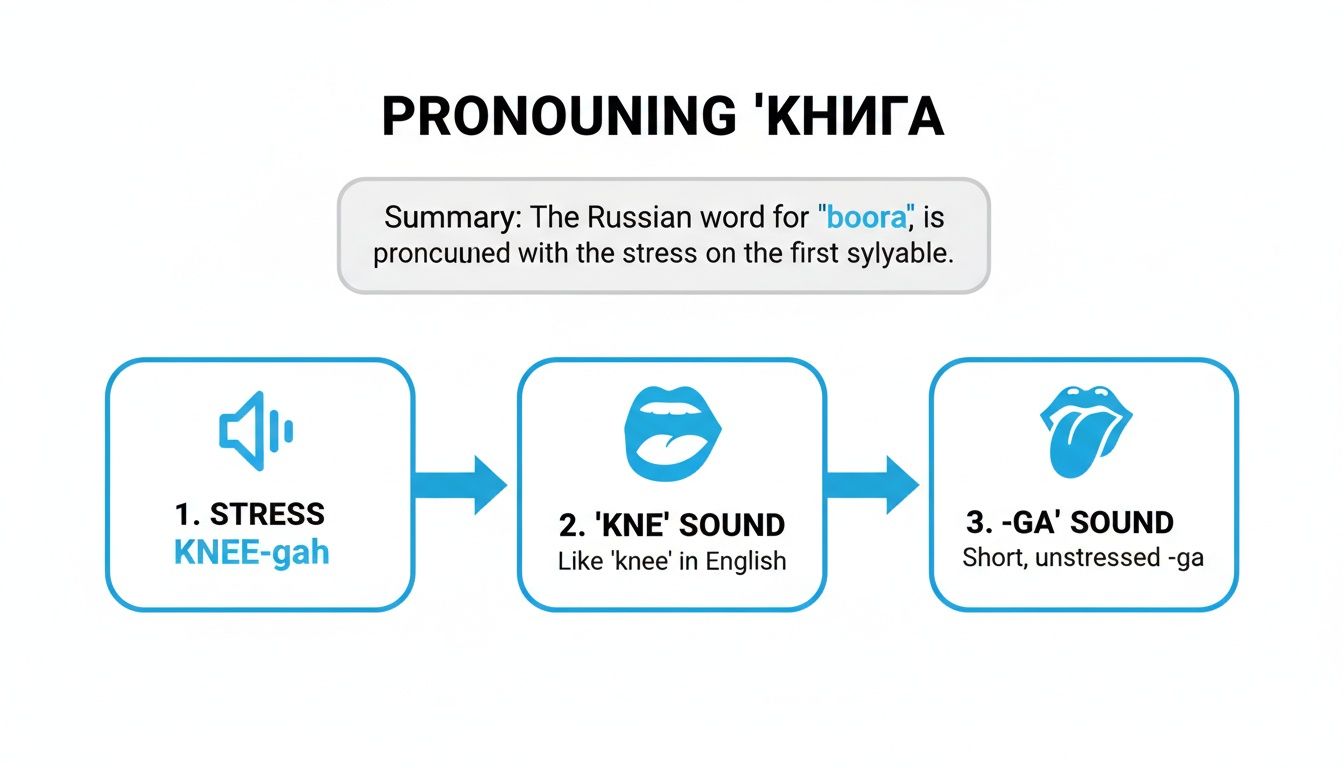
The key is to stress that first syllable ("KNEE") and end with a soft "ga" sound. Getting this right makes a world of difference.
Talking About More Than One Book
Naturally, you'll want to talk about multiple books. The plural form is pretty straightforward: книги (knigi), which sounds a lot like "KNEE-gee."
- Example: Это интересные книги. (Eto interesnyye knigi.) — These are interesting books.
Being able to talk about books in Russian is a gateway to a massive literary culture. It’s no surprise that Russia’s language translation market is growing, reflecting a global industry valued at $60.68 billion in 2022. As authors and publishers look to connect with readers worldwide, understanding these nuances becomes crucial. For those interested in the data, you can discover more insights about Russia's NLP sector on Statista.com.
If you can get comfortable with these three basic forms—kniga, knigu, and knigi—you’ll have a solid foundation for building sentences and understanding what you hear.
Expanding Your Russian Literary Vocabulary

Now that you've got the hang of книга (kniga), let's build out your vocabulary so you can actually talk about reading. Knowing the word for "book" is a great first step, but the real magic happens when you can confidently walk into a bookstore or chat about your favorite authors.
Two words you'll use all the time are читать (chitat')—"to read"—and писатель (pisatel')—"writer" or "author." You can string them together easily. For instance, "Я люблю читать" (Ya lyublyu chitat') is a simple and perfect way to say, "I love to read."
It's also interesting to note just how much translated literature Russians consume. In 2023 alone, Russia published 8,778 book titles that were originally in English, way more than from any other language. With 233 million copies sold in 2024, it's clear there's a huge appetite for stories from around the world.
Beyond the Basic Book
Just like in English, Russian has specific words for different kinds of books, and using them will make you sound much more like a native speaker. A textbook, for example, isn't just a kniga. It’s an учебник (uchebnik).
And if you’re reading on a Kindle or tablet, you’d talk about your электронная книга (elektronnaya kniga), which is a direct, literal translation of "electronic book." Easy to remember!
Here are some of the most common words you'll come across when talking about books and reading.
Essential Russian Vocabulary for Readers
This quick-reference table covers some of the key terms you'll want to commit to memory.
| Russian Word | Transliteration | English Meaning |
|---|---|---|
| читать | chitat' | to read |
| писатель | pisatel' | writer, author |
| учебник | uchebnik | textbook |
| электронная книга | elektronnaya kniga | e-book |
| забронировать | zabronirovat' | to book, reserve |
As you can see, there’s a bit more to it than just kniga. Mastering these will help you navigate conversations with much more precision.
One common trip-up for English speakers is the difference between "book" (the object) and the verb "to book" (a reservation). In Russian, there’s no room for confusion because they are completely separate words.
Expert Tip: To say you want to reserve a table or book a hotel room, you'll need the verb забронировать (zabronirovat'). It has absolutely no connection to книга.
Getting these little details right is what separates a beginner from an intermediate speaker. For authors thinking about taking their work to the Russian market, understanding these nuances is key. Our guide on AI book translation provides a path to reaching global audiences and navigating this massive readership.
Using Kniga in Everyday Russian Sentences

Alright, you know the word книга (kniga). Now, let's put it to work. Just memorizing a word isn't enough; the real key is knowing how to drop it into a conversation so you sound like you actually speak the language.
These next few phrases are your ticket to navigating a Russian bookstore or just chatting with a friend about what you're reading. We'll go beyond the basics and look at questions and expressions you’ll genuinely use.
Practical Phrases for Book Lovers
Picture yourself in a shop in Moscow, surrounded by shelves of books. How do you ask for what you want or share an opinion? These examples are your conversational launchpad.
Где я могу купить эту книгу? (Gde ya mogu kupit' etu knigu?)
- This is how you ask, "Where can I buy this book?" Pay attention to that -у ending on книгу (knigu). It changes because the book is the direct object of the verb "to buy"—a little taste of Russian grammar in action!
Это моя любимая книга. (Eto moya lyubimaya kniga.)
- Want to share your enthusiasm? Use this phrase to say, "This is my favorite book." In this case, книга (kniga) is the subject of the sentence, so it keeps its standard form.
Getting comfortable with a new word is a process. It’s about building a web of context around it, a technique that works whether you're learning Russian or figuring out how to master phrases in Spanish and sound natural.
A Quick Tip: Try to spot these phrases when you're watching Russian movies or YouTube videos. Hearing them used by native speakers is a fantastic way to cement them in your mind. It connects the sound to a real-world situation.
For those of you who are writers or publishers, getting these details right is crucial. When translating a story, having dialogue that feels natural is everything. Using a dedicated Russian to English book translator can help ensure these nuances aren't lost, making your work resonate with a new audience. This is where theory meets practice, giving you the tools to speak with confidence.
Common Questions About Saying "Book" in Russian
Once you start using new Russian words, questions are bound to pop up. It’s totally normal. Moving past the basic "what does this mean?" stage and into the nitty-gritty of grammar is where the real learning happens. Let's walk through some of the most common questions people have about using the word книга.
Getting the Grammar Right
A big one is adjectives. In Russian, adjectives have to "agree" with the nouns they describe. Since книга (kniga) is a feminine noun, any adjective you use with it needs a feminine ending. So, to say "an interesting book," you’d use интересная книга (interesnaya kniga), making sure the adjective ends in "-aya".
Another frequent point of confusion is the different forms of the word itself. Don't mix up книги (knigi) and книгу (knigu)! Книги is the plural—"books." But книгу is what you use when the book is the direct object of a verb. For example, "I am reading a book" is Я читаю книгу (Ya chitayu knigu).
The takeaway here is that Russian grammar is all about context. Word endings change constantly depending on what role they play in the sentence. Nailing these small details is the secret to sounding less like a textbook and more like a native speaker.
Putting It All Together in Real Life
Of course, the questions often go beyond simple grammar. You might be wondering how to talk about literature or find new authors to read in Russian. These details become incredibly important in more complex situations, like translation. When translating a novel, getting these subtleties right is key to preserving the author's voice. We actually dive deep into this topic in our guide on the cultural nuances in AI book translation explained.
And as you get more comfortable, you'll naturally want to discover new things to read. If you’re looking for some fresh material to practice with, checking out a few book recommendation websites can be a fantastic way to find your next favorite Russian author. Answering these kinds of practical questions is what truly solidifies your learning and gets you ready for real conversations.
At BookTranslator.ai, we handle these linguistic details so you can focus on the story. Instantly translate entire e-books while preserving the original layout and meaning. Start your professional-quality book translation today.