- Access to a German-language document or text you want to translate
- A free or paid translation tool account (Google Translate, DeepL, or BookTranslator.ai)
- Basic familiarity with your document format (PDF, DOCX, EPUB, or plain text)
- Understanding of your translation purpose (personal use, publication, academic, or business)
Introduction: why German-to-English translation matters
German-to-English translation sits at the intersection of two of the world's most influential languages, connecting millions of readers, researchers, and businesses every day. Whether you're a publisher bringing a German novel to English-speaking audiences or a researcher decoding academic papers, the stakes are high and the challenges are real.
The growing demand
German is the most widely spoken native language in the European Union, and demand for German content in English continues to climb across publishing, law, science, and commerce. The global AI translation market was valued at $7.5 billion in 2024, growing at roughly 10% annually, which signals just how seriously the world is taking cross-language communication.
Why machine translation isn't enough
Tools like Google Translate process over 200 billion words daily across 243 languages, yet volume alone doesn't guarantee quality. German's compound nouns, grammatical gender, and flexible word order create patterns that trip up even sophisticated systems. Research from WMT24 evaluations confirms that translation quality varies significantly across systems, particularly for nuanced or literary content.
How modern AI is changing the workflow
At BookTranslator.ai, our analysis shows that context-aware AI models dramatically outperform word-for-word approaches, especially for long-form content like books where consistency of terminology and voice matters across hundreds of pages.
This guide sets realistic expectations and walks you through every step of getting German-to-English translation right. 📖
What you'll need: prerequisites and tools
Before diving into the translation process, gathering the right tools and materials saves significant time and prevents frustrating mid-project pivots. Your specific use case, whether translating a novel, a research paper, a PDF contract, or a website, determines which tools and preparation steps apply to you.
The right translation tool for your use case
Not all translation tools are built for the same job. Here is a quick breakdown of the main options:
- Google Translate: Best for quick, informal translations of short text snippets. It supports 133 languages and processes documents in as little as 30 seconds, but formatting preservation sits around 75% accuracy, meaning complex layouts often break.
- DeepL: A strong choice for professional documents. It offers a free tier up to 5,000 characters, processes 10-page documents in 2 to 4 minutes, and preserves formatting at roughly 95% accuracy. According to German to English Translation – Best Free Tools 2025 (2025), DeepL consistently outperforms general-purpose tools on European language pairs.
- BookTranslator.ai: Purpose-built for long-form content like EPUB books. Its context-aware AI maintains consistent terminology, character names, and voice across hundreds of pages while preserving the original layout and structure. This matters enormously for authors, publishers, and researchers working with book-length material.
Your source material
Prepare your files before starting:
- Books and long documents: Convert to EPUB format for BookTranslator.ai, or PDF for DeepL
- Short texts and web content: Plain text or copied content works fine for Google Translate or DeepL
- Scanned documents: Run OCR (optical character recognition, software that converts scanned images into editable text) first
A glossary or terminology list
For any project longer than a few pages, build a short reference list of key terms, proper nouns, and technical vocabulary before you begin. This is especially critical for academic texts, legal documents, and fiction with invented names or specialized language. Context-aware tools like BookTranslator.ai apply this consistency automatically across the full document.
Human review: do you need it? 🔍
Consider professional human review if your translation involves:
- Legal or medical content where errors carry real consequences
- Literary work where stylistic nuance is central
- Content for formal publication
For personal reading, research exploration, or self-publishing, high-quality AI translation with a careful personal proofread is often sufficient.
Step 1: Assess your translation needs and choose the right tool
Before you open any translation tool, spend a few minutes mapping your project requirements. The right tool for translating a German academic dissertation is rarely the right tool for a novel, and choosing poorly at this stage costs time and money later.
Define your project scope and content type
Identify whether you're translating a novel, academic paper, business document, or technical manual. Each content type has different requirements for tone, terminology precision, and formatting preservation. Document the approximate word count, subject matter, and any specialized vocabulary that will need consistent handling throughout the project.
Evaluate your budget and timeline constraints
Determine how much time and money you can allocate to the translation. Professional human translation costs significantly more than AI-assisted approaches, while free tools offer limited functionality. Consider whether you need the translation in days or weeks, as this affects which tools and workflows are practical.
Research and compare available translation tools
Compare options based on your specific needs. Google Translate supports 133 languages with broad coverage, DeepL offers a 5,000-character free tier with strong literary quality, and specialized tools like BookTranslator.ai are purpose-built for full-length books. Test each tool with a sample passage from your German source material.
Select your primary tool and identify backup options
Choose the tool that best matches your content type and constraints. Have a secondary option ready in case your primary tool encounters limitations or produces unsatisfactory results for specific passages. Document your selection rationale for future reference.
Identify your project type
Start by placing your project in one of these categories:
- Literary content (novels, poetry, memoirs): Requires context awareness, consistent voice, and stylistic sensitivity across long passages
- Academic or technical documents (research papers, manuals): Prioritises precise terminology and structural fidelity over stylistic flair
- Business documents (contracts, reports, correspondence): Demands accuracy and professional register, often within tight deadlines
- Personal or general reading: General comprehension is the goal, so speed and cost matter more than polish
Your category determines which quality bar you are actually trying to clear.
Match tool capabilities to your requirements
According to German to English Translation – Best Free Tools 2025 (2025), the landscape of translation tools varies enormously in speed, formatting preservation, terminology control, and cost. The WMT24 evaluation benchmarked 39 machine-translation systems, finding that quality ranges from near-human output to incomplete or unreliable results depending on the system and language pair.
Use this framework when comparing tools:
| Requirement | What to look for |
|---|---|
| Long-form books or EPUBs | Document-level, context-aware AI |
| Formatting preservation | Tools that maintain original layout |
| Terminology consistency | Systems with memory across the full document |
| Budget sensitivity | Pay-per-use models over subscriptions |
For translating full German books into English, BookTranslator.ai handles all four requirements in a single workflow. Its context-aware engine maintains consistent names and terminology from chapter one to the final page, and the pay-per-book pricing means you only pay for what you actually translate.
Decide whether AI alone is sufficient
For self-publishing, personal reading, or research exploration, a high-quality AI translation is typically sufficient when paired with a careful personal proofread. If you are translating content similar in scope to what you might approach with portuguese to english projects, the same logic applies: match the quality level to the actual stakes of the output.
Step 2: Prepare and format your German source material
Before any translation begins, take time to organize and clean your source document. A well-prepared file produces significantly better results because modern AI translation systems, including context-aware tools like BookTranslator.ai, analyze surrounding text to maintain tone and consistency. Feeding a messy file into any tool compounds errors downstream.
Clean and standardize your source document
Remove unnecessary formatting, fix encoding issues, and ensure consistent spacing and punctuation. Modern AI translation systems process meaning at the document level, so a well-organized source file produces significantly better results. Check that special characters, diacritics, and German-specific punctuation (like guillemets or em-dashes) are properly preserved.
Create a terminology list for specialized vocabulary
Identify key terms, character names, place names, and domain-specific vocabulary that must be translated consistently. For literary works, note proper nouns and their English equivalents. For technical or academic content, compile a glossary of specialized terms with their intended English translations.
Organize your document into manageable sections
Break longer works into chapters or sections if working with a full-length book. This makes the translation process less overwhelming and allows you to test your workflow on a smaller sample before committing to the entire document. It also simplifies quality assurance and revision tracking.
Preserve formatting and structural elements
Note the location of headers, footnotes, italics, bold text, and other formatting. Some translation tools handle formatting automatically, while others require manual reapplication. Document your source formatting so you can replicate it accurately in the English version.
Back up your original file first
Save a copy of your original German document before touching anything else. Store it in a separate folder or cloud location. This takes thirty seconds and protects you from irreversible formatting mistakes during cleanup.
Clean up formatting and structure
Open your document and remove:
- Unnecessary line breaks inserted mid-sentence (common in copy-pasted PDFs)
- Duplicate spaces and inconsistent paragraph spacing
- Stray headers or footers that have bled into the body text
Consistent structure matters because document-level, context-aware translation is increasingly how leading AI systems preserve tone and style across long texts. A clean, logically organized file gives the model the context it needs to make coherent choices.
Handle PDFs carefully
If your source is a PDF, confirm the text is selectable, not a scanned image. Click and drag over a paragraph. If you cannot highlight individual words, the file is image-based and requires OCR (optical character recognition) processing before translation. According to Best PDF Translator 2025 (2025), skipping this step is one of the most common reasons translations fail or return garbled output.
Segment books by chapter
For longer works, break content into chapters before uploading. BookTranslator.ai handles full EPUB files natively, preserving chapter structure, footnotes, and images automatically. This mirrors best practices from academic translation benchmarks, where segmenting documents into discrete, manageable units consistently improves output quality and reviewability.
Build a terminology list 📋
Create a simple spreadsheet listing:
- Proper nouns: character names, place names, institutions
- Specialized vocabulary: technical, legal, or domain-specific terms
- Recurring phrases with preferred English equivalents
Having this list ready lets you spot inconsistencies quickly during your proofread, especially across a full book-length project where terminology drift is a real risk.
Step 3: Perform initial machine translation using your chosen tool
With your source material prepared and your terminology list in hand, you're ready to run the actual translation. Choose your platform, configure it correctly, and treat this output as a working draft rather than a finished product.
Configure your translation tool with correct language settings
Set the source language to German and target language to English. If your tool offers dialect or regional options (e.g., British vs. American English), select the variant that matches your intended audience. Verify that any custom terminology lists or style guides are loaded into the tool before beginning.
Run the translation on your prepared source material
Upload or paste your German text into your chosen tool. If translating a full-length book, consider processing it section by section to maintain context and catch any tool-specific limitations early. Save the output in an editable format (such as DOCX or TXT) that preserves the original structure.
Review the initial output for obvious errors or gaps
Scan the translated text for incomplete sentences, repeated passages, or sections that appear garbled. This quick pass identifies whether the tool handled your content type well or whether you need to adjust your approach. Note any patterns in errors for later investigation.
Treat the machine output as a working draft, not a final product
Remember that machine translation is a starting point, not a finished translation. Even the best AI systems require human review and refinement. The goal at this stage is to have a readable English version that captures the source meaning, which you'll polish in subsequent steps.
Upload or paste your German text 📤
Open your chosen translation platform and import your content. Most tools accept plain text, Word documents, or EPUB files directly.
If you're working on a book-length project, BookTranslator.ai accepts EPUB files and handles the entire document in one upload, preserving your original chapter structure, footnotes, images, and styling throughout the process. Simply upload your EPUB, select English as the target language, and let the context-aware AI process the full manuscript without you needing to split it manually.
For shorter texts or web-based tools, paste your German content directly into the editor.
Configure your translation settings ⚙️
Before hitting translate, check these settings:
- Target language: Set to English (and specify British or American English if the option exists)
- Formality level: Choose formal for academic, legal, or literary texts; informal for conversational content
- Domain or subject area: Select legal, medical, or technical if your platform offers it. Domain-specific models handle specialized vocabulary far more accurately
These settings matter more than most users realize. German legal prose and German literary fiction require very different register choices in English.
Translate in sections for large documents
For lengthy manuscripts, translate chapter by chapter rather than all at once. This keeps context tighter and makes it easier to isolate problems. According to German to English Translation – Best Free Tools 2025 (2025), tools like DeepL typically take 2 to 4 minutes for a 10-page document with strong formatting preservation, while faster tools like Google Translate process the same volume in 30 seconds to 2 minutes with less structural fidelity.
Review and save your raw output 💾
Once translation completes:
- Save the translated file separately from your German original. Never overwrite your source
- Scan for missing text, broken formatting, or garbled passages
- Flag sections for human review: idiomatic expressions, compound nouns, culturally specific references, and anything that reads awkwardly
Add flags or comments directly in your document. These annotations become your roadmap for the editing stage ahead. If you're curious how translation conventions have shifted over centuries, the history covered in our old english translator article offers useful context on how language tools have evolved.
Step 4: Create a terminology and style guide for consistency
Build your terminology and style guide before editing begins. This document becomes the single source of truth for every decision made during the translation process, ensuring that a character's name, a technical term, or a narrative tone stays consistent from page one to the final chapter.

Build a glossary of key terms
Start by listing every German term that required a deliberate choice during machine translation. For each entry, record:
- The original German term and its chosen English equivalent
- Context notes explaining why that equivalent was selected
- Terms to leave unchanged: proper nouns, brand names, character names, place names, and titles
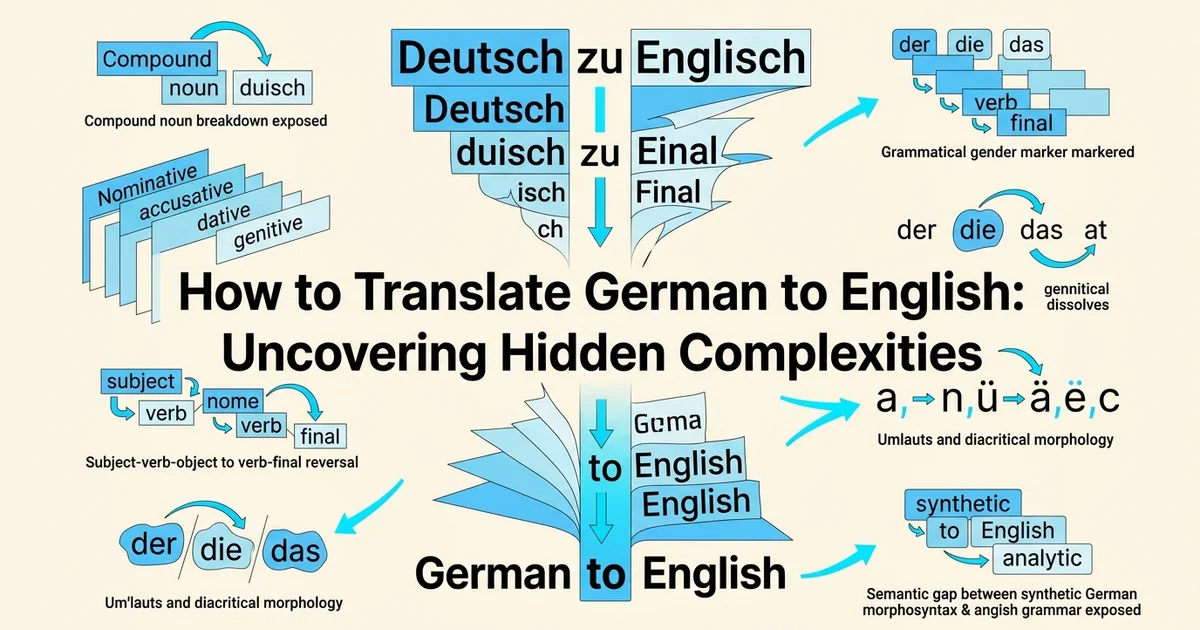
This is especially important for compound nouns. German regularly fuses concepts into single words that English must unpack across several. Documenting your preferred unpacking keeps those choices consistent throughout.
Define your tone and style preferences
Establish whether the final text should read as formal, conversational, technical, or literary. For books, extend this into a style sheet covering:
- Dialogue: punctuation conventions, dialect representation, and register
- Internal monologue: italics, tense, and narrative distance
- Narrative voice: sentence rhythm and vocabulary level
For technical documents, define domain-specific abbreviations and preferred terminology. If you're also working with Portuguese source material, the same approach applies, as outlined in our guide to translate portuguese to english.
Use context-aware tools to reinforce your guide
BookTranslator.ai's context-aware AI is built to maintain consistency across names, terms, and voice throughout an entire book. When you upload your EPUB using the Pro Plan, the system applies broader contextual understanding rather than translating sentence by sentence in isolation. This significantly reduces the number of inconsistencies your glossary will need to correct manually.
Once your guide is complete, share it with any human reviewers involved. A shared reference eliminates guesswork and keeps every collaborator aligned on the same decisions.
Step 5: Review and edit the machine-translated output
With your terminology guide in place, open your translated document alongside the original German text and read through both systematically. This comparative review is where you catch what automation missed: subtle mistranslations, unnatural phrasing, and structural inconsistencies that only a careful human eye will spot.
Read the full translation against the source
Start at the beginning and work through the document linearly. Resist the urge to skim. German sentence structure often places the verb at the end of a clause, and machine translation systems sometimes reconstruct these sentences in ways that are technically accurate but read awkwardly in English. Mark every passage that feels stilted, even if you cannot immediately identify why.
According to German to English Translation – Best Free Tools 2025 (2025), German-to-English translation quality varies considerably across tools, with some systems producing near human-level output while others require significant revision. Knowing which category your output falls into early saves considerable time.
Target idioms, cultural references, and context-dependent phrases
These are the passages most likely to fail. German idioms rarely translate literally, and cultural references tied to German-speaking regions may land without context for English readers. Flag each one and decide whether a direct equivalent exists in English or whether a brief explanatory note is needed.
Check formatting, headings, and document structure
Verify that every heading level, paragraph break, and list matches the original. If you used BookTranslator.ai to translate your EPUB, the preserved layout means structural drift is minimal, but always confirm chapter titles and section headings render correctly and carry the intended meaning.
Flag passages for human review
Research from WMT24 biomedical translation evaluations found that even strong machine-translated output can contain incomplete or difficult passages that undermine comprehension. For academic papers, published books, or technical documents, mark any section where meaning feels uncertain and schedule it for professional human review before the document moves forward. 🔍
Step 6: Conduct quality assurance and final proofreading
Quality assurance transforms a serviceable translation into a polished, professional document. At this stage, you shift from editing for meaning to verifying every technical detail, from punctuation to page structure, ensuring the final output is accurate, readable, and complete before it reaches its audience.
Run automated grammar and spell-check tools
Open your translated document in a grammar-checking tool such as Grammarly or LanguageTool. These tools catch residual errors that survive the editing stage: misplaced commas, subject-verb disagreements, and inconsistent capitalization. Pay particular attention to German proper nouns that may have been incorrectly lowercased during translation, since English capitalizes them differently.
Read the translation aloud
Read the entire document aloud, or use a text-to-speech tool to listen to it. Your ear will catch awkward phrasing and unnatural rhythm that your eyes skip over. If a sentence makes you stumble, rewrite it. Fluent German prose does not always map to fluent English prose, and this step surfaces those friction points quickly.
Verify numbers, dates, and special characters
Check every figure, date, and symbol individually. German uses commas as decimal separators and periods as thousands separators, the opposite of English convention. A figure like 1.500,75 in German means 1,500.75 in English. Confirm currency symbols, measurement units, and any special characters have transferred correctly.
Check structural elements and formatting
Verify that hyperlinks resolve, footnotes are numbered sequentially, and references point to the correct sources. For book-length projects, confirm chapter breaks, page numbers, and image captions are intact. According to Best PDF Translator 2025 (2025), DeepL preserves formatting at roughly 95% accuracy compared to 75% for Google Translate. If you used BookTranslator.ai for your EPUB, its layout-preservation engine keeps chapters, images, and footnotes structurally identical to the source, reducing the formatting checks you need to perform manually.
Consider professional proofreading for high-stakes projects
For published books, academic submissions, or legal documents, hire a professional proofreader with native English fluency. A human expert catches tonal inconsistencies and cultural blind spots that no automated tool reliably identifies. Think of this as the final safety net before your work reaches readers. 📋
Common mistakes to avoid
Even with a solid workflow in place, certain recurring errors can undermine an otherwise careful German to English translation. Recognising these pitfalls before they occur saves significant rework and protects the quality of your final document.
Discover how BookTranslator.ai - Basic Plan approaches german to english BookTranslator.ai - Basic Plan.
Relying entirely on machine translation for published work
Machine translation has improved dramatically, but it is not a finished product on its own. Research from WMT24 showed that even highly understandable AI output can still contain incomplete or difficult passages that confuse readers. Always pair automated tools with human review before publishing.
Ignoring idioms and cultural context
German idioms rarely map directly into English. Translating them word-for-word produces awkward or meaningless sentences. Research the cultural meaning behind phrases rather than accepting the literal output.
Skipping a terminology glossary
Without a consistent glossary, the same German term may appear as three different English words across a long document. This is especially damaging in academic or technical texts where precision matters.
Neglecting formatting and layout
Formatting corruption is a common and underestimated problem. In our experience at BookTranslator.ai, layout loss is one of the top complaints from authors who used generic translation tools before switching to a format-preserving solution.
Translating sentences in isolation
Context shapes meaning. A sentence that reads correctly on its own may contradict the surrounding paragraph's tone or argument.
Underestimating review time
Thorough editing typically takes as long as the initial translation. Budget accordingly.
Skipping a readability check
Read the finished translation aloud or share it with a native English speaker. Natural English flow is the clearest sign your translation has succeeded. 🎯
Why this method works: understanding modern translation technology
Modern translation technology has moved far beyond simple word-for-word substitution. Today's best tools process meaning at the document level, track terminology across chapters, and preserve the formatting structures that make a translated text actually usable. Understanding why this matters helps you make smarter choices at every stage.
Neural networks and document-level context
Early machine translation handled one sentence at a time, with no memory of what came before. Modern neural machine translation (NMT) and large language models (LLMs) process broader context windows, recognising how a word used in chapter one should behave in chapter fifteen. According to German to English Translation – Best Free Tools 2025 (2025), the AI translation market is growing at roughly 10% annually, driven largely by these improvements in contextual accuracy and document handling. A WMT24 benchmark evaluation assessed 39 distinct machine translation systems, highlighting just how much capability varies between tools.
Quality assessment and error detection
Knowing a translation is good is as important as producing it. Frameworks like METRICX24-HYBRID, which achieved 80.7% macro-average accuracy in detecting linguistic errors, give translators a systematic way to identify problems rather than relying on instinct alone.
Formatting preservation and terminology control
For book-length German texts, consistency is everything. Tools like BookTranslator.ai are built specifically around this challenge. Its context-aware AI maintains consistent character names, technical terms, and narrative voice across an entire EPUB, while preserving the original chapter structure, footnotes, and styling intact. That combination of structural fidelity and linguistic consistency is what separates purpose-built book translation from generic text tools.
Human-in-the-loop workflows
AI handles speed and scale. Human reviewers handle nuance, cultural register, and edge cases the model has not encountered before. Combining both produces results neither could achieve alone. 🔍
Alternative methods for German-to-English translation
Not every translation project calls for the same approach. Depending on your goals, budget, and the nature of your German source material, several distinct methods can deliver strong results. Understanding the trade-offs helps you choose the right tool before you invest time or money.

Hiring a professional human translator
For literary work, legal documents, or anything where nuance is non-negotiable, a professional human translator remains the gold standard. A skilled translator brings cultural fluency, stylistic judgment, and subject-matter expertise that no automated system fully replicates. Expect higher costs and longer turnaround times, but also the highest ceiling for quality.
Using a specialized book translation service
For authors and publishers working with EPUB files, purpose-built tools outperform generic translation software significantly. BookTranslator.ai handles full EPUB translation with context-aware AI that keeps character names, terminology, and narrative voice consistent from the first chapter to the last. The original layout, footnotes, and chapter structure stay intact throughout. Its pay-per-book pricing (starting at $6.99 per 100,000 words) makes it practical for independent authors who need professional-grade output without a subscription commitment.
Combining multiple AI tools
Run your German source text through two or three different AI translation engines, then compare outputs side by side. This approach surfaces disagreements between tools, which often signals a genuinely ambiguous passage worth reviewing carefully. According to German to English Translation – Best Free Tools 2025 (2025), no single free tool dominates across all text types, making comparison a practical quality check.
Using CAT tools for large, terminology-heavy projects
Computer-Assisted Translation (CAT) tools, software that stores approved translations in a reusable database called a translation memory, are especially valuable for technical manuals, academic series, or any project where consistent terminology matters across multiple documents. Tools like SDL Trados or memoQ let translators build glossaries that enforce consistency automatically.
Hybrid approach: AI draft plus professional editing
The most cost-effective path for many publishing projects is letting AI handle the initial draft, then bringing in a professional editor to refine tone, catch cultural missteps, and polish the prose. This human-in-the-loop model is increasingly standard in professional publishing workflows, combining AI speed with human judgment at the revision stage.
Real-world example: translating a German novel chapter
Translating a 5,000-word German novel chapter is a concrete way to see all these complexities in action. This walkthrough uses a fictional literary chapter to demonstrate how the hybrid approach plays out in practice, from the first machine draft to a polished, publishable result.
Setting up the project
Start by uploading your EPUB file to BookTranslator.ai. The platform's context-aware AI reads the entire document before translating, which means character names, recurring motifs, and narrator voice stay consistent from the opening line to the final paragraph. You should see a formatted preview confirming your chapter structure is intact before you proceed.
Before clicking translate, note any proper nouns, dialect markers, or culturally specific terms you want to flag for review. For a German novel, this typically includes regional place names, honorifics like Herr and Frau, and any compound nouns the author has coined.
Handling dialogue, monologue, and narrative voice
German fiction often layers three distinct registers in a single page: crisp dialogue, flowing free indirect discourse (a technique where the narrator slips into a character's thoughts without quotation marks), and formal third-person narration. A raw machine translation frequently flattens these into a single neutral voice.
After BookTranslator.ai produces the initial draft, read each register separately. Check that dialogue sounds spoken, not written. Confirm that internal monologue retains its urgency or hesitation. Narrative passages should carry the author's stylistic fingerprint, not generic prose.
Before and after: a machine translation pitfall
Consider the German idiom Da liegt der Hund begraben (literally, "that's where the dog is buried"), meaning "that's the crux of the matter." A raw translation produces the literal image, which confuses English readers entirely. The edited version replaces it with a natural English equivalent that preserves the rhetorical weight.
According to German to English Translation: Best Free Tools 2025 (2025), quality varies significantly across systems and use cases, which is exactly why post-editing idioms, wordplay, and cultural references by hand remains essential even after a strong AI draft.
Realistic time and effort
For a 5,000-word chapter using the hybrid model:
- AI translation: under 5 minutes with BookTranslator.ai
- First-pass editing (idioms, voice, register): 2 to 3 hours
- Terminology consistency check (names, cultural references): 30 to 45 minutes
- Final proofread: 1 hour
Total realistic effort sits between 3.5 and 5 hours per chapter, a significant saving over translating from scratch while still producing literary-quality output.
Time and cost breakdown
Understanding how long translation takes and what it costs helps you plan realistically, whether you are working on a novel, an academic paper, or a business document. Timelines and budgets vary dramatically depending on the method you choose.
Speed by method
The fastest option is machine translation alone. According to German to English Translation – Best Free Tools 2025 (2025), tools like Google Translate process a 10-page document in 30 seconds to 2 minutes, while DeepL takes 2 to 4 minutes for comparable material. For a full 10,000-word document:
- Machine translation only: 30 minutes to 2 hours
- Machine translation plus self-review: 2 to 6 hours
- Machine translation plus professional editing: 1 to 3 weeks depending on complexity
Cost comparison
| Method | Cost range | Best for |
|---|---|---|
| Google Translate | Free | Quick reference, informal use |
| DeepL Pro | From $8.99/month | Business documents, general content |
| BookTranslator.ai | From $6.99 per 100,000 words | Books, EPUBs, long-form content |
| Professional translator | $0.10 to $0.30 per word | Legal, literary, certified work |
BookTranslator.ai's pay-per-book model is particularly cost-effective for authors translating a single title without committing to a subscription.
ROI by document type 🎯
- Books and EPUBs: AI-first with light editing offers strong ROI. A full novel costs a fraction of professional rates.
- Academic papers: Invest in professional post-editing. Terminology errors carry real consequences.
- Business documents: Paid AI tools with self-review usually strike the right balance between speed and accuracy.
The global AI translation market reached $7.5 billion in 2024, reflecting how broadly professionals now trust AI as a starting point, not a shortcut.
Troubleshooting common translation issues
Even the best workflow hits snags. Knowing how to diagnose and fix specific problems saves hours of rework and protects the quality of your final document.
Handling untranslatable idioms and cultural references
German idioms rarely map cleanly into English. Phrases like Fingerspitzengefühl (literally "fingertip feeling," meaning intuitive sensitivity) need a functional equivalent, not a literal rendering. Keep a running glossary of culturally loaded terms and decide early whether to adapt, explain, or retain them.
Fixing inconsistent terminology across long documents
Inconsistency compounds across chapters. If your tool renders Bundesrat three different ways, readers lose trust. Tools like BookTranslator.ai address this through context-aware AI that tracks names, terms, and voice across an entire EPUB, reducing drift without manual find-and-replace passes.
Correcting formatting issues in PDFs and DOCX files
According to Best PDF Translator 2025 (2025), formatting corruption is one of the most common complaints users report with PDF translation tools. Always export to an editable format before translating where possible.
Addressing incomplete translations in complex sentences
WMT24 benchmarking showed that some AI systems produce incomplete output on structurally dense German sentences, particularly those with nested subordinate clauses. Flag any sentence where meaning feels truncated and re-run it with added context.
Managing tone and style in literary works
Literary translation demands consistency in register, rhythm, and character voice. Read translated passages aloud to catch tonal shifts that automated quality checks miss entirely.
Dealing with technical and specialized vocabulary
Expert review remains essential for academic and technical documents. Build a domain-specific glossary before translation begins, and validate it against your source material before finalizing output. 📋
Conclusion: choosing your German-to-English translation path
Translating German to English well comes down to five repeatable steps: assess your needs, prepare your material, translate, review, and refine. Quality at every stage depends on your use case and how much you invest in the review process. A legal contract demands more scrutiny than a personal letter.
Start small before committing
Test any new tool or workflow on a short chapter or document excerpt first. This reveals formatting issues, terminology gaps, and tone problems before they multiply across a full manuscript. For book-length projects, BookTranslator.ai handles EPUB files with context-aware AI that keeps character names, chapter structure, and formatting intact throughout, making it a practical starting point for self-publishers and researchers alike.
Prioritize human review for published work
Research suggests the AI translation market is growing at roughly 10% annually, yet human-in-the-loop workflows remain the standard for anything intended for publication. Automated output is a first draft, not a final product.
Your next steps
Choose your tool, build a domain-specific glossary, and consult a professional reviewer for high-stakes content. Each investment compounds into measurably better output. 📖
Frequently asked questions
What is the best German-to-English translator?
The best tool depends on your content type. DeepL excels at literary and nuanced prose, Google Translate covers breadth across many languages, and BookTranslator.ai is purpose-built for full-length books, preserving chapter structure, footnotes, and formatting throughout.
How do I translate a German book into English?
Upload your EPUB file to BookTranslator.ai, select English as the target language, and let the context-aware AI process the entire manuscript in one pass. The output retains your original layout, making it ready for review without manual reformatting.
Is DeepL better than Google Translate for German to English?
According to PublicWatch (2025), DeepL offers a 5,000-character free-tier limit per translation, making it strong for shorter, nuanced texts. Google Translate suits quick lookups across more languages. Neither is optimised for book-length documents.
How accurate is German-to-English AI translation?
Quality varies considerably by system and domain. The WMT 2024 Biomedical Translation Shared Task noted that results ranged from human-level output to incomplete or difficult-to-understand passages, depending on the system used. Human review remains essential for published work.
Can I translate a German PDF into English?
Most AI tools require a conversion step first, since PDFs lock formatting. Converting to EPUB before using BookTranslator.ai preserves structure far more reliably than feeding a raw PDF into a general-purpose tool.
How long does it take to translate German to English?
A short document translates in seconds with AI tools. A full-length book processed through BookTranslator.ai typically completes within minutes, compared to weeks for a human translator working alone.
How do you translate German idioms into natural English?
Identify idioms before translation, research their functional English equivalents, and avoid literal renderings. Context-aware AI models handle common idioms reasonably well, but a native-speaker reviewer should confirm that culturally specific expressions land naturally.
Can AI translate a German book while preserving its formatting and style?
Yes, when the tool is designed for it. BookTranslator.ai maintains identical EPUB structure, including chapters, images, and styles, while keeping character names and terminology consistent across the full manuscript. Based on our work at BookTranslator.ai, formatting integrity is one of the most common pain points that general-purpose tools fail to address adequately.