
EPUB Translation for Rare Languages
Translating books into rare languages is challenging but increasingly possible with AI tools. Here's the big picture:
- 40% of the world's 7,000 languages are endangered, many with limited digital resources like translators or dictionaries.
- Translating EPUB files, a common digital book format, adds complexity due to formatting and encoding issues.
- Traditional translation services for books can cost over $10,000 and take months, making them inaccessible for many.
AI tools, like BookTranslator.ai, are changing this landscape by offering fast, low-cost translation for over 99 languages, including underrepresented ones like Manchu, Gitksan, and Arapaho. These tools use Neural Machine Translation to preserve both accuracy and EPUB formatting, ensuring text, layout, and design remain intact.
With prices starting at $5.99 per book, these platforms make it feasible for communities to translate educational and literary texts, helping preserve endangered languages and making global literature accessible to more people.
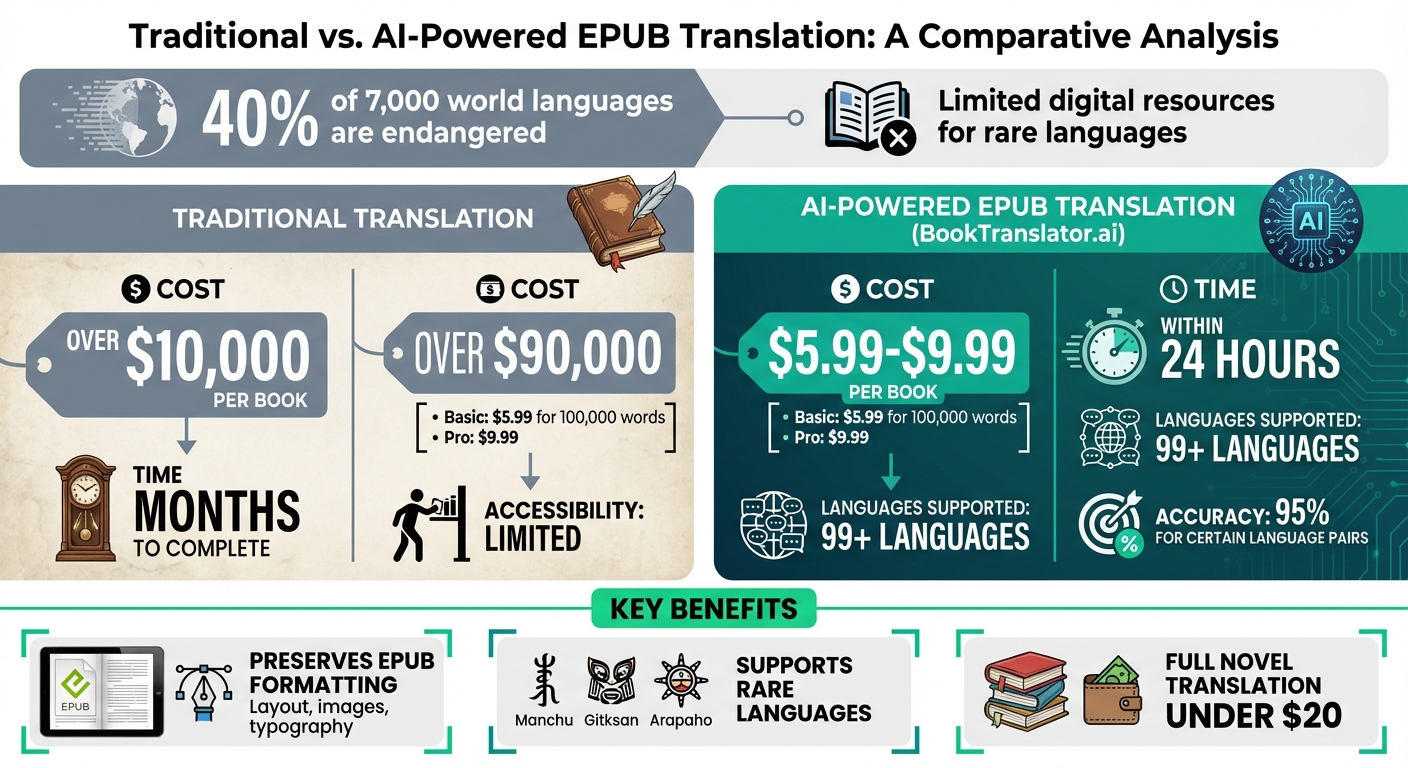
Traditional vs AI-Powered EPUB Translation: Cost and Speed Comparison
How AI Addresses Rare Language Translation
AI Translation for Low-Resource Languages
Modern AI systems rely on advanced transformer architecture and self-attention mechanisms to understand the context of entire sentences, rather than translating word by word. This shift allows Neural Machine Translation (NMT) to produce translations that feel natural and are both grammatically and semantically accurate[4]. Unlike older methods, these models consider the broader context, which significantly improves the quality of translations.
When it comes to rare languages with limited training data, AI platforms employ intelligent routing to select the best-performing models for the task[5]. These systems can achieve impressive accuracy levels - GPT-4, for example, scores a BLEU of 44.6 for English-to-German translations - while maintaining narrative flow and specialized terminology[2][5]. Further refinement is achieved through fine-tuning on domain-specific datasets and the use of project-specific glossaries and metadata. This ensures consistency in terminology, even for lengthy or technical texts.
Maintaining EPUB Formatting During Translation
Accurate translation is only part of the challenge; preserving EPUB formatting is equally important to ensure a seamless reading experience. EPUB files are built on intricate HTML and CSS frameworks, which define elements like chapter divisions, text styles, and layout. AI-powered book translators use a File Parser to analyze this underlying code, identifying key elements such as headings, chapters, and style attributes before starting the translation process. Once translated, a formatting engine reinstates the original styles - like bold, italics, and layout - into the new content[1].
This method ensures that chapter titles, breaks, and overall narrative flow remain intact, regardless of the target language. Elements like paragraph spacing, line breaks, and embedded images are also preserved. Reviewers have praised these tools for maintaining complex formatting across a variety of language pairs. However, for certain low-resource languages, such as Swahili, minor manual adjustments may occasionally be required to perfect the final output[2].
sbb-itb-0c0385d
BookTranslator.ai for EPUB Translation
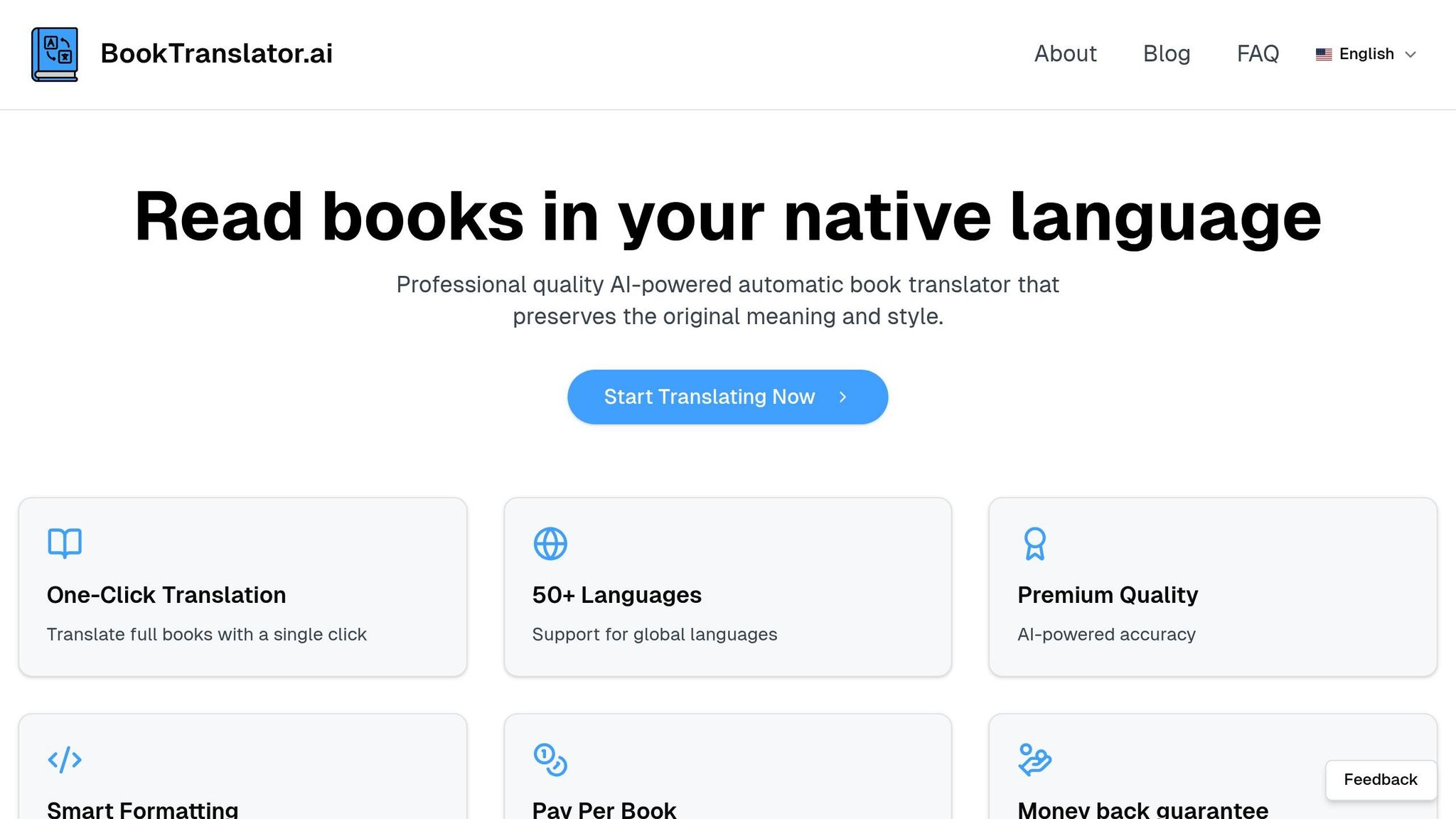
Main Features of BookTranslator.ai
BookTranslator.ai takes EPUB translation to the next level by combining advanced AI with precise formatting preservation. Supporting over 99 languages, including those considered low-resource, the platform uses cloud-based technology to handle even lengthy texts with ease [1].
With its one-click translation tool, entire EPUB files can be translated while keeping the original formatting intact. Users have reported an impressive 95% accuracy for certain language pairs, such as English to Catalan. To enhance consistency, especially in technical documents or book series, the platform includes built-in glossary support [2].
BookTranslator.ai is designed to deliver translations quickly - within 24 hours - and even offers a money-back guarantee for dissatisfied users. It also accommodates right-to-left scripts and complex dialects, ensuring that important linguistic and cultural subtleties are preserved during translation [1]. This makes it a valuable tool for communities aiming to protect their literary and cultural heritage.
Pricing Plans and Value
BookTranslator.ai offers a straightforward pricing model based on a pay-per-book system, avoiding recurring monthly fees. The Basic Plan translates up to 100,000 words for $5.99, while the Pro Plan costs $9.99. This means translating a full-length novel can cost less than $20.
Compared to traditional translation services - which can cost over $10,000 for professional work - this platform provides a far more affordable alternative. The Pro Plan is ideal for projects that demand the highest accuracy or involve specialized cultural terminology, utilizing the most advanced AI models available [2].
"Far more reliable than other tools." - Min-jun P., Researcher
This pricing approach makes rare language translation accessible to a wide range of users, from individual readers to researchers and indigenous communities. It opens the door for translating educational materials and cultural texts that might otherwise remain out of reach in their native languages [1].
Preserving Culture Through EPUB Translation
Keeping Endangered Languages Alive
When a language fades away, it takes with it unique perspectives, oral traditions, and centuries of history. EPUB translation offers a way to fight against this loss by making ancestral literature available to younger generations who might otherwise miss out on written works in their native tongues.
Unlike basic text formats, EPUB preserves the full design of a book - its illustrations, layout, and typography - ensuring that cultural nuances remain intact [6]. This attention to detail allows readers to engage with the material in a way that feels true to its origins. For instance, researchers at Carnegie Mellon University and UC Santa Barbara created LingoLLM, a tool capable of translating languages like Manchu, Gitksan, and Arapaho, which are often overlooked by mainstream translation platforms [3]. By doing so, they’ve shown how AI can support languages with little digital representation, providing resources that help communities pass their linguistic heritage to future generations. This not only preserves the authenticity of literary works but also opens doors for inclusive education and cultural renewal.
Supporting Indigenous Communities Through Translation
For many Indigenous communities, the lack of educational materials in their native languages poses a significant barrier to literacy and cultural preservation. EPUB translation steps in to bridge this gap by adapting books into native languages while keeping the original design and cultural essence intact. This approach provides access to a wide range of content, from educational resources to traditional narratives, which helps strengthen both language skills and cultural pride.
Features like bilingual displays and compatibility with devices worldwide make these translations accessible to Indigenous diaspora communities as well [6]. Tools like BookTranslator.ai play a key role in this effort, ensuring that digital literature becomes a powerful resource for empowering communities and preserving their linguistic and cultural identities.
I taught an AI 99 languages. Here's the easiest one to learn
Conclusion
BookTranslator.ai brings together affordability, speed, and precise format preservation to make rare language translation more accessible than ever. With AI-driven tools now capable of translating entire novels for under $20 [1], this technology is reshaping how we approach global literature.
But the impact goes beyond cost. Nearly 40% of the world's 7,000 languages are endangered, highlighting the critical need for tools like this to promote digital access and preservation [3]. BookTranslator.ai ensures that translations maintain the original formatting, illustrations, and layout, while also respecting cultural subtleties [6]. With accuracy rates reported at around 95% for certain language pairs, it’s a reliable solution for both casual readers and serious preservation efforts [2].
For Indigenous communities and speakers of underrepresented languages such as Manchu, Gitksan, and Arapaho, this technology plays a crucial role in preserving linguistic heritage [3]. Supporting over 99 languages with prices starting at just $5.99, BookTranslator.ai opens the door to global literature while helping communities pass their traditions to future generations.
This innovation eliminates the long waits and high costs traditionally associated with translations. Whether you're an independent author looking to reach underserved audiences or a reader eager to experience stories in your native language, AI-powered EPUB translation offers a new way forward - making literature more accessible and empowering efforts to preserve cultural heritage.
FAQs
How can I tell if a rare-language translation is accurate?
To achieve accurate translations, it's essential to use a mix of automated metrics and human expertise. Tools like BLEU or COMET help evaluate the semantic and linguistic quality of translations. However, automated assessments alone aren't enough. Native speakers or professional reviewers play a crucial role in verifying the tone and ensuring the translation aligns with the cultural context. This combination of AI and human review is especially important when working with less common languages, where subtle nuances can easily be lost.
Will my EPUB layout, images, and styles stay exactly the same after translation?
Yes, your EPUB's layout, images, and styles will stay the same after translation. Tools like BookTranslator.ai are specifically built to keep the original formatting intact, so the translated version looks just like the original while preserving its meaning and tone.
What should I do if my language or dialect isn’t listed in the supported languages?
If you don’t see your language or dialect listed, you can use the platform’s user-driven expansion feature to request its addition. BookTranslator.ai frequently updates its language options based on user feedback. It’s also worth checking if your dialect is already covered under one of the existing language options. If it’s not, reaching out to the support team or submitting a request can help ensure it’s considered for future updates.