Introduction: why English-to-Hindi translation matters now
English-to-Hindi translation has never been more consequential. With 886 million active internet users in India in 2024 and Hindi accounting for 24% of all internet language use in the country, the demand for accurate, culturally resonant Hindi content is reshaping publishing, education, and digital communication at scale.
The Hindi content opportunity
Research suggests that 57% of urban Indian internet users prefer consuming content in Indian languages over English. For authors, publishers, and educators, this is not a minor footnote. It is a fundamental shift in how knowledge and stories reach their audiences. A book translated into Hindi does not just cross a language barrier. It enters a living cultural conversation, one with its own idioms, registers, and emotional textures that no word-for-word conversion can capture.
At BookTranslator.ai, our analysis shows that the most common failure point in English-to-Hindi translation is not vocabulary. It is context. Translators and AI tools alike often stumble on honorifics, gendered grammar, and culturally embedded expressions that require genuine linguistic intelligence to handle well.
What these tips will do for you
The seven expert tips ahead are built for readers who want professional-grade results, whether you are a self-publishing author reaching new Indian readers, an academic making research accessible, or a publisher expanding into one of the world's fastest-growing book markets. Each tip addresses a real, recurring challenge and gives you a concrete way to solve it. 🎯
By the end, you will have a practical framework for translations that feel native, not translated.
Top 3 quick wins for better English-to-Hindi translation
Before diving into the deeper craft of linguistic accuracy, three foundational habits will immediately raise the quality of your English to Hindi translation work. These wins are fast to implement, measurable in their impact, and relevant whether you are translating a single document or an entire book.
Tip 1: Prioritize context over literal word matching
Literal translation is the single most common trap in English-to-Hindi work. Hindi is a deeply contextual language where the same English word can require entirely different translations depending on tone, relationship, and setting. The word "you," for example, maps to tum, aap, or tu depending on formality and intimacy.
Train yourself to ask: who is speaking, to whom, and in what situation? That question alone will prevent dozens of awkward phrasings per document. According to Evaluating Large Language Models in English-Hindi Translation, WMT 2024 Shared Task (2024), contextual understanding remains one of the most significant differentiators between high-quality and poor-quality Hindi translations, even among advanced AI systems.
Tip 2: Identify and preserve cultural idioms and expressions
Hindi carries idioms that have no direct English equivalent, and English idioms rarely survive literal translation into Hindi. "It's raining cats and dogs" becomes nonsensical; the Hindi equivalent, मूसलाधार बारिश हो रही है, conveys the same feeling through entirely different imagery.
Build a running list of idioms in your source text before you begin translating. Flag each one and research its closest Hindi cultural equivalent rather than forcing a word-for-word rendering. This single habit transforms translations from technically correct to genuinely readable. The same principle applies when working across related language pairs, such as english to urdu, where cultural nuance is equally critical.
Tip 3: Use terminology glossaries for consistency across documents
Inconsistent terminology is the silent quality killer in longer translation projects. A character name rendered three different ways, or a technical term that shifts meaning between chapters, erodes reader trust immediately.
Create a simple glossary before you start: key names, recurring concepts, domain-specific vocabulary, and their agreed Hindi equivalents. Lock them in and apply them uniformly. Tools like BookTranslator.ai are built with this challenge in mind, using context-aware AI translation that maintains consistent terminology across an entire EPUB file, preserving chapter structure and formatting so your glossary decisions carry through from page one to the last footnote. 📋
For authors comparing the full cost of maintaining that consistency professionally versus using AI-assisted tools, The Definitive Book Translation Cost Breakdown by Service offers a clear breakdown worth reviewing before you commit to a workflow.
Linguistic accuracy tips: preserving meaning and nuance
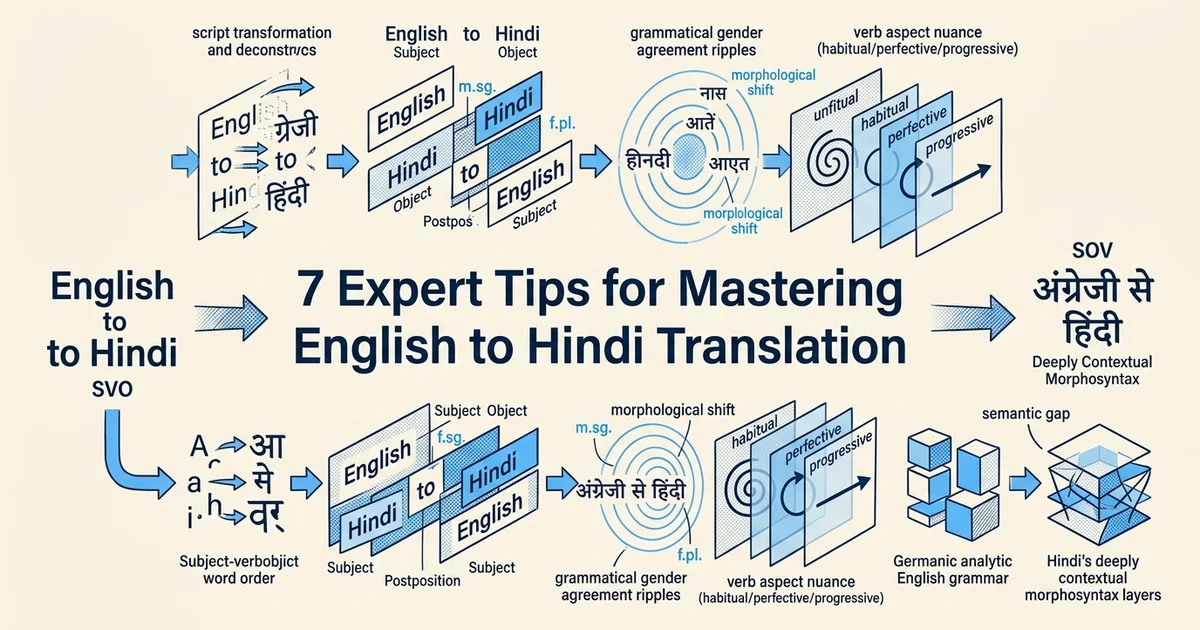
Getting the grammar right is where English-to-Hindi translation either earns trust or loses it. Hindi and English are structurally different in ways that go far beyond vocabulary, and understanding those differences at a mechanical level is what separates a readable translation from a genuinely accurate one.
Understand the SOV word order shift
English follows a Subject-Verb-Object pattern: "She reads the book." Hindi flips this to Subject-Object-Verb: "वह किताब पढ़ती है" (literally, "She book reads"). This isn't just a stylistic quirk. It affects how clauses nest, how emphasis lands, and how naturally a sentence flows to a native Hindi reader. Forcing English word order onto Hindi syntax produces translations that feel mechanical, even when every individual word is correct.
Practical fix: Restructure sentences at the clause level, not word by word. Read the Hindi output aloud, or have a native speaker do so. Awkward rhythm is usually a sign that English syntax has bled through.
Handle gender agreement carefully
Hindi assigns grammatical gender to nouns, and that gender ripples through adjectives, verbs, and postpositions. English has almost none of this. "The old book" is neutral in English; in Hindi, the adjective "पुरानी" or "पुराना" changes depending on whether the noun is feminine or masculine. Errors here are immediately noticeable to native readers and undermine credibility, especially in published work.
This is one area where automated tools still require human review. According to Evaluating Large Language Models in English-Hindi Translation, WMT 2024 Shared Task (2024), current LLM-based systems are actively benchmarked on this language pair, with gender agreement and morphological consistency among the persistent challenges researchers are working to resolve.
Map verb tenses with nuance, not literalism
Hindi has verb aspects that don't map cleanly onto English tenses. The habitual present, the perfective aspect, and the progressive all carry distinct shades of meaning that a word-for-word tense match will distort. Translating "I have been reading" requires understanding what the speaker means, not just what tense they used.
Preserve tone and register
A formal English source text should produce formal Hindi, using "आप" rather than "तुम" or "तू" for second-person address. Register collapse is one of the most common accuracy failures in automated translation. For authors translating full-length books, BookTranslator.ai applies context-aware AI that holds register consistent across chapters, which matters enormously when a character's speech patterns or a narrator's voice need to feel uniform from the first page to the last.
For translators working across multiple language pairs, the structural lessons here apply broadly. Similar register and syntax challenges appear in portuguese to english translation, where formality markers and verb aspect also require careful handling. 🎯
Cultural and contextual adaptation: beyond literal translation
Linguistic accuracy gets you halfway there. The other half is cultural fluency. Even a grammatically perfect Hindi translation can feel hollow or confusing if it ignores the lived context of Hindi-speaking readers. Adapting meaning across cultures requires understanding what resonates, what confuses, and what simply does not exist in the target language.

Recognizing when direct translation fails
Idioms and colloquialisms are the first casualties of literal translation. The English phrase "bite the bullet" has no intuitive Hindi equivalent. Forcing a word-for-word rendering produces nonsense. A skilled translator reaches instead for a Hindi expression that carries the same emotional weight, such as "दांत पीसकर सहना" (bearing something through gritted teeth). The goal is equivalence of feeling, not equivalence of words.
Colloquial English humor is particularly tricky. Puns, wordplay, and culturally loaded jokes often depend on phonetic or cultural coincidences that simply do not survive the crossing. Recognizing these moments early, and choosing to adapt rather than translate literally, is a mark of genuine expertise.
Adapting cultural references for Hindi-speaking audiences
A reference to Thanksgiving dinner or a Super Bowl analogy may land perfectly with an American reader and fall completely flat in Mumbai or Lucknow. Effective adaptation means either substituting a culturally familiar equivalent (a festival meal, a cricket final) or adding brief context that lets the reference breathe without interrupting narrative flow.
According to Evaluating Large Language Models in English-Hindi Translation, WMT 2024 Shared Task (2024), cultural nuance remains one of the most persistent gaps in automated translation systems, precisely because cultural knowledge is harder to encode than grammatical rules. This is where human review adds irreplaceable value, especially for literary and creative projects.
Handling proper nouns, place names, and brand names
Proper nouns require a consistent strategy. Place names often have established Hindi transliterations (New York becomes न्यूयॉर्क), but lesser-known locations need careful phonetic rendering. Brand names are usually retained in their original form to preserve recognition, though some publishers prefer a transliterated version for accessibility.
For book-length projects, tools like BookTranslator.ai help maintain consistent transliteration of proper nouns across chapters, so a character's name does not shift spelling between page 40 and page 200.
Preserving literary voice across regional variation
Hindi is not monolithic. 🗺️ Readers in Delhi, Varanasi, and Bhopal each bring slightly different linguistic expectations. Standard Hindi (Manak Hindi) works as a safe baseline for most publishing contexts, but literary fiction that draws on regional flavor may benefit from dialect-aware choices that honor the original's sense of place.
Preserving an author's voice means holding onto their rhythms, their tonal register, and their cultural assumptions, even when those assumptions need to be reframed for a new audience. This is the kind of nuanced, layered work that separates a good translation from a great one.
Domain-specific translation tips: technical, academic, and literary content
The principles of cultural adaptation shift significantly depending on what you are translating. A legal contract, a physics textbook, and a novel each demand a different relationship between accuracy and expression. Understanding those differences before you begin is what keeps a translation from feeling technically correct but fundamentally wrong.
Technical translation: precision above all
In technical content, every term carries weight. Whether you are translating a software manual, a medical report, or an engineering specification, consistency in terminology is non-negotiable. Establish a glossary before you start and stick to it throughout. If "bandwidth" is translated as "बैंडविड्थ" in chapter one, it cannot become "नेटवर्क क्षमता" in chapter four.
According to Evaluating Large Language Models in English-Hindi Translation (2024), domain-specific vocabulary remains one of the most persistent challenges for automated translation systems, which underscores why human review of technical glossaries is still essential even when AI handles the bulk of the work.
Academic translation: tone and citation integrity
Academic Hindi carries its own register. Scholarly writing expects formal Sanskritized vocabulary, passive constructions, and precise attribution. When translating research papers or textbooks, preserve the citation format of the original institution and resist the urge to simplify complex arguments. Readers in this context expect density and rigor.
Literary translation: fidelity meets beauty
Literary translation is where the craft becomes most visible. Your job is not just to transfer meaning but to recreate the emotional texture of the original. This often means making bold choices: restructuring a sentence to honor Hindi's natural cadence, finding an idiom that carries the same cultural weight, or choosing a word that sounds right even when a more literal option exists. Think of how translators approach old english translator work, where every archaic register demands deliberate, creative reconstruction.
For authors translating full EPUB manuscripts across these domains, BookTranslator.ai applies context-aware AI that maintains consistent terminology and preserves chapter structure, footnotes, and formatting throughout. That structural integrity matters enormously when the source material is dense, layered, or domain-specific.
Legal and business translation: stakes are highest here
Legal translation demands certified terminology and zero ambiguity. A mistranslated clause can invalidate a contract. Business translation carries a different pressure: brand voice and marketing intent must survive the language shift. A tagline that energizes an English-speaking audience needs equivalent emotional punch in Hindi, not just a word-for-word rendering. 🎯
Common mistakes to avoid in English-to-Hindi translation
Even skilled translators stumble on predictable pitfalls. Knowing where English-to-Hindi translation goes wrong is half the battle. These six mistakes appear repeatedly across publishing, academic, and business projects, and each one is entirely avoidable with the right habits and tools.
See how BookTranslator.ai - Basic Plan handles english to hindi translation BookTranslator.ai - Basic Plan.
Over-relying on machine translation without human review
Machine translation has improved dramatically, but it still struggles with nuance. According to Evaluating Large Language Models in English-Hindi Translation, WMT 2024 Shared Task (2024), model performance varies significantly by language direction, domain, and dialect. A passage that looks fluent at a glance may carry subtle errors that only a human reviewer catches. Human-in-the-loop translation remains essential for literary and specialized projects, where a single mistranslation can shift meaning entirely.
Ignoring cultural context
Hindi speakers bring cultural assumptions to every sentence they read. Phrases that feel neutral in English can land as awkward, offensive, or simply confusing in Hindi. Always ask: does this reference translate culturally, not just linguistically?
Inconsistent terminology across long documents
Terminology drift is a silent killer in long-form translation. A character name, technical term, or brand phrase rendered three different ways across chapters erodes reader trust and professional credibility. In our experience at BookTranslator.ai, context-aware AI translation that maintains a consistent terminology layer across an entire EPUB file solves this problem before it starts, which is why the platform was built to process full documents rather than isolated paragraphs.
Failing to preserve the author's voice
Translation is not rewriting. The author's rhythm, tone, and stylistic choices deserve protection. A formal academic voice should remain formal. A breezy conversational narrator should stay breezy.
Translating idioms word-for-word
"Bite the bullet" does not mean what it says. Hindi has its own rich idiomatic tradition, and finding the right equivalent, rather than forcing a literal rendering, is what separates competent translation from genuinely readable prose. The same principle applies when you translate Portuguese to English: idioms always need cultural mapping, not word substitution.
Neglecting proofreading for grammar and formatting
A final proofread catches the errors that accumulate invisibly: inconsistent use of the Devanagari script, spacing issues around punctuation, and grammar slips that automated tools miss. 📝 Never skip this step, no matter how confident you feel about the draft.
Tools and resources for professional English-to-Hindi translation
The right toolkit separates a polished Hindi translation from a rough draft. Whether you are a self-publisher, an academic researcher, or a language learner, combining AI-powered platforms with human expertise and solid reference materials gives you the best chance of producing accurate, natural-sounding Hindi.
AI-powered translation platforms
AI translation has matured significantly, but it still has real limits. According to Evaluating Large Language Models in English-Hindi Translation (2024), modern LLMs perform competitively on general Hindi text yet struggle with domain-specific vocabulary and culturally embedded expressions.
For book-length projects, BookTranslator.ai addresses one of the most frustrating pain points in AI translation: formatting collapse. Its context-aware engine preserves chapter structure, footnotes, and images inside EPUB files, so you receive a translated manuscript that reads like a finished book rather than a raw text dump. If cost is a concern, the pay-per-use model ($6.99 per 100,000 words) makes it a genuinely practical option compared to traditional services. You can also explore a cheap book translation service to understand the full range of budget-friendly approaches.
Terminology management and glossary resources
Consistency across long documents requires dedicated terminology tools. India's government-backed BHASHINI project offers open-access language resources for multiple Indian languages, including Hindi, making it a strong starting point for domain-specific glossaries. C-DAC Pune's Kanthasth 2.0 system is another specialized resource built specifically for English-to-Hindi translation workflows.
Human networks and quality assurance
Freelancer platforms like ProZ and Upwork connect you with certified Hindi translators for sensitive or high-stakes content. Pair human review with grammar-checking tools calibrated for Devanagari script to catch spacing errors and punctuation inconsistencies before final delivery. 🔍
Beginner vs. advanced translation strategies
Your translation strategy should match your current skill level, project scope, and quality requirements. A first-time self-publisher has very different needs from an academic institution producing multilingual research at scale. Matching the right workflow to your situation saves time, money, and avoids costly rework.

Starting out: AI-first with human review
Beginners should lean on AI translation tools to handle the heavy lifting, then bring in a human reviewer for critical sections like introductions, legal disclaimers, or culturally sensitive passages. This approach keeps costs manageable while still catching the errors that matter most.
For authors just entering the Hindi market, BookTranslator.ai's Basic Plan offers a practical entry point. Its context-aware AI preserves chapter structure, footnotes, and formatting automatically, so you spend less time reformatting and more time refining the actual language. At $6.99 per 100,000 words with no subscription required, it makes affordable book translation genuinely accessible for independent authors testing a new market.
Intermediate: combining AI with terminology management
Once you are handling multiple projects or building a consistent body of work in Hindi, the priority shifts to terminology consistency. Intermediate translators benefit from pairing AI output with in-house glossaries that lock down key terms, character names, or subject-specific vocabulary across every chapter.
This is where the Pro Plan from BookTranslator.ai adds real value, supporting consistent terminology across longer, more complex manuscripts.
Advanced: human-in-the-loop workflows
Advanced practitioners implement full human-in-the-loop systems, where cultural consultants review AI drafts for register, regional dialect appropriateness, and idiomatic accuracy. According to Evaluating Large Language Models in English-Hindi Translation (2024), even high-performing LLMs show measurable gaps in nuanced Hindi output, which reinforces why expert human oversight remains essential at scale.
When to invest in professional translation
For high-stakes publishing, academic research, or content targeting rural Hindi-speaking audiences with distinct dialectal expectations, professional translators are worth the investment. AI workflows excel at speed and volume; human expertise handles cultural depth. The smartest approach at any level combines both. 🎯
Checklist for English-to-Hindi translation success
A structured checklist transforms good intentions into consistent results. Whether you are translating a single chapter or an entire manuscript, moving through preparation, execution, and review as distinct phases catches errors that a single read-through will miss every time.
Pre-translation preparation
- Define your target audience: urban Hindi readers, rural dialects, or diaspora communities
- Compile a glossary of key terms, proper nouns, and brand-specific language
- Confirm the script standard (Devanagari) and any regional spelling conventions
- Identify culturally sensitive topics that may need adaptation, not just translation
During-translation quality checkpoints
- Verify terminology consistency every 2,000 to 3,000 words
- Flag idiomatic English phrases for cultural equivalence review rather than literal rendering
- Preserve formatting cues: headings, footnotes, and chapter breaks
For book-length projects, BookTranslator.ai handles this automatically, maintaining chapter structure, images, and footnotes throughout the EPUB file so formatting integrity never becomes a separate task.
Post-translation review and validation
- Read the Hindi output aloud to catch unnatural phrasing
- Run a terminology consistency audit against your pre-translation glossary
- Verify cultural references land appropriately for the intended audience
- Check final formatting against the source document structure
According to Evaluating Large Language Models in English-Hindi Translation, WMT 2024 Shared Task (2024), systematic evaluation frameworks significantly improve output reliability, reinforcing why a post-translation audit step is non-negotiable for professional results. ✅
Frequently asked questions
How do I translate English to Hindi?
Start with a reliable AI tool or professional translator, prepare a glossary of key terms, and always review the output for cultural accuracy. The best results combine automated translation with human post-editing, especially for nuanced or formal content.
What is the best English-to-Hindi translator?
The best tool depends on your content type. For books and long-form documents, BookTranslator.ai preserves formatting, chapter structure, and footnotes while delivering context-aware English to Hindi translation across entire EPUB files.
How accurate is English-to-Hindi translation?
Accuracy has improved significantly with modern AI systems. Research suggests current large language models perform competitively, though complex idiomatic expressions and cultural references still benefit from human review.
Can I translate a full book from English to Hindi?
Yes. BookTranslator.ai handles full EPUB books with one-click translation, maintaining original layout and consistent terminology throughout, at just $6.99 per 100,000 words.
How do I translate an English PDF into Hindi?
Convert your PDF to an editable format first, then use an AI translation tool. Preserving original formatting during this process requires tools specifically designed for document structure.
How do I translate English text into Hindi without losing the meaning?
Build a pre-translation glossary, choose culturally appropriate equivalents over literal translations, and always perform a post-translation review against your source text.
Which app is best for English-to-Hindi translation?
For everyday text, Google Translate works well. For publishing-quality results on longer content, a dedicated book translation platform offers superior consistency and formatting preservation.
How can I translate English to Hindi professionally?
Combine AI tools with human expertise: use AI for speed and consistency, then engage a native Hindi reviewer for cultural refinement. Based on our work at BookTranslator.ai, this hybrid approach consistently delivers the most natural, publication-ready results.