
An ebook translator is, at its core, a sophisticated tool that uses artificial intelligence to take your book from its source language and accurately render it into another. For authors and publishers, this opens up a world of possibilities. Modern services like BookTranslator.ai are designed to do more than just swap words; they meticulously preserve your original formatting and style, ensuring your work reaches new audiences exactly as you intended. It’s how a great book in one language can become a beloved bestseller in another.
Why Ebook Translation Is a Game Changer for Authors

If you've been thinking about translating your ebook, it's important to see it as more than just a way to get "more readers." This is a genuine strategic move that can fundamentally reshape your career. When you break through the language barrier, you're not just adding a new edition; you're unlocking access to massive, high-growth international markets where readers are hungry for new stories.
Think about it. Your sci-fi epic could find a passionate following in Germany, or your business guide could become essential reading for entrepreneurs in Brazil. This isn't just a fantasy. It's a tangible step toward building a global author brand. Each new language you add builds your prestige and authority, signaling to the world that your work has universal appeal.
Tapping into Global Digital Reading Trends
The digital book market is booming, and that growth isn't confined to English-speaking countries. Far from it. The global e-book market is on track to hit USD 23.6 billion by 2031, with projections showing more than 1.1 billion e-book readers worldwide by 2029. This explosive growth is creating a huge opportunity for authors who are ready to think globally. You can dig deeper into these trends over at Mordor Intelligence.
What this data really tells us is that there’s a clear, unmet demand for quality digital content in countless languages. An ebook translator is your direct line to this waiting audience.
Here’s what that means for you in practical terms:
- Market Diversification: Stop being so reliant on your home market. Translation lets you build multiple income streams from around the world.
- Increased Discoverability: Your book will start showing up in international searches and on local bestseller lists, reaching people who never would have found you otherwise.
- Enhanced Author Credibility: Having your work available in several languages seriously boosts your professional profile. This can open doors to speaking gigs, international collaborations, and other opportunities.
For an indie author, tapping into the Spanish-speaking market could mean tens of thousands of new potential readers. For a researcher, a German translation could lead to crucial citations from European institutions.
At the end of the day, the goal is to connect your story with people who will love it, no matter where they live or what language they speak. As you start down this road, you'll find that understanding AI book translation is key to global reader engagement. The great news is that modern tools have made this process more accessible and affordable than ever before, turning what used to be a complex, expensive headache into a manageable and rewarding project.
How to Prepare Your Ebook for a Flawless Translation
Before you jump into any translation tool, the most important work happens on your own computer. Think of it this way: a clean, well-structured source file is the bedrock of a successful translation. The old saying "garbage in, garbage out" is especially true here. If you feed a messy EPUB or MOBI file into an AI, you're practically guaranteed to get formatting chaos in return.
You don't need to be a coding wizard. The goal is just to do a few simple, proactive checks to sidestep common problems that can trip up even the smartest AI. It’s like tidying a room before you paint it—a little prep work now saves you a massive headache later.
Polishing Your Manuscript Structure
The first thing to look at is the structure. AI translators don't just read the words; they read the underlying code of your ebook to understand the layout. Any inconsistencies in that code can confuse the AI, leading to jumbled chapters or misplaced text in the final version.
Here’s a quick checklist of what to look for:
- Consistent Chapter Headings: Make sure every single chapter title is formatted the same way. If "Chapter 1" is an H1 heading, then "Chapter 2" must also be an H1, not an H2 or just some bolded text.
- No Text Baked into Images: Any text embedded directly into an image—like a custom graphic or a chart—is completely invisible to the translator. You need to pull that text out and place it as regular, live text in the ebook itself.
- Keep Tables Simple: Really complex tables with merged cells or funky layouts are tough for AI to figure out. If you can, simplify them into basic rows and columns. You'll get much cleaner results.
A classic mistake I see all the time is authors manually making chapter titles bigger with a font-size change instead of using a proper heading tag. An AI sees that as just another paragraph, which can completely break the book's structure and even merge chapters together in the translation.
Clean Up with Calibre
For those who want to get their hands a little dirty, a free tool like Calibre is an absolute lifesaver. This powerful ebook management software has an "Edit book" feature that lets you peek under the hood of your EPUB file.
With it, you can quickly find and fix inconsistent heading tags or get rid of junk code left over from your word processor. Seriously, a few minutes spent cleaning up your file in Calibre can make a world of difference in the final translation quality. For a more detailed walkthrough, our guide on preserving format and style during EPUB translation covers more advanced techniques.
One last thing: don't forget the metadata. This is all the background info that identifies your book—the title, author name, publisher, and so on. Make sure this information is accurate and complete within the source file. Getting this right from the start ensures your translated ebook shows up correctly on storefronts and e-readers, saving you from a major publishing headache.
A Practical Walkthrough of an AI Ebook Translator
Alright, let's get out of the weeds of theory and see what this looks like in practice. Walking through a real-world tool can make the whole process feel much less intimidating. We’ll use BookTranslator.ai as our example to go from uploading a file to getting a final price tag.
When you first land on the site, you'll notice it’s designed to be simple. No confusing menus, no technical jargon. The main goal is to get your polished manuscript into the system so the AI can do its thing.
This is a great visual summary of the prep work you should do before you even get to a translation tool.
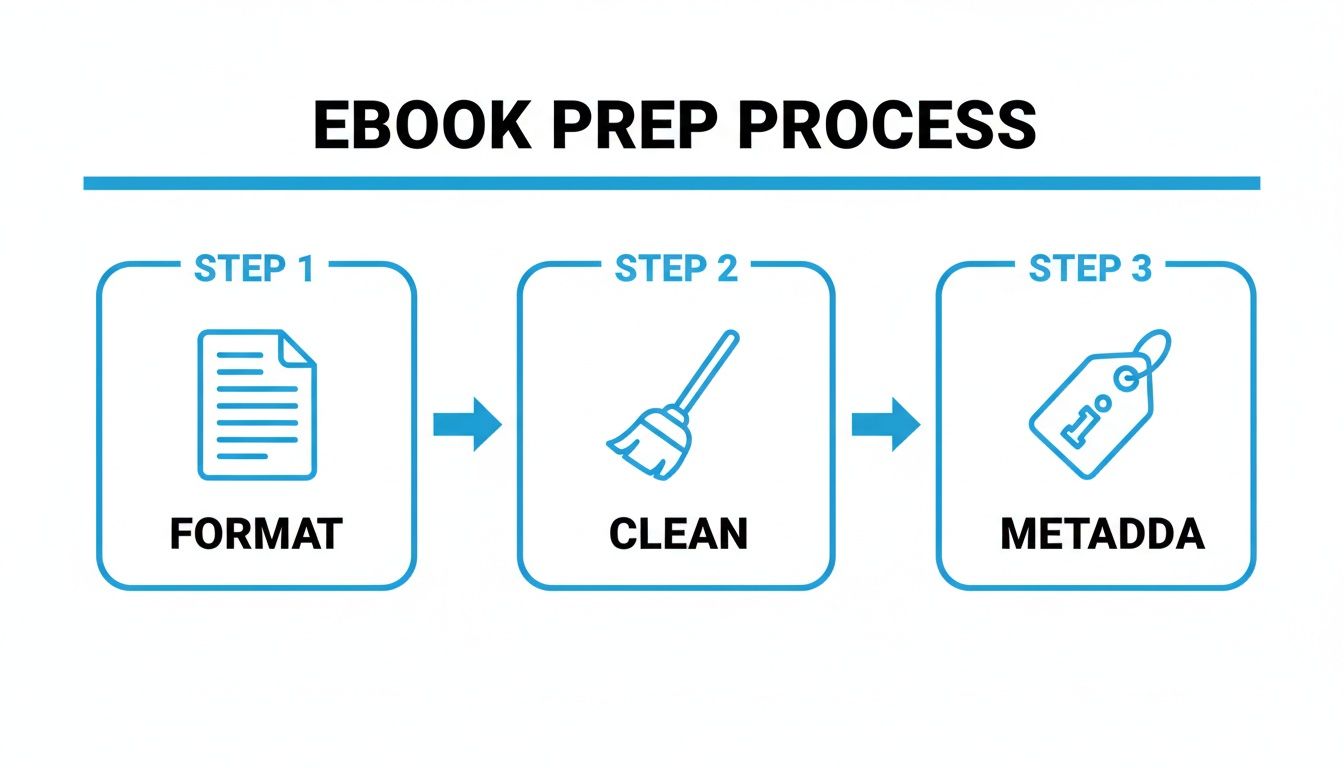
As you can see, a great translation always starts with a clean, properly formatted source file with all its metadata in place.
Kicking Off Your Translation Project
The first part is refreshingly easy: getting your file uploaded. Like most modern platforms, BookTranslator.ai uses a straightforward drag-and-drop interface. Just grab your prepared EPUB file and drop it into the box on the website.
Once the upload is complete, the system will ask for your project's basic details:
- Source Language: The original language your manuscript is in.
- Target Language: The language you want to translate your book into.
Don't rush this step. Double-check that you've selected the right languages, as this choice is what guides the entire translation engine.
Choosing Your Translation Quality
Here’s where you have to make a key decision. Most AI ebook translation services offer a couple of quality tiers, often called something like 'Basic' and 'Pro'. This choice affects both the final quality of the translation and, of course, the price.
A 'Basic' model will give you a very accurate, literal translation. This is often a great fit for straightforward non-fiction or genres where literary flair isn't the top priority.
The 'Pro' model, on the other hand, runs on a more advanced, next-generation AI. This is what you'll want for fiction, poetry, or any manuscript where your unique authorial voice and tricky cultural nuances are crucial to the reader's experience. If you want to get into the nitty-gritty of file types, our complete guide to EPUB translation is a great resource.
The real difference isn't just about word-for-word accuracy—both are highly accurate. It's about sophistication. The Pro model is much better at picking up on subtext, tone, and the artistic craft of your writing, which leads to a more fluid and natural-sounding book.
Understanding the Cost Structure
The best part? No hidden fees. Once you've chosen a model, the platform instantly analyzes your book's word count and calculates the cost using a token-based system. Think of tokens as the small pieces of words that the AI processes.
This kind of upfront, transparent pricing is a huge benefit. You see the exact cost before you spend a penny, making it easy to budget for your project. This approach is part of a larger trend of making powerful tech more accessible to everyone. In fact, the global market for language translation devices is expected to jump from USD 1.9 billion in 2025 to USD 6.5 billion by 2035, which shows just how much demand there is for easy-to-use translation tools. You can see more about this remarkable growth in translation technology adoption in recent market analysis.
After you confirm the details, the AI gets to work. In a surprisingly short amount of time, your newly translated ebook will be ready for you to download.
The Human Touch in Your Post-Translation Review

So, your AI ebook translator has crunched the data and handed you back a complete manuscript. The heavy lifting is done, and you've got a version that's structurally sound and probably quite accurate. But don't hit "publish" just yet.
This next part—the human review—is where the magic really happens. It’s what transforms a technically correct translation into a story that genuinely connects with a new audience. Think of it as the final polish that makes the piece shine.
AI is brilliant with denotation—the dictionary definition of a word. Where it often stumbles is with connotation, which is all about the cultural and emotional baggage words carry. This is your chance to step in and make sure your authorial voice and the original's intent weren't lost in translation.
The demand for this kind of quality is exploding. The global translation service market is on track to hit USD 89.94 billion by 2032, a clear sign that as more content goes international, readers expect a flawless, natural experience. You can dig into the globalization and AI-driven trends from Astute Analytica to see just how big this is getting.
Refining for Accuracy and Tone
First things first, do a side-by-side read-through. Put your original manuscript next to the translated one and check for pure accuracy and consistency. You’re hunting for those sentences that just feel a bit "off" or overly literal, which is a classic tell of machine translation. A phrase that sounds perfectly natural in English can come across as stiff or clunky when translated word-for-word into Spanish or Japanese.
Once you're confident in the accuracy, shift your focus to the tone. Does the book still sound like you? If your original was witty and informal, the translation needs to capture that same spark. If it was a serious academic work, it must maintain that formal weight.
Here are a few tricks I've learned over the years:
- Read It Aloud: This is the best way to catch awkward phrasing. If a sentence makes you stumble, it will trip up your reader, too.
- Check Key Terminology: Especially for non-fiction, make sure every specialized term, brand name, and core concept is translated the exact same way every single time it appears.
- Watch for Repetition: AI models can get stuck on certain words. If you notice the same adjective popping up too often, grab a thesaurus and introduce some variety to make the prose flow more naturally.
The Crucial Cultural Check
Now for what is arguably the most critical part of the process: localization. This goes beyond language—it's about making sure your book is culturally appropriate. Something perfectly normal in one culture can be confusing, or worse, offensive in another.
Think about it: an American author describing a business success as a "home run" would completely lose a German reader. A smart human reviewer would swap that for a culturally relevant metaphor, like scoring a goal in soccer, to keep the meaning and impact intact.
This is where you hunt down idioms, metaphors, historical inside jokes, and humor that just won't land with a new audience. A casual reference to a local celebrity or a specific brand could leave your international readers completely lost.
In the end, a great translation is a blend of AI and human creativity. The AI builds a solid, reliable foundation, but it's the human expert who adds the final, essential layer of nuance and polish.
My best advice? If the budget allows, hire a native-speaking proofreader for one final pass. Their intuitive grasp of the language and culture is the best quality assurance you can get before sending your work out into the world.
Publishing and Marketing Your Translated Ebook
Your beautifully translated ebook is polished and ready to go. Now for the exciting part—getting it into the hands of a brand new international audience. This is where all your hard work starts to pay off, but it demands a completely different strategy than your original launch.
The first hurdle is distribution. When you’re ready to publish, exploring the best platforms for selling digital products is the logical first step to get the widest reach. Thankfully, major retailers like Amazon KDP, Apple Books, and Kobo have global storefronts, so uploading your new edition is usually straightforward.
The real secret to success on these platforms, though, isn't the upload process. It's the metadata. This goes far beyond just translating your book's title; it's about a complete localization of your entire book listing.
Optimizing Your International Book Listing
Your book’s visibility in a new market depends almost entirely on how well you adapt its listing. A direct, word-for-word translation of your English keywords might completely miss what local readers are actually searching for.
Here’s a practical checklist to get your metadata right:
- Translated Title: Don't just translate it; workshop it with a native speaker. The goal is a title that feels compelling and culturally natural in the new language.
- Localized Book Description: Think of this as your new sales pitch. It needs to be rewritten to connect with local readers, using phrases and cultural references that make sense to them.
- Targeted Keywords: Do your homework. Research popular search terms and genre conventions in the target country's ebook market. This is about investigation, not just translation.
- Appropriate Categories: Make sure you're placing your book in the most relevant categories for that country's specific storefront. These often differ from the English-language stores.
One of the most common mistakes I see authors make is running their English book description through an online translator and pasting it into KDP. This almost always results in clunky, unnatural phrasing that screams "foreign book" and can scare off potential buyers instantly.
Marketing Your Book to a New Audience
Once your book is live, you have to let people know it exists. Your marketing efforts need to be just as localized as your translation was.
First, update your author website. Create a dedicated page or section showcasing the new international editions, with direct links to the correct storefronts for each country. This gives your growing global readership a central place to find your work.
Next, shift your focus to targeted outreach. Forget your usual marketing channels for a moment and start looking for book bloggers, reviewers, and influencers who are well-known in your target country. A single positive review from a trusted local voice can give you more credibility and visibility than a dozen of your own ads.
Finally, think about running small, highly targeted ad campaigns on platforms like Facebook or Amazon Ads. You can dial in the geographic and language settings to reach readers in specific countries with pinpoint accuracy. Even a small budget can kickstart those initial sales, helping your book gain the traction it needs for long-term success in a new market.
Frequently Asked Questions About Ebook Translation
It's completely normal to have a few questions before diving into the translation process, even with a solid plan. I've heard a lot of the same concerns from authors over the years, especially when it comes to AI, quality, and the technical side of things. Let's tackle some of the most common ones head-on.
Getting these worries out of the way is the first step to feeling good about the process. You might be surprised to find that today's AI tools are far more sophisticated than you think.
Will an AI Ebook Translator Keep My Formatting Intact?
Yes, for the most part. A good AI ebook translator is built specifically to understand and preserve the structure of your original EPUB file. That means your chapters, headings, bold and italic text, and even basic paragraph breaks should come through perfectly. The technology is smart enough to read the underlying code of your ebook and replicate it.
The key here, though, is starting with a clean, well-formatted source file. If your original ebook is a mess, the translation will be too. The main exceptions are highly complex layouts, like intricate tables or text that's actually part of an image. Those will almost always need a manual touch-up after the AI does its job.
How Does AI Handle an Author's Unique Voice?
This is the big one, isn't it? Modern neural machine translation, especially the "Pro" level models, has gotten incredibly good at picking up on context and style. The AI analyzes your writing to figure out your tone—is it academic and formal, or chatty and fun?—and then does its best to find the right equivalent in the new language.
A top-tier ebook translator isn't just swapping words. It's trying to capture the feel of your writing. That said, if your work is very poetic, full of humor, or relies heavily on cultural idioms, having a native speaker give it a final polish is the best way to make sure your voice and creative intent truly shine through.
This blend of powerful AI and a final human touch is where the magic really happens.
Can I Translate a Scanned PDF of My Book?
Unfortunately, you can't directly translate a scanned PDF with most ebook translation platforms. Think of a scanned PDF as a photograph of a page; the computer sees an image, not actual text it can read and process. These tools need a text-based file, like an EPUB, to work their magic.
If a scanned PDF is all you have, you'll first need to run it through Optical Character Recognition (OCR) software. OCR technology scans the "image" of the text and converts it into an editable, digital format. From there, you'd have to clean it up and format it properly into an EPUB. Honestly, it’s a lot of work. You'll always get the best results by starting with the original digital file.
What Is the Real Difference Between Basic and Pro AI Models?
The difference really comes down to the engine under the hood. A 'Basic' model typically uses a standard, but still very powerful, neural machine translation engine. It delivers solid accuracy and is a great value, making it perfect for more straightforward books and projects.
A 'Pro' model, on the other hand, is running on the latest, most advanced large language models out there, like GPT-4. These are the models that excel at handling tricky sentence structures, preserving subtle meaning, keeping the tone consistent, and even understanding deep cultural context. The output is a noticeably more fluid and natural translation that usually requires less editing on your end.
Ready to see what AI can do for your book? With BookTranslator.ai, you can get a professional-quality translation in minutes, keeping your formatting and capturing your unique voice. Translate your first ebook today.