
When you're creating documents in Spanish, you're doing more than just changing words from one language to another. You're building a bridge—a cultural and professional connection to a massive global audience. This applies to everything from legal contracts and business proposals to creative e-books and academic papers.
Why Creating Good Documents in Spanish Matters
Translating a document literally, without any thought for cultural context, is a bit like showing up to a formal dinner in sweatpants. Sure, you're wearing clothes, but you've completely missed the mark and left a clumsy, unprofessional impression. The same is true when you're preparing documents for a Spanish-speaking audience.
A simple word-for-word translation is almost guaranteed to fail. It completely overlooks the regional dialects, local customs, and even formatting standards that are essential for clear communication. Getting these details right is what separates a document that just exists from one that truly connects, persuades, and gets the job done.
Reaching a Global Audience
The power of a well-crafted Spanish document can't be overstated. It opens up entire new markets, connects you with collaborators, and introduces you to readers all over the world. The Spanish-speaking population has exploded, with current estimates suggesting that over 630 million people can communicate in the language.
By 2025, the number of native speakers alone is expected to surpass 500 million, cementing its role as a global powerhouse. If you want to genuinely engage with that audience, your documents need to be more than just understood; they need to feel culturally right. A complete guide on how to professionally translate Spanish to English audio and text underscores this need for a deeper, more authentic connection. When you factor in people learning the language, this community makes up nearly 7.6% of the world's population—a demographic you simply can't afford to ignore. You can find more details on this incredible growth from The Diplomat in Spain.
A well-crafted document in Spanish does more than convey information; it demonstrates respect for the reader's culture, builds trust, and positions your message for maximum impact.
The Nuances That Define Professionalism
Beyond just the words, truly professional documents have to nail the subtle details that automated tools often fumble. Understanding these differences is what makes your message land correctly and leaves a lasting, positive impression.
Here are a few key things to keep in mind:
- Regional Dialects: The Spanish spoken in Spain (Castilian) is very different from what you’ll hear across Latin America. A word that sounds perfectly professional in Mexico might come off as overly casual or even confusing in Argentina or Spain.
- Formatting Conventions: Little things like how you write dates, numbers, and currency symbols change from one Spanish-speaking region to another. Using the wrong format can cause serious confusion in legal contracts or financial reports.
- Cultural Context: Idioms, humor, and professional etiquette don't always translate. A clever marketing slogan that’s a hit in Madrid could easily fall flat—or worse, be misinterpreted—in Bogotá.
Choosing Your Translation Approach
When you're creating documents in Spanish, figuring out how to translate them is a lot like planning a road trip. The vehicle you choose depends entirely on where you're going, how fast you need to get there, and what you’re bringing along.
Each translation method offers a different mix of speed, cost, and quality. Getting this decision right is crucial—it affects everything from how your brand is perceived to whether a contract holds up in court. Let's break down the three main options.
Human Translation: The Luxury Sedan
Think of human translation as the luxury sedan. It’s your go-to when every detail matters and the journey has to be perfect. For any high-stakes documents—legal contracts, immigration paperwork, or a make-or-break business proposal—nothing beats a professional human translator.
These experts do more than just switch words from one language to another. They understand cultural nuances, interpret context, and make sure the tone is spot-on for your specific audience. It’s the surest way to get a flawless translation, but be prepared for a higher cost and a longer timeline. For critical documents, that investment is always worth it.
Machine Translation: The Speedy Scooter
Machine translation tools, like Google Translate, are the zippy scooters of the translation world. They're lightning-fast and basically free, which makes them great for getting the general idea of a document in a hurry. Need to quickly understand an internal email from a colleague or a competitor's blog post? Machine translation is your friend.
But you wouldn't take a scooter on an interstate highway. In the same way, you should never use raw machine output for important documents your clients will see. These tools can easily miss idioms, cultural context, and the professional tone you need, leading to embarrassing mistakes. When you need a quick-and-dirty translation, exploring dedicated Spanish translation tools can give you that instant gist.
Hybrid Translation: The Versatile SUV
The hybrid approach is your modern SUV—it combines the best of both worlds. It starts with powerful AI to do the initial heavy lifting, producing a solid first draft way faster than any human could.
Think of it as using cruise control for the long, straight parts of the highway. Then, a professional human translator gets in the driver's seat to navigate the tricky parts. They review, edit, and polish the text, fixing any awkward phrasing, checking for cultural appropriateness, and making sure the final document is perfect.
This balanced method is a smart, cost-effective solution for a huge range of documents, like websites, technical manuals, marketing materials, and business reports. It gives you professional-grade results much more efficiently than relying on a human translator alone.
To help you decide, this table breaks down the key differences between each method.
Comparing Translation Methods for Spanish Documents
| Method | Best For | Pros | Cons |
|---|---|---|---|
| Human | Legal contracts, official documents, high-impact marketing, literary works. | Highest accuracy, cultural nuance, context-aware. | Slower, most expensive. |
| Machine | Getting the gist, internal communications, user-generated content. | Instant, very low cost (often free). | Low accuracy, no nuance, prone to major errors. |
| Hybrid | Business reports, websites, technical manuals, e-books. | High quality, faster than human-only, cost-effective. | Requires a human expert for the final review step. |
Ultimately, the right choice balances your specific needs for quality, speed, and budget.
This flowchart shows how your target audience—whether they're in Spain, somewhere else in Europe, or Latin America—should influence your translation strategy.
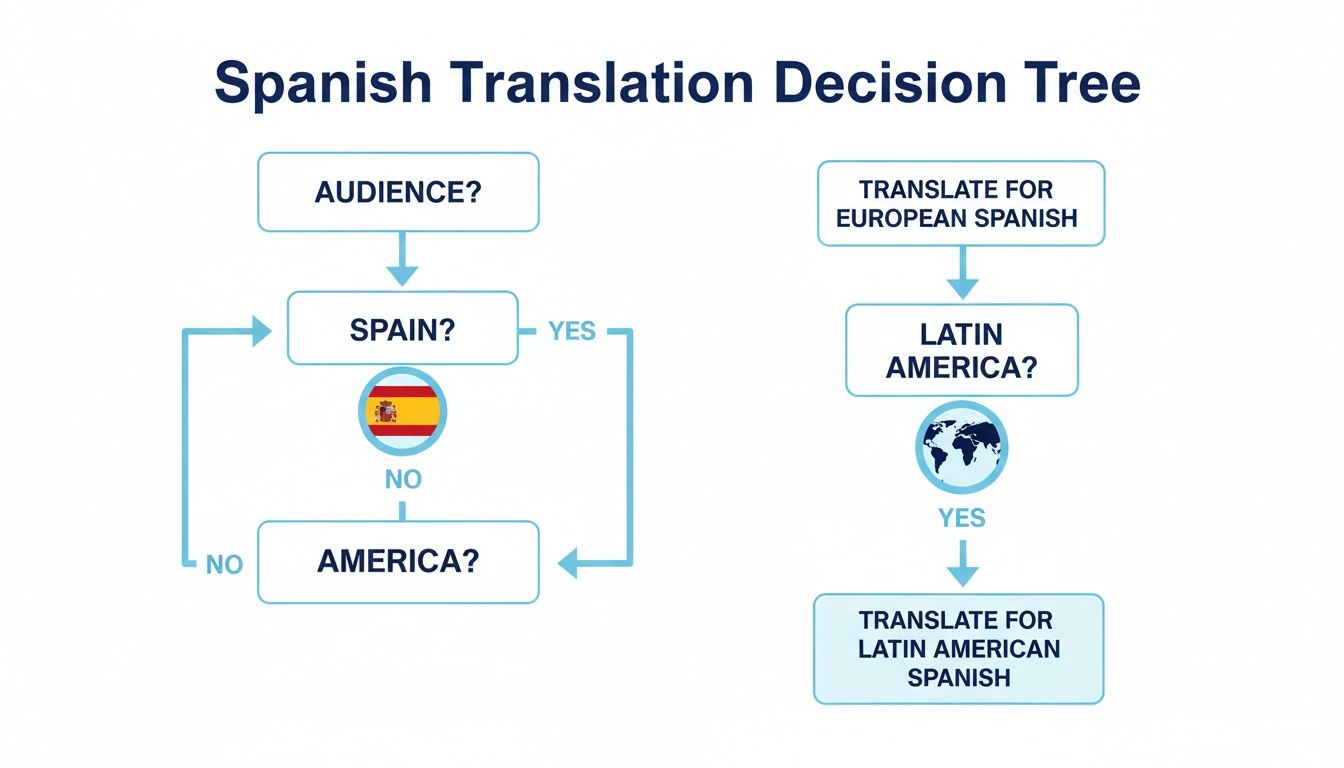
The main takeaway here is that a one-size-fits-all approach to Spanish simply doesn't fly. You have to be specific to the region to communicate effectively. To learn more, take a look at our practical guide on how to choose a Spanish document translator.
Avoiding Common Formatting and Layout Issues
Getting the translation right is a huge win, but your work isn't done just yet. So many perfectly translated documents in Spanish get tripped up at the finish line by technical glitches that pop up after the words are all in place. These formatting and layout problems can instantly make a polished document look amateurish.
Think of it like swapping an engine in a car. The translation is the new, powerful engine, but the formatting is the chassis. If you drop a bigger engine into a frame that wasn't built for it, the whole thing falls apart. It's the exact same idea here, and a couple of common issues cause the most headaches.
The Challenge of Text Expansion
One of the sneakiest culprits is text expansion. As a rule of thumb, Spanish text can easily be 20-30% longer than its English counterpart. This isn't because it's "wordy"; it's just that Spanish grammar often uses more words to express the same idea with precision.
This seemingly small difference can absolutely wreck a carefully crafted layout.
- Overflowing Text Boxes: That perfectly sized text box in your PDF or PowerPoint? It's now bursting at the seams, with Spanish sentences spilling out and covering up important graphics.
- Broken Tables: Table cells that fit English phrases snugly now can't contain the longer Spanish text, throwing the whole grid into a misaligned mess.
- Misaligned Graphics: Images and text that were once in perfect harmony get shoved around, completely ruining the visual flow you worked so hard to create.
The best defense is a good offense. Plan for extra white space in your original design, or be ready to go back and tweak the layout once the Spanish text is in.
Dealing with Character Encoding
Another classic mistake is overlooking character encoding. Spanish uses special characters you won't find in English, like accented vowels (á, é, í, ó, ú) and the iconic 'ñ'. If your document is saved with the wrong encoding, these characters get mangled into gobbledygook.
For example, the simple word año (year) could show up as a?o or even año. This doesn't just look sloppy—it can completely alter the meaning of a sentence and confuse your reader.
Pro Tip: Always make sure your files are saved with UTF-8 encoding. It’s the universal standard that supports characters from virtually every language, preventing those weird symbols from appearing and keeping your Spanish documents clean and accurate.
By staying ahead of these formatting issues, you can run a final quality check after translation to ensure your document is not only accurate but also visually impressive. For a smoother workflow, some advanced document translation tools can help you preserve formatting and translate globally without the usual hassle. A final, careful review of your DOCX, PDF, and EPUB files is an essential step to producing truly professional work.
A Proven Workflow for Professional Translation
To get consistent, high-quality results when creating documents in Spanish, you need more than just a talented translator—you need a solid plan. A structured workflow turns what could be a chaotic mess into a predictable roadmap, helping you sidestep common mistakes and ensure the final product is truly professional.
Think of it like building flat-pack furniture. If you toss the instructions aside, you’re probably going to end up with a wobbly table. This four-stage process is your set of instructions, giving you a clear, step-by-step path to a successful translation project, every single time.
Stage 1: Preparation and Foundation
Before a single word gets translated, you have to lay the groundwork. The very first step is to finalize your source text. Seriously, lock it down. Making changes to the English document mid-translation is a surefire way to introduce errors, create delays, and drive up costs.
Next, build a project glossary. This is just a simple list of key terms, brand names, and industry jargon with their approved Spanish equivalents. This small step is a game-changer for maintaining consistency, especially when you're dealing with large documents or a series of projects over time.
Your glossary should include things like:
- Brand Terminology: Product names, slogans, and any company-specific phrases that need to be the same every time.
- Technical Terms: Niche vocabulary that has one, and only one, correct translation.
- Words to Exclude: Any terms that should never be translated, like trademarked names.
Putting in this effort upfront means that no matter who works on the text, your core message stays intact and on-brand.
Stage 2: Translation and Execution
With your finalized text and glossary in hand, it's time for the actual translation. This is where you put your chosen method—human, machine, or hybrid—into action based on your project's needs, budget, and timeline.
Whichever path you take, that glossary you made becomes your most valuable tool. For a human translator, it’s a clear guide. For a hybrid workflow, it can be used to prime the AI, which dramatically improves the accuracy of the first draft and saves the human editor a ton of time.
A well-prepared project empowers your chosen translation method to perform at its best, reducing ambiguity and creating a more accurate and consistent first draft.
Stage 3: Review and Refinement
This is arguably the most critical stage of the whole process. A translated document should never go straight from the translator to publication. It needs a thorough review by a separate, qualified person—ideally, a native Spanish speaker from your target region.
This reviewer’s job is so much more than just a quick spell-check.
- Cultural Appropriateness: They make sure your idioms, examples, and overall tone land correctly with the local culture and don't come off as awkward or, worse, offensive.
- Linguistic Flow: They check that the text reads naturally in Spanish. You want it to sound smooth, not stiff and robotic like a literal, word-for-word translation.
- Consistency Check: The reviewer confirms that all the key terms from your glossary were used correctly and consistently from beginning to end.
This quality check catches the subtle errors that even the best translators can miss, adding that final layer of polish.
Stage 4: Final Formatting and Quality Assurance
At last, the text is approved! But you're not done yet. The final step is a quality assurance (QA) check on the document's layout. Remember how we talked about text expansion? This is your last chance to fix the formatting problems it can cause.
Go through your PDF, DOCX, or EPUB file with a fine-tooth comb. Look for any text that’s overflowing its box, images that are out of alignment, or tables that have broken. You may need to tweak text box sizes, adjust fonts, or change line spacing to get everything looking perfect. This last check guarantees your professional documents in Spanish are not only well-written but also impeccably presented.
Translating Ebooks and Complex Documents
When you’re creating documents in Spanish, tackling a 300-page ebook is a world away from translating a one-page memo. A simple tool might get you by for a short business letter, but it will almost certainly mangle a novel or a detailed technical manual. The job is so much more than just swapping out words.
For long documents, you have to think about the big picture. Preserving the author's unique voice, keeping the narrative flowing smoothly, and making sure complex structures like chapters and footnotes stay intact are absolutely critical. Most general-purpose translation tools just aren't built for that. They look at each sentence by itself, which completely shatters an author's tone and can turn a great story into a confusing mess.
The Problem with One-Size-Fits-All Tools
Think about what happens when a machine tries to translate a novel one sentence at a time. Sure, it might get the basic meaning of each line right, but it will completely miss the context that ties everything together. It won’t pick up on the subtle foreshadowing in chapter two that has a huge payoff in chapter ten. It won't be able to maintain the personality of a main character across hundreds of pages.
This is exactly why you need a specialized solution for these bigger, more complex projects. When the document is a valuable asset—like a book you plan to sell—using a tool built for that specific job is the only way to get a professional result. A generic approach just can’t handle the nuance.
For authors and publishers, the goal isn't just to make an ebook readable in Spanish. It's to deliver the same emotional and intellectual experience as the original. That requires a tool that understands literary context, not just isolated words.
A Specialized Approach with BookTranslator.ai
This is where purpose-built AI platforms really make a difference. A service like BookTranslator.ai, for instance, is designed from the ground up to handle the unique challenges of ebook translation. It’s engineered to see the entire book as a single, cohesive project, not just a long string of disconnected text.
Here’s a look at how a specialized tool takes on the challenge:
- Maintains Formatting Integrity: It keeps your chapters, headings, and styling perfectly consistent from your original file to the final translated EPUB.
- Preserves Authorial Tone: The AI is trained to recognize an author's style and replicate it throughout the whole manuscript, so their voice doesn't get lost in translation.
- Handles Complex Structures: It properly manages all the tricky bits like footnotes, tables of contents, and internal links, rather than ignoring or breaking them.
This kind of focused approach gives creators a powerful and reliable way to tap into the massive Spanish-speaking market. By matching your tool to your document's complexity, you set yourself up for a high-quality outcome. If you want to dive deeper, our complete guide to ebook translation has even more detailed insights.
The Growing Importance of Spanish in Academia
While it’s easy to think of English as the one and only language of global science, that’s a dangerously incomplete picture. A massive amount of influential research and intellectual debate happens in Spanish every single day. For academics, researchers, and universities, ignoring this vibrant community isn't just an oversight—it's a strategic mistake that limits collaboration and discovery.
Creating high-quality documents in Spanish has moved far beyond a simple "nice to have." It's now essential for anyone serious about having a global impact.
When you translate academic work, you're doing so much more than just swapping out words to share data. You’re building a bridge to an entirely different intellectual world. It's about sparking international partnerships and making sure your findings get into the hands of everyone who can benefit from them, not just English speakers.
A Powerhouse in Scientific Publishing
Most people are genuinely surprised when they see the numbers. Spanish is the second most common language for scientific texts worldwide, right behind English. In fact, a solid 4.4% of all scientific production comes from Spanish-speaking countries, and that output is heavily concentrated in some incredibly influential fields.
This is especially true in disciplines where cultural and social context is everything. Think about this: a whopping 72% of all scientific work published in Spanish falls into just three areas.
- Social Sciences: This is the giant, making up 44% of the total. We're talking about groundbreaking research in sociology, economics, and political science that you just won't find anywhere else.
- Medical Sciences: At 15%, this includes vital clinical studies and public health findings relevant to millions.
- Arts and Humanities: Coming in at 13%, this category is filled with essential works in history, literature, and philosophy.
These aren't just abstract numbers; they point to an undeniable reality. A huge chunk of the world's knowledge is being created, debated, and advanced in Spanish. You can dig deeper into these findings on the Cervantes Institute's blog.
For any researcher, this is a clear opportunity. Engaging with Spanish-language academia isn't just about getting your own work out there. It's about joining a global conversation that is actively shaping the future of critical disciplines. To have a truly complete understanding of modern research, you have to be able to access and contribute to this body of work.
Common Questions About Spanish Documents
As you get closer to finalizing your project, a few practical questions always seem to pop up. Getting these details right is what separates a good Spanish document from a great one. Let's tackle some of the most frequent sticking points people run into.
Should I Use Castilian or Latin American Spanish?
This really boils down to one thing: who are you trying to reach?
If your audience is primarily in Spain, you'll want to use Castilian Spanish. It’s what they speak, read, and expect.
For just about everyone else in the Spanish-speaking world, from Mexico down to Argentina, a neutral Latin American Spanish is your best bet. It’s the standard for business and media across the Americas and ensures your message is clearly understood by the widest possible audience.
Are Machine-Translated Documents Legally Valid?
The short answer is almost never. When it comes to official documents that carry legal weight—think contracts, immigration forms, court records, or academic transcripts—a certified human translator is mandatory.
Machine translation just doesn't have the required precision or legal recognition for these critical tasks. An algorithm can’t provide the nuance and certified accuracy that legal systems demand.
For any document that has legal consequences, professional human translation isn't just a good idea; it's a requirement. Relying on AI here could lead to serious legal and financial problems down the road.
What’s the Best File Format for Translation?
If you want a smooth, headache-free process, DOCX is your friend. It’s flexible, allowing text to expand or contract (which it always does during translation) without shattering your layout.
Try to avoid sending PDFs for translation if you can. Their fixed format is a nightmare to work with, and extracting the text often creates a formatting mess. For e-books, a clean EPUB file or a well-organized DOCX document is the perfect starting point for tools like ours.
Ready to translate your e-book with precision and ease? At BookTranslator.ai, our specialized AI preserves your book's formatting and voice across 50+ languages. Get started with a single click at BookTranslator.ai.