
Ever thought about what it would take to have a multilingual assistant on hand? Not just someone who swaps out words, but a partner who truly understands the context, layout, and purpose of your document. That's exactly what modern document translator software delivers. These aren't just simple text converters; they are sophisticated tools built to handle entire files—e-books, reports, you name it—while keeping the original structure perfectly intact.
Beyond Words: How Modern Translation Software Works
The early days of translation tech were, frankly, pretty clumsy. The results were often literal, awkward, and completely missed the original's soul. Imagine using a basic dictionary to translate a poem—you’d get the words, but lose all the rhythm and meaning. That's what it was like. You'd end up with confusing text that needed a ton of manual editing to make any sense.
Thankfully, we've come a long way since then. Today’s document translator software is a much smarter system. It's designed to solve the fundamental problem of breaking down language barriers for creators and businesses, opening up a global audience without compromising on quality.
This technology now caters to the specific needs of various users:
- Authors can finally reach readers in new countries.
- Businesses can confidently step into international markets.
- Students and researchers can access and share knowledge across borders effortlessly.
The real magic of this software isn’t just in the translation itself. It’s about preserving the entire communication package—the words, the layout, and the message’s impact. It ensures your work arrives exactly as you intended, no matter the language.
This evolution from simple word-swapping to deep, contextual understanding is powered by huge leaps in artificial intelligence. And the demand for these tools is exploding. The global translation software market is valued at around $15 billion in 2025 and is expected to grow at a compound annual rate of about 15%, hitting an estimated $45 billion by 2033. You can explore more about this growth in the Market Report Analytics translation software report.
This incredible growth points to a clear, universal need. People and organizations everywhere require dependable ways to share complex ideas across linguistic divides. From the carefully designed layouts of e-books to the precise language of legal contracts, modern software offers the accuracy and reliability to make global communication a daily reality.
What Separates Good Software from Great?
On the surface, most document translation tools seem to promise the same thing. But when you get down to it, there’s a world of difference between a decent tool and a truly great one. Getting this choice right means finding a solution that doesn't just swap words, but carefully protects the soul of your project.
Let's walk through the essential features that make or break a document translator.
1. Format Preservation
This is, without a doubt, the most important feature. Think about it: you've poured countless hours into perfecting the layout of your e-book, with its specific headings, image placements, and paragraph breaks. The last thing you want is a translated version that looks like a jumbled mess of text.
A top-tier tool understands that formatting is part of the content. It ensures everything—from your chapter titles to your carefully placed tables—stays exactly where it should be. For a deep dive into keeping your layout intact, our EPUB translation guide on preserving format and style is a great resource.
2. AI-Powered Accuracy and Nuance
Today’s best software uses sophisticated AI to understand context, not just individual words. Instead of a clunky, literal translation, it analyzes whole sentences to pick up on the intended tone, meaning, and subtle nuances. The result? Translations that feel like they were written by a person, not a machine.
A huge part of this is the ability to create and use a glossary. This lets you define key terms—like character names, unique place names, or branded phrases—and tell the AI to use them consistently. For any serious project, this is non-negotiable.
3. Broad (and High-Quality) Language Support
A long list of supported languages might catch your eye, but quality beats quantity every time. The best tools deliver excellent results for specific language pairs because their AI models are finely tuned for the unique grammar and cultural quirks of those languages.
A translation tool's true value isn't just about handling a language. It's about capturing the small cultural and linguistic details that make the text connect with a native-speaking audience.
A tool's ability to handle complex documents is also a great sign of its power. For instance, the capability for translating Excel files instantly with AI while preserving formatting shows that the software is robust enough to manage highly structured data alongside narrative text.
4. Speed, Scale, and Security
Finally, let's talk logistics. How does the tool fit into your actual workflow? If you have more than one document, the ability to upload and translate multiple files at once—known as batch processing—is a massive time-saver.
Look for a combination of these practical features:
- Speed and Scalability: A great tool should translate a full novel or a dense technical manual in minutes, not hours.
- Security and Privacy: Your work is your intellectual property. Always choose a service that uses end-to-end encryption and has a crystal-clear privacy policy. This ensures your files aren't stored or used for anything else—a critical distinction from most free online translators.
Essential Features of Modern Document Translator Software
To help you sort through your options, this table breaks down the most important features to look for.
| Feature | What It Does | Why It Matters for You |
|---|---|---|
| Format Preservation | Keeps original layout, including headings, images, tables, and spacing, in the translated file. | Authors & Publishers: Protects your e-book’s design. Students & Professionals: Keeps reports and presentations readable. |
| AI Accuracy | Uses contextual analysis to produce natural-sounding translations that capture nuance and tone. | Everyone: Avoids embarrassing or confusing translations that sound robotic and unprofessional. |
| Custom Glossaries | Allows you to define specific terms (names, jargon) for consistent use throughout the document. | Authors: Ensures character names are consistent. Businesses: Maintains brand terminology across all languages. |
| Batch Processing | Translates multiple files at once, streamlining the workflow for large projects. | Publishers: Quickly translate an entire book series. Researchers: Process dozens of academic papers efficiently. |
| Data Security | Encrypts your files and guarantees your data is not stored or used for training AI models. | Everyone: Protects your intellectual property and sensitive information from being exposed or misused. |
In the end, the best document translator software brings all these elements together seamlessly. It respects your hard work on formatting, delivers translations with human-like nuance, and keeps your valuable content safe.
The AI Engine Driving Modern Translation
To really get what makes modern document translator software tick, you have to look under the hood. The core technology that changed everything is an AI model called Neural Machine Translation (NMT). This isn’t your old, clunky translation tool that just swapped words one-for-one and spat out gibberish.
Think of NMT as an AI that learns a language much like a human does. Instead of memorizing a dictionary, it analyzes millions of sentences and entire documents to spot patterns, context, and the real meaning behind the words. This helps it figure out that a single word can mean completely different things depending on what surrounds it.
This ability to understand context is what gives us the fluid, natural-sounding translations we see today. For an author translating a novel, that's pure gold. It means the software can grasp the original tone and style, preserving the story's emotional weight instead of letting it get lost in translation.
From Literal to Literary Translation
The jump from old-school statistical methods to NMT was massive. The old systems would take an idiom and translate it word for word, which usually ended up being confusing or just plain funny. NMT, on the other hand, learns from huge libraries of human-translated texts, so it can recognize those quirky expressions and find the right way to say them in another language.
Neural Machine Translation doesn't just see words; it understands relationships between them. This ability to grasp syntax, semantics, and context is why AI can now translate complex creative and technical documents with impressive accuracy.
And this AI-driven approach is always getting better. Every time a user makes a correction, the model learns, becoming a little smarter and more accurate. For niche fields, you can even train the AI on specific material, so it picks up on technical jargon or gets a feel for a particular author's voice. If you want to dive deeper into the nuts and bolts, a good starting point is understanding foundational AI models like GPT.
The Broader Impact of AI in Translation
This technology is moving fast. The constant improvements in AI and machine learning are pushing translation tools to be quicker and more accurate than ever before. This is helping to meet a huge demand for translation in everything from e-commerce and global health to localizing videos and apps.
It's this sophisticated engine that allows a platform to offer solid translations across dozens of languages. It's why a tool can confidently handle common language pairs like English to Spanish, but also tackle the trickier ones. If you're curious about the technical hurdles, you can learn more about the challenges of scaling AI translation to 99 languages in our detailed guide.
Once you understand the AI powering these tools, you can trust the technology a lot more. It's no longer a simple word-swapper but a genuinely powerful assistant ready to take on nuanced and complex projects, helping us connect with people all over the world.
Real-World Scenarios Where Translation Software Shines
A tool's real worth isn't in its feature list; it's in the problems it solves for actual people. So, to really get a feel for what a good document translator software can do, let's walk through a few scenarios.
We'll look at three different professionals, each staring down a unique language barrier. These aren't just hypotheticals—they're everyday situations where the right technology can transform a massive headache into a genuine opportunity.
The Independent Author Reaching a Global Audience
Imagine Elena, an indie author whose first sci-fi novel is doing well in English-speaking countries. She knows there are huge audiences for her genre in Germany and Japan, but the cost of hiring human translators is just not in the budget. It feels like a dead end.
Instead of giving up, Elena finds a specialized document translator and uploads her EPUB file. The software's AI, which has been trained on mountains of literary works, gets started.
- It keeps the formatting: Her chapter breaks, headings, and custom fonts—all the little details she spent hours on—are perfectly preserved in the German and Japanese versions.
- It captures her style: The AI understands the nuances of her writing, making sure her characters' voices don't get lost in translation.
- It learns her world: She feeds it a glossary with character names and fictional places, so "Zorgon-5" stays "Zorgon-5" consistently.
In about an hour, Elena has two beautifully formatted, remarkably accurate drafts. She gives them a final read-through and suddenly, her book is ready for new international markets. What seemed impossible is now a new source of income.
The Academic Researcher Sharing Critical Findings
Now, let's meet Dr. Chen. He’s just had a major breakthrough in renewable energy research. His paper is packed with technical data, charts, and complex terminology. He needs to get it into the hands of an international group of scientists, fast, to speed up peer review.
The tricky part isn't just translating the words. It's about flawlessly rendering data, diagrams, and very specific scientific terms inside a highly structured academic paper. One small mistake could cast doubt on his entire work.
He uploads his PDF to a secure document translator. The platform is smart enough to identify and translate the text inside his charts and tables, not just the paragraphs around them. And because the service guarantees data privacy, he isn't worried about his unpublished research leaking. The result? A perfectly mirrored document in several languages, ready to be shared with colleagues around the globe, pushing scientific collaboration forward.
The Business Leader Closing an International Deal
Finally, think about a small company making its first move into Latin America. To close a key partnership, they need a whole package of documents translated: a legal contract, a marketing deck, and a technical manual. Each one demands a completely different tone and level of precision.
The team uses the batch processing feature to upload all three files at once. The document translator software handles each one perfectly:
- The Legal Contract: The AI adopts a formal tone, using precise legal terminology to avoid any ambiguity.
- The Marketing Proposal: The translation shifts to a persuasive, energetic voice that resonates with the local culture.
- The Technical Manual: It translates complex steps with absolute clarity, keeping every diagram intact.
By using a single, powerful tool, the business looks polished and professional. They close the deal, gaining a foothold in a new market much faster and for a fraction of the cost of traditional translation services.
How to Choose the Right Translation Tool for Your Project
Picking the right document translator software can feel overwhelming, but it gets a lot easier when you know what to look for. The goal is simple: find a tool whose strengths match your project's needs, so the translated version is just as good as the original.
First, think about what you're actually translating. Is it a novel, full of colloquialisms and subtle character voices? Or is it a dense technical manual where every term has to be precise? The answer really matters. Some AI models, like the one we built for BookTranslator.ai, are fine-tuned on literary texts specifically to nail that kind of creative tone and style.
Evaluate Core Technical Needs
Once you've defined your content, it's time to get practical and look at the technical side of things. This is where a lot of people get tripped up, especially with file formats. A great translation tool has to do more than just swap words; it needs to handle your specific file type—whether that’s a PDF, DOCX, or an EPUB for your e-book—without wrecking the layout.
Here’s a quick checklist to run through when you're comparing different platforms:
- Format Compatibility: Does the tool actually support your file format (like EPUB) and promise to keep your layout, images, and chapter breaks intact? This is non-negotiable.
- Pricing Model: Are you better off with a monthly subscription, or does paying as you go make more sense? For authors who only translate a book every now and then, a pay-per-book model like the one at BookTranslator.ai can save a lot of money.
- Test Translation: Can you translate a small sample for free or get a money-back guarantee? There's no better way to judge the quality than to see how it handles a piece of your own work.
This visual shows how different types of documents flow through a translation process, from creation to final use.
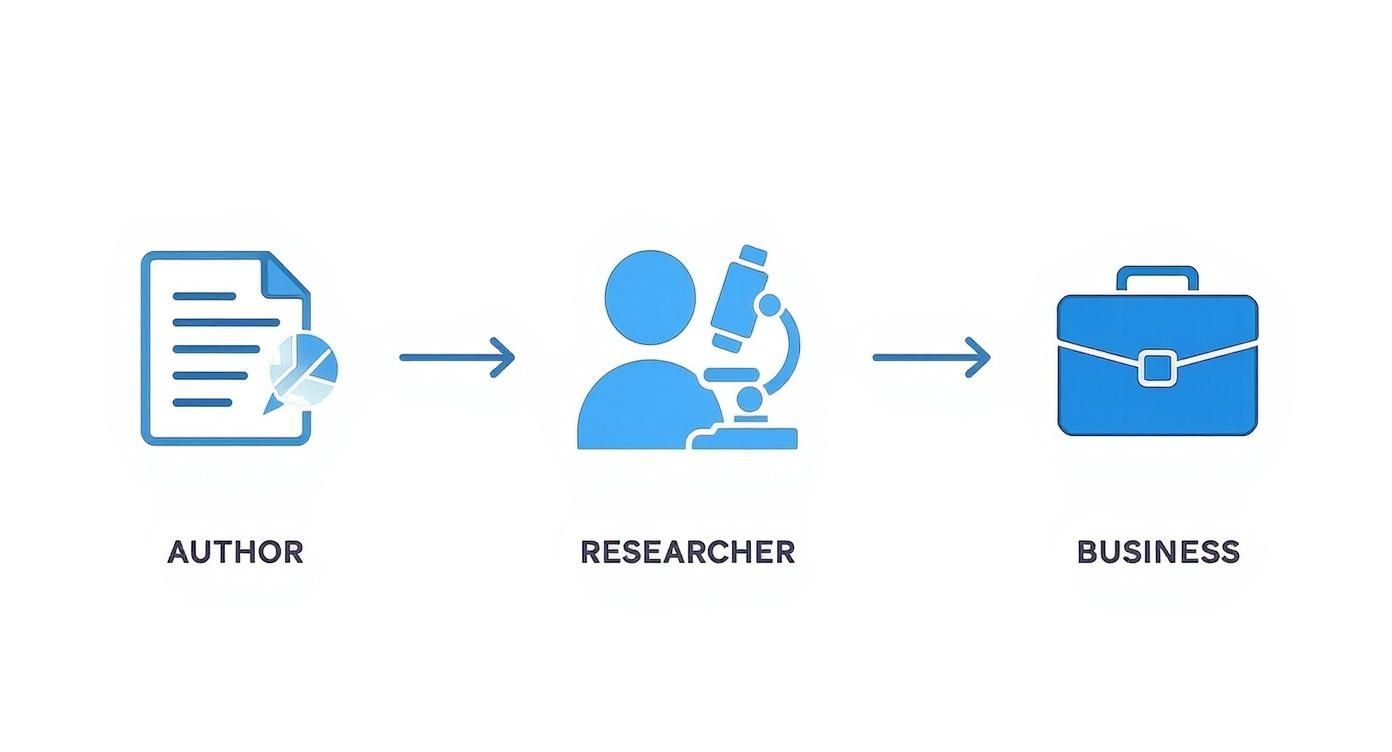
As you can see, whether it's a creative manuscript or a complex research paper, the core need for accurate, format-preserving translation is the same.
Making a Confident Decision
When you find the right tool, you’re not just translating—you’re protecting the integrity of your hard work. And the impact is huge. A staggering 70% of professional translators say this kind of software is essential to their job, helping them boost productivity by at least 30%. For businesses, getting it right the first time can slash costs from manual errors and rework by up to 90%.
Before you commit to any tool, always run a test. Translate one chapter from your book or a key section of your report. That simple step will give you all the proof you need about whether it can handle your specific content and formatting.
One last tip: a smooth translation starts with a well-prepared file. Making sure your original document is set up correctly can prevent a world of headaches later on. We've put together a guide on the top tools for translation-friendly formatting to help you get started.
By taking the time to match your project's needs with a tool's capabilities, you can pick a partner that helps you connect with a global audience without compromising on quality.
Common Questions About Document Translation Software
Dipping your toes into the world of document translation software can bring up a lot of questions. It's totally normal to wonder about accuracy, security, and whether these tools can actually handle the unique demands of your project.
Let's tackle some of the most common uncertainties head-on with clear, straightforward answers. This should help you move forward with a bit more confidence, knowing exactly what to expect.
Can Software Really Preserve My E-book’s Formatting?
Yes, absolutely—if you’re using the right tool. Modern, high-quality document translator software is built specifically for this challenge. Tools like BookTranslator.ai use smart algorithms that are trained to recognize and maintain your original layout, from images and fonts to tables of contents and chapter breaks.
Simple online converters often just rip the text out, leaving your formatting behind in a jumbled mess. But dedicated solutions treat the visual integrity of your document as a top priority. It's always smart to give the final document a quick once-over, as an incredibly complex layout might need a tiny tweak here or there. Still, the goal is to get you 99% of the way there automatically.
The real difference is specialization. Basic tools just translate words. Professional document translator software translates the entire file, respecting both the content and the design.
Is AI Translation Good Enough for Professional Use?
For a huge range of professional needs, the answer is a definite yes. The Neural Machine Translation (NMT) models we have today are light-years ahead of older systems. They can grasp context, understand industry-specific jargon, and even adapt to a brand's tone of voice.
This makes AI incredibly effective for translating things like technical manuals, business reports, academic papers, and internal communications. When it comes to more nuanced content—think literary fiction or high-stakes legal contracts—AI delivers a stunningly accurate first draft. A human editor can then swoop in to polish that draft, creating a hybrid approach that dramatically speeds up the workflow and cuts down on costs.
How Do I Know My Sensitive Documents Are Secure?
This is a huge one, and any reputable provider takes it very seriously. Unlike free online translators that might use your text to train their AI models, professional software operates under strict privacy policies.
Before you commit to a service, look for these key security markers:
- End-to-End Encryption: This ensures your data is protected from the moment you upload it to the moment you download it.
- Clear Data Policies: The service should state, in no uncertain terms, that your content will not be stored, shared, or used for any other purpose.
- Regulatory Compliance: Look for mentions of standards like GDPR, which is a strong signal of a company's commitment to data protection.
Bottom line: for any document containing sensitive or proprietary information, always go with a paid, professional-grade service.
What Is the Real Difference Between This and Google Translate?
The difference really comes down to purpose and capability. Think of Google Translate as a handy pocket dictionary—it's fantastic for quick, informal translations of short bits of text. Perfect for figuring out a menu in another country or a brief email.
In contrast, document translator software is a specialized powerhouse built to process entire, complex files like PDFs, EPUBs, and DOCX documents. It’s engineered to do two critical things at once: translate the text accurately and preserve the original file’s structure, layout, and formatting. These platforms also offer professional features like custom glossaries, batch processing, and beefed-up security, making them the only logical choice for publishing, business, and academic work where both precision and presentation matter.
Ready to see how a specialized tool can change the game for your books and documents? With BookTranslator.ai, you can translate entire EPUB files while keeping your original formatting intact, ensuring your work looks professional in any language. Try it now and reach a global audience with just one click.