
Document translation software is essentially your personal, high-speed interpreter for entire files—think books, research papers, and business reports. Instead of just swapping out words one by one, today's tools use advanced AI to grasp the context, preserve the original formatting, and even keep the author's tone intact.
So, What Exactly Is Doc Translator Software?
Picture this: you've poured your heart into a novel and dream of reaching readers in Spain. Or maybe you're a student with a crucial research paper that's only published in German. Not long ago, your only option was a slow, often expensive manual translation. Document translation software was created to fix that exact problem.
This technology takes the incredibly complex job of translating full documents—from entire ebooks to dense legal contracts—and makes it almost effortless.
It's More Than Just Swapping Words
We've all seen the clunky, literal translations that early tools used to spit out. They felt robotic because they were just acting like a digital dictionary, trading one word for another without understanding how they fit together. The best document translation software today is worlds away from that.
These modern platforms run on a sophisticated type of artificial intelligence called neural machine translation (NMT). You can think of NMT as an AI that has spent years studying billions of sentences in hundreds of languages. Because of this deep learning, it doesn't just see individual words; it analyzes whole sentences and paragraphs to figure out:
- Context: It knows the difference between the "bank" where you keep your money and the "bank" of a river.
- Nuance: It can tell if the writing is formal or casual and tries to maintain that same style.
- Idioms: It understands that "it's raining cats and dogs" isn't about animals falling from the sky and finds the right equivalent in the new language.
This ability to "read between the lines" is what ensures the translated document feels natural and stays true to the original, which is absolutely essential for long-form content like a book.
At its heart, document translation software doesn't just change words. It's about moving ideas, stories, and knowledge from one culture to another with accuracy and speed, making information accessible to everyone.
By knocking down these language barriers, the software gives authors, academics, and businesses a direct line to a global audience. It puts the world's knowledge and creativity within reach, no matter what language you speak. This power to handle complex, lengthy documents is what makes it such a vital tool today.
Essential Features of High-Quality Translation Tools
What really separates a powerful piece of doc translator software from a simple, free online tool? It’s more than just swapping words. The difference lies in a handful of critical features that protect the integrity of your work and deliver a professional, ready-to-use result. Without them, you risk ending up with a translated document that’s a jumbled mess of broken layouts and clunky, awkward phrasing.

Think of it this way: you could move furniture around a room yourself, or you could hire a skilled interior designer. The designer understands the flow, structure, and aesthetics to make sure everything not only fits but looks right. High-quality translation software does the same for your document—it goes beyond the words to preserve the entire experience for the reader.
The market reflects just how important this is. The document translation segment holds the largest share of the entire global language translation software market, which was valued at a massive USD 10.1 billion in 2023. That dominance is all thanks to its vital role in handling complex, structured content like books, research papers, and reports. And it's not slowing down; the total market is projected to hit USD 16.2 billion by 2032.
Preserving Your Original Layout
The most glaring sign of a poor translation is a wrecked layout. You open the file and see chapters running together, images pushed to the wrong page, and headings that have lost all their formatting. It's a nightmare. Top-tier software avoids this disaster with robust format preservation.
This feature is non-negotiable, especially for these file types:
- EPUB: For ebooks, the software must keep chapter breaks, paragraph styles, and the reflowable text structure intact. This is what makes the digital reading experience smooth and enjoyable.
- PDF: A good tool can handle both text-based and even scanned PDFs, keeping the fixed layout of tables, charts, and columns perfectly aligned.
- DOCX: The software needs to retain everything from headings and bullet points to comments and footnotes without forcing you to do hours of manual cleanup.
The whole point is for the translated file to be a perfect mirror of the original, just in a different language. If you want to set your files up for success from the start, check out our guide on the top tools for translation-friendly formatting.
Maintaining The Author’s Voice
A truly great translation captures not just what you said, but how you said it. This is where a feature called nuance retention comes into play. It’s the software’s ability to understand and replicate your unique authorial tone, style, and intent.
Modern AI models are trained on immense literary and academic datasets, which gives them the ability to:
- Tell the difference between a formal, scholarly tone and a casual, narrative one.
- Recognize idioms and cultural references, then find appropriate equivalents.
- Keep key terminology consistent across a long book or research paper.
This is what stops your witty novel from becoming dry and lifeless, or your serious research paper from sounding overly simplistic. As you're evaluating options, you can explore specific features of high-quality translation tools that are designed to maintain this stylistic integrity.
When you're choosing a document translator, it's helpful to have a clear checklist. This table breaks down the key features that truly matter for authors, publishers, and researchers.
Essential Features of High-Quality Doc Translator Software
| Feature Category | What It Does | Why It's Critical for Authors & Researchers |
|---|---|---|
| Layout & Format Preservation | Retains original formatting, including fonts, images, charts, and paragraph structure. | Ensures your ebook, manuscript, or research paper looks professional and is readable, saving you from hours of manual reformatting. |
| Contextual Nuance & Tone | The AI understands the context to translate idioms, sarcasm, and style accurately. | Maintains your unique authorial voice, preventing the translated work from sounding robotic, flat, or losing its intended emotional impact. |
| Terminology Consistency | Creates and uses a glossary (termbase) to ensure key terms are translated the same way every time. | Crucial for academic papers and technical manuals where consistency in terminology is essential for clarity and credibility. |
| Large File & Batch Processing | Can handle entire books or multiple documents at once without crashing or slowing down. | Allows you to translate a full manuscript or a series of articles efficiently, streamlining your workflow. |
Looking for these features will help you pick a tool that respects every aspect of your document.
A truly effective doc translator software acts as a guardian of your original work. It ensures that your message, design, and voice all arrive intact, no matter the destination language.
Ultimately, by prioritizing both layout preservation and authorial nuance, you can be confident that your work will connect with a brand new audience exactly as you intended.
Comparing AI Translation With Human Experts
Deciding between an AI document translator and a human expert isn't about which one is "better." It's about picking the right tool for the job. Think of it like choosing between a high-speed industrial loom and a master artisan weaver. Both produce incredible fabric, but their methods, speed, and costs are worlds apart.
Modern AI translators are the industrial looms of the language world. They're built for speed and consistency, capable of translating an entire novel in minutes. More importantly, they ensure that a main character's name or a critical technical term stays the same from the first page to the last. This makes them a perfect fit for authors, researchers, and publishers who need to get large volumes of text translated quickly and affordably.
This sheer efficiency is changing the game. The AI language translation market is booming, jumping from USD 1.88 billion in 2023 to an estimated USD 2.34 billion in 2024. That's a massive 24.9% growth rate in a single year. It's not just hype, either; over 70% of European language professionals now use machine translation in their daily work, proving its reliability.
Where Human Experts Still Shine
On the other side, you have the human experts—the artisan weavers. Their strength lies in tasks that demand deep cultural understanding, creative flair, and pure intuition. This process, often called "transcreation," is essential for translating things like poetry, witty marketing slogans, or high-stakes legal contracts where a single misplaced word could have huge creative or financial fallout.
The real difference is this: AI is phenomenal at scale and consistency, while human experts are unbeatable at creativity and cultural adaptation. For the majority of document translation needs, from ebooks to academic papers, AI delivers a powerful mix of speed, cost, and quality.
The Power of a Hybrid Approach
So, what's the best of both worlds? A hybrid approach. This is where the most effective workflows are heading.
An advanced AI, like the one we've built into BookTranslator.ai, does the initial heavy lifting. It produces a remarkably accurate and context-aware first draft, handling the tedious work of translation while keeping your original formatting intact. The technology behind this is fascinating, rooted in the field of Natural Language Processing (NLP).
Once the AI has done its part, a human editor can step in. Instead of spending weeks translating from scratch, their job is now to refine, polish, and add that final human touch. They can focus entirely on the nuances of style and flow. This partnership of AI speed and human oversight gives you a professional-grade translation at a fraction of the time and cost. We explore this powerful strategy in our guide on using AI with human editors to improve book translation.
How Software Handles Different Document Formats
The real measure of any doc translator software isn't just about swapping words from one language to another. It’s about whether the final document is actually usable. What good is a perfectly translated novel if the chapter breaks are gone and the paragraphs are a jumbled mess? An academic paper loses all credibility if its charts and tables are completely broken.
This is why preserving the original layout is the absolute cornerstone of any quality translation tool.
Think of your document's format as its unique blueprint. Every file type—whether it's an EPUB for an ebook, a PDF for a manual, or a simple DOCX file—has a different structure. A cheap tool might just bulldoze through it all, leaving you with a chaotic wall of text. A professional-grade tool, on the other hand, acts more like a skilled restoration expert, carefully rebuilding the document's structure in the new language.
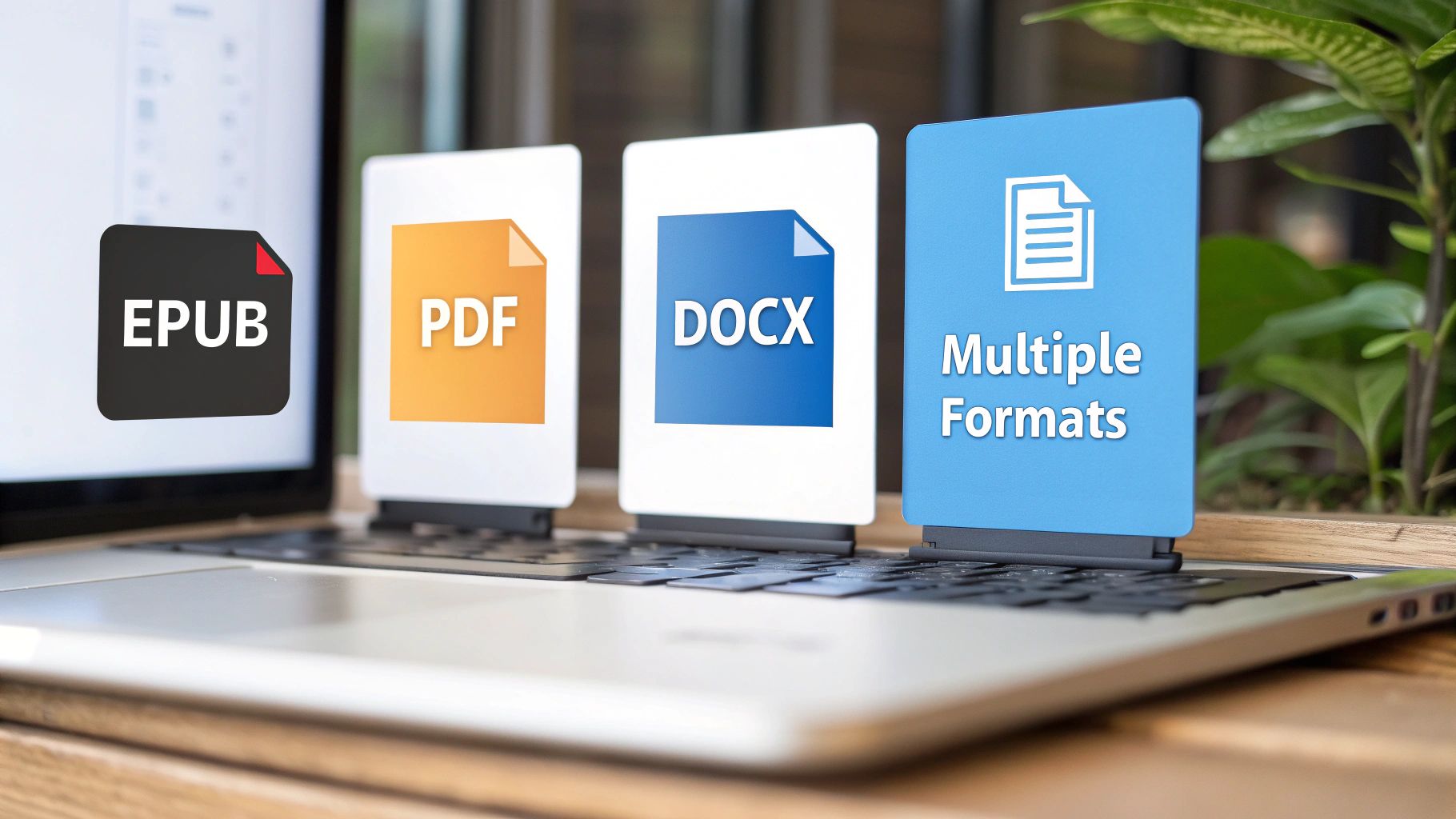
This single capability is what separates a professional result from a frustrating, amateurish one. Without it, you're looking at hours—maybe even days—of manually fixing everything yourself.
Handling Ebooks with EPUB Files
There’s a reason EPUB is the global standard for ebooks: its text is reflowable. This is just a fancy way of saying the content automatically adjusts to fit any screen, from a tiny smartphone to a big e-reader. For authors and publishers, this is a non-negotiable feature that must survive the translation process.
Good document translation software is built to understand the intricate DNA of an EPUB file. It knows how to protect the critical elements:
- Chapter Breaks: Making sure each new chapter starts on its own page, just like you intended.
- Table of Contents: Keeping the clickable navigation intact so readers can easily jump around.
- Paragraph Styling: Preserving your indents, blockquotes, and other custom formatting.
- Embedded Images: Ensuring your illustrations and cover art stay exactly where they belong.
By respecting the EPUB’s underlying code, the software delivers a translated ebook that feels just as seamless and polished as the original.
Translating Complex PDF Documents
PDFs are notoriously difficult to work with. They're designed to be static, like a digital snapshot of a printed page. This fixed layout creates a real headache for translation, especially when you're dealing with scanned documents that aren't even made of text to begin with.
A powerful translation tool comes at PDFs from two angles:
- Text-Based PDFs: If the PDF was created from a program like Word, the software can pull out the text, translate it, and then carefully slot it back into the original layout. It maintains the exact position of columns, images, and headers.
- Scanned PDFs: For scanned documents, which are just pictures of text, the software uses Optical Character Recognition (OCR). This technology essentially "reads" the image, converts it into editable text, translates it, and then rebuilds the document from scratch.
The goal with PDF translation is simple: create a translated file that is visually indistinguishable from the original. This is vital for academic papers, legal contracts, and technical manuals where the layout itself carries meaning.
If you're weighing your options, you can learn more about which format works best in our detailed guide on EPUB vs PDF for AI translation.
Retaining Formatting in DOCX Files
For most of us—writers, students, and business professionals—Microsoft Word's DOCX format is our daily driver. These documents are often packed with formatting that adds important context and clarity. The best software makes sure none of these crucial elements get lost along the way, including:
- Tracked Changes and Comments
- Tables and Charts
- Footnotes and Endnotes
- Headers and Footers
By keeping all this rich formatting, the software gives you a translated DOCX file that’s ready for collaboration or publishing right away. No tedious cleanup required.
Putting Doc Translator Software to the Test: Real-World Scenarios
It's one thing to talk about features and workflows, but where does the rubber really meet the road? The true value of a doc translator shines when you see how it solves actual problems for real people. This isn't just about converting words; it's about opening doors, saving precious time and money, and making projects happen that would have otherwise been impossible.
Let's walk through a few concrete examples. These stories show how modern translation tools are being used right now for everything from creative writing to critical research.
For the Independent Author
Picture an indie author with a freshly published sci-fi novel. It's doing well in English, but she knows there are huge audiences waiting in Spanish-speaking countries, Germany, and Brazil. The problem? Hiring professional human translators for three languages would set her back thousands of dollars—a non-starter for someone just starting out.
Instead, she turns to an advanced doc translator software to handle her EPUB file. For a tiny fraction of the traditional cost, she gets high-quality, readable drafts in Spanish, German, and Portuguese.
- Benefit: Market Expansion. She can now upload her ebook to international platforms, reaching millions of potential new readers and starting to build a global name for herself.
- Result: The software becomes her key to unlocking markets that were once locked behind a massive financial barrier.
This kind of accessibility completely changes the game. It allows creators to think globally from day one, leveling the playing field between a solo author and a big publishing house.
For the Academic Researcher
Now, think about a grad student deep in the trenches of her dissertation research. Her topic is highly specific, and she discovers that the most important, groundbreaking studies were all published in Japanese, Korean, and French academic journals. Trying to manually translate dozens of dense, 50-page papers is a project in itself—one that would take months and bring her progress to a screeching halt.
So, she uses a specialized document translator to process the PDFs. In just one afternoon, she has accurate, readable English versions of every single paper. All the original charts and tables are preserved, right where they should be.
The real win here is speed. The software collapses a process that would have taken months of painstaking labor into a matter of hours. This fundamentally accelerates the pace of discovery and innovation.
This efficiency means she can synthesize global research quickly, build a much stronger case in her dissertation, and actually finish on schedule. For anyone in research, this is an incredible tool for staying on top of a fast-moving academic world.
For Publishers and Readers
Finally, consider a small, independent press that wants to bring more international voices into its catalog. They can use doc translator software to get a quick, reliable translation of manuscripts submitted from all over the world. This allows them to make smart, informed decisions without spending a fortune on freelance translators just to evaluate a submission.
And it’s not just for businesses. An avid reader who loves a niche Japanese light novel series—one that has no official English release—can finally translate the EPUB files for their own personal enjoyment. They get to access stories they love without waiting years for a publisher to, maybe, pick it up.
Ultimately, the software empowers everyone by simply removing the language barrier that has always stood between people and global content.
How to Choose the Right Translation Tool
Picking the right doc translator software really boils down to three things: your budget, how much you value your privacy, and what you actually need the tool to do. Get this right, and you've got a partner for your project that saves you time and money without exposing your sensitive work. It’s about preventing headaches down the road.
First, let's look at the money. Translation tools have all sorts of pricing models, and if you're not careful, the costs can get out of hand, especially on a big project. You need to know how they charge to make sure it lines up with how you’ll be using it.
Decoding the Different Pricing Models
The way a service charges will make or break your budget, particularly when you're translating something substantial like a full-length book or a dense research paper. You’ll typically run into one of these three pricing setups.
- Subscription Plans: These are perfect if you're translating content all the time. You pay a set fee each month or year for a certain amount of work. The catch? If your translation needs are few and far between, you could be paying for a service you barely touch.
- Pay-Per-Word: This is as straightforward as it gets, but it can get pricey fast with long-form content. It’s usually a better fit for short, one-off documents where you need a crystal-clear cost estimate from the start.
- One-Time Fee Per Document: This is the most transparent option out there. You get a clear, fixed price for your entire file, like an ebook. It completely removes the worry of hidden fees or being locked into a subscription, making it a fantastic choice for authors and researchers who work on a project-by-project basis.
Protecting Your Intellectual Property
Next up, and this is a big one, is data privacy. When you upload your manuscript, your years of research, or a confidential business contract, you're placing a massive amount of trust in that platform. The last thing you want is for your original work to be used for someone else's benefit.
Here's the dirty little secret of many free or cheap services: you pay with your data. They often use your uploaded documents to train their AI models, meaning your private content could end up in their dataset, potentially seen by others.
Always read the privacy policy. A reputable service will be upfront and clear, stating that your documents are kept secure, are never used for AI training, and are permanently deleted from their servers. That commitment to confidentiality is the sign of a professional-grade tool.
Choosing a tool that guarantees your data stays yours is non-negotiable for protecting your intellectual property.
Creating Your Decision-Making Checklist
With pricing and privacy sorted, the last piece of the puzzle is to make a quick checklist for your project. This simple framework will help you ignore the marketing noise and find a doc translator software that genuinely fits your needs.
This flowchart maps out a simple path to follow as you weigh your options.
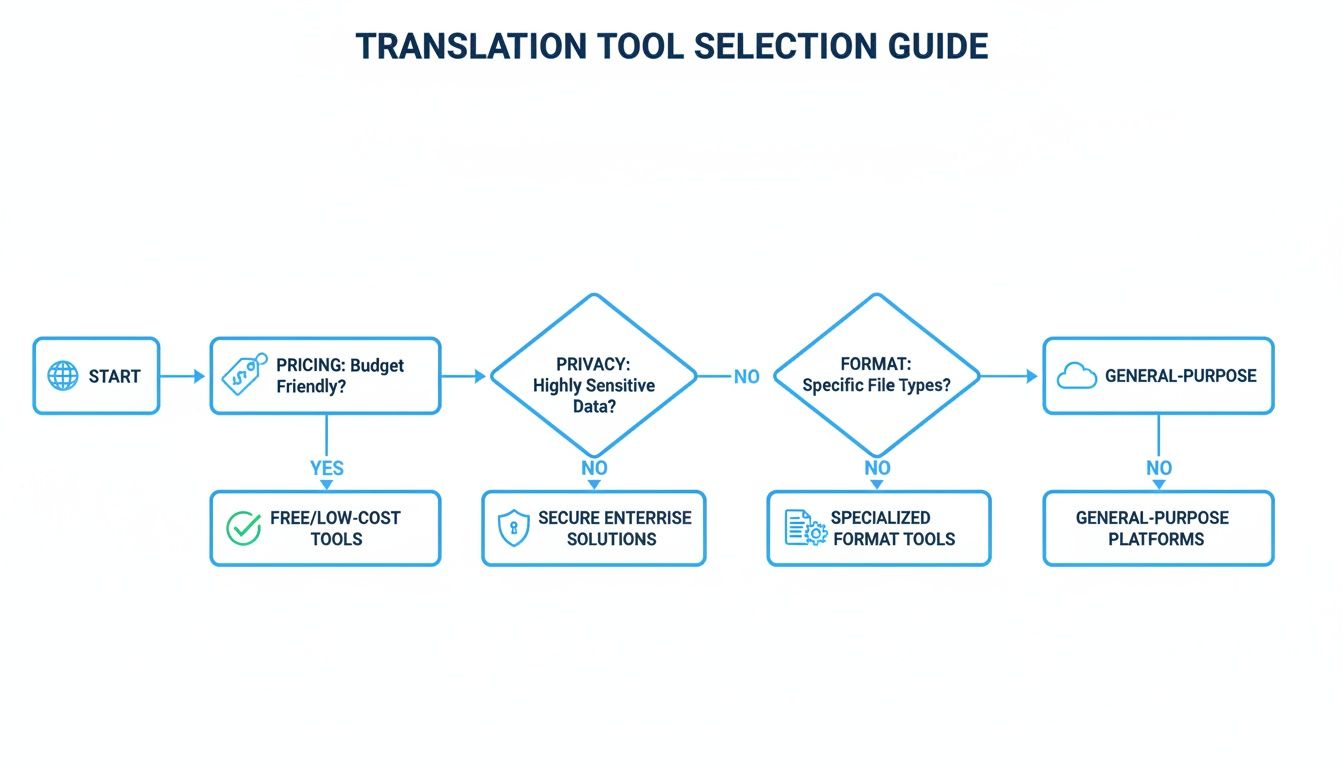
As you can see, thinking through your budget, privacy concerns, and format requirements will naturally guide you to the best solution.
Here’s a practical checklist to get you started:
- What's my budget? Is this a one-time translation, or will I need this service regularly? Match the pricing model to your workflow.
- What kind of documents am I translating? Am I dealing with EPUB files for ebooks, complex PDFs for academic papers, or standard DOCX manuscripts? Make sure the tool excels with your most-used format.
- What features are my "must-haves"? Is keeping the original formatting perfectly intact the number one priority? Do I need it to handle a less common language? List out your absolute dealbreakers.
By working through these questions, you put yourself in the driver's seat. You’ll be able to confidently pick a tool that does what you need, fits your budget, and keeps your work safe.
For authors, researchers, and anyone working with long-form content, BookTranslator.ai is a compelling choice. It offers straightforward pay-per-book pricing and a rock-solid commitment to data privacy, so you can translate your EPUB files with total peace of mind. Translate your book now.