
Before you can even think about translating a historical English text, you have to figure out when it was written. This isn't just academic nitpicking; it's the most critical first step. Trying to translate a text without knowing its era—Old, Middle, or Early Modern English—is a recipe for disaster.
A text like Beowulf is, for all intents and purposes, a foreign language. Shakespeare, on the other hand, feels much closer to home, even with its "thees" and "thous." Nailing down the source period shapes your entire approach.
Untangling The Roots of Modern English
Jumping straight into translation without a little detective work is like trying to navigate London with a map of ancient Rome. It won’t work. The English language has morphed dramatically over 1,500 years, and the tools and knowledge you need will change completely depending on the text's age.
This journey started back in the mid-5th century AD, when Germanic tribes—the Angles, Saxons, and Jutes—settled in Britain. The language they brought, which we now call Old English, is so far removed from what we speak today that a modern reader might recognize less than 10% of the words without dedicated study. Its grammar, full of complex inflections, is completely alien. To get a deeper sense of this evolution, the history of the English language on Wikipedia is a great starting point.
Why Beowulf Is So Different from Shakespeare
The real trick is learning to spot the differences between the three major eras: Old, Middle, and Early Modern English. Each has distinct linguistic fingerprints, and recognizing them will save you from a world of frustration and error.
- Old English (c. 450–1150): This is the language of epic poems like Beowulf. You'll see strange letters like thorn (þ) and eth (ð), a heavily Germanic vocabulary, and a complex case system where word endings do all the work. The word order can feel chaotic because a word's function depends on its ending, not its position in a sentence. It’s genuinely a different language.
- Middle English (c. 1150–1500): Think Chaucer. After the Norman Conquest, French vocabulary flooded the language, and the old case system mostly collapsed. Spelling was a free-for-all, but the sentence structure begins to look a lot more like something we'd recognize today.
- Early Modern English (c. 1500–1700): Welcome to the world of Shakespeare and the King James Bible. The grammar is nearly identical to ours. The main hurdles are archaic words ("thee," "thou," "hath") and, more subtly, words that are still in use but have completely different meanings now.
Use this quick reference guide to distinguish between Old, Middle, and Early Modern English based on their core linguistic features.
Key Differences in English Language Stages
| Feature | Old English (c. 450–1150) | Middle English (c. 1150–1500) | Early Modern English (c. 1500–1700) |
|---|---|---|---|
| Vocabulary | Primarily Germanic | Mix of Germanic and French/Latin | Primarily Modern; some archaic words |
| Grammar | Complex case system (inflections) | Simplified case system; prepositions common | Very similar to Modern English grammar |
| Spelling | Fairly consistent but uses unique letters (þ, ð, æ) | Highly inconsistent; regional variations abound | More standardized, but with "e" endings and u/v, i/j swaps |
| Pronouns | Complex forms (e.g., hē, hēo, hit) | More familiar forms emerge (he, she, it, ye) | Archaic forms like "thee," "thou," "thy" |
| Example | Hwæt! Wē Gār-Dena in geārdagum... | Whan that Aprill with his shoures soote... | To be, or not to be, that is the Question... |
This table helps illustrate just how much changed from one era to the next, making that initial identification step so important.
Key Takeaway: The single biggest mistake you can make is treating all "old" English as one and the same. Identifying the correct period isn't just busywork; it dictates the dictionaries, grammar guides, and overall strategy you'll need for an accurate translation.
Spotting the clues is your first real skill. If you see words like "habban" for "have" or "cyning" for "king," you're deep in Old English territory. But if you see "ye" for "you" and wild spelling variations like "sonne" for "sun," you're probably working with Middle English. Getting this right from the start puts you on the right path for a translation that is both accurate and authentic.
Building Your Historical Translation Toolkit
Translating historical texts is so much more than just swapping out old words for new ones. You've got to have the right tools for the job. Trying to convert Old English to Modern English without a solid toolkit is like trying to assemble furniture with your bare hands—frustrating and almost guaranteed to fail.
A good workflow combines old-school scholarship with modern digital resources.
Your journey starts with a serious historical dictionary. For Old English, the absolute gold standard is the Dictionary of Old English (DOE). It’s an exhaustive project that aims to define every single word we know from the period. For something a bit more nimble and searchable online, the Bosworth-Toller Anglo-Saxon Dictionary is fantastic. It gives you definitions, grammar notes, and where the words appeared.
But dictionaries only give you part of the story. Words live and breathe in sentences, not in a list.
Going Beyond Definitions: Context is Everything
To truly understand a word, you have to see how it was actually used. This is where a corpus—a big, searchable database of texts—becomes your best friend. A corpus lets you see a word in dozens of real-world examples, revealing its subtle meanings, who it hung out with, and how it behaved grammatically. It’s the difference between knowing a word’s basic definition and understanding its personality.
Here are a few resources I can't live without:
- The Dictionary of Old English Corpus: This is the big one. It contains a complete record of surviving Old English texts and you can search it all online.
- Online Grammar Guides: The grammar of Old English is a completely different beast than Modern English. Thankfully, many university websites offer fantastic, easy-to-understand guides.
- The Old English Thesaurus: An incredible tool that groups words by concept. It's perfect for when you need to find the right synonym or just explore how people thought about a particular idea.
These aren't just nice-to-haves; they are the scholarly foundation of any serious translation. If you're interested in digging even deeper into digital aids, our guide to open-source tools for rare language translation has some great pointers.
A dictionary tells you what a word can mean. A corpus shows you what it did mean in a specific context. I never, ever skip the corpus check when I hit a tricky word.
This is how it all comes together in practice. I'll look up a word in Bosworth-Toller, then jump over to the DOE Corpus to see it in a few different sentences. Finally, I’ll double-check its grammatical role with a trusted guide. This methodical process is the key to creating a translation that’s not just technically correct, but truly authentic.
A Practical Workflow for Modernizing Texts
With your toolkit ready, it's time to get your hands dirty. To successfully convert Old English to Modern English, you can't just wing it. You need a reliable process—a method that turns a monumental task into a series of smaller, more manageable steps. This is less about swapping words and more about taking apart an ancient sentence and rebuilding it for a modern reader.
Your first encounter will likely be with the script itself. You'll need to get comfortable spotting archaic letters like thorn (þ) and eth (ð), which both make our modern "th" sound, or ash (æ), which is the "a" in "cat." Normalizing these is the easy part. The real work starts when you dive into the grammar.
Deconstructing Sentence Structure
Old English is an inflected language. That means word endings—not word order—do all the heavy lifting. These inflections signal a noun's job in a sentence, whether it’s the subject, object, or something else. We abandoned that system long ago in favor of strict word order.
This is why a literal, word-for-word translation will almost always produce gibberish. The entire architectural blueprint of the sentence is different.
Let's look at a simple example to see what I mean:
- Old English: Se cyning geaf þǣm þegne ān swurd.
- Literal Translation: The king gave to-the thane a sword.
- Modern English: The king gave the thane a sword.
See how þǣm þegne uses a dative case ending to mean "to the thane"? Your job as a translator is to spot that grammatical cue and then express its meaning using modern syntax, which drops the "to."
The process is a blend of old-school scholarship and new-school technology. You're constantly moving between different resources to piece together the meaning.
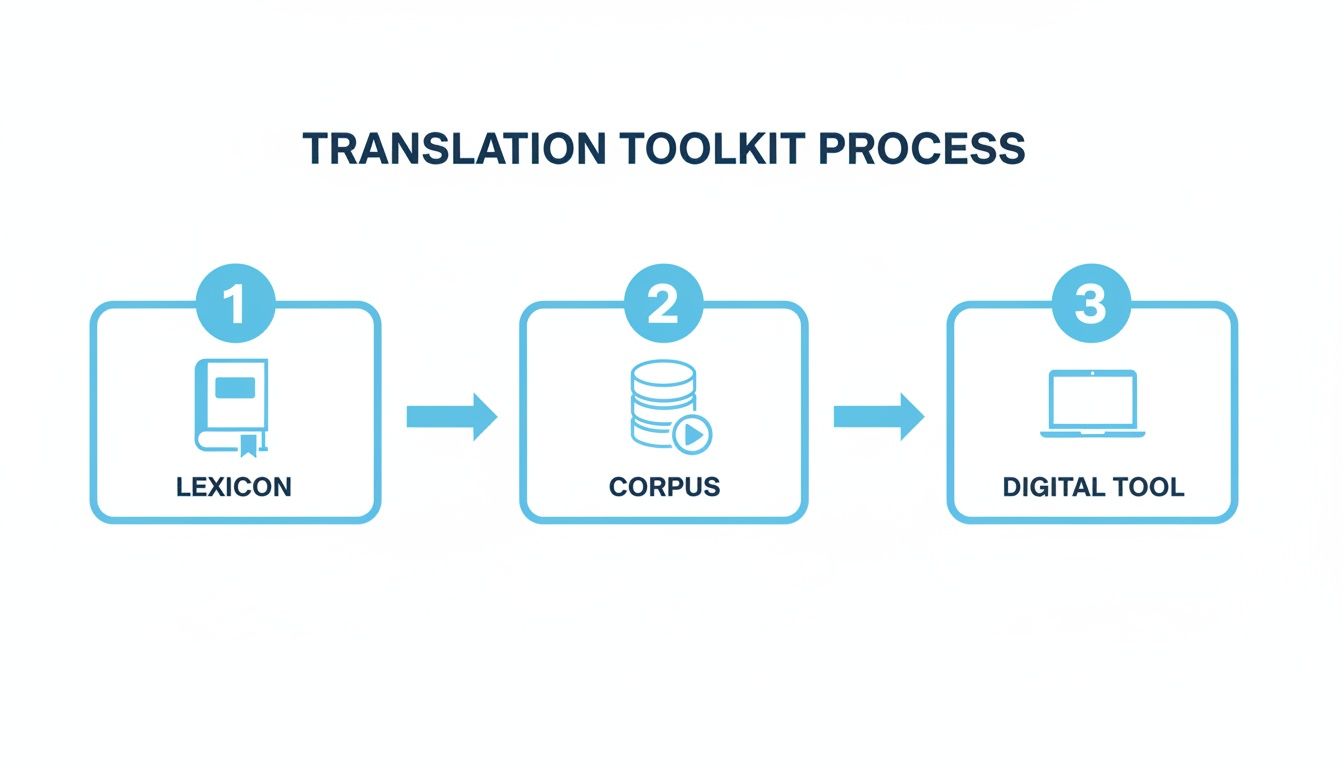
This diagram really gets to the heart of it. A solid workflow means tapping into your lexicon, checking usage in a corpus, and using digital tools to fill in the gaps. It's an iterative loop, not a straight line.
Tackling Grammar and Vocabulary
Let's be honest: Old English grammar can feel like a brick wall. Without dedicated study, texts like the epic Beowulf are virtually unreadable to a modern English speaker—mutual intelligibility is estimated to be below 5%. The language was a beast, with four noun declensions, three grammatical genders, and up to 13 tenses for verbs.
But here’s the good news. Our language still carries the DNA of its ancestor. Of the 100 most common nouns we use today, about 48% come directly from Old English or Old Norse. That Germanic core is incredibly resilient. You can read more about this fascinating journey on Duolingo's language blog. This shared vocabulary gives you a foothold, but the grammatical chasm still needs to be crossed carefully.
My Personal Tip: I always start by hunting for the main verb and the subject. Once I’ve locked in that core relationship, I work my way out, identifying objects and modifiers. I keep a grammar guide handy to decipher the noun and adjective endings. It turns what looks like a complex puzzle into a much simpler connect-the-dots game.
This methodical approach keeps you from getting bogged down. By breaking each sentence into its fundamental parts and then reassembling them according to modern rules, you build an accurate and, most importantly, readable translation.
Moving Beyond Words to Capture Meaning
So, you’ve wrestled with the grammar and have a solid grasp of the vocabulary. But now you’ve hit the real challenge: a direct, word-for-word translation just sounds… off. It’s stiff, unnatural, and sometimes downright nonsensical.
This is where the true artistry of translation comes into play. To really convert Old English to Modern English, you have to get past the literal definitions and start translating the intent behind the words.
Ancient texts are packed with idioms and cultural touchstones that simply don't have a modern counterpart. A literal translation completely misses the spirit of the original, leaving the text feeling hollow and distant. It's a bit like explaining a joke—by the time you break it down, the humor is gone. The same thing happens when you mechanically swap old phrases for new ones without capturing the cultural flavor.
Take the famous Old English kenning for the sea: "hwæl-rād," or "whale-road." Translating it literally is technically correct, but "whale-road" feels clunky and a little silly to a modern reader. A more thoughtful approach might be to render it as "the vast sea" or "the whale's domain," which captures the poetic grandeur and imagery in a way that resonates today.
Interpreting the Cultural Context
Every text is a product of its time. The original author was writing for an audience that shared a deep, unspoken understanding of their world—from social hierarchies to religious beliefs. Your job is to bridge a gap of a thousand years, and that requires some historical detective work.
What were the common metaphors of that era? What did a concept like "honor" or "kinship" truly mean in Anglo-Saxon society? Answering these questions is the key to making smart translation choices.
- Research historical norms: Get a feel for the societal structures, like the bond between a lord (hlāford) and his retainers (þegnas). This context is absolutely vital for translating dialogue and actions accurately.
- Identify cultural symbols: Look for recurring motifs that carry heavy meaning. The mead-hall, for example, wasn't just a building; it was the vibrant heart of community, loyalty, and civilization itself.
- Recognize literary conventions: Old English poetry is built on specific techniques like alliteration and kennings (those compound metaphorical expressions like "battle-sweat" for blood). Preserving the feel of these conventions is just as important as translating the words.
The best translations happen when you can truly step into the author's worldview. You're not just swapping words from one language to another; you're re-telling a story for a new generation, ensuring its emotional and cultural impact isn't lost to time.
This deep dive into cultural nuance is central to the conversation around AI versus human translators and preserving literary style. It’s where human insight and empathy for historical context really shine. A great translation feels less like a technical exercise and more like a genuine conversation with the past.
Tackling a Whole Book with AI's Help
Let’s be realistic: manually translating an entire book from Old English is a Herculean effort, often taking years of painstaking work. This is precisely where modern tools can step in, especially when you need to convert old english to modern english for a full-length manuscript or a sprawling epic poem.
AI tools offer a practical way to manage the sheer volume of text. Think of them not as a replacement for your expertise, but as a tireless assistant. Their real strength lies in generating a high-quality first draft, handling the initial, heavy lifting of the linguistic conversion. This frees you up to focus on the finer, more interpretive aspects of the translation.
This hybrid approach really is the best of both worlds, blending the raw speed of a machine with the essential, subtle touch of a human expert.
A Practical AI-Assisted Workflow
To get good results, you need a smart approach. Just dumping an entire Old English epic into a tool and hitting "translate" is a recipe for disaster. It's better to think of it as a collaboration. You bring the historical context and deep linguistic knowledge; the AI gives you a solid starting block.
Here’s a workflow that actually works:
- Chunk It Down: Instead of the whole book, feed the AI smaller, more manageable sections—a chapter or even just a few paragraphs at a time. This almost always produces more accurate, context-aware results.
- Be Specific with Your Prompts: Don't just ask for a simple translation. Give it context and direction. Try something like: "Translate this passage from Beowulf into Modern English. Keep the alliterative, poetic feel but explain the kennings in a way a modern reader would understand."
- Validate and Polish: Treat the AI's output as raw material. Now it’s your job to go through it with a fine-toothed comb, checking for historical accuracy, cultural nuance, and stylistic consistency. This is where your expertise truly shines.
When you're leaning on AI for a big project, you have to understand its limits, especially when it comes to sounding genuinely human. Some advanced tools can act as an undetectable AI writer, but a machine can't replicate the scholarly judgment needed for historical texts.
This screenshot from BookTranslator.ai shows a simple interface built for handling large files like EPUBs, making the process much more manageable. The "Upload a book" function is front and center, highlighting the platform’s focus on translating entire books efficiently.
Blending Machine Speed with Human Finesse
This combined workflow is incredibly effective. The AI can speed up the initial drafting process by a factor of ten or more, saving you from the monotonous, word-for-word grind. You can then pour that saved time and energy into what really matters: capturing the author's voice, untangling complex metaphors, and making sure the final translation isn't just correct, but truly compelling.
My Takeaway: AI isn't an 'easy button' for translation. It's a force multiplier. It automates the mechanical bits, empowering you, the human translator, to focus on the artistic and scholarly challenges that machines still can't touch.
If you’re thinking about translating a whole book, it's worth seeing how these platforms operate under the hood. Our guide on how AI translation for books works gives a great breakdown. Ultimately, this fusion of machine efficiency and human intellect is where the future of translating historical texts is headed.
Got Questions About Translating Old English?
If you're just starting to wrestle with Old English, you've probably realized it's a different beast entirely. It’s a rewarding puzzle, but a few common hurdles can trip up anyone. Let’s walk through some of the questions I hear most often to help you get a clearer picture.
What's the Toughest Part of Translating Old English?
It's not just the vocabulary, though words like wīf (woman) or beorn (warrior) can be tricky. The real mountain to climb is the grammar. Old English is a highly inflected language, which is a world away from how we communicate now.
In Modern English, word order is king. "The man bites the dog" means something completely different from "The dog bites the man." But in Old English, the endings of the words tell you who’s doing what. A noun changes its form depending on whether it's the subject, the object, or something else entirely. This is called the case system.
You can't just look up words in a dictionary and piece them together. You’ll get gibberish. You absolutely have to get your head around the grammar to make any sense of it.
Can I Just Use Google Translate?
In a word: no. Your go-to tools like Google Translate are brilliant for modern languages, but they are completely out of their depth with Old English. They just haven't been trained on the right kind of data to understand its unique structure.
If you try it, the output will be nonsense—often comically so. For a translation that's even remotely accurate, you need tools built for the job:
- Scholarly Dictionaries: The Bosworth-Toller Anglo-Saxon Dictionary is the gold standard.
- Academic Corpora: These are fantastic databases that let you see how words were actually used in context.
- Specialized AI Tools: A few newer platforms are now being trained specifically on historical texts, offering a much better starting point for long-form work.
How Long Does It Take to Learn to Read It?
Think of it like learning a completely new language from the ground up, because that’s essentially what you're doing. This isn’t something you’ll pick up over a weekend with a language app.
For a solid, basic reading ability, you're looking at one to two semesters of a university-level course. That time is spent mastering the alphabet, pronunciation, vocabulary, and, of course, that all-important grammar.
If you're studying on your own, your mileage will vary depending on your resources and dedication. It's a serious undertaking, but incredibly rewarding when it finally clicks.
Is Middle English Easier to Translate?
Oh, absolutely. It's not even a close contest. Middle English—the language of Chaucer's Canterbury Tales—is far closer to what we speak today. By that point, the language had ditched most of the complicated case system that makes Old English such a challenge.
Plus, after the Norman Conquest in 1066, a flood of French words entered the vocabulary. Many of them are still with us. While you'll still grapple with weird spellings and some unfamiliar words, a modern speaker can often get the gist of a Middle English text with a good glossary. Old English, on the other hand, is a foreign language. Without dedicated study, it's pretty much indecipherable.
Ready to tackle a full book without spending years on manual translation? BookTranslator.ai offers a powerful AI solution designed for long-form content. Upload your EPUB and get a high-quality, structurally preserved translation in minutes. Visit BookTranslator.ai to get started.
Old English to Modern English Translation Examples
The best way to grasp how an old english to modern english translator approaches Anglo-Saxon text is to read real passages side by side. Old English poetry and prose look almost like a foreign language to a modern reader because roughly 85% of its core vocabulary did not survive into the language we speak today. The grammar relied heavily on inflectional endings, the alphabet contained letters such as thorn (þ), eth (ð), wynn (ƿ), and ash (æ), and word order was far more flexible than ours. The examples below come from canonical Old English texts that are entirely in the public domain.
| Old English (original) | Modern English (translation) |
|---|---|
| Hwæt! We Gardena in geardagum, þeodcyninga, þrym gefrunon, hu ða æþelingas ellen fremedon. (Beowulf, opening lines, c. 8th–11th century) |
Listen! We have heard of the glory of the Spear-Danes in days of old, of the kings of the people, how those princes performed deeds of courage. |
| Fæder ure þu þe eart on heofonum, si þin nama gehalgod. Tobecume þin rice. Gewurþe ðin willa on eorðan swa swa on heofonum. (The Lord's Prayer, West Saxon Gospels, c. 990) |
Our Father, who art in heaven, hallowed be thy name. Thy kingdom come. Thy will be done on earth as it is in heaven. |
| Her on þissum geare com micel sciphere hider on land, and gehergodon on Wessexe. (Anglo-Saxon Chronicle, entry for the year 851) |
Here in this year a great ship-army came hither to land, and ravaged in Wessex. |
| Eala, frynd mine, hwær syndon nu þa welan and þa wuldor þissere worulde? (homiletic prose, c. 10th century) |
Alas, my friends, where now are the riches and the glory of this world? |
Notice how a literal word-for-word render rarely produces natural English: the translator must constantly choose between preserving the rhythm of the original and producing a sentence a modern reader can actually parse. Tools like BookTranslator.ai handle the heavy lifting on long manuscripts, while linguists usually polish the final phrasing by hand.
Why Old English Translation Is Challenging
Going from modern english to old english — or back the other way — is harder than translating between two living languages for several structural reasons. First, Old English is a heavily inflected Germanic tongue: nouns have four cases (nominative, accusative, genitive, dative), verbs are conjugated for person, number, tense, and mood, and adjectives agree with their nouns. Second, the alphabet itself is different; the letters thorn (þ), eth (ð), wynn (ƿ), ash (æ), and yogh (ȝ) all appear in genuine manuscripts and must be normalised before any modern parser can read them.
Third, the lexicon shifted dramatically after the Norman Conquest of 1066, when French and Latin vocabulary flooded into what became Middle English (the language of Chaucer). By Shakespeare's time we had moved into Early Modern English, which is much closer to today's speech. So an honest translator has to decide which historical layer the source actually belongs to before choosing the right modern equivalents. If you are translating a full book and want help across these layers, our English to Spanish book translation workflow is a good example of how chapter-level context improves accuracy.
Related Reading
If you enjoyed this guide, these related posts on BookTranslator.ai go deeper into adjacent topics:
- Book Translation to German: Answers to Your Most Common Questions
- Best booktranslator of 2026: Ultimate guide and which to choose
- Why METEOR Matters for AI Book Translation
Frequently Asked Questions About Old English Translation
What is Old English?
Old English, also called Anglo-Saxon, is the earliest historical form of the English language, spoken in England from roughly 450 to 1150 AD. It is so different from the language we speak today that most native English speakers cannot read it without training, which is why a dedicated old english to modern english translator is usually needed even for short passages.
Can AI translate Old English to Modern English?
Yes — modern AI models trained on parallel corpora of Old English and Modern English can produce a readable translation of most prose passages and many famous poems. The caveat is that poetry such as Beowulf relies on alliterative meter and compressed kennings (compound metaphors), so a good AI translation captures the literal meaning while a literary translator is still the best choice for preserving rhythm and tone.
What is the difference between Old English and Middle English?
Old English (c. 450–1150) is the language of Beowulf and the Anglo-Saxon Chronicle, and looks almost foreign to a modern reader. Middle English (c. 1150–1500) is the language of Chaucer's Canterbury Tales — still archaic, but recognisably English. The shift happened gradually after the Norman Conquest of 1066 introduced massive amounts of French vocabulary.
Is Old English the same as Shakespeare's English?
No. Shakespeare wrote in Early Modern English (c. 1500–1700), which is much closer to the language we speak today — most of his plays are readable with light footnotes. Old English is roughly a thousand years older than Shakespeare, and translating from modern english to old english requires reaching back past Chaucer, Wycliffe, and the Norman Conquest into genuinely Anglo-Saxon vocabulary and grammar.
How accurate is AI Old English translation?
For everyday meaning, AI translation of Old English prose is surprisingly accurate, often comparable to a first-year philology student. For published scholarly work, manuscript editions, or poetic translation, you should always have the output reviewed by a specialist in Old English or medieval studies, because nuances of case, mood, and metrical structure can flip the sense of a line.